Article
How to Avoid Dangerous Cross‑Collateralisation on Inner‑South Loans
Clear, decision‑grade guide for Green Square and inner‑south borrowers on using a broker to avoid dangerous cross‑collateralisation, protect equity and keep refinancing options open.
Key Takeaway
Using a broker is one of the most effective ways to avoid dangerous cross‑collateralisation on inner‑south properties, because they can design standalone loans where each property secures only its own debt. This is critical in Green Square and Zetland, where apartment values can be volatile and one weak valuation can otherwise lock up equity or force sales. Investors should map all securities, then work with a CPA‑grade broker to prioritise uncrossing and protect the family home first.
Using a broker is the easiest way to avoid dangerous cross‑collateralisation on Green Square and inner‑south properties because a good broker designs standalone securities: each property only secures its own loan, keeping equity accessible and avoiding one bad valuation dragging down your whole portfolio.
If you’re buying or refinancing in Green Square, Zetland, Waterloo or Alexandria this month, your job is simple: don’t sign any loan offer until you understand exactly which property secures which loan.
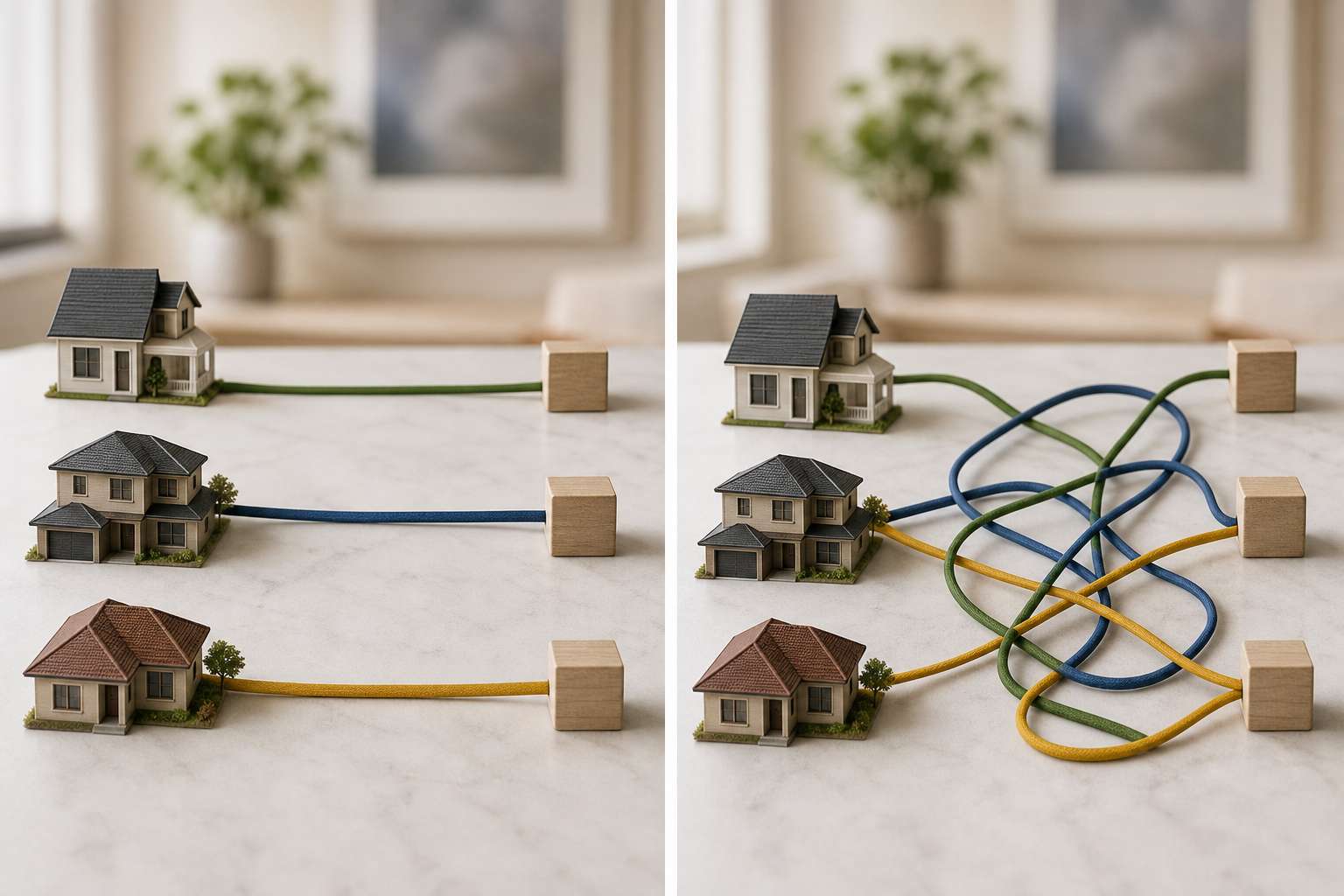
Standalone loans keep each inner‑south property separate, unlike crossed structures.
What cross‑collateralisation actually is (and why it’s worse in Green Square)
Cross‑collateralisation is when the bank uses more than one property as security for one or more loans.
Example:
- Home in Alexandria worth $1.5m with $600k loan.
- Investment unit in Green Square worth $850k.
- Bank offers one big $1.45m facility secured by both properties.
It looks neat. But you’ve just given the lender control over both properties for every decision: increases, refinances, releases, even fixing valuations.
In dense apartment markets like Green Square and Zetland, this is riskier because:
- Valuations can move fast – if one tower or complex falls out of favour, the valuer can mark the whole block down.
- Lenders often shade high‑density postcodes – tighter LVRs, lower valuations, or different policies for small or investor‑heavy units.
- You’re likely to own more than one apartment – many clients own 2–3 near‑city units; crossing them amplifies any wobble in one building.
A standalone structure means:
- Each Green Square property secures only its own debt.
- Your Alexandria home is ring‑fenced from your units.
- If a Zetland valuation comes in low, it doesn’t freeze the whole portfolio.
For a deeper explainer of the mechanics, see /insights/avoiding-dangerous-cross-collateralisation-broker-keeps-properties-uncrossed.
How a broker keeps Green Square loans safely uncrossed
A broker who understands portfolio lending will quietly block crossing in three ways: structure, paperwork and lender selection.
1. Structure: separate loans, clean securities
Your broker should design:
- Standalone investment loans – one loan per property, or per clear purpose.
- Split loans instead of crossed loans – multiple splits can sit under one lender but each has a defined security.
- Family home protection – your principal place of residence is not used to secure inner‑south units where possible, even if that means a slightly lower LVR on the new purchase.
Worked example:
- You own a $1.4m home in Rosebery, loan $500k.
- You’re buying a $900k Green Square unit as an investment.
- Instead of one big $1.4m crossed loan, a broker might structure:
- Split A: $500k, secured only by home (owner‑occupied P&I).
- Split B: $220k equity release from home for the 20% + costs (investment split, clearly tagged for tax).
- Split C: $680k secured only by the new unit.
You now have three clean splits and know exactly what secures what.
2. Paperwork: reading (and changing) security pages
Most people skip the security schedule in their loan contracts.
A good broker doesn’t. They:
- Check that each loan number lines up with one property.
- Push back if the bank tries to list multiple securities for a single split.
- Use phrases like “standalone security only” or “no cross‑collateralisation” in instructions to the lender.
This is where DIY borrowers get trapped: a last‑minute ‘credit restructure’ from the lender quietly crosses securities, and no one notices until years later.
3. Lender and policy selection
Some lenders are more likely to:
- Auto‑cross when there are multiple properties.
- Be conservative on inner‑south postcodes.
A broker who works a lot in Green Square will:
- Know which lenders are friendlier to high‑density or smaller units.
- Choose policies that allow higher LVRs on individual securities, so you don’t need to cross to make the numbers work.
- Model your borrowing power under the APRA 3% buffer so you’re not relying on risky structures just to ‘make it pass’.
For broader strategy ideas, have a look at /insights/designing-flexible-investment-loan-structures-geared-investors.
Warning signs your inner‑south loans might already be crossed
If you already own property around Green Square, Zetland or Waterloo, do a 10‑minute check:
- One big loan covering multiple properties on your internet banking.
- Valuation delays every time you try to top up, even for a small amount.
- Bank says ‘we need to revalue everything’ when you talk about selling or refinancing one property.
- You’re not sure which property secures which split.
If any of these sound familiar, assume you’re crossed until proven otherwise.
This is where a one‑page visual map of all loans, securities and offsets becomes powerful – a broker can build it with you and then design an uncrossing plan. There’s a practical week‑one plan at /insights/step-by-step-plan-uncross-your-loans-without-fire-sales.
What you can do this week (practical checklist)
If you’re about to buy a Green Square or inner‑south property:
- Ask your broker (or bank) for a simple table: loan number, amount, property securing it.
- Insist that the new purchase is standalone unless your adviser can explain, in writing, why crossing is worth the risk.
- If using equity from another property, make that equity release a separate split, clearly tagged for investment purposes.
If you already own 2+ properties in the inner south:
- Email your broker: “Can you confirm if any of my properties are cross‑collateralised? Please map securities vs loans for me.”
- Prioritise uncrossing the family home first, even if that means:
- Lowering LVR on your home, or
- Moving some investment debt to another lender.
- Line up an annual review to check structure, not just rate.
If you’re self‑employed or running a small business:
- Be extra careful not to let business lending drag your home and Green Square units into the same security pool.
- Keep business facilities secured, where possible, against business or investment property – and again, in standalone form.
FAQs
Is cross‑collateralisation ever a good idea for inner‑south investors?
Very rarely. It can sometimes be used as a temporary bridge when equity is tight or timing is messy, but it usually reduces flexibility and increases risk. In concentrated markets like Green Square and Zetland, any benefit from ‘making a deal work’ is usually outweighed by the risk of one weak valuation trapping your entire portfolio.
Can I fix this if my Green Square and Zetland properties are already crossed?
In most cases, yes – but it needs a staged plan so you don’t trigger fire sales or cashflow shocks. A broker can use refinances, security substitutions and partial releases to move you towards standalone loans over 6–24 months. The first step is always a clear map of your current structures and a priority list for which properties to uncross first.
Does uncrossing my loans affect tax deductions on my Green Square investments?
Not if it’s done properly. Tax deductibility follows the purpose of the loan, not which property secures it, so the key is to preserve or clearly document the purpose of each split. A broker who understands tax can coordinate with your accountant to make sure restructuring doesn’t blur the lines between home and investment debt.
Key takeaways
- In Green Square and the inner south, cross‑collateralisation amplifies valuation and policy risk across your whole portfolio.
- A good broker designs standalone loans, protects your home from investment risk and keeps each property’s equity accessible.
- Your action this week: map your current loans vs securities and refuse any new structure you don’t fully understand.
Book a free 15‑minute strategy call at /contact to map your inner‑south properties on one page and check whether your loans are safely uncrossed – one consultation covering tax, lending and structure.
General advice only.
Frequently asked questions
Is cross‑collateralisation always bad for Green Square investors?▾
How do I know if my inner‑south properties are cross‑collateralised?▾
Can I avoid cross‑collateralisation if I need equity from my home to buy a Green Square unit?▾
Speak with a specialist advisor
Confidential consultation, bespoke advice for your situation.