Article
Hidden Debts: How BNPL, Overdrafts and Trade Accounts Hurt Home Loans
BNPL, overdrafts and trade accounts look harmless, but lenders often treat them like ongoing debts that quietly cut your home loan borrowing power. Here’s how they’re assessed and what to fix this week.
TL;DR
BNPL, overdrafts and trade accounts can seriously reduce your borrowing capacity, even if you clear them regularly. Lenders often assess limits and recent usage as if they’re ongoing debts. Audit and clean up these facilities 3–6 months before applying to protect your home loan or refinance plans.
If you’re planning a home loan, refinance or investment purchase, BNPL, overdrafts and trade accounts can quietly smash your borrowing power. Lenders often treat them as ongoing debts, even if you clear the balance every month or see them as “just for cashflow”.
In practice, most banks factor in your limits and recent usage on these facilities when running serviceability. That means less capacity for your mortgage, more scrutiny of your file, and for some borrowers, a flat “no” that could have been avoided by tidying things up a few months earlier.
In 2 sentences: Lenders usually treat BNPL, overdrafts and trade accounts as recurring credit commitments, using either the actual repayment or a percentage of the limit when testing your borrowing capacity. Reducing limits, closing unused facilities and cleaning up conduct 3–6 months before you apply can materially increase how much you can borrow.
How lenders actually see short-term credit
From a lender’s perspective, anything that looks like readily-available credit or “buy now, pay later” is a potential ongoing drain on your income. This matters even more with the current APRA 3% serviceability buffer, because every extra dollar of assumed repayment gets tested at a rate well above today’s actual interest rates.
BNPL: small purchases, big impact
Most mainstream lenders now ask about BNPL and scan statements for Afterpay, Zip, Klarna and similar brands. Even if your account is repaid each fortnight, regular use is often treated as a recurring monthly commitment.
Common approaches (varies by lender):
- Assume a monthly repayment (for example, 4% of the current balance or recent average spend).
- Treat frequent BNPL usage as a sign of stretched cashflow, which can trigger closer scrutiny of your overall spending and HEM assumptions.
So a few hundred dollars per month in BNPL can be treated like a personal loan – exactly the type of high-impact debt that we know hurts borrowing power more than productive business lending.
Overdrafts: the limit matters more than the balance
With overdrafts, lenders worry less about today’s balance and more about what you could draw tomorrow. That’s why they usually assess a percentage of the limit as an ongoing commitment, even if the account sits close to zero.
Typical treatment:
- Personal overdraft: assessed at around 3% of the limit per month.
- Business overdraft: still counted, especially if it’s regularly near the limit or used to cover wages and rent.
A $20,000 overdraft limit can easily be treated as a $600 per month commitment – the same ballpark as a $30,000–$35,000 car loan.
Trade accounts: business-as-usual or hidden loan?
Trade credit (e.g. 30‑day accounts with suppliers) doesn’t always appear as a “loan” on your credit file, but lenders see it in bank statements and financials.
Warning signs for home loan assessors:
- Trade accounts constantly at or beyond terms (e.g. 60–90 days overdue).
- Reliance on extended terms instead of stable cashflow.
- Large rolling balances that function like an unpriced working capital loan.
In those cases, a lender may effectively treat long‑overdue trade balances as business debt that reduces how much you can safely borrow for a home.
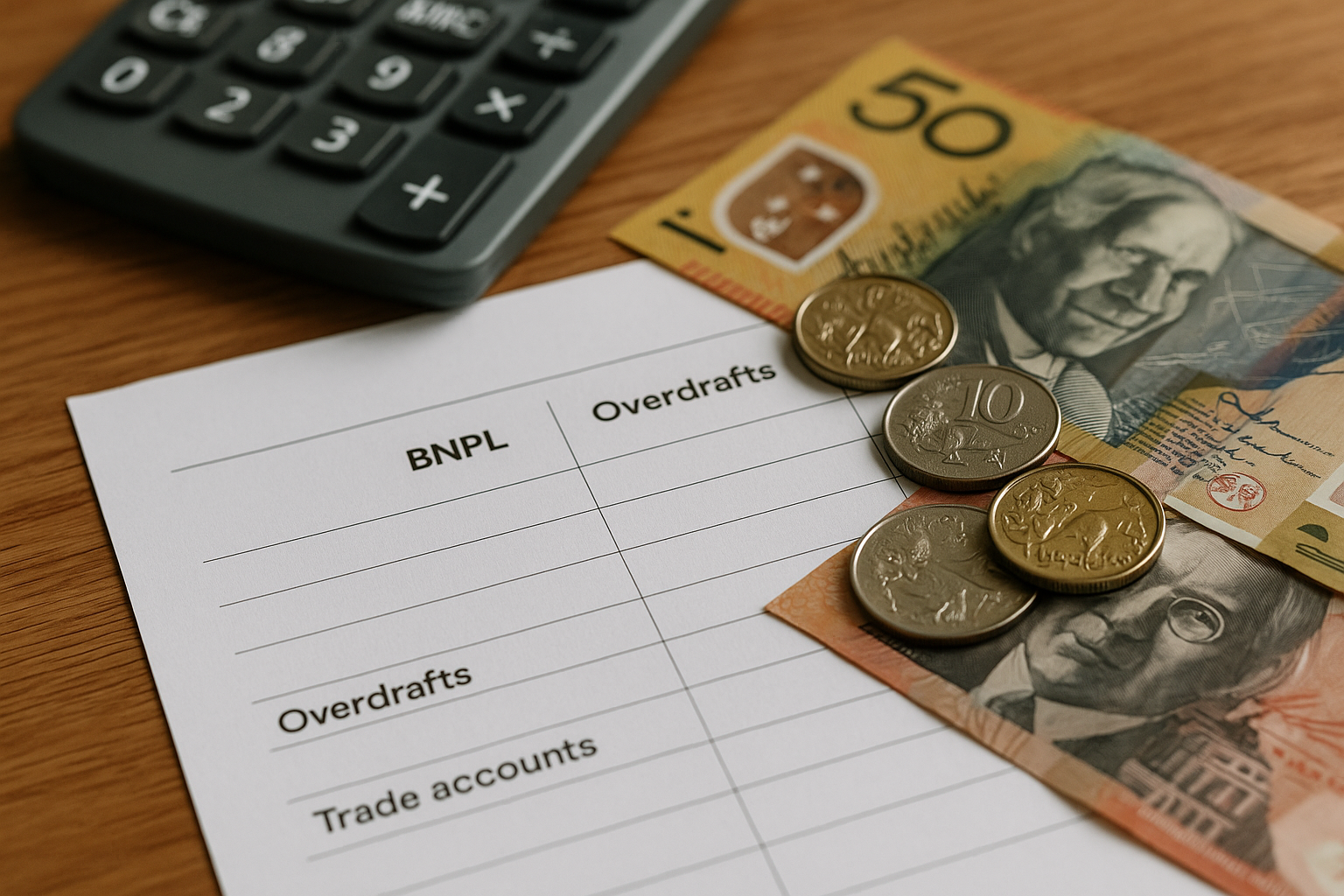
BNPL vs overdraft vs trade accounts: key differences
| Facility type | Where it shows up | How lenders often assess it* | Typical impact on borrowing power | Clean‑up timeframe |
|---|---|---|---|---|
| BNPL (personal) | Bank/credit card statements, sometimes credit file | Regular usage treated as recurring monthly repayment | High – looks like unsecured consumer debt | Stop using and close 3–6 months before applying |
| Personal overdraft | Credit file and transaction account | % of limit (e.g. ~3%/month) | High – similar to a personal loan | Reduce limit or close 3–6 months before applying |
| Business overdraft | Business bank statements, sometimes credit file | % of limit, plus conduct review | Medium–high – especially if frequently maxed | Stabilise cashflow and consider resizing facility |
| Trade accounts | Supplier statements, aged payables in financials | Focus on overdue and rolling balances | Medium – rises if consistently late | Bring terms back to 30 days for 6+ months |
*Indicative only – each lender has its own policy and appetite.
The strategy continues below
You've seen the problem and the groundwork — now unlock the exact steps our CPA-certified brokers use, including 4 more sections. Enter your email for instant, free full access.
Free access. No spam — unsubscribe anytime. Your details stay confidential.
Frequently asked questions
Does BNPL show up when I apply for a home loan?▾
Do unused overdraft limits reduce my borrowing power?▾
How do trade accounts affect my home loan application?▾
How far back do lenders look at BNPL and overdraft conduct?▾
Will closing BNPL and overdrafts immediately boost my credit score?▾
Speak with a specialist advisor
Confidential consultation, bespoke advice for your situation.