Article
Smart borrowing for home batteries and EV chargers without over‑capitalising
A decision-grade guide to financing home batteries and EV chargers in Australia so you future‑proof your home or investment without over‑capitalising or straining your mortgage.
Key Takeaway
This article explains how Australians can borrow for home batteries and EV chargers without over‑capitalising by matching loan term to asset life, running breakeven checks, and keeping a separate 5–10 year loan split for energy upgrades. With batteries typically lasting 10–15 years and EV chargers 7–10, stretching costs over a 30‑year mortgage can more than double interest paid. Readers learn how to size systems, compare finance options, and stage upgrades so cashflow and resale values remain robust.
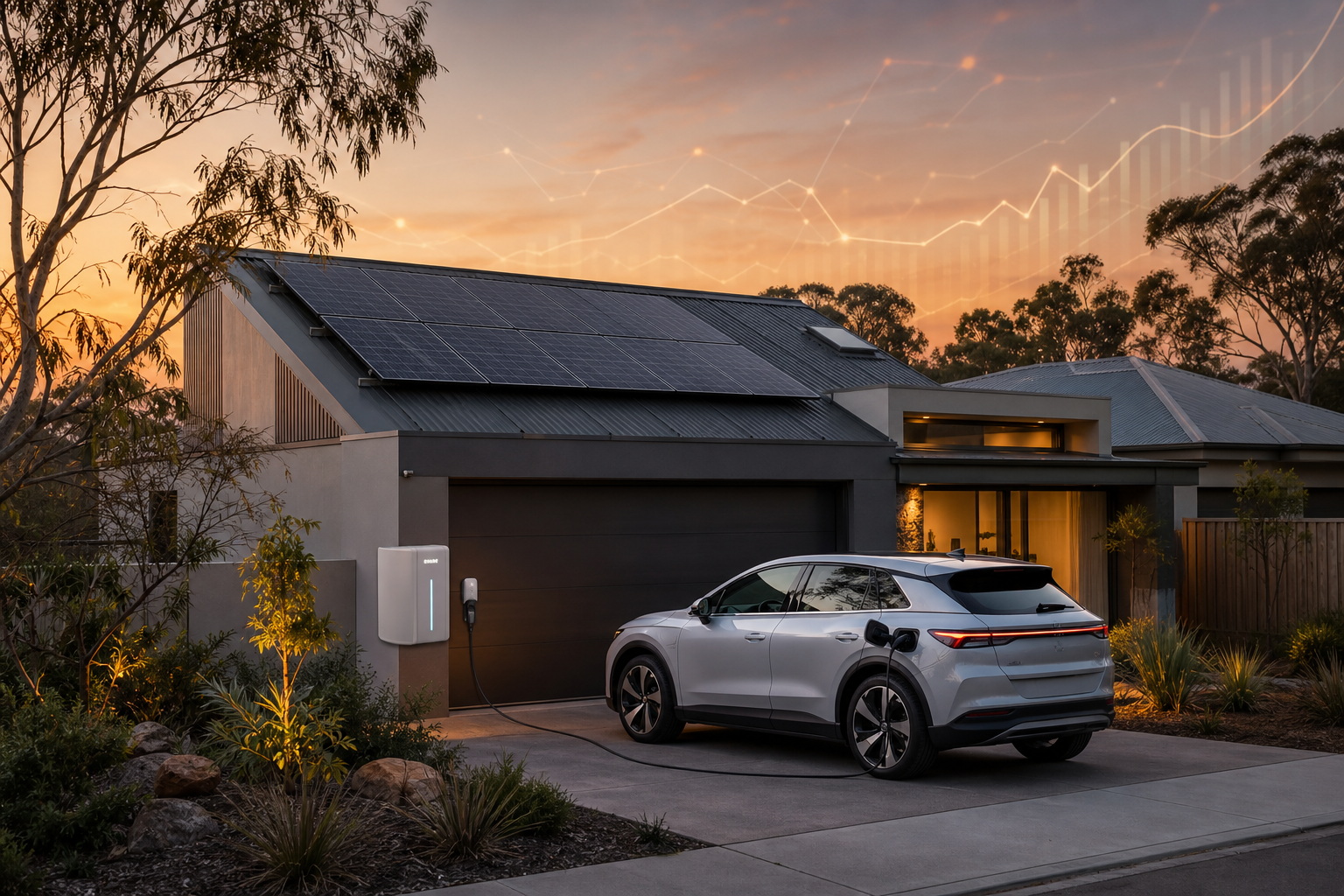
Adding a home battery or EV charger can absolutely make sense to borrow for – but only if the numbers, timing and loan structure all line up.
Within the first hour of looking at quotes, most people hit the same questions: Will this over‑capitalise my place? Should I add the cost to my home loan or keep it separate? Do I buy the big system now, or a smaller one and add later?
This guide is designed so you can make a decision this week, with clear numbers and next steps.
1. Big picture: when borrowing for batteries and EV chargers makes sense
For most Australians, borrowing for a battery or EV charger makes sense when three things are true:
- The annual bill savings or extra rent can reasonably cover most or all of the extra repayments;
- The loan term roughly matches the asset life (you’re not still paying it off long after it’s worn out); and
- You’re not pushing your total debt or cash buffer into a stressful zone.
Those same principles sit behind all our solar lending content – from choosing between bank green loans and installer finance [/insights/bank-green-loans-vs-solar-installer-finance] to deciding whether to add solar to your mortgage or refinance [/insights/add-solar-to-home-loan-or-refinance]. Batteries and EV chargers are just the next step, with a few extra wrinkles.
Typical asset lives and payback windows
These are indicative ranges – always check the specific product warranties:
- Home batteries: 10–15 years typical life, many with 10‑year performance warranties.
- EV chargers (home wallbox): around 7–10 years, depending on quality and usage.
- Solar panels: 20–25 years+ (important when you’re bundling battery + solar).
In many cases, a battery’s simple payback (bill savings vs cost) in 2026–27 is 10–15 years unless you’re on a high tariff, have big evening usage, or are accessing specific VPP/feed‑in deals.
That’s why loan term is critical. As covered in our other solar finance guides, keeping energy upgrades in a separate 5–10 year home loan split can more than halve interest versus stretching them across a 30‑year mortgage [/insights/bank-green-loans-vs-solar-installer-finance].
2. Core decision: add now, add later, or not at all?
Before you worry about lender products, you need a rough design decision:
- Battery now, EV charger later
- EV charger now, battery later
- Both now
- Neither (at least for this property, right now)
Step 1: How likely are you to own an EV within 3–7 years?
Consider:
- Your car replacement cycle
- Access to workplace or public charging
- Your driving pattern (daily commute vs occasional use)
- Off‑street parking vs on‑street
If you’re highly likely to buy an EV within 3–5 years and you own your home, a wired‑in home charger often makes sense to provision now, especially if you’re already doing electrical or solar work.
If you’re unsure on timing or you’re a renter, a cheaper portable charger and public fast‑charging might be fine for your first EV.
Step 2: What’s your night‑time and EV charging load?
Batteries pay off fastest where there’s solid evening demand:
- Families home from mid‑afternoon
- Electric cooking and heating/cooling
- One or more EVs charging at home
If your home is often empty until late, or you’re already on low tariffs (e.g. controlled load hot water), the battery case is weaker unless the property’s value uplift or resilience (blackout protection) is especially important to you.
Step 3: How long will you keep this property?
Rough rule of thumb:
- Holding for 10+ years (home or investment): more scope to do a well‑sized system and battery if the payback fits within your expected holding period.
- Likely to sell within 5–7 years: be very careful not to over‑capitalise with a top‑shelf battery that a buyer won’t fully value.
In markets like the Eastern Suburbs and inner Sydney, local data suggest buyers are starting to value energy upgrades, but the uplift is rarely dollar‑for‑dollar yet. You’re still largely doing this for bill savings, comfort and future‑proofing, with resale value as a bonus.
3. Over‑capitalisation 101: how to tell when you’re going too far
Over‑capitalising simply means you’re spending more on an improvement than the market is willing to pay you back when you sell.
With batteries and EV chargers, it’s easy to do – especially when bundled with a broader renovation or when cheap finance is dangled in front of you.
A quick over‑capitalisation test (4 numbers)
You only need four inputs:
- System cost (installed, after STCs/rebates) – say $16,000 for a mid‑range battery.
- Expected annual bill savings – say $1,400/year (check your solar quote carefully [/insights/reading-solar-quotes-inclusions-warranties-finance-traps]).
- Extra annual loan cost – repayments on a 7–10 year split at current rates.
- Estimated resale value uplift – ask a good local agent for a conservative view.
Work through:
- If annual savings > annual repayments and you’re comfortable with risks, you’re not over‑capitalising on cashflow, even if the resale uplift is modest.
- If annual savings < annual repayments, you’re betting that future prices, tariffs or resale uplift will bridge the gap. That’s not automatically wrong, but it’s a conscious bet.
Worked example: battery on a dedicated loan split
- Battery supply & install: $16,000
- Loan: 7‑year P&I split at 6.4% (illustrative)
- Approximate monthly repayment: $240
- Annual repayments: $2,880
- Expected bill savings: $1,400/year
Net annual cost before tax: $1,480 ($2,880 − $1,400).
Unless you strongly value blackout protection or carbon reductions, or you’re confident on future tariff changes, this looks like a marginal investment on a pure numbers basis.
Contrast that with a smaller battery or a longer term.
Smaller battery, 7‑year term
- Cost: $10,000
- 7‑year P&I at 6.4%: roughly $150/month ($1,800/year)
- Savings: say $1,000/year
- Net annual cost: $800
Still not cashflow‑positive, but less of a drag – and less risk of over‑capitalising.
Same $16,000 battery, 15‑year term
- 15‑year P&I at 6.4%: roughly $139/month ($1,668/year)
- Savings: $1,400/year
- Net annual cost: $268
The cashflow looks much better, but now you’re paying for the battery long after its warranty. This is why we so often recommend 5–10 year splits for solar and batteries rather than 25–30 year terms [/insights/add-solar-to-home-loan-or-refinance].
4. Finance structures for batteries and EV chargers
You’ve got a few main paths. Most can work if structured correctly; most can also hurt you if stretched too far or mixed with the wrong debts.
4.1 Home loan equity top‑up or extra split
Best for: owners with equity, solid borrowing capacity and a medium‑term plan to stay in the property.
How it works
- You use available equity to fund the battery or charger.
- Your broker sets up a separate loan split – usually 5–10 years, P&I – so you’re not dragging the cost over 30 years.
This is the approach we keep coming back to in our solar finance articles: separate, labelled splits for energy upgrades [/insights/questions-to-ask-broker-before-borrowing-for-solar]. It keeps:
- Interest lower than personal loans or installer finance.
- Tax tracing clearer if there’s any investment or business use.
- Discipline higher, because the balance is forced down reasonably quickly.
Key watch‑outs
- Don’t let the lender or online form roll the cost into your main 25–30 year home loan with no separate split.
- Stress‑test repayments at 2–3% above the current rate, especially if you’re self‑employed [/insights/rent-rentvest-or-buy-small-business-owners].
4.2 Bank green loan or unsecured personal loan
Best for: homeowners without much equity, or who don’t want to touch their main mortgage.
- Green loans often offer lower rates than standard personal loans, but are still above home loan rates.
- Terms are usually 3–10 years, which aligns reasonably well with battery and charger life.
The trade‑off is higher interest cost vs using home equity, but less risk to your home if something goes wrong. Our comparison of green loans vs installer finance walks through the line‑by‑line differences [/insights/bank-green-loans-vs-solar-installer-finance].
4.3 Solar/installer finance
Best for: limited scenarios where the terms are very transparent, the rate is competitive, and you’ve benchmarked it carefully.
Installer finance can be:
- Genuinely cheap, or
- A way of hiding a high effective rate in the system price.
You must compare the total cost against bank options. Our guide on reading solar quotes explains how to spot finance traps and bundled mark‑ups [/insights/reading-solar-quotes-inclusions-warranties-finance-traps].
4.4 Business or commercial finance
This is relevant if:
- You’re fitting out business premises with chargers for staff/customers; or
- You’re a self‑employed professional using an EV significantly for work.
Here, you might use:
- Chattel mortgage or equipment finance for business‑owned chargers.
- Fit‑out finance if the chargers form part of a broader renovation.
Be aware: business facilities with personal guarantees are often treated as personal liabilities for home loan serviceability [/insights/using-tax-returns-to-prove-income-home-loan]. It’s critical to coordinate the business and home lending so you don’t box yourself in.
Table 1: Comparing common finance options for batteries and EV chargers
| Option | Typical rate* | Typical term | Security | Pros | Cons |
|---|---|---|---|---|---|
| Home loan split (equity top‑up) | Lowest (vs others) | 5–10 years | Home mortgage | Lowest interest, flexible terms, clear splits | Puts home at risk if payments fail |
| Bank green / personal loan | Medium | 3–10 years | Unsecured | No need for equity, separate from mortgage | Higher rate, lower max amounts |
| Installer finance | Medium–High (often) | 5–10 years | Varies | Convenience, fast approvals | Risk of hidden costs, harsh terms |
| Business/equipment finance | Medium | 3–7 years | Business assets | Potential tax benefits, matched to business use | Impacts home loan serviceability, documentation needed |
*All rates indicative only – always check current offers.
The strategy continues below
You've seen the problem and the groundwork — now unlock the exact steps our CPA-certified brokers use, including 8 more sections. Enter your email for instant, free full access.
Free access. No spam — unsubscribe anytime. Your details stay confidential.
Frequently asked questions
Is it better to add a battery to my home loan or use a green loan?▾
Will a battery or EV charger increase my property’s value?▾
Can I claim tax deductions for a battery or EV charger?▾
How do I avoid over‑capitalising on a rental property with a battery?▾
What if my solar and battery savings are lower than the quote promised?▾
Is it worth installing an EV charger if I don’t own an EV yet?▾
How big a battery should I finance?▾
Speak with a specialist advisor
Confidential consultation, bespoke advice for your situation.