Article
Use Bronte Home Equity To Fund A Major Renovation Safely
A clear, numbers‑based guide to using Bronte home equity to fund a major renovation without blowing your cashflow or losing your safety buffer.
Key Takeaway
This guide explains how to use Bronte home equity to fund a major renovation without overstretching by capping total loan‑to‑value ratio around 80%, ring‑fencing renovation debt in a separate split, and keeping repayments within roughly 25–35% of net income. With 28.2% of Australian mortgage holders already at risk of stress, it emphasises a 6–12 month cash or offset buffer and modelling repayments 3% above current interest rates. The key actionable step is to build a stress‑tested renovation cashflow model before committing to any builder contract.
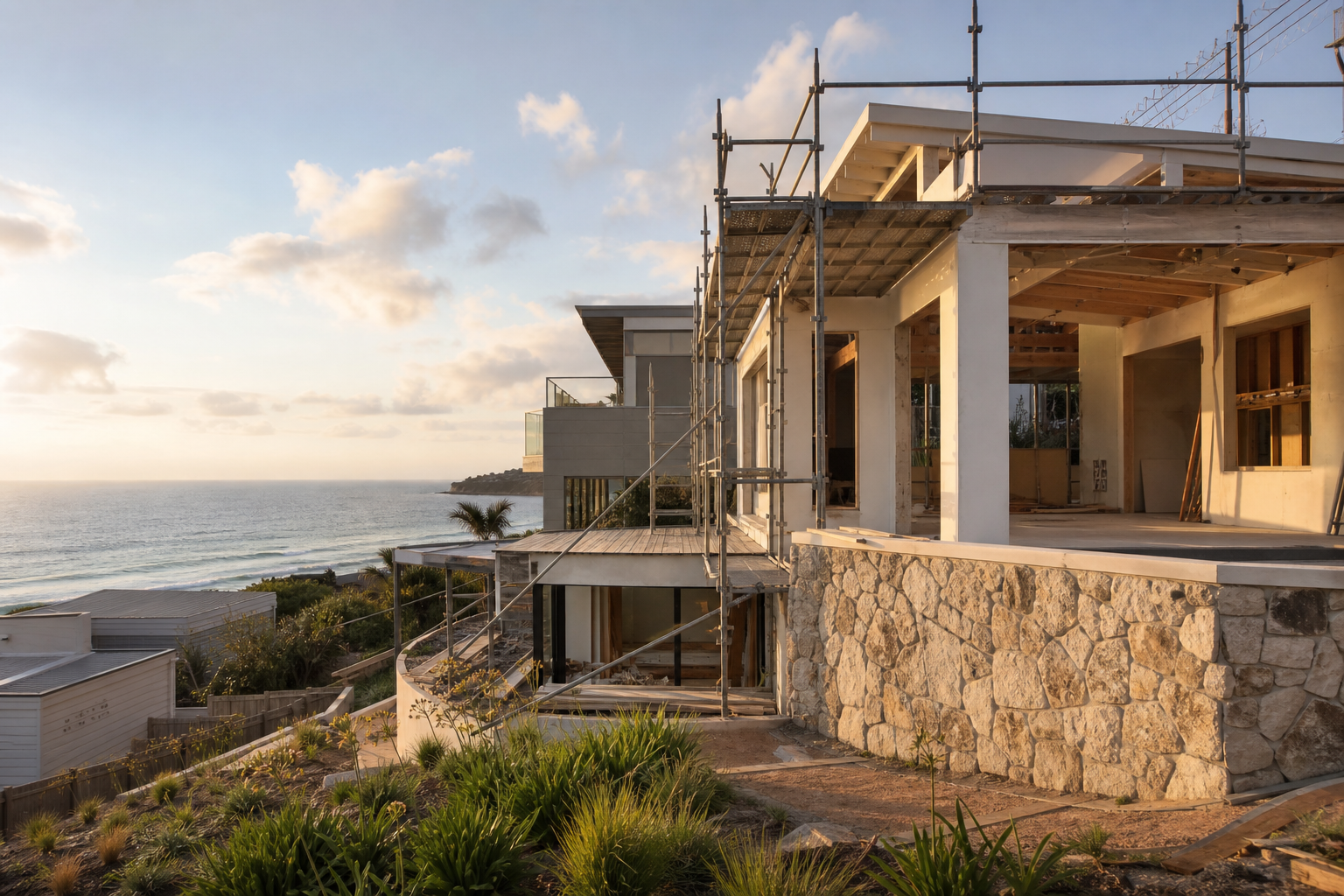
Using Bronte home equity to fund a major renovation is usually safest when you keep your total LVR around 80%, place the new borrowing in a separate renovation split, cap repayments at roughly 25–35% of your net income, and hold a 6–12 month cash or offset buffer before you sign a building contract.
This article gives you a decision‑grade framework you can work through this week so the renovation you dream about in Bronte doesn’t turn into mortgage stress.

1. Start With Three Non‑Negotiable Guardrails
Before talking to a builder, lock in these settings.
1.1 Safe LVR for a Bronte Renovation
For most households, a practical ceiling is:
- Target LVR after renovation borrowing: ~80% of current value.
- Only go above 80% if you have very strong, stable income and are comfortable with LMI and tighter buffers.
Bronte values are high and volatile. Staying around 80% gives you room if prices dip or construction runs over.
1.2 Minimum Buffers
For Bronte borrowers, building on [/insights/build-cash-buffer-bronte-home]:
- Personal buffer: 6–12 months of stressed essential living costs + all loan repayments, in cash or true offset.
- Renovation buffer: 10–15% of build cost in cash/offset for variations and delays.
Do not count redraw, shares or crypto as buffer; they can vanish when you most need them.
1.3 Cashflow Cap
Use a simple rule:
- Aim for total home‑loan repayments (all splits) at 25–35% of after‑tax household income, tested at rates 3% above today (APRA buffer).
If your numbers only work at today’s rate, you’re over‑geared.
2. Equity Top‑Up vs Construction Loan For Bronte Renos
Your core decision is whether to:
- Top up your existing home loan using equity, or
- Use a construction‑style facility with progress payments.
This mirrors the Rose Bay trade‑offs discussed in [/insights/construction-loan-vs-equity-top-up-rose-bay-renovation], but tailored to Bronte.
2.1 Quick Comparison Table
| Feature | Equity Top‑Up (Renovation Split) | Construction Loan / Facility |
|---|---|---|
| Best for | Smaller / cosmetic renos, live‑in works | Major structural, second‑storey, big extensions |
| How funds are released | Lump sum into offset/redraw | Staged progress payments to builder |
| Interest calculation | On full drawn amount | On amounts as they’re drawn |
| Cashflow control | You self‑manage spend | Bank/valuer sign off at each stage |
| Paperwork & approvals | Usually simpler, faster | More documentation, builder contract required |
| Risk of overspend | Higher – temptation to raid funds | Lower – tied to certified progress |
For a Bronte second‑storey or large rear extension, a construction facility like in [/insights/eastern-suburbs-second-storey-rear-extension-cashflow-valuation-basics] usually gives better discipline and protects your buffer.
3. Worked Example: Bronte Equity Release For a Major Reno
Say you own a Bronte semi worth $3.2m with a current home loan of $1.7m.
3.1 How Much Renovation Equity Can You Tap?
- Current value: $3,200,000
- Target LVR: 80% → $3,200,000 × 80% = $2,560,000 total debt limit
- Existing loan: $1,700,000
- Indicative max new borrowing: $2,560,000 − $1,700,000 = $860,000
On paper you could borrow up to about $860k for the renovation without going over 80%.
But that’s not the whole story.
3.2 Cashflow Check (Principal & Interest)
Assume a principal & interest rate of 6.5% p.a. over 25 years (illustrative only, not a quote).
- Existing $1.7m: roughly $11,500/month
- New reno split $800k: roughly $5,400/month
- Combined: about $16,900/month
If your after‑tax household income is $45,000/month, then:
- Total repayments ≈ 37.5% of net income at 6.5%
- Stress‑tested 3% higher (9.5%), repayments might climb to ~$21,000/month, or 47% of net income.
That’s uncomfortably high – especially with Roy Morgan estimating 28.2% of mortgage holders already at risk of stress.
In practice, you might:
- Cap the renovation borrowing at $600k–$650k.
- Keep total repayments under ~35% of net income even at higher rates.
- Retain a full 6–12 month buffer in offset after settlement.
The strategy continues below
You've seen the problem and the groundwork — now unlock the exact steps our CPA-certified brokers use, including 3 more sections. Enter your email for instant, free full access.
Free access. No spam — unsubscribe anytime. Your details stay confidential.
Frequently asked questions
Can I fund 100% of my Bronte renovation from equity?▾
Is a construction loan always better than an equity top-up for Bronte renovations?▾
Should I fix the interest rate on my renovation loan split?▾
Can I combine renovation funding with other purposes like school fees or investments?▾
What should I do if build costs rise during my Bronte renovation?▾
Speak with a specialist advisor
Confidential consultation, bespoke advice for your situation.