Article
Safely Funding an Alexandria Terrace Extension: Construction Loan or Equity Top-Up?
Clear, decision-grade guide on whether to use a construction loan or equity top-up to fund an Alexandria terrace extension, manage progress payments and avoid renovation stress.
Key Takeaway
For an Alexandria terrace extension, the choice between a construction loan and an equity top-up depends on project size, structural complexity, contract type and cashflow buffers. In Australia, lenders typically require a construction facility for structural works with fixed-price contracts and staged progress payments over $300k–$400k, while simpler or smaller renovations can often use an equity release split. Homeowners should stress‑test repayments at rates 3% higher than today and keep 3–6 months of essential costs in cash to reduce the risk of cost overruns causing mortgage stress.
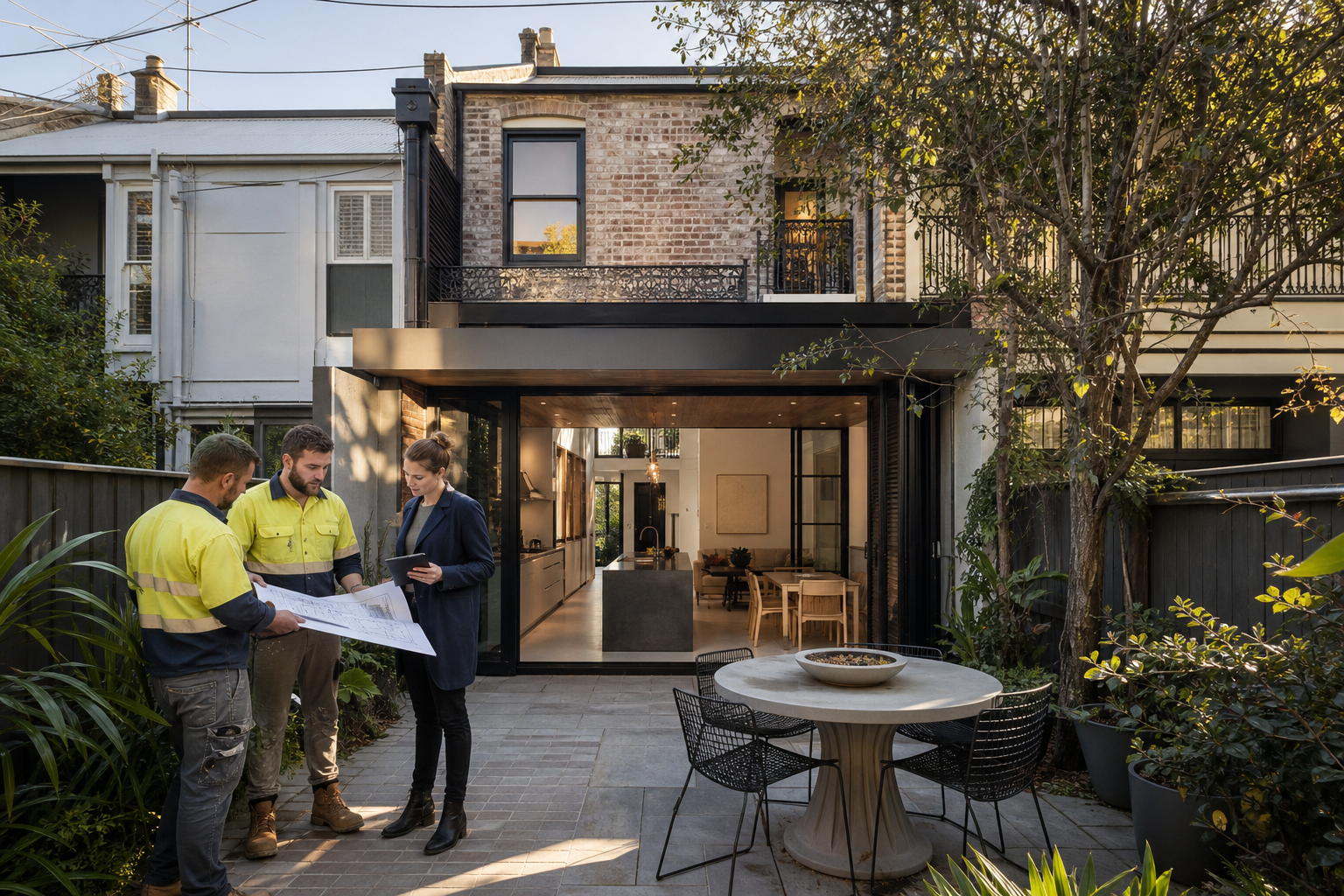
Extending an Alexandria terrace is one of the biggest financial decisions many inner‑south owners will make. The core choice is whether to fund it with a full construction loan, or by topping up the equity in your current home loan. The “right” answer depends on your build type, budget, contract, and how much risk you’re willing to carry in a world of rising construction costs and higher interest rates.
In practice, structural extensions with fixed‑price contracts and staged progress payments often suit construction loans, while smaller or more cosmetic projects can run comfortably from a well‑structured equity top‑up. The real job this week is to match the loan structure to your specific Alexandria terrace, builder and cashflow – not to what worked for a mate in the suburbs.

1. Start with the project: what are you really building?
Before you choose a loan, you need a sharp picture of the build itself. Lenders and valuers don’t fund “vibes”; they fund specific works, on a specific property, at a specific price.
1.1 Common Alexandria terrace extension types
For terraces around Alexandria, Erskineville and Green Square, most extension projects fall into four buckets:
-
Rear ground‑floor extension
• Push the living area into the yard, add doors and light
• Usually involves slab, plumbing, roof adjustments
• Often structural – walls removed, beams added -
Second‑storey addition
• New bedrooms and bathroom upstairs
• Heavier engineering, more council oversight
• Commonly requires a fixed‑price contract and staged payments -
Attic conversion / pop‑top
• Utilises existing roof space
• May be part structural, part fit‑out
• Sometimes split from other cosmetic works -
Mostly cosmetic upgrade with minor structural tweaks
• New kitchen, bathroom, windows, doors
• Limited changes to the building envelope
• Often possible with an equity top‑up if cost is modest
The more structural the project and the more it changes floor area, the more likely a lender will push you towards a construction loan.
1.2 Key questions to answer this week
Sit down with your designer or builder and answer:
- Is this structural work (moving or removing walls, new storey, major foundation changes)?
- Will you have a formal fixed‑price building contract, or just quotes and invoices?
- Are there planned progress payments (slab, frame, lock‑up, fit‑out, completion)?
- Do you need to move out for all or part of the build?
- Is your total budget (including contingency) closer to $200k or $700k+?
For many inner‑south projects over about $400k–$500k, especially with a builder doing staged claims, a construction facility starts to make more sense – a pattern we also see in the wider east in [/insights/construction-loan-vs-equity-top-up-eastern-suburbs-renovation].
2. Construction loan vs equity top‑up: how they actually work
2.1 What is a construction loan?
A construction loan is a specialised home loan where:
- The lender approves a total facility limit for land + build, or existing home + extension.
- Funds for the build are released in stages (progress payments) as the work is completed.
- You usually pay interest‑only on the drawn balance during construction, then switch to principal & interest.
- The bank may send inspectors or valuers before each stage payment.
These are common for knock‑down rebuilds and full second‑storey extensions, and are also used for some custom projects described in [/insights/construction-loans-for-off-the-plan-purchases].
2.2 What is an equity top‑up (or renovation split)?
An equity top‑up means increasing your current home loan (or adding a new split) based on:
- The current value of your Alexandria terrace (not the post‑reno value)
- A typical LVR cap of 80% for no‑LMI, or up to 90–95% with LMI, if the lender allows
You draw the extra funds into an offset or redraw, pay your builder directly, and repayments start immediately on the full amount you draw.
This is usually simpler, cheaper in fees and more flexible – but you carry more of the project‑management and overrun risk yourself.
2.3 Side‑by‑side comparison
| Feature / Risk Area | Construction Loan | Equity Top‑Up / Renovation Split |
|---|---|---|
| Best for | Structural works with fixed‑price contract | Smaller or mixed cosmetic / minor structural |
| Typical project size (inner south) | ~$350k–$1m+ build costs | Up to ~$400k–$500k total, depending on equity |
| How funds are released | Staged progress payments to builder | Lump sum or as‑needed into your account |
| Bank inspections | Common at each stage | Rare (may inspect at start only) |
| Interest during build | On progressive drawdowns only | On the full amount once drawn |
| Paperwork | Higher – fixed contract, plans, builder details | Lower – valuation, income docs, quotes sometimes |
| Flexibility for changes | Less – variations may need approval | More – you control payments and timing |
| Overrun management | Harder to increase limit mid‑build | Easier if you’ve left borrowing capacity & buffers |
For many Alexandria terrace owners, the choice is which set of risks you prefer to manage.
The strategy continues below
You've seen the problem and the groundwork — now unlock the exact steps our CPA-certified brokers use, including 8 more sections. Enter your email for instant, free full access.
Free access. No spam — unsubscribe anytime. Your details stay confidential.
Frequently asked questions
Is a construction loan always more expensive than an equity top-up?▾
Can I start with an equity top-up and switch to a construction loan later?▾
How big should my contingency be for an Alexandria terrace extension?▾
Do banks value the extension at full cost when deciding my loan size?▾
What if my builder wants a bigger deposit than the bank will release?▾
Is an Alexandria terrace extension likely to over-capitalise my property?▾
Speak with a specialist advisor
Confidential consultation, bespoke advice for your situation.