Article
Choosing Between Construction Loans and Equity Top‑Ups for Mascot Renos
Planning a renovation in Mascot and unsure whether you need a full construction loan or just an equity top‑up? This guide walks through how banks treat each option, how progress payments and valuations work, and a clear framework so you can choose the right structure this week.
Key Takeaway
For Mascot renovation projects, construction loans suit larger, structural works with staged builder invoices and give the bank tighter control over progress payments, while equity top‑ups are simpler and faster for moderate renovations when borrowers have strong cash buffers. The article explains how banks in Australia apply a 3% serviceability buffer, typically cap LVRs around 80%, and order as‑if‑complete valuations that influence both loan size and approval type. Readers gain a clear decision framework and worked examples to choose a safe structure this week.
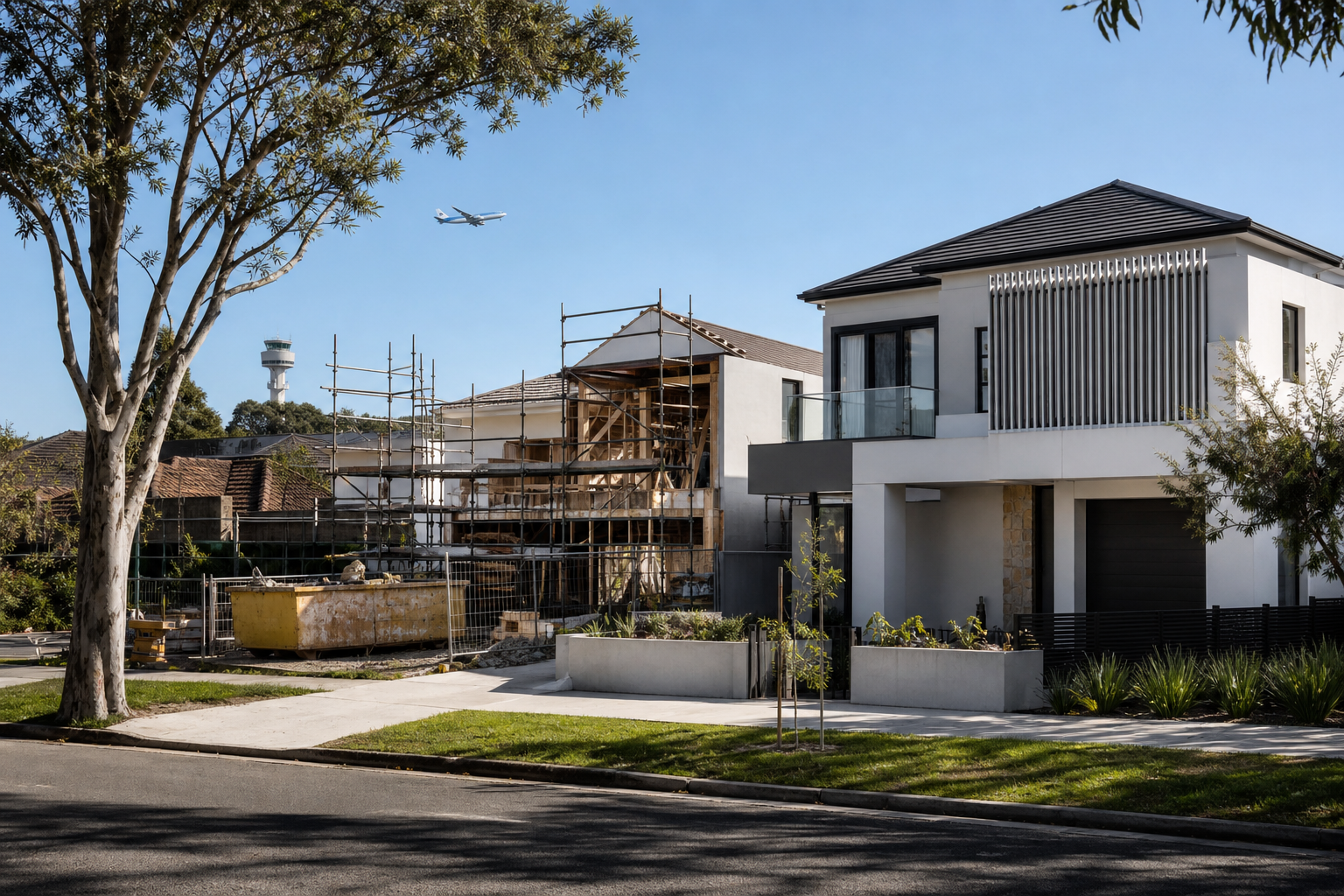
Planning a renovation in Mascot usually comes down to one core finance question: do you need a full construction loan, or will a simple equity top‑up on your home loan do the job safely? In practice, banks look at the build cost, how the builder is paid, your buffers and the post‑reno valuation to decide whether construction‑style progress payments are required.
In this guide, we’ll break down how construction loans work, how equity top‑ups work, how Mascot‑specific valuations and build costs influence each option, and a decision framework you can use this week with your builder and broker.
Quick answer: when to use each for a Mascot reno
For a Mascot renovation:
-
Use a construction loan when:
- The build is structural (extensions, second storey, major reconfiguration).
- Your builder invoices by progress stages.
- The bank wants to control progress payments linked to inspections.
- You need every dollar of equity and can’t afford to overpay early.
-
Use an equity top‑up when:
- Works are modest to mid‑range (kitchen, bathrooms, internal layout changes) and you can live through the reno.
- You can manage payments directly from your offset/redraw.
- You’re comfortably under 80% loan‑to‑value ratio (LVR) with good cash buffers.
The right choice isn’t just about build size. It’s about cashflow safety, bank valuation and your risk appetite.

Step 1: Understand how banks see Mascot renovation risk
Mascot context: prices, density and construction costs
Mascot has a mix of older freestanding houses, semi‑detached homes and a lot of apartments. That matters because:
- Houses and semis: renovations can dramatically shift value, but buyers can also be wary of over‑capitalised, over‑designed homes on busy streets.
- Apartments: many renovations are internal only, and valuers look at recent sales in your building or similar blocks.
Upstream construction costs have risen sharply due to higher energy and materials prices (ABS Producer Price Indexes, June 2026). That means:
- Builders are pricing more cautiously.
- Contingency margins matter more than ever.
- Banks know blowouts are common and are conservative on both end values and loan limits.
How Mascot renovation valuations usually work
A bank valuer will typically assess:
- Current value – based on recent settled sales.
- As‑if‑complete value – assuming works are finished per plans and spec.
They then cap lending at the lower of:
- A percentage (often 80% LVR) of the as‑if‑complete value; and
- What you can afford under serviceability tests, usually with a 3% interest rate buffer over today’s rate (APRA guidance).
For example:
- Current Mascot house value: $1.5m
- Proposed renovation cost: $400k
- As‑if‑complete valuer estimate: $1.9m
- 80% of as‑if‑complete value: $1.52m capped total lending
If you already owe $1.0m, the bank might allow up to $520k extra in theory – but they’ll also test your income and buffers.
How that extra $400k is structured (construction loan vs equity top‑up) is the crux of this article.
Step 2: How construction loans for Mascot renos actually work
Core features of a construction loan
A construction loan is designed for bigger, staged projects where you pay your builder in chunks.
Key features:
- Separate loan split for the build, usually interest‑only during construction.
- Progress payments released at agreed stages (e.g. slab, frame, lock‑up, fix‑out, completion).
- Bank often orders interim valuations or inspections before each major drawdown.
- You only pay interest on the funds drawn so far.
This structure is common for:
- Second‑storey additions and rear extensions.
- Full gut and reconfiguration of older Mascot houses.
- Raising and building under a home.
Example: Mascot second‑storey addition with progress payments
Say you’re adding a second storey to a Mascot semi:
- Existing loan: $900k at 5.8% P&I (30 years remaining).
- Build contract: $500k, paid in 5 stages of $100k.
- As‑if‑complete value: $2.0m → 80% LVR cap = $1.6m total lending.
The bank approves:
- Existing loan: $900k (unchanged).
- New construction split: $500k (interest‑only, 18–24 months).
Repayments:
- Before works: P&I on $900k.
- After first draw of $100k: you pay P&I on $900k + interest‑only on $100k.
- By completion: P&I on $900k + interest‑only on $500k.
At the end of construction, the lender will usually revert the construction split to P&I and you can then:
- Keep separate splits (helpful for tracking reno debt), or
- Restructure into a single loan.
Pros of a construction loan in Mascot
- Tighter control of progress payments. Bank only pays the builder when work is done and inspected. This protects you if the builder tries to front‑load payments.
- Interest only on drawn amounts. Slows the cashflow hit while the house may be partially unliveable or you’re paying rent elsewhere.
- Cleaner tracking of renovation costs in a separate split, which can help your accountant if part of the property becomes or remains an investment later.
- More acceptable to some builders. Many Eastern Suburbs builders are used to bank‑funded progress payments.
Cons of a construction loan
- More paperwork and slower approvals. You’ll need fixed‑price or detailed contracts, plans, insurance and council approvals before formal approval.
- Less flexibility for variations. Unplanned upgrades usually require a variation process with the bank.
- Valuation risk mid‑build. If costs rise, the bank won’t necessarily lift your limit. You need your own buffer (ideally in cash or true offset) to cover overruns, as discussed in our Rose Bay and Mascot cost‑overrun guides.
For more detail on how banks and builders interact at each stage, see our guide on keeping progress payments tight in nearby Alexandria: /insights/managing-progress-payments-cost-overruns-alexandria-renovation.
The strategy continues below
You've seen the problem and the groundwork — now unlock the exact steps our CPA-certified brokers use, including 8 more sections. Enter your email for instant, free full access.
Free access. No spam — unsubscribe anytime. Your details stay confidential.
Frequently asked questions
Do I always need a construction loan for a Mascot renovation?▾
Is an equity top‑up or construction loan cheaper for Mascot renos?▾
How do banks calculate how much I can borrow for a Mascot renovation?▾
Can I use a construction loan if I’m self‑employed in Mascot?▾
What happens if my renovation costs more than my approved loan?▾
Can I change from an equity top‑up to a construction loan mid‑project?▾
Speak with a specialist advisor
Confidential consultation, bespoke advice for your situation.