Article
Orchestrating Personal, Company and SMSF Loans for Big Purchases
How to coordinate your personal, company and SMSF borrowing capacity so your next premium home or investment move works across tax, serviceability and risk – not just on paper, but with buffers that survive real‑world shocks.
Key Takeaway
This article explains how to coordinate personal, company and SMSF borrowing so an Australian buyer can safely fund premium property while preserving borrowing capacity and buffers. It outlines how lenders aggregate group debts, why SMSF limited recourse loans usually cap at around 60–70% LVR, and how personal guarantees pull business loans into home-loan assessments. The key actionable insight is to map all entity balance sheets with a broker and accountant before committing to any large purchase.

This topic is covered in full on Local Knowledge Finance
How to coordinate your personal, company and SMSF borrowing capacity so your next premium home or investment move works across tax, serviceability and risk – not just on paper, but with buffers that survive real‑world shocks.
Read the full guide on ding.financialCoordinating personal, company and SMSF borrowing means planning all your loans as one ecosystem so you can buy premium property without blowing up your home borrowing power, business stability or retirement savings. In practice, that means deciding which entity buys which property, in what order, and how much each should borrow, before you sign a contract.
Done well, a coordinated plan lets you:
- Secure the home you actually want.
- Grow your business and investments sensibly.
- Keep enough cash and super intact to handle shocks.
This guide is written for time‑poor founders, professionals and investors who want decision‑grade clarity this week.
1. Start with the real goal: your premium property plan
A “premium property plan” isn’t just buying the most expensive home a bank will approve. It’s the mix of:
- Your main residence (often $1.5m–$5m+ in major cities).
- One or two quality investment properties.
- Possibly your own business premises (owned personally, via a company, trust or SMSF).
The mistake is treating each purchase as a one‑off. Lenders and regulators (APRA, ATO, ASIC) don’t see it that way. They look at:
- Your whole income story across entities.
- All debts you’ve guaranteed, even in the company.
- How leveraged your SMSF is and how concentrated its assets are.
The planning sequence that generally works best:
- Define the end state: what you’d like to own in 10–15 years (home + premises + investments).
- Rank priorities: usually home first, then business premises/investments, then SMSF property.
- Map borrowing buckets: personal, business/company, SMSF.
- Decide which bucket funds which asset and when.
If you only do one thing this week, sketch that end‑state picture and rough order on a single page. Everything else flows from there.
2. Your three borrowing buckets: features, limits and trade‑offs
2.1 Personal borrowing (home and investment loans)
Personal borrowing is usually your most flexible and cheapest source of property finance.
Key features:
- Security: usually your home or investment properties.
- LVRs: up to 80% without LMI, sometimes up to ~95% with LMI for homes (less for investments).
- Assessment: based on taxable income (salary, business profit, dividends) with a 3%+ APRA buffer on rates.
- Rates: generally lowest for owner‑occupied, principal & interest (P&I) loans.
Why this bucket matters most:
- It determines where you can live, and your kids’ school zones and lifestyle.
- Lenders weigh high‑impact personal debts (cards, personal loans, BNPL) heavily, often more than productive business loans.
- For self‑employed borrowers, aggressively minimising taxable income can hurt this bucket badly because lenders work off taxable profit.
If you’re self‑employed or a high‑income owner, read our deeper dive on home loans for high‑income self‑employed professionals and owners alongside this guide.
2.2 Company / business borrowing
Company or business borrowing (often via a company or trust) is typically used for:
- Business premises.
- Fit‑outs and equipment.
- Working capital and trade/invoice finance.
Key features:
- Security: the business premises and/or your home; often backed by director guarantees.
- Assessment: based on business cashflow and profit, plus your personal income and net worth.
- Rates & terms: depend on security quality, LVR, lease strength and business performance.
Critical issue: personal guarantees.
Most lenders treat business facilities you’ve personally guaranteed as personal commitments when assessing your home loan. Even when a vehicle loan or small equipment facility is in the business name, lenders often count the repayments in your personal serviceability.
For more on how business facilities and cards cut into your borrowing power, see Business Debts, Credit Cards and Car Loans: Protect Your Borrowing Power.
2.3 SMSF borrowing (property via LRBA)
SMSFs can borrow to buy property using a limited recourse borrowing arrangement (LRBA). These loans:
- Are limited recourse – the lender’s rights are limited mostly to the property held in a separate bare trust.
- Typically have lower maximum LVRs (often 60–70% for residential/commercial) and higher interest rates than standard home loans.
- Must meet strict rules about arm’s‑length rent and terms when leasing to related parties.
Because the LVR is lower, you often need a large existing balance plus ongoing contributions to make SMSF property viable.
And crucially, using your SMSF to buy property ties up a big chunk of your retirement savings in a single, illiquid asset, increasing concentration risk if it’s your only big SMSF holding.
For business owners considering putting premises in super, read Should Your SMSF Own Your Business Premises or Not? alongside this guide.
2.4 Comparing your three borrowing buckets
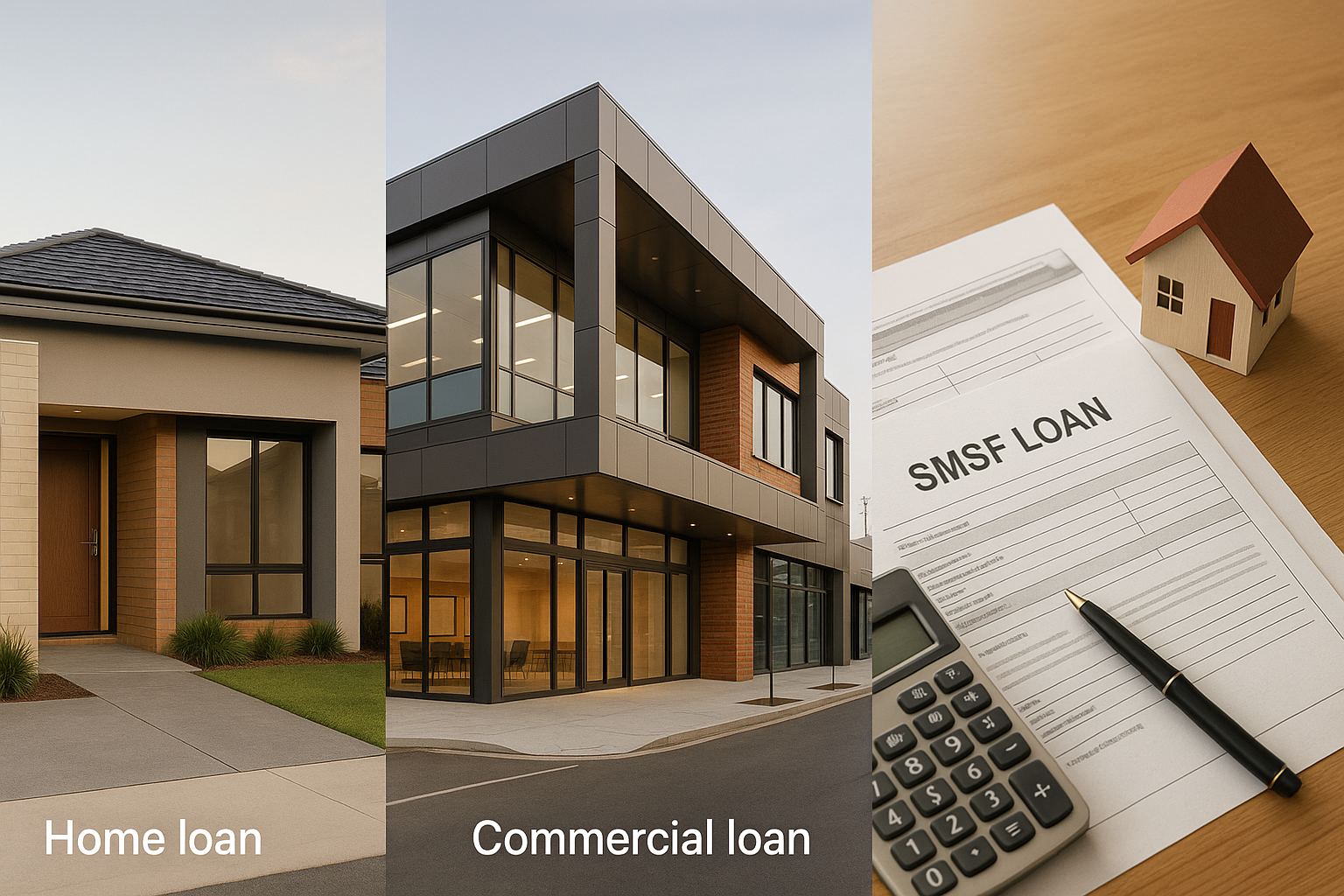
| Feature | Personal home/investment loan | Company / commercial loan | SMSF LRBA property loan |
|---|---|---|---|
| Typical max LVR (illustrative) | Up to 80–95% (home), 80–90% (investor) | ~60–80% depending on asset, lease, business | ~60–70% |
| Recourse | Full recourse to you (and guarantors) | Often to company + directors / cross‑collateral | Limited mainly to SMSF property |
| Rate level (indicative only) | Lowest for owner‑occupied P&I | Higher than home loans, lower than SMSF usually | Often highest of the three |
| Who’s assessed | You and co‑borrowers | Business + guarantors | SMSF cashflow, contributions and rent |
| Typical use | Home, residential investments | Business premises, fit‑outs, equipment, working capital | Business premises, long‑term investments |
All figures are indicative only – lenders and products vary, and no live rates are quoted.
The table makes one thing clear: personal borrowing is usually the cheapest and most flexible, SMSF borrowing is often the tightest and most expensive, and business borrowing sits in the middle.
The strategy continues below
You've seen the problem and the groundwork — now unlock the exact steps our CPA-certified brokers use, including 7 more sections. Enter your email for instant, free full access.
Free access. No spam — unsubscribe anytime. Your details stay confidential.
Frequently asked questions
Should I buy my premium home in a company, trust or my own name?▾
Can my SMSF help me buy my family home?▾
How do business debts and guarantees affect my home loan borrowing power?▾
In what order should I buy my home, business premises and SMSF property?▾
What professionals do I need to set up a coordinated borrowing plan?▾
Can I change my structure later if I get it wrong now?▾
Speak with a specialist advisor
Confidential consultation, bespoke advice for your situation.