Article
Equipment Finance Paperwork: The Exact Documents Lenders Expect From You
A practical, step‑by‑step equipment finance paperwork checklist for Australian small businesses and self‑employed owners. Use it to get lender‑ready this week and avoid slow, messy approvals.
Key Takeaway
Australian lenders usually require identification, business registration, 1–2 years of financial statements, 6–12 months of bank statements, ATO portals or notices, and a signed equipment quote or contract before approving equipment finance. For many small business loans, they also want evidence that cashflow covers repayments 1.25–1.5 times. By assembling these documents and a basic equipment and funding summary in advance, businesses can materially speed up approvals and improve their chances of a yes.
Watch the short answer
How ABN age can affect your chances with the banks
Find out why many lenders care how long your ABN has been active before they lend.
Read the transcript
Most banks have a rigid rule: if your ABN hasn't been active for two full years, you can't get a home loan. But if your trade business has been booming for 12 months, why should your family wait to buy a house? We have direct access to alternative doc lenders who accept 6 to 12 months of active trading backed by clean business bank deposits. Stop waiting for arbitrary timelines. DM me 'GROWTH' to look at your options.
General information only, not personal advice. Your situation is assessed before any recommendation.

This topic is covered in full on Local Knowledge Finance
A practical, step‑by‑step equipment finance paperwork checklist for Australian small businesses and self‑employed owners. Use it to get lender‑ready this week and avoid slow, messy approvals.
Read the full guide on ding.financialIf you’re planning to buy a vehicle, machine or piece of tech for your business, equipment finance can be much safer than rolling the cost into your home loan. But lenders won’t approve it on a handshake. They’ll want a clear picture of your business, your numbers and the asset itself – and that means paperwork.
This guide gives you a step‑by‑step equipment finance paperwork list for Australian small businesses and self‑employed owners. Follow it and you’ll know exactly what to gather this week so your next application doesn’t stall.
Quick answer: what paperwork do I need for equipment finance?
Most Australian equipment lenders want three things: (1) proof of who you are and that your business exists, (2) proof your business can afford the repayments, and (3) details of the asset they’re funding and how it will be protected.
That usually means: ID, ABN/ASIC documents, 1–2 years of financials and/or tax returns, 6–12 months of bank statements, ATO portal or notices, a current equipment quote or contract, and evidence of insurance and security. Smaller, simpler deals may need less; bigger, riskier or low‑doc deals usually need more.
We’ll break this into a practical checklist you can work through in under an hour.
1. Start here: a simple equipment finance checklist
Before we get into the detail, here’s a one‑page view of the common documents.
1.1 Core paperwork most lenders will request
| Category | Common documents | Notes |
|---|---|---|
| Proof of ID | Driver licence, passport, Medicare card | For all individual borrowers and guarantors |
| Business registration | ABN lookup, ASIC company extract, trust deed | Shows who owns and controls the business |
| Financial statements | Profit & loss, balance sheet (last 1–2 years) | For companies/trusts with full accounting records |
| Tax returns | Business and personal tax returns (1–2 years) | Helps lenders assess serviceability and stability |
| Bank statements | Trading account and loan statements (6–12 months) | Verifies cashflow and existing commitments |
| ATO information | Integrated client account, BAS, payment plans | Confirms tax position and undisclosed debts |
| Asset documents | Supplier quote, invoice, spec sheet, photos | Tells lender exactly what they are funding |
| Insurance & security | Insurance quote/policy, PPSR consent | Required for most asset‑backed equipment loans |
1.2 What changes with deal size?
Smaller ticket items can be much simpler.
| Deal size (approx.) | Typical documentation level | Common features |
|---|---|---|
| Up to ~$50,000 | Streamlined / low‑touch | May rely on bank statements, ID and supplier quote only |
| $50,000–$250,000 | Standard full‑doc | Financials, tax returns, bank statements, ATO portal |
| $250,000+ or multi‑asset facilities | Enhanced / credit memo | Detailed financials, forecasts, asset schedules, security structuring |
If you’re looking at construction or earthmoving gear, the structure matters as much as the paperwork. See how lenders look at risk and term in How to Finance Construction and Earthmoving Gear Without Risking It All.
2. Personal and business identification: proving who’s borrowing
Lenders must meet strict “know your customer” rules. If you get this wrong, nothing else moves.
2.1 Personal ID checklist
For each individual borrower, director or guarantor, you’ll usually need:
- Current driver licence (front and back)
- Passport (if available)
- Medicare card (often used as secondary ID)
- Proof of address if licence doesn’t show current address (rates, utility bill, tenancy agreement)
Tip: Scan these clearly, in colour, and check that names match exactly across ID, ASIC records and tax returns. Small mismatches can delay approvals.
2.2 Business identity and structure documents
What you need depends on how you trade.
Sole trader
- ABN registration (screenshot from ABN lookup is fine)
- Registered business name extract (if you trade under a name)
Company
- ASIC current company extract (showing directors and shareholders)
- Constitution (for some lenders, especially for larger facility limits)
Trust (with corporate trustee)
- Full trust deed and any amending deeds
- ASIC extract for the corporate trustee
Lenders use these to confirm:
- Who is legally borrowing the money
- Who must sign guarantees
- Who owns the equipment for tax and security purposes
If you’re planning a more complex setup – say, a trading company with a separate asset‑holding trust – it’s worth getting your accountant and broker aligned early. The guide Why Your Accountant And Broker Must Align On Every Equipment Purchase walks through that process.
3. Financials and tax: showing the numbers stack up
Most lenders want to see that your business can comfortably cover repayments from recurring cashflow. For many small businesses, that means:
- The new loan repayments are covered at least 1.25–1.5 times by free cashflow after expenses and owner drawings (see also /insights/small-business-qualify-equipment-finance-eligibility-checklist).
To test that, they’ll ask for financial statements and tax information.
3.1 Business financial statements
For companies and trusts, expect to provide:
- Profit & loss statements – last 1–2 financial years
- Balance sheets – last 1–2 financial years
- A current year interim P&L and balance sheet if year‑end is more than 6–9 months ago
Checklist:
- Make sure they’re accountant‑prepared or at least reconciled from your accounting system (Xero, MYOB, QuickBooks).
- If there were unusual one‑offs (e.g. COVID grants, major write‑offs, sale of an asset), add a short explanation.
3.2 Tax returns and ATO information
For many SME equipment loans, lenders will also ask for:
- Latest 1–2 years business tax returns (company or trust)
- Latest 1–2 years personal tax returns for directors/owners
- Latest ATO notices of assessment
- ATO integrated client account and running balance account (or screenshots from the portal)
- Recent BAS statements (usually 2–4 quarters)
They are looking for:
- Stability and trend in taxable income
- Hidden tax debts that don’t show on your balance sheet
- Whether BAS lodgements and tax payments are up to date
If you have an ATO payment plan:
- Provide the payment plan letter or screenshot
- Provide evidence of on‑time payments (bank statement lines)
That’s far better than hoping the lender won’t see it. They generally will.
4. Bank statements: the real cashflow story
Some lenders put more weight on bank statements than on your P&L, especially for:
- Smaller ticket deals
- Self‑employed borrowers without up‑to‑date financials
- Fast‑turnaround approvals
4.1 What bank statements to provide
Typically you’ll be asked for:
- Main business trading account – last 6–12 months
- Any existing business loan or equipment finance accounts – last 6–12 months
- For sole traders, sometimes personal account statements as well (if business income flows there)
Lenders will scan for:
- Patterns of income (is it stable, seasonal, lumpy?)
- Large cash deposits that don’t match your stated income
- Regular expenses and other loan repayments
- Dishonours, overdrawn periods, and late payments
4.2 How to make your bank statements lender‑ready
In the week before you apply:
- Avoid unnecessary transfers or cash withdrawals that create noise.
- Keep the main trading account in positive territory.
- Clear any small overdue amounts or dishonours if possible.
This is the kind of “one‑week tidy‑up” we also talk about in How Banks Really See Your Alexandria Small Business At Loan Time.
5. Asset documents: exactly what are you buying?
Equipment finance approvals live or die on the asset details. Lenders care about:
- What the asset is
- How long it will last in your business
- How easily it could be resold if they had to step in
That’s because many lenders cap the total age of the asset at the end of the term (often 10–15 years for vehicles and machinery, and 5–7 years for technology: see /insights/new-vs-used-equipment-what-lenders-will-and-wont-finance).
5.1 Standard asset paperwork
For each asset, gather:
- Supplier quote or pro‑forma invoice (on letterhead, with ABN)
- Make, model, year, and serial/VIN (if known)
- Detailed specifications (capacity, size, features)
- New vs used (if used, kilometres/hours, prior use)
- Purchase price (ex‑GST and inc‑GST)
- Proposed term and any balloon/residual value
For used gear, lenders may also want:
- Photos from multiple angles
- Maintenance history
- Recent valuation or market price estimate
Why it matters:
- New standard equipment is easier to finance at higher LVRs and longer terms.
- Used, specialised or niche assets often mean lower LVRs, shorter terms and slightly higher pricing.
We explore those trade‑offs in more depth in /insights/new-vs-used-equipment-what-lenders-will-and-wont-finance.
5.2 Contracts, purchase orders and progress payments
If you’re buying multiple assets or a large system (e.g. production line, medical fit‑out, solar array), you may have:
- Supply contract or purchase agreement
- Milestone or progress payment schedule
- Commissioning or go‑live date
Provide these to your broker or lender early. They affect:
- How and when the finance is drawn (single advance vs staged drawdowns)
- When repayments start
Staging drawdowns with contract milestones – a theme in /insights/scaling-equipment-finance-for-national-contracts – can materially reduce interest cost and protect cashflow.
6. Insurance and security: protecting the lender and your business
Most equipment finance is secured – the lender takes security over the asset, and sometimes over property or other collateral. They’ll usually require two supporting elements: insurance and PPSR registration.
6.1 Insurance documents
Asset‑finance lenders typically require:
- Insurance schedule or quote covering the equipment at or near replacement value
- Policy noting the lender as an interested party or loss payee (so claims can be paid to them if needed)
You don’t always need the policy in place at application, but you’ll usually need it before settlement.
For a deeper explanation of how lenders view insurance, see Protecting Business Equipment: PPSR, Insurance And What Lenders Expect.
6.2 PPSR and security agreements
For secured equipment finance, expect:
- A security agreement granting the lender security over the asset
- PPSR (Personal Property Securities Register) registration in the background
You usually don’t have to lodge the PPSR yourself, but you may have to:
- Confirm the legal owner (who’s on the invoice/title)
- Sign to allow the lender to register their interest
If you’re also considering using property as security (e.g. to lower the rate), read Secured vs unsecured equipment loans: which is safer for your cashflow?. Using your home as security concentrates risk and can backfire if the business hits a rough patch.
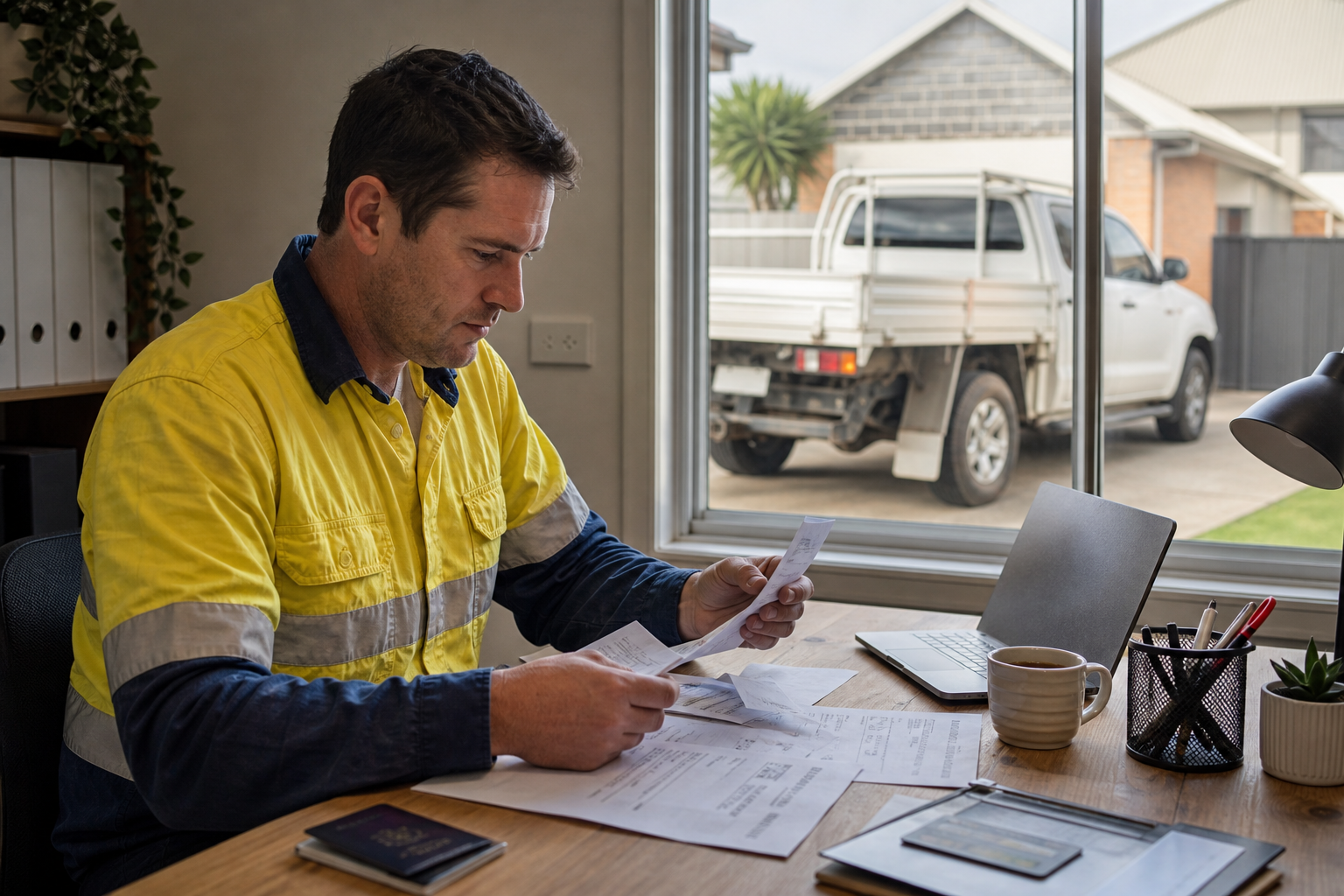 Sole traders can often secure equipment finance with a tight but focused set of documents. ### 7.1 Sole traders and very small businesses If you’re a tradie, freelancer or one‑person operation, lenders may lean on: - Personal and business tax returns (often the same document) - 6–12 months…
The strategy continues below
You've seen the problem and the groundwork — now unlock the exact steps our CPA-certified brokers use, including 9 more sections. Enter your email for instant, free full access.
Free access. No spam — unsubscribe anytime. Your details stay confidential.
Frequently asked questions
What documents do I need to apply for an equipment loan?▾
Can I get equipment finance without full financial statements?▾
Do I need my accountant involved for an equipment finance application?▾
Will lenders check my ATO portal for equipment finance?▾
How many months of bank statements do equipment lenders need?▾
Do I need insurance in place before my equipment loan is approved?▾
What extra paperwork is needed if I secure the loan against my home?▾
Speak with a specialist advisor
Confidential consultation, bespoke advice for your situation.