Article
Exit Options For Mascot Owners: Sell Now Or Hold As Life Shifts
A decision-grade guide for Mascot owners weighing up whether to sell or hold their unit as life changes — upgrade, downsize, relocate or restructure debt.
Key Takeaway
Mascot property owners should decide whether to sell or hold by stress-testing five numbers: usable equity, deposit or debt gap, safe repayments at 3% above current rates, realistic post-reform net rent, and a 6–12 month buffer for concentrated Mascot exposure. With negative gearing changes from 1 July 2027 and potential soft valuations, modelling both keep-and-rent and sell-and-regroup scenarios clarifies which option best supports upcoming life events. Owners can then implement a staged exit plan rather than react to the next rate or job shock.
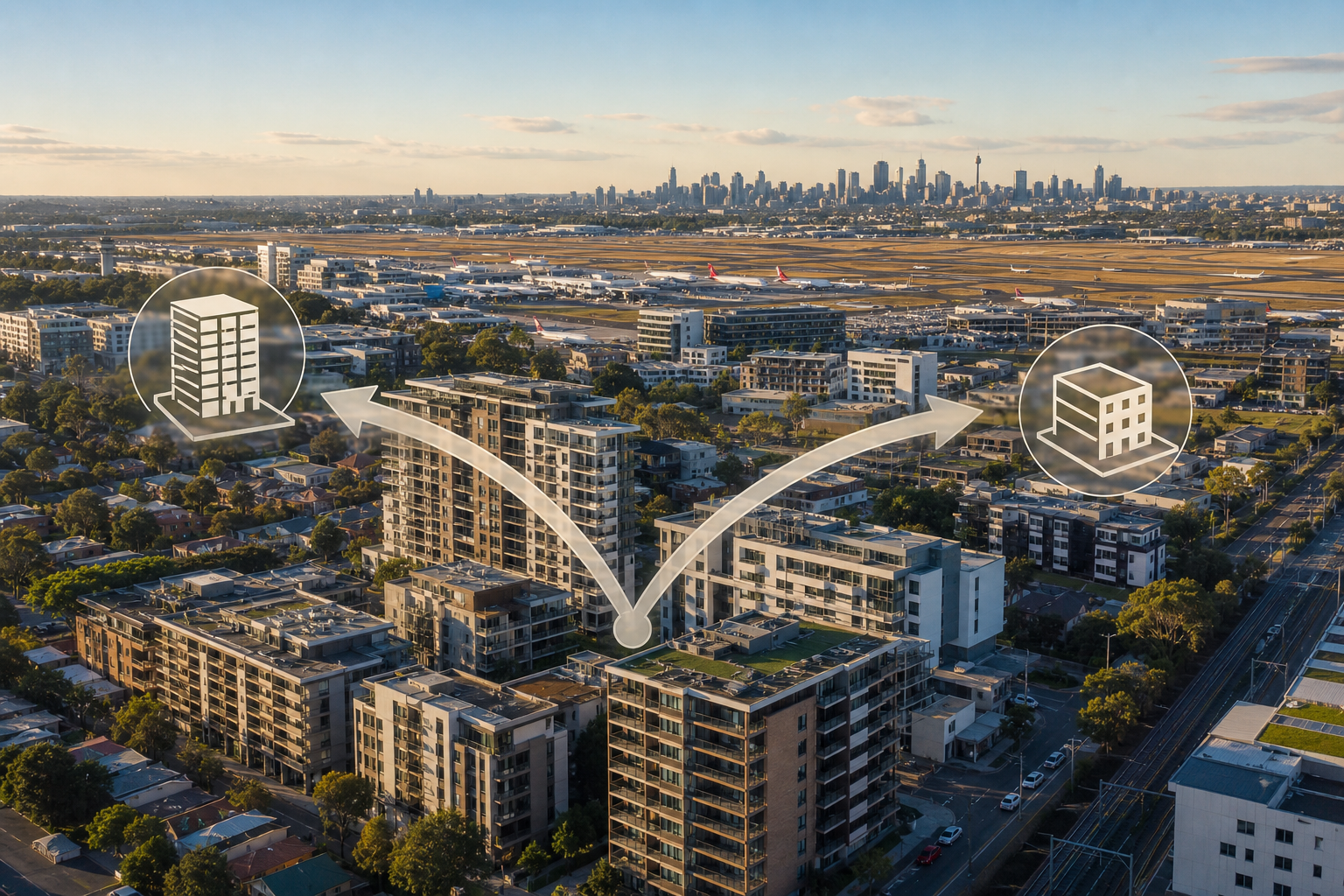
If you own a Mascot apartment and life is changing—new baby, relocation, divorce, business opportunity—the core question is simple: is your best exit strategy to sell now or hold the property and pivot around it? The answer sits in five numbers: usable equity, the deposit or debt gap on your next step, safe repayments, realistic rent after tax rule changes, and your cash buffer.
This guide shows how Mascot owners can get to a decision-grade answer within a week, and then turn that into a practical exit strategy—not just a rushed sale.

Step 1: Define the life event and time window
Before you crunch numbers, be explicit about what’s changing and when.
Common Mascot exit triggers
- Upgrading from a Mascot unit to a house in another suburb.
- Downsizing after kids leave home or a relationship ends.
- Relocating interstate or overseas for work.
- Starting or expanding a business (often self-employed around Mascot and the airport).
- Health, redundancy or burnout driving a need to de-gear.
Write down:
- What must change in the next 6–18 months? (home, work, family, business)
- What’s optional if the numbers are tight? (timing, size of upgrade, business scale)
- Your non-negotiables. (school zone, commute, being debt-free by a certain age)
If your timeline is under six months, you’re in execution mode. If it’s 6–18 months, you have room to stage the exit, similar to the approach in /insights/property-portfolio-exit-strategy-by-55-60-65.
Step 2: Run the five-number Mascot decision framework
This is the same framework we use in /insights/keep-or-sell-mascot-unit-when-you-upgrade, adapted for life-change exits.
The five critical numbers
- Usable equity – What you can safely extract without LMI.
- Deposit/debt gap – What you need to fund the next move.
- Safe repayment level – At rates 3% higher than today (APRA buffer).
- Realistic net rent – After costs and post-2027 negative gearing changes.
- Cash buffer – 6–12 months of stressed costs if Mascot is your main asset.
Worked example: Mascot owner relocating to Brisbane
- Mascot unit value (indicative): $800,000
- Loan today: $520,000 (65% LVR)
- Usable equity to 80% LVR: 0.80 × 800k − 520k = $120,000
- Target Brisbane house: $1,100,000
- Purchase costs (stamp duty, legals, moving): $60,000 (approx.)
If you keep Mascot and use that $120k as deposit/costs, your new Brisbane loan is about $1,040,000. At, say, 6.5% P&I over 30 years, that’s roughly $6,580/month before stress-testing.
Now stress-test at 9.5% (3% buffer). Repayments jump to around $8,600/month. If that plus your Mascot loan and living costs push you beyond roughly 30–35% of after-tax income, keeping the Mascot unit becomes aggressive.
Step 3: Compare “sell now” vs “hold and pivot”
Set up two simple scenarios: Sell vs Keep as investment.
Comparison: keeping or selling your Mascot unit
| Scenario | Sell Now (Mascot) | Keep & Rent (Mascot) |
|---|---|---|
| Upfront cash | Sale proceeds after loan & costs fund new deposit | Smaller deposit; higher new-home debt |
| Debt level | Lower total debt; one main mortgage | Two loans; higher total exposure |
| Cashflow risk | Lower if repayments fit well within income | Higher; must cover vacancies, rate rises, repairs |
| Tax impact (post-2027) | No rental deductions; possible CGT on sale | Rental losses quarantined; pre-tax cashflow more critical |
| Flexibility | Easier future moves, refinancing and de-gearing | More options long term if cashflow and buffers are strong |
| Emotional/mental load | One property to manage | Landlord obligations, strata and tenant risk |
The right answer is the one that:
- Hits your non-negotiables.
- Keeps repayments safe at +3% rates.
- Leaves you with a clear cash buffer after the move, not just on paper.
If both scenarios are marginal on buffers, that’s a signal to slow down, reduce the purchase budget, or consider a staged sale.
The strategy continues below
You've seen the problem and the groundwork — now unlock the exact steps our CPA-certified brokers use, including 5 more sections. Enter your email for instant, free full access.
Free access. No spam — unsubscribe anytime. Your details stay confidential.
Frequently asked questions
Should I sell my Mascot unit before or after buying my next place?▾
Is it worth keeping my Mascot apartment as an investment after negative gearing changes?▾
How big should my cash buffer be if Mascot is my only property?▾
What if my Mascot valuation comes in too low to fund my next move?▾
How do divorce or separation change my Mascot exit strategy?▾
Speak with a specialist advisor
Confidential consultation, bespoke advice for your situation.