Article
How to Finance Acreage and Lifestyle Estates Without Crippling Borrowing Power
A clear, decision‑grade guide to financing acreage and lifestyle properties in Australia without blowing your borrowing power, cashflow or future options.
Key Takeaway
Financing acreage and lifestyle estates in Australia is harder than standard homes because banks often cap LVRs at 60–80% and use conservative rural valuations. This guide explains how property zoning, land size, and income sources affect borrowing power, why repayments should be stress-tested at current rates plus 3%, and how to structure loans to preserve equity for future moves or investments. It ends with concrete steps buyers can take this week to secure safer acreage finance.
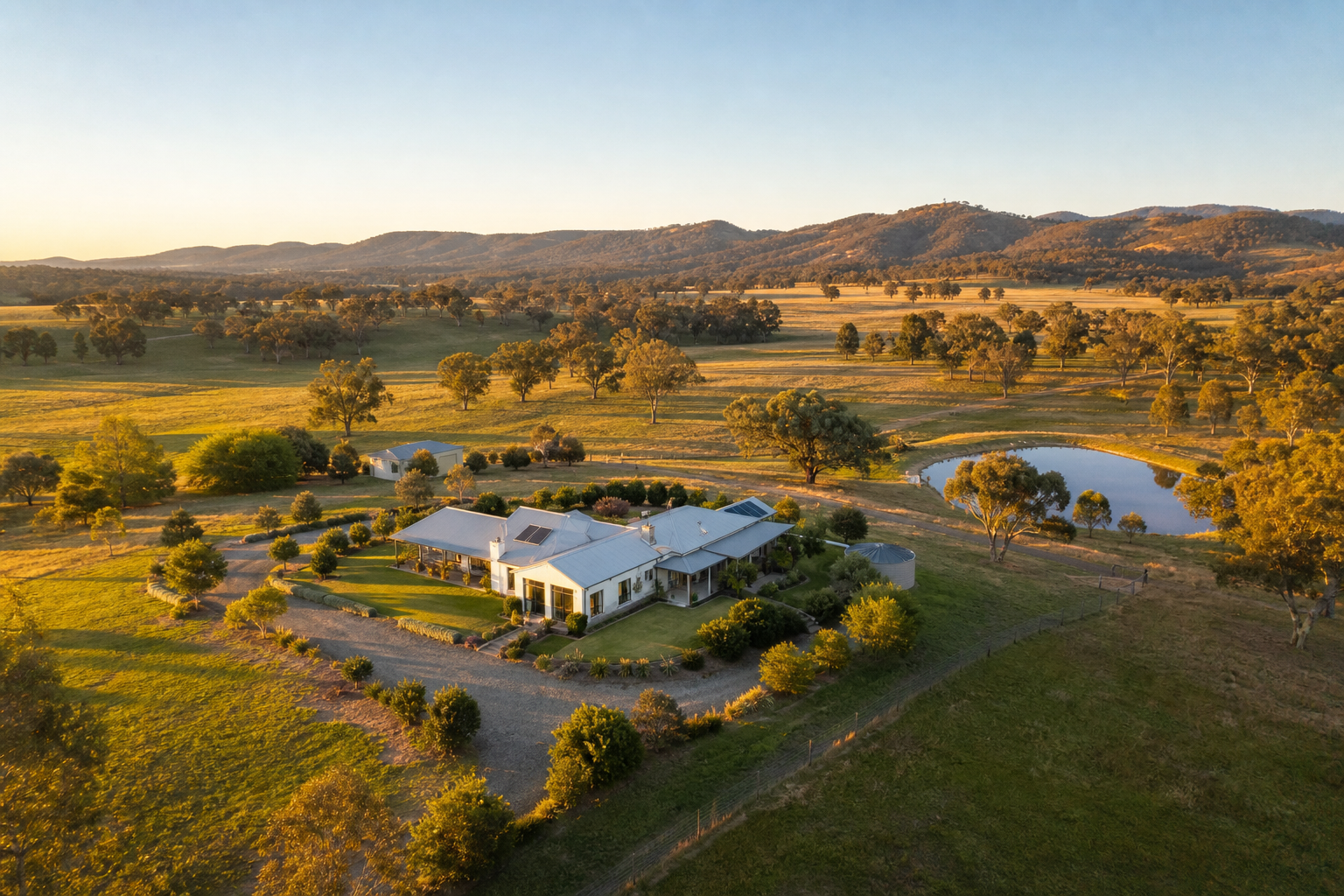
Acreage and lifestyle properties are where the dream and the bank’s risk rules collide.
In Australia, financing acreage or a lifestyle estate is harder than a standard suburban home because lenders worry about resale and income stability. They often cap loan‑to‑value ratios (LVRs), apply conservative valuations, and treat parts of the land as non‑residential. To keep your borrowing power intact, you need to choose the right property, match it with the right lender, and structure the debt so future moves are still possible.
This guide steps through how to do that in a way a busy professional, self‑employed client or small business owner can act on this week.
1. How lenders really see acreage and lifestyle blocks
Not all acreage is equal in lender eyes. The same 10–20 acres can look like a normal home, a semi‑rural hobby farm, or a full commercial rural asset, depending on zoning and use.
1.1 Key lender questions on lifestyle property
Most banks start with three questions:
-
Is it residential or rural?
Zoning (R, RU, etc.), land use and local council rules drive this. -
How easily could we sell it if needed?
They look at local demand, days on market and recent comparable sales. -
How much of the land is ‘lender‑friendly’?
Often only the house plus a few surrounding hectares are valued like a standard home.
Those answers then shape your LVR, interest rate category and borrowing power.
1.2 Common lender categories for acreage
While every lender has its own credit policy, acreage and lifestyle estates usually fall into one of four buckets:
- Standard residential on larger land – e.g. 2–5 acres within commuting distance of a major town or city, clearly residential zoning.
- Lifestyle acreage / hobby farm – 5–40+ acres, mixed use, maybe some agistment or hobby‑level income.
- Rural residential with commercial elements – substantial income‑producing activity (crops, livestock, short‑stay cabins); may tip into commercial lending.
- Specialised or remote rural – very large landholdings, niche use, or in a thin market.
The further you move from standard residential, the more conservative the bank becomes.

1.3 Why this matters for borrowing power
Borrowing power is shaped by two levers:
- Maximum LVR – how much the bank will lend against the property value.
- Serviceability – how much your income can safely support once they apply their buffers.
APRA expects lenders to test repayments at least 3% above the actual rate. A safe personal rule (and one we use across guides like /insights/sea-change-tree-change-regional-move-finance-rules) is to keep all mortgage repayments under about 30–35% of your after‑tax income when modelled at that stressed rate.
If the bank caps LVR at, say, 70% instead of 90%, you need a bigger deposit or more equity, which can quietly drain your capacity for the next property or business move.
2. Typical LVR rules and how they hit acreage buyers
Understanding how LVRs change with land size and property type is critical before you fall in love with a place.
2.1 Indicative LVR bands on acreage
Every lender is different, but you’ll often see ranges like:
| Property type | Typical max LVR* | Notes |
|---|---|---|
| Suburban house ≤ 2,000 m² | Up to 95% (with LMI) | Standard residential lending. |
| Lifestyle block 2–10 acres (near town) | 80–90% | Tighter if secondary dwelling or unsealed access. |
| Acreage 10–40 acres (mixed use) | 60–80% | Often treated as lifestyle/hobby farm. |
| Larger rural or part‑commercial property | 50–70% | May need rural/commercial loan. |
*Indicative only – actual policy varies by lender and postcode.
LMI (Lenders Mortgage Insurance) may be unavailable for some acreage categories, effectively capping you at 80% LVR even if your income is strong.
2.2 Worked example: LVR impact on your cash
Say you’re eyeing a $1.2m lifestyle acreage.
- At 90% LVR, you’d need $120,000 plus costs.
- At 70% LVR, you’d need $360,000 plus costs.
That extra $240,000 has to come from somewhere:
- Additional savings, or
- Equity from existing property, or
- Family assistance.
If you strip $240,000 of equity from your current home, you may:
- Reduce flexibility to upgrade again later.
- Limit your ability to buy an investment property.
- Increase risk if markets soften.
This is how the dream block can quietly kill your borrowing power for the next 10–15 years if you don’t plan the structure.
2.3 Where regional risk overlays creep in
Many acreage properties sit in regional or outer‑regional postcodes. As we explored in /insights/sea-change-tree-change-regional-move-finance-rules, risk overlays can include:
- Lower maximum LVRs in certain postcodes.
- Harsher shading of short‑term or variable income.
- More conservative valuations and fewer valuers willing to quote.
The result: your actual borrowing power can differ widely between lenders. This is where a broker who knows both rural policy and your tax position can make a meaningful difference.
3. Protecting borrowing power: structure before property
Before you sign a contract or pay a holding deposit, you want your finance structure sketched out.
3.1 Separate loan splits by purpose
When you’re using equity from an existing property to fund a lifestyle block, clarity of purpose matters:
-
Split A – Existing home loan
Your main residence debt. -
Split B – Equity release for lifestyle property deposit and costs
Often interest‑only for a defined period, then principal and interest. -
Split C – Stand‑alone loan on the new acreage
Secured only against the new property where possible.
This style of clear, purpose‑labelled splitting is consistent with what we recommend for dual‑property strategies: interest deductibility follows purpose, not postcode.
It also gives you options later if you want to convert one property to an investment, or refinance one loan without disturbing the other.
3.2 Avoid cross‑collateralisation traps
Many lenders will happily take both properties as security for one big loan. It looks simple today, but can:
- Tie your city home and acreage together for every future refinance.
- Let the lender block property sales or equity moves unless the whole portfolio passes their current rules.
- Increase the chance that business or investment issues spill over to your home (a risk we unpack in /insights/protect-dover-heights-home-when-you-run-business-practice).
A cleaner structure is usually:
- Separate loans for each property.
- Thoughtful use of limited cross‑collateralisation only if there’s a clear, time‑bound benefit.
3.3 Cash buffers and the 3% stress test
Acreage living tends to come with:
- Higher running costs (water, roads, fencing, machinery, fuel).
- Potentially lumpy income if you’re self‑employed or semi‑retired.
Given Roy Morgan’s finding that over 30% of borrowers are already ‘At Risk’ of mortgage stress, you don’t want to join them.
Use this rule of thumb:
- Model all loans at current rates + 3% (in line with APRA’s buffer expectations).
- Keep total home and investment repayments under about 30–35% of after‑tax income.
- Hold 3–6 months of essential living costs plus all loan repayments in cash or true offset.
If the numbers are tight under that test, dial back the purchase price or delay until buffers are healthier.
The strategy continues below
You've seen the problem and the groundwork — now unlock the exact steps our CPA-certified brokers use, including 7 more sections. Enter your email for instant, free full access.
Free access. No spam — unsubscribe anytime. Your details stay confidential.
Frequently asked questions
Can I get 90% LVR on a lifestyle acreage property?▾
Do banks count hobby-farm or Airbnb income from my acreage?▾
Is it better to keep my city home and buy acreage, or sell first?▾
How do I protect my lifestyle property if I run a business?▾
What happens if the valuation comes in below my purchase price?▾
Can I use equity from my current home to buy an acreage estate?▾
Speak with a specialist advisor
Confidential consultation, bespoke advice for your situation.