Article
How to Finance a Second‑Storey or Rear Extension in Rose Bay
A decision‑grade guide for Rose Bay owners planning a second‑storey addition or rear extension. Learn how banks assess valuations, structure renovation loans, and protect your cashflow so you can start this week without overstretching.
Key Takeaway
To finance a second‑storey addition or rear extension in Rose Bay, borrowers typically use a construction loan or equity top‑up assessed against current value and an ‘on‑completion’ valuation, while keeping total repayments near 25–35% of net income. Lenders apply at least a 3% APRA serviceability buffer and rely on fixed‑price contracts and progress payments. The key actionable step is to map total project cost, borrowing requirement and post‑reno value before signing a build contract.
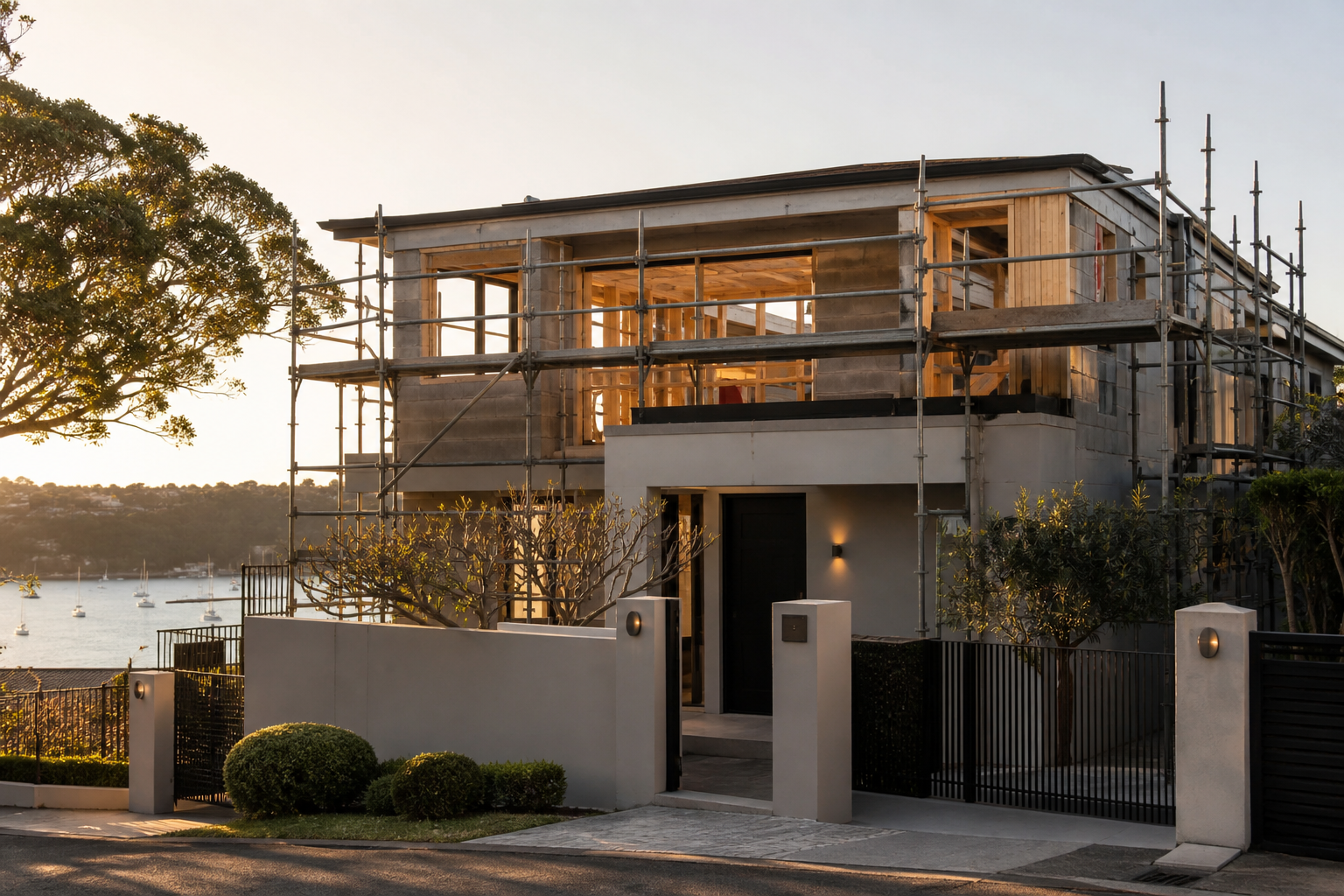
Planning a second‑storey addition or big rear extension in Rose Bay usually means using a construction‑style loan based on both your home’s current value and its expected value after renovation, while keeping total repayments in the 25–35% of net income band and preserving 2–3 months of living expenses as cash buffers.
If you can’t tick those three boxes, the project size or timing probably needs to change.

1. Start with three numbers: cost, borrowing, post‑reno value
Before you talk to a builder, you need a basic finance frame:
- Total project cost (build + design + approvals + contingency).
- How much cash/equity you’ll contribute vs how much you need to borrow.
- Likely value on completion – what your Rose Bay home should be worth when finished.
For many Rose Bay clients, the safest structure is:
- Loan‑to‑value ratio (LVR) at or below 80% on completion (to avoid LMI and keep flexibility).
- Total repayments (home + investment + other loans) sitting roughly at 25–35% of net household income.
- Cash buffers of at least 2–3 months’ living costs, separate from the build funds.
If you’re not sure how much equity you can safely release, pair this article with the equity‑focused guide: Rose Bay Renovation: Using Home Equity Without Overstretching.
Worked example – Rose Bay second storey
- Current value (unrenovated semi): $3.0m
- Existing home loan: $1.5m (50% LVR)
- Planned second storey + rear extension: $900k total project cost
- Target max LVR on completion: 80%
To avoid LMI, your total debt post‑reno should be no more than 80% of the completed value.
If a conservative valuer thinks the finished home will be worth $3.8m, then:
- Max debt at 80% LVR = $3.04m
- Existing debt = $1.5m
- Indicative borrowing capacity for reno = $1.54m (subject to income serviceability)
In that scenario, a $900k build is inside the valuation envelope – but serviceability and cashflow still have to stack up under a 3% APRA buffer.
2. How banks actually lend for Rose Bay extensions
2.1 Equity top‑up vs construction loan
Most second‑storey additions or major rear extensions fall into one of two structures.
| Option | Best for | Key features | Main risks |
|---|---|---|---|
| Equity top‑up | Smaller or staged works (e.g. $200k–$400k), plenty of spare equity | Lump‑sum increase to existing home loan; usually based on current value only; funds released to you | Easier to overspend; less lender oversight; may not cover blowouts |
| Construction loan | Major structural works ($500k+) with staged build | Based on both current and on‑completion valuation; progress payments direct to builder; interest usually charged only on drawn amounts | More documentation; stricter valuations and inspections; less flexibility to change scope mid‑build |
For most Rose Bay second storeys and substantial rear extensions (often $600k–$1.2m), a construction loan is safer, even if you have a lot of equity. It hard‑wires in progress payments and gives the bank clarity on cost and completion.
For a deeper dive into structure options, see Safely Using Eastern Suburbs Home Equity for Reno, Investment and Buffers.
2.2 How the valuation works (before and after)
Expect two related but distinct valuation questions from the lender:
- As‑is value – what the property is worth today, unrenovated.
- On‑completion value – what it should be worth when the agreed scope of works is finished.
The valuer will lean heavily on:
- Plan‑approved drawings and specifications.
- A fixed‑price building contract or detailed costings.
- Comparable sales of renovated homes in your part of Rose Bay / Eastern Suburbs.
For harbourside pockets, lenders may shade exuberant agent appraisals to stay conservative, particularly while the RBA cash rate is sitting around 4.35% (August 2026) and household borrowing is under scrutiny.
If the valuer comes in low, you might need to:
- Tip in more cash.
- Trim the scope of works.
- Stage the project (e.g. rear extension now, high‑spec internal fit‑out later).
The strategy continues below
You've seen the problem and the groundwork — now unlock the exact steps our CPA-certified brokers use, including 5 more sections. Enter your email for instant, free full access.
Free access. No spam — unsubscribe anytime. Your details stay confidential.
Frequently asked questions
How much can I borrow for a second‑storey addition in Rose Bay?▾
Do I need a construction loan for a rear extension?▾
How do valuers assess my home after renovation?▾
What if my build costs blow out mid‑project?▾
Should I wait for interest rates to fall before starting a big renovation?▾
Speak with a specialist advisor
Confidential consultation, bespoke advice for your situation.