Article
Financing Solar On Your New Build Without Derailing The Bank Loan
How to include solar in a new build without blowing up your construction loan approval. Understand builder contracts, variations, valuations and bank rules so you can lock in panels and batteries with confidence this week.
Key Takeaway
Financing solar on a new build works best when the system is clearly included as a line item in the fixed‑price building contract and your construction loan approval covers the full contract plus contingencies. Lenders usually accept solar as part of the build if the valuation and loan‑to‑value ratio still fit policy, but mid‑build variations can trigger re‑approval and delays. Borrowers should stress‑test repayments 3% above current rates and lock in solar design and pricing before signing the contract to avoid finance shocks.
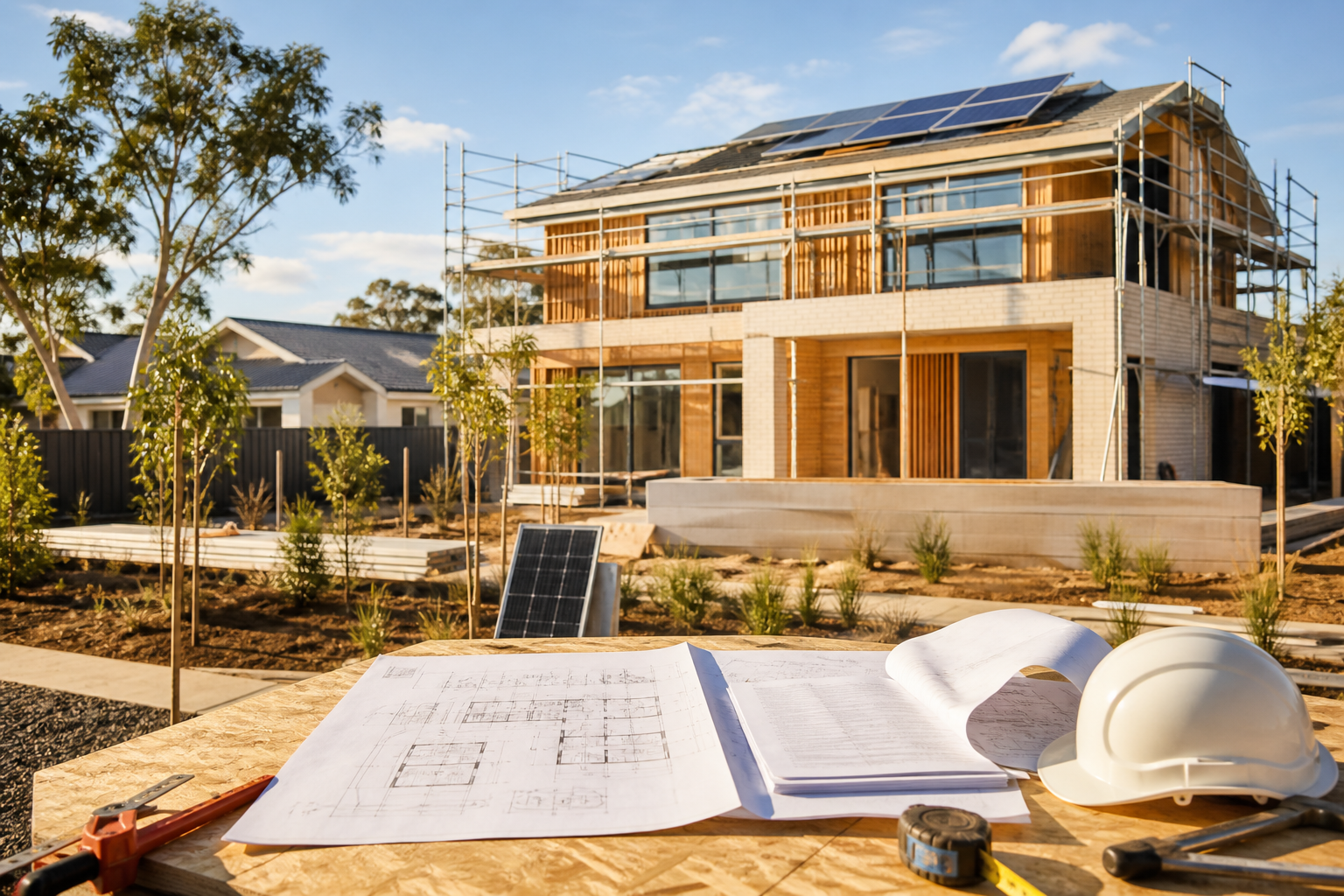
Putting solar on a new build is usually cheaper and cleaner than retrofitting later – but it can also be a minefield for finance.
In Australia, banks will generally fund solar as part of a construction loan if it’s properly documented, fits within your valuation and loan‑to‑value ratio (LVR), and doesn’t blow up your serviceability. The trouble starts when solar is added late as a variation, or when the builder’s contract and the bank’s rules are speaking different languages.
This guide steps through how to structure solar in your builder contract, what your bank actually looks at, and how to handle variations without derailing your new build.

1. Big picture: where solar fits in a construction loan
1.1 How construction loans normally work
Most Australian construction loans are structured around:
- A fixed‑price building contract
- A lender‑ordered valuation “as if complete”
- Progress payments triggered by stages (slab, frame, lock‑up, fit‑off, completion)
The bank approves a maximum loan based on your income, expenses (using HEM benchmarks), and the lower of:
- The total project cost, and
- The valuer’s estimate of the completed property value.
APRA expects banks to apply a 3% serviceability buffer above your actual interest rate, so repayments are stress‑tested at higher rates.
Solar can sit in this picture in three different ways:
- Included in the main builder contract (cleanest for most borrowers)
- Added later as a contract variation (higher risk for delays and re‑approval)
- Funded separately via a green loan, top‑up or cash after handover
Weighing option 3? See how separate solar loans stack up in Should You Use a Green Loan or Home Loan Top‑Up for Solar?.
1.2 When banks like solar in a new build – and when they don’t
Lenders are generally comfortable funding solar as part of a new build when:
- The system and wiring are part of the building contract
- The valuer can see it in the specs and include it in the value
- The total contract still fits within the approved loan and LVR limit
They get nervous when:
- Solar is a late add‑on that pushes up the contract price
- The new price means your LVR crosses a key threshold (e.g. >80% and into LMI territory)
- Variations are large relative to your savings buffer and contingency
- The installer is unrelated to the builder, causing warranty and completion risk
So the planning question is simple: how can you lock in solar early enough that your finance, valuation and contract all reflect it from day one?
2. Should you include solar in the builder contract or do it separately?
2.1 Pros and cons at a glance
Here’s how including solar in the main building contract compares with organising it separately after handover.
| Approach | Pros | Cons | Best for |
|---|---|---|---|
| Solar in main building contract | One loan, one valuation; solar fully integrated into design; can be capitalised into 25–30 year mortgage at home loan rates | Long repayment term means more total interest; any change may force contract re‑approval; dependent on builder’s pricing and installer | First‑home buyers, standard builds, those tight on cashflow during build |
| Separate solar after handover (loan or cash) | Freedom to choose installer; can match loan term to solar’s life (e.g. 7–10 years); avoids mid‑build variations | Need extra equity or cash after build; might pay higher rate on a green/solar loan; system isn’t in original valuation | Owners who will have equity on completion, or want a shorter, focused solar loan |
A key principle from our solar finance work: you should always compare total interest over the term, not just rates [(/insights/green-loan-vs-home-loan-top-up-solar)]. A 30‑year home loan split at 6% can cost more interest than a 7‑year green loan at 9%.
2.2 Worked example: including solar in the build vs separate loan
Assume:
- Solar + battery package: $18,000
- Home loan rate: 6% p.a. P&I over 30 years (illustrative only)
- Green loan rate: 9% p.a. P&I over 7 years (illustrative only)
Option A – add $18,000 to the construction loan (30 years)
- Monthly repayment: ≈ $108
- Total interest over 30 years: ≈ $20,880
Option B – separate 7‑year green loan for $18,000
- Monthly repayment: ≈ $288
- Total interest over 7 years: ≈ $6,192
Cashflow is easier under Option A, but the long-term cost is over three times higher. For a busy household, the right answer is often to:
- Include the solar in the contract and construction loan but
- Overpay that solar portion aggressively, or split and run it on a 7–10 year schedule.
3. Getting the builder contract right so the bank will fund solar
3.1 How solar should appear in the contract
For the bank and valuer to treat solar as part of the build, you want:
- A fixed‑price building contract (HIA/MBA style) including solar
- Solar as a separate line item in the inclusions schedule or specifications
- Model, capacity and key specs listed (e.g. 8kW PV, 10kWh battery, inverter brand)
- Timing – usually part of the fit‑off or practical completion stage
Vague wording like “energy efficient package” doesn’t help the valuer. Clear line items do.
If the builder insists on a provisional sum (PS) or prime cost (PC) allowance for solar, make sure:
- The allowance is realistic (based on current quotes), and
- You have capacity and cash buffer if final quotes push it higher.
3.2 Solar installers: builder’s team vs your own choice
Many builders prefer using their own solar subcontractor. That’s simple for the bank because it’s part of one contract and one warranty chain.
If you want to use your own installer:
- Some lenders will still be comfortable if the solar is clearly included in the building contract, even if the builder subcontracts to your preferred installer
- Others will want the solar excluded and done post‑completion, treating it as a separate project
From a risk and finance perspective, it’s often cleaner to:
- Keep genuine structural and integrated works (roof pitch, wiring, switchboard upgrades, conduit runs) within the main contract
- Delay final panel and battery choice until shortly before installation, where allowed, as long as the contract clearly allows for a system of similar size and cost
3.3 Valuations: will the bank recognise solar value?
Valuers don’t add dollar‑for‑dollar value for solar, but they will usually:
- Treat a decent solar system as a positive; and
- Reflect it in their overall assessment of the completed dwelling, particularly in areas where solar is common
Expect the valuer to:
- Review the building contract and specifications
- Compare with recent sales (“comparable evidence”) of similar homes
If your solar system pushes the contract price well above local benchmarks, the valuer may not fully support the cost. That can reduce your effective LVR capacity.
A local broker who understands valuation dynamics can help manage this as explained in How Smart Local Brokers Use Valuations, Sales Data and LMI Rules.

The strategy continues below
You've seen the problem and the groundwork — now unlock the exact steps our CPA-certified brokers use, including 7 more sections. Enter your email for instant, free full access.
Free access. No spam — unsubscribe anytime. Your details stay confidential.
Frequently asked questions
Can my bank refuse to fund solar that’s in the builder contract?▾
Do I need a separate quote from the solar installer for the bank?▾
Will solar increase my property valuation for a construction loan?▾
Can I change my solar system size after loan approval?▾
Is it better to finance solar within the home loan or separately?▾
Do solar rebates and feed‑in tariffs increase my borrowing power?▾
Speak with a specialist advisor
Confidential consultation, bespoke advice for your situation.