Article
A Hard‑Headed Finance Playbook For Your First Eastern Suburbs Unit
A decision-grade, numbers-first guide to buying your first Bondi, Coogee or Randwick apartment, with concrete borrowing tactics you can act on this week.
Key Takeaway
This article explains how to finance a first apartment purchase in Bondi, Coogee or Randwick by turning vague price hopes into hard borrowing limits, using a 3% APRA buffer and 6–12 month cash reserves. It outlines realistic price and deposit bands for units, when FHBG and FHSS can help, and how to stress‑test repayments at 2–3% above current rates. The key action is to build a one‑page finance plan and get a conditional approval before you start bidding.
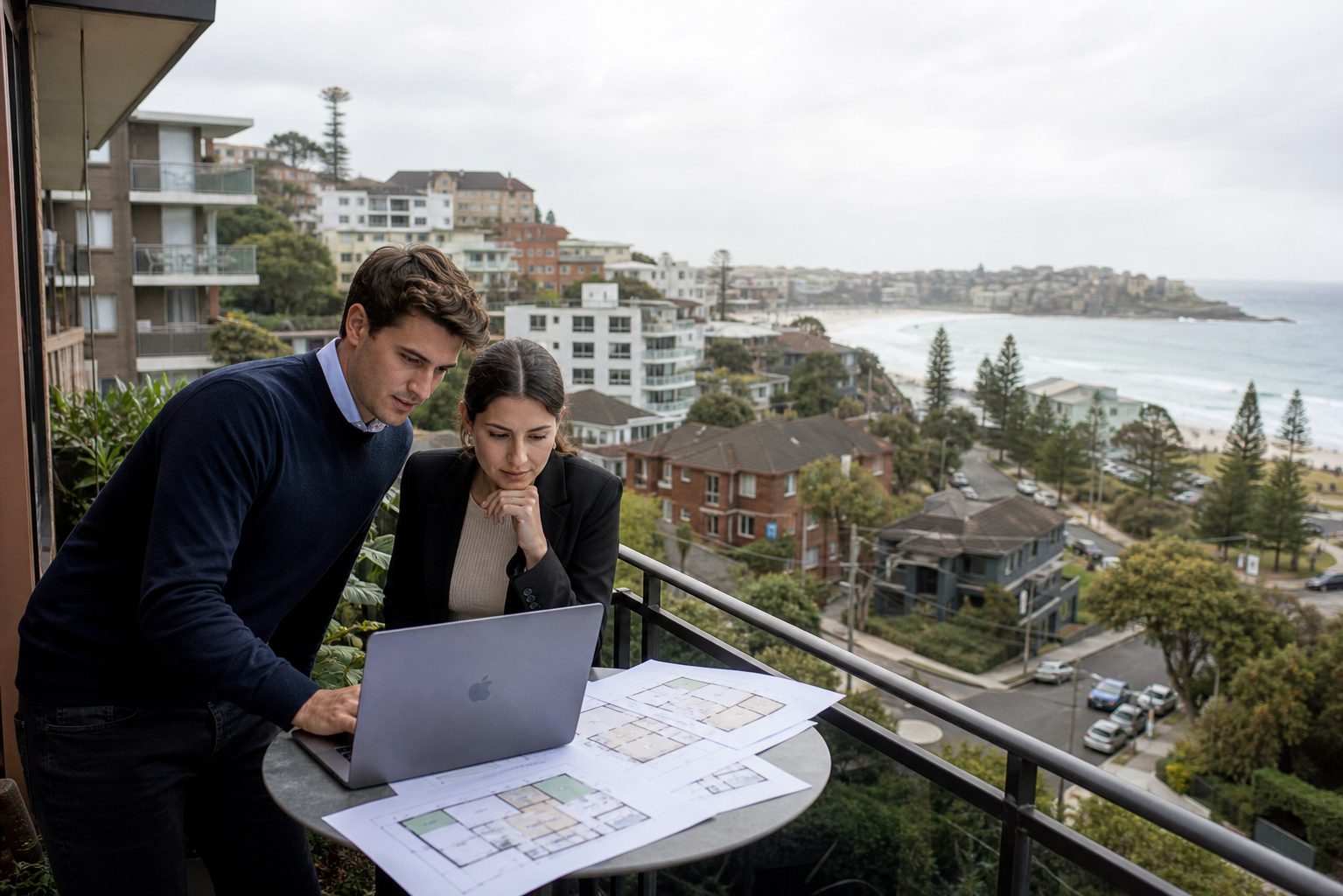
Most first‑home buyers in Bondi, Coogee or Randwick start with the wrong question: “What’s my max budget?” The better question is: “What loan size can I live with through rate hikes, job changes and a couple of bad years?” Buying your first eastern suburbs unit safely means building your finance plan first, then fitting the apartment to it — not the other way around.
In plain terms: your Bondi, Coogee or Randwick first‑home strategy is a structured way to decide (1) what you can borrow under bank rules, (2) what you should borrow under real‑life rules, and (3) how you’ll get from today’s deposit to a contract you can actually complete. Everything in this playbook is about those three steps.
Here’s what I tell my clients: a good plan should give you a clear borrowing range, a target price band and a one‑week action list. If your current plan doesn’t, treat this article as your checklist.

1. Start With the Numbers, Not the View
1.1 A realistic price lens for Bondi, Coogee and Randwick
As at 2024, you don’t buy a shiny Bondi beachfront two‑bedder as your first place on a modest income without serious help. But you can usually find:
- Entry‑level older one‑bed units further back from the beach
- Compact two‑bed walk‑ups a little off the café strips
- Renovation‑ready stock that scares off cosmetic‑averse buyers
Indicative (not guaranteed) price bands I’m seeing for first‑home‑type stock:
- Bondi: $850k–$1.2m for 1–2 bed units
- Coogee: $800k–$1.1m
- Randwick: $750k–$1.05m (often better value per square metre)
Your job this week is not to pick a perfect apartment. It’s to work out which of those bands your borrowing, deposit and risk settings can actually support.
1.2 Bank capacity vs real‑world safety
Lenders must add at least a 3% serviceability buffer to current rates (APRA guidance). If your actual variable rate might be 6.3%, the bank tests you at ~9.3% principal and interest (P&I). That’s why their calculator often spits out a scary big number.
But I don’t let clients use the bank’s max as their budget. A more grounded check is:
- Keep total home loan repayments around 25–35% of net household income
- Hold at least 6 months of stressed living costs plus all loan repayments in cash or offset (12 months if you’re geared professionals or business owners, building on the buffer principles in our Rose Bay and Bronte pieces).
This is in line with Roy Morgan’s finding that roughly 28% of mortgage holders are at risk of stress when rates move higher — you’re choosing not to be in that cohort by design.
2. What You Can Borrow: Worked Examples
2.1 A simple stress‑test example
Let’s say:
- Household net income: $9,500 per month (after tax)
- Target loan: $900,000
- Actual rate (illustrative only): 6.3% p.a. P&I, 30 years
Repayments on $900,000 at 6.3% over 30 years are roughly $5,600 per month.
- That’s ~59% of net income — way too high in my view, even if a bank says yes.
If you cap housing at 35% of net income (~$3,325/month), the corresponding safer loan size at 6.3% is closer to $530,000–$550,000. That’s a big gap — and it’s why a lot of first‑home strategies in the east quietly rely on:
- A higher household income than people admit
- Family help (gift, loan or guarantee)
- Partnering up earlier than planned, or
- Adjusting suburbs, size, or property condition
The mistake I see most is people mentally buying a $1m unit on a single moderate salary without doing this stress‑test.
2.2 Deposit and cost ranges you can actually use
For a $900,000 unit:
- 20% deposit: $180,000
- 10% deposit: $90,000 (usually with LMI unless using a government guarantee)
- Buyer’s stamp duty (NSW, owner‑occupier, first home, threshold dependent): roughly $0–$35,000 depending on concessions
- Legal, inspections, misc: $3,000–$5,000
A rough minimum cash requirement if you’re not using a first home guarantee and buying around $900,000 could be $120,000–$140,000 once you include costs and a starter buffer. Government schemes and structured family help can bring that down, which we’ll cover shortly.
If your current savings are $60,000 and you’re targeting Bondi, the play may not be “buy now”. It may be “12–18 months of aggressive saving, plus smart use of FHSS and FHBG”, or “shift the brief slightly to Randwick or a smaller unit”.
For a deeper dive into coming prepared and getting a tight borrowing range in 60–90 minutes, read Make Your First Strategy Session With an Eastern Suburbs Broker Count.
3. Government Schemes: What Actually Moves the Needle
3.1 The three levers that matter
For Bondi, Coogee and Randwick first‑home buyers, the big three are:
- First Home Guarantee (FHBG) – buy with as little as 5% deposit without LMI, subject to price caps and eligibility.
- First Home Super Saver (FHSS) – withdraw extra voluntary super contributions (plus earnings) for your deposit.
- NSW first home stamp duty concessions – reduce or remove transfer duty up to certain thresholds.
The details change, but in combination they can easily move your effective deposit by tens of thousands. We walk through this sequencing in our Green Square guide: Step‑by‑step: using FHBG, FHSS and duty breaks to buy in Green Square — the principles are identical in the eastern suburbs, just with higher price pressure.
3.2 Where schemes help vs where they’re a distraction
Schemes help most when:
- Your household income fits the eligibility caps
- You’re willing to buy in the price band that the scheme caps allow
- You have at least 5–8% genuine savings and a clean credit file
They become a distraction when:
- Your income is well above the caps and you’re stretching into $1.2m+ units
- You’d have to compromise on property quality or strata risk just to stay under a cap
- You’re self‑employed with messy numbers and would be better off focusing on bank‑readiness first
For self‑employed clients in the east, tidying two years of accounts and getting “bank‑ready” often unlocks more than chasing a particular scheme. See Self-Employed in Sydney’s East: Make Messy Accounts Bank-Ready Fast for a 7‑day clean‑up plan.
The strategy continues below
You've seen the problem and the groundwork — now unlock the exact steps our CPA-certified brokers use, including 6 more sections. Enter your email for instant, free full access.
Free access. No spam — unsubscribe anytime. Your details stay confidential.
Frequently asked questions
How much deposit do I really need for a first unit in Bondi, Coogee or Randwick?▾
Is it still worth buying an apartment in these suburbs with rates so high?▾
Should I aim for Bondi, or buy something cheaper in Randwick first?▾
How important is it to get conditional approval before bidding?▾
I’m self‑employed. Do I need to wait two more years to buy?▾
Speak with a specialist advisor
Confidential consultation, bespoke advice for your situation.