Article
How Green Square and Mascot Lending Rules Differ From Harbourside Homes
Green Square and Mascot units sit on very different lender rulebooks to harbourside houses and Eastern Suburbs stock. This guide shows how postcode risk, building type and valuation behaviour change your borrowing, and how to structure deals safely.
Key Takeaway
Lenders apply tighter rules to Green Square and Mascot apartments than to many harbourside or Eastern Suburbs houses, often capping LVRs at 80–90% and scrutinising building quality, size and postcode risk lists. A 5–10% valuation swing on a $900k inner-south unit can change usable equity by $45k–$90k, directly affecting upgrade plans. Buyers should match their property choice to lender appetite, avoid risky micro-units, and use multi-lender valuation strategies when planning an Eastern Suburbs upgrade.
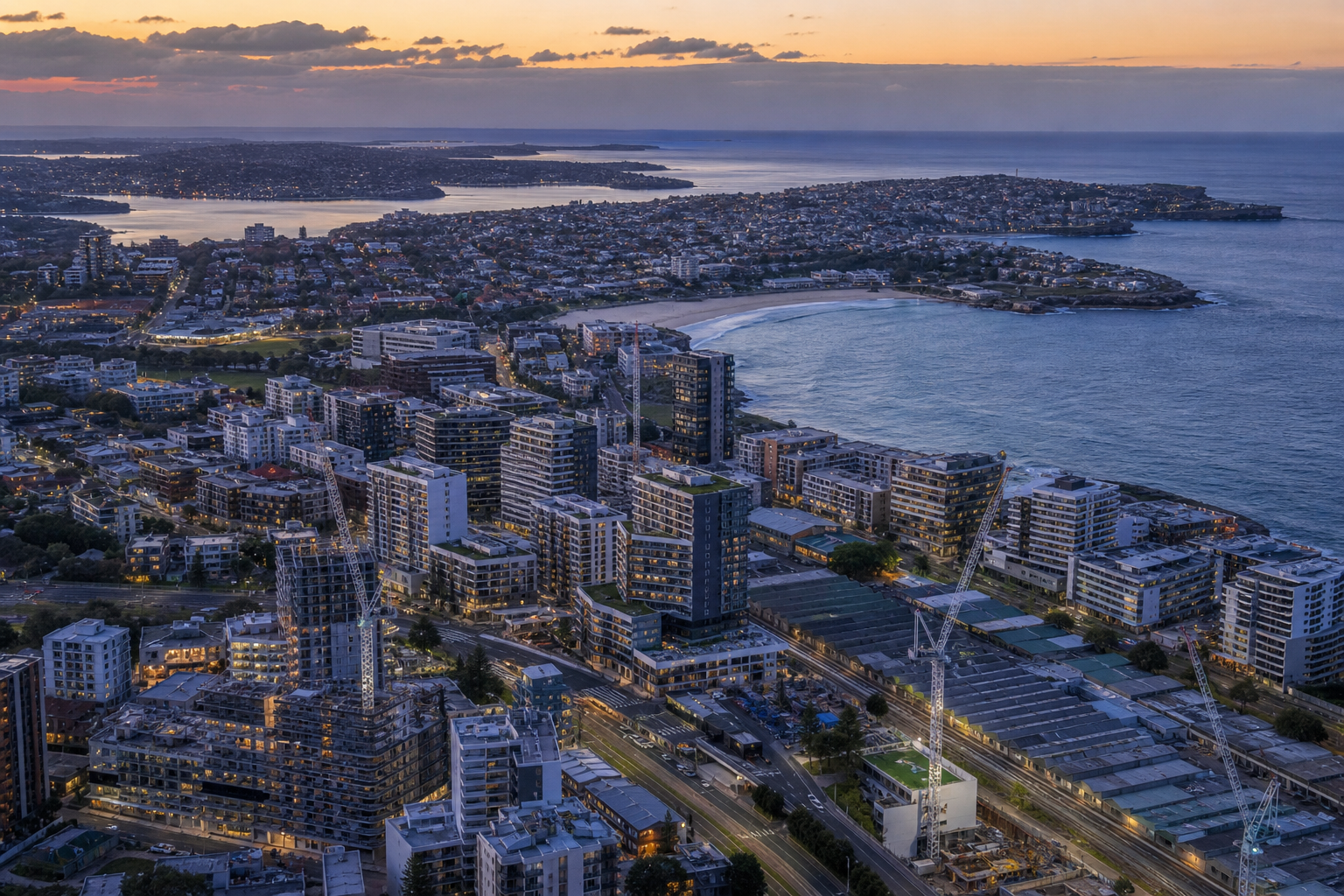
Inner-south property does not sit on the same rulebook as harbourside houses.
For Green Square and Mascot, many lenders quietly apply tighter rules: lower maximum LVRs on some buildings, tougher valuation assumptions, and extra checks on size, quality and investor concentration. Harbourside houses and Eastern Suburbs semis often get more generous treatment. Understanding those differences is the key to choosing the right property type and structure if you want to live, hold or eventually upgrade into the Eastern Suburbs.
Here’s the short version:
- High‑density inner‑south stock is more likely to sit on postcode risk lists than established harbourside homes, which can mean lower LVR caps, especially for investors.
- Valuers commonly haircut Green Square/Mascot prices harder in weak markets than they do for tightly held harbourside houses.
- Your property type choice this year can make a six‑figure difference to future borrowing power and upgrade options.
This guide walks through how lender rules differ by area and property type, what that means for deposits, valuations and equity, and what you can do this week to position safely.
1. Why lenders see Green Square and Mascot differently
1.1 High‑density vs blue‑chip scarcity
Green Square and Mascot are deliberately dense precincts.
Thousands of near‑new apartments sit within a few postcodes, often with similar layouts and finishes. Many buildings share:
- High investor percentages
- Small internal sizes
- Mixed‑use zoning (retail at ground, residential above)
- Ongoing defect or cladding remediation stories
By contrast, harbourside and broader Eastern Suburbs stock – think houses and semis in Rose Bay, Coogee, Bronte or Randwick – tends to be:
- Land‑rich and tightly held
- Lower‑density, with more differentiated housing
- Supported by long sales histories and deep buyer pools
Lenders price risk at postcode and building level. Dense inner‑south postcodes are more likely to trigger internal flags than established harbourside streets.
For background on how postcode lists work in the East, see /insights/eastern-suburbs-postcode-risk-lists-where-banks-get-cautious.
1.2 Postcode risk lists: inner south vs east
Most major lenders maintain internal postcode risk tiers. While the exact lists are confidential, patterns are clear:
- Inner‑south high‑density postcodes (parts of Green Square, Zetland, Mascot) are more often marked as medium or high risk.
- Harbourside and Eastern Suburbs houses may attract risk flags at the very high end (jumbo loans) but rarely because of density.
When a postcode is flagged, lenders may:
- Cap LVRs at 70–80% for investors
- Reduce maximum exposure per building or per borrower
- Require full valuations rather than ‘desktop’ or AVM estimates
This doesn’t mean you can’t buy there. It means you need to pick bank‑friendly stock and match it with the right lender.
1.3 Valuation behaviour: units vs houses
Valuers are meant to be independent, but they still respond to market conditions and comparable sales.
In a suburb of mainly freestanding homes and semis, like much of the Eastern Suburbs, each sale is relatively unique and tightly bid. In a tower with 300 similar units, valuers may:
- Rely on the weakest recent sale in the building or complex
- Apply larger discounts if they see lots of vendor discounts or rental incentives
- Be slower to recognise a rebound in prices
In high‑value Eastern Suburbs markets, a 5–10% valuation swing on a $2m–$3m property can change usable borrowing power by six figures (see /insights/local-broker-advantage-eastern-suburbs-valuations-auctions-negotiation). The same principle applies at lower price points:
- A 7% valuation haircut on a $900k Mascot unit is $63,000 of lost equity on paper.
That can be the difference between upgrading in two years or waiting five.
2. Key lender differences: Green Square & Mascot vs harbourside
2.1 At-a-glance comparison
Below is a simplified, illustrative comparison of how lenders may treat common scenarios. Policies vary by lender and change over time.
| Scenario | Green Square / Mascot high‑density unit | Harbourside / Eastern Suburbs house or semi |
|---|---|---|
| Typical LVR cap – owner‑occupied (strong profile) | Up to 90–95% with LMI, but some towers capped at 80% | Up to 95% with LMI in many cases |
| Typical LVR cap – investor (flagged postcode) | Often 70–80%; some lenders refuse >80% | 80–90% commonly available |
| Min. internal size scrutiny | Strong below 50–60 m² internal; some lenders decline | Usually only an issue for studios or tiny terraces |
| Building concentration limits | Common – max exposure per building | Rarely relevant for detached houses |
| Valuation conservatism in weak markets | Frequently higher | Usually lower, esp. for land‑rich homes |
| Appetite for interest‑only at high LVR | Limited; often P&I only above 80% | More flexible for strong borrowers |
| Off‑the‑plan settlement risk | High – valuation shortfalls common | Less common for established houses |
2.2 LVR caps and deposit requirements
For a bank‑favoured inner‑south building, an owner‑occupier might still access up to 90–95% LVR with lenders’ mortgage insurance (LMI) or government schemes.
But for flagged towers or very investor‑heavy complexes, you’ll often see:
- Owner‑occupier: capped at 80–85% LVR
- Investor: capped at 70–80% LVR
On a $850,000 Green Square unit:
- At 90% LVR you’d need about $85k plus costs.
- At 80% LVR you’d need about $170k plus costs.
That is a very different savings and timing story.
If you’re comparing to a house or semi in a non‑flagged Eastern Suburbs street, the numbers might flip – you could access 90–95% LVR on the house but only 80% on the unit.
For detailed deposit planning around new inner‑south stock, see /insights/green-square-apartment-how-much-deposit-2.
2.3 Servicing rules and rental assumptions
Serviceability is still driven by APRA’s minimum 3% buffer above the actual rate, plus household spending benchmarks like HEM.
Where the inner south often differs is in rental assumptions:
- Lenders may shade rental estimates more heavily if they see lots of vacancies or incentives in a particular building.
- Short‑stay or corporate rental use in the complex can make some lenders nervous.
Harbourside houses, by contrast, often sit in rental markets with deeper demand and lower vacancy, so valuers and lenders may be more comfortable with upper‑end rent estimates.
2.4 Off‑the‑plan and new builds
New Green Square and Mascot apartments come with extra layers of scrutiny:
- More conservative valuation at settlement
- Building quality and defect history (or lack of history) concerns
- Higher risk of bulk resales in any downturn
Many buyers use 5–10% deposits during the build, then rely on valuation and finance being there at settlement. A 5–10% valuation shortfall at settlement can be brutal if your lender also caps LVR at 80%.
The strategy continues below
You've seen the problem and the groundwork — now unlock the exact steps our CPA-certified brokers use, including 8 more sections. Enter your email for instant, free full access.
Free access. No spam — unsubscribe anytime. Your details stay confidential.
Frequently asked questions
Why do banks treat Green Square and Mascot differently to harbourside suburbs?▾
Can I still get a 90–95% loan on a Green Square or Mascot apartment?▾
Are Eastern Suburbs houses always safer from a finance perspective?▾
How do valuation differences affect my ability to upgrade?▾
I’m self‑employed. Should I buy in the inner south or Eastern Suburbs first?▾
Do the 2026 negative gearing changes make inner‑south units a bad investment?▾
Speak with a specialist advisor
Confidential consultation, bespoke advice for your situation.