Article
How Valuers Really Think: Suburb Benchmarks, Reno Risk and Price Gaps
Understand how bank valuers use local suburb benchmarks, treat renovations and deal with contract price gaps so you can buy, build or refinance without nasty valuation surprises.
Key Takeaway
Bank valuers primarily rely on recent comparable local sales, not agent price guides, to determine a property’s value, which means renovations can be marked down if they risk over‑capitalisation relative to suburb benchmarks. Around 5–15% of valuations can land below contract price in hot markets, forcing buyers to cover the gap in cash or renegotiate. Understanding how valuers select sales, adjust for quality and treat renovations gives borrowers clear levers: prepare targeted evidence, stage big upgrades and choose lender/valuer panels strategically.
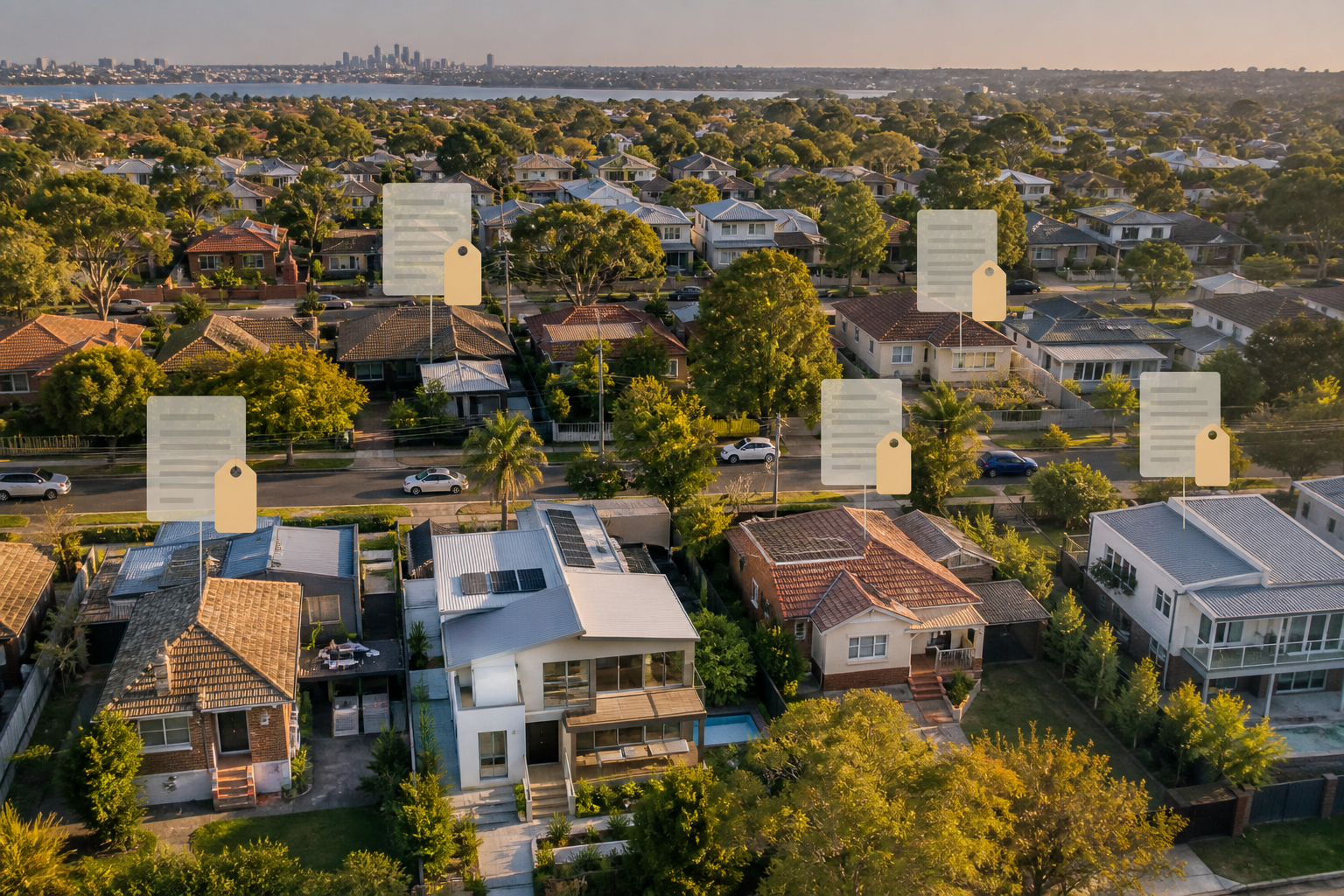
Property valuations feel mysterious until you see how local valuers actually think.
In practice, bank valuers anchor your property to recent local sales, adjust for quality and land, and then sanity‑check the result against suburb benchmarks. Renovations only add value up to what the area will realistically support. When your contract price sits well above those benchmarks, you run a real risk of a short valuation and a funding gap.
This guide breaks down how that thinking works, what you can influence, and what you can’t.
1. What local valuers are actually hired to do
Valuers are not there to support the contract price. They’re hired by the lender to answer a narrower question:
“If we had to sell this property in a reasonable time frame, what is the most probable price today?”
A few key points shape everything they do:
- Risk first, price second. The lender wants to know: if the borrower defaults, can we get our money back?
- Evidence‑based. For residential loans, they must show comparable settled sales (not just listings or price guides), usually within the last 3–6 months and close by.
- Standardised methods. They work under professional standards and lender instructions. Opinions are constrained by process.
- Time‑bound. They’re valuing today, not where the market might be in six months.
This is why the number the valuer produces can differ from:
- The agent’s quote range
- Your contract price
- Online estimates like CoreLogic or Domain
For a deeper look at how this lands with banks, see how brokers use valuation data in /insights/local-brokers-sales-evidence-valuer-panels-lmi-rules.
2. How valuers use suburb benchmarks
2.1 The “mental map” of a suburb
Local valuers build a mental map of each suburb:
- Typical price bands for house vs unit, by bedroom count
- Premium and discount streets or pockets
- How land size and outlook change value
- The usual value gap between renovated and unrenovated stock
They constantly update this from:
- Recent settled sales
- Auction results they’ve verified
- New developments completing nearby
When they inspect your property, they’re asking:
- Where in this suburb’s hierarchy does this home sit?
- Does the contract price fit the pattern, or is it an outlier?
If your price is an outlier, expect more conservative treatment.
2.2 Comparable sales: what “comparable” really means
Valuers favour:
- Same suburb first, then adjacent suburbs with similar demographics
- Same property type – house vs townhouse vs apartment
- Similar land size and layout
- Same quality band – tired original vs well‑renovated vs luxury
They then adjust each sale up or down for differences: land, condition, parking, views, noise, position on the street.
In tightly defined areas like Sydney’s Eastern Suburbs, the sales pool can be surprisingly narrow. That’s explored in detail in /insights/how-local-valuers-benchmark-eastern-suburbs-sales-loan-impact.
2.3 Suburb ceilings and floors
Every area has rough price ceilings:
- The highest recent sale for a standard‑size house
- The top end for apartments in “average” blocks
When your property’s price or your renovation budget pushes far above these levels, valuers start to discount.
Example – house in a $1.6m–$2.2m band suburb
- Typical unrenovated 3‑bed house: $1.6m–$1.8m
- Nicely renovated, larger blocks: $2.0m–$2.2m
- You buy at $2.4m and plan to spend $400k on upgrades.
A valuer might reasonably say:
“This is already at the top of the suburb. Even with renovations, there’s limited buyer depth above $2.3m–$2.4m. We won’t assume a post‑reno value of $2.8m.”
That’s suburb benchmarking at work.
3. Over‑capitalisation: when renovations stop adding value
3.1 What over‑capitalisation means to a valuer
Over‑capitalisation is when:
The total spend on land + dwelling + renovations is more than what typical buyers in that area are willing to pay.
Valuers worry about over‑capitalisation because it increases the lender’s risk. If there’s a forced sale, the market might not recognise your total spend.
They look for three danger signs:
- Renovation spend well above local norms
- Finishes and inclusions out of step with the area
- A house that now feels mis‑matched to its surroundings – e.g. a luxury home surrounded by basic stock on a busy road
3.2 How valuers treat renovation cost vs value
Valuers do not simply add your renovation cost to your property’s value.
They consider:
- What similar renovated homes in the area have sold for
- How much premium buyers pay for new kitchens/bathrooms vs basic
- How efficiently your renovation uses the site (e.g. a smart extension vs an awkward one)
Worked example – partial renovation
- Current value (tired but liveable house): ~$1.3m
- Planned renovation spend: $250k (kitchen, bathrooms, flooring, paint)
- Recent sales show renovated equivalents sell around $1.45m–$1.5m
A pragmatic valuer might end up around $1.45m–$1.5m post‑reno, even though you’ve put $250k in.
From their perspective, the market pays about $150k–$200k more for that quality jump in that suburb. The extra spend is your lifestyle choice, not a bankable asset.
3.3 Extreme over‑capitalisation: when value barely moves
The harshest cases are high‑spec, high‑cost builds in modest suburbs.
Example:
- Land value in area: ~$900k–$1.0m
- Typical family homes: $1.3m–$1.5m
- You spend $1.2m on a luxury knock‑down rebuild (total spend ~$2.1m–$2.2m)
- Top recent sale in the area: $1.7m for a near‑new project‑home build
A valuer will likely sit near $1.7m–$1.8m, not $2.2m.
To the lender, there is significant over‑capitalisation risk. You’ve created a lifestyle asset, but the margin above suburb benchmarks is fragile.
The strategy continues below
You've seen the problem and the groundwork — now unlock the exact steps our CPA-certified brokers use, including 7 more sections. Enter your email for instant, free full access.
Free access. No spam — unsubscribe anytime. Your details stay confidential.
Frequently asked questions
Why did my bank valuation come in lower than my purchase price?▾
How do valuers decide which local sales are comparable?▾
Do renovation costs always increase my property’s valuation?▾
Can using a different lender change my valuation outcome?▾
How can I reduce the risk of a valuation shortfall when buying at auction?▾
What’s a safe margin to avoid over‑capitalising on a renovation?▾
Speak with a specialist advisor
Confidential consultation, bespoke advice for your situation.