Loading the latest on mortgages, RBA & inflation…

Article

Working Out Your Real Deposit Need for an Off‑the‑Plan Apartment

A practical, numbers‑based guide to how much deposit you really need for an off‑the‑plan apartment in Australia, and how to protect yourself from valuation shocks and policy changes by settlement.

13 July 2026Updated 13 July 202614 min read

Key Takeaway

Most Australian buyers need a 5–10% deposit at exchange for an off‑the‑plan apartment, but the real requirement is driven by the final valuation, loan‑to‑value ratio (LVR) and lenders mortgage insurance (LMI) at settlement. Because lenders use the lower of contract price or final valuation, even a 10% valuation drop can lift your effective LVR above 90%, creating extra cash and LMI costs. Planning for at least 15–20% net equity plus a cash buffer is a practical way to reduce settlement risk.

Working Out Your Real Deposit Need for an Off‑the‑Plan Apartment

Buying off‑the‑plan in Australia usually means paying a 5–10% deposit at exchange, then nothing more until settlement – but that’s only part of the story. How much deposit you really need depends on the final valuation, your target loan‑to‑value ratio (LVR), and whether you’re prepared to pay lenders mortgage insurance (LMI) or risk a last‑minute cash scramble.

In practice, most off‑the‑plan buyers should plan for enough savings or equity to end up with around 15–20% net equity at settlement, plus a separate cash buffer for costs and surprises. The more your valuation or income could move over the build period, the higher that target should be.

This guide turns that into numbers you can work through this week.
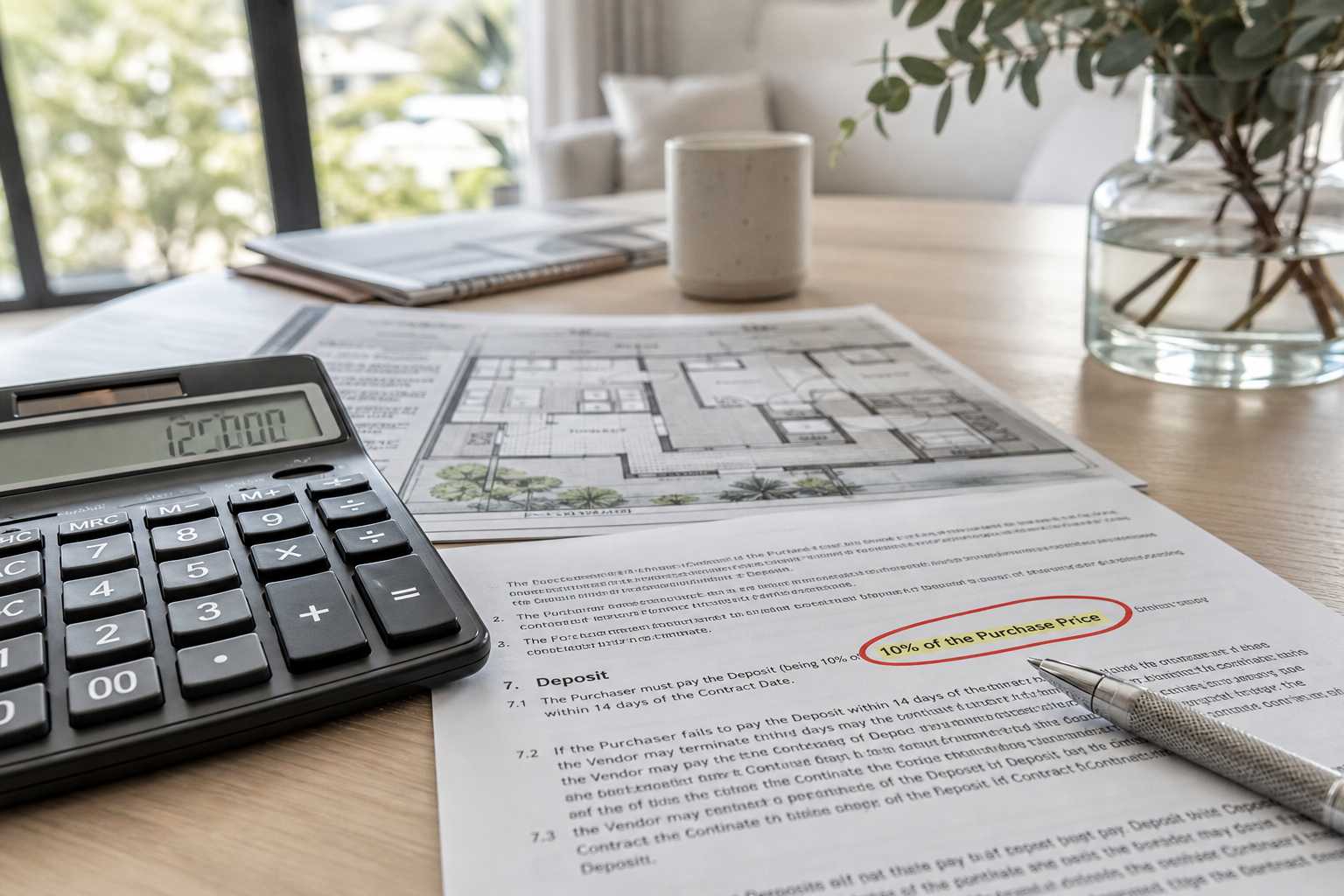
Off-the-plan contract and calculator showing 10% deposit Your contract deposit is only the first piece of the off‑the‑plan puzzle.


1. The two deposits you need to think about

When people ask, “How much deposit do I need for an off‑the‑plan apartment?”, they usually mean the money due now. Lenders and risk, however, care about the money available at settlement.

1.1 Exchange deposit vs settlement deposit

You effectively have two “deposit” concepts:

  • Exchange deposit (contract deposit)
    Paid to the developer’s trust account when you sign the contract. Commonly:

    • 5% for some projects or promotions
    • 10% as a standard expectation in many markets
  • Settlement deposit (equity position)
    What the bank sees as your contribution when the building is finished. This is driven by:

    • Final valuation at completion
    • Your loan size
    • Resulting LVR and whether LMI applies

Your exchange deposit counts towards your equity, but it may not be enough if prices fall or your borrowing power changes.

For a broader overview of other upfront costs beyond the deposit, see Planning Deposits and Upfront Costs for Off‑the‑Plan Apartments.

1.2 Why off‑the‑plan deposits are riskier

With an established property, deposit and settlement are close together. Your valuation, income and lending rules are largely “now issues”.

With off‑the‑plan, there’s a gap of 1–3 years (sometimes more). Over that period:

  1. Property values can move up or down.
  2. Your income, savings and debts can change.
  3. Lending rules, interest rates and tax policy can shift.

Lenders are very aware of this. They use conservative assumptions – including APRA’s typical 3% serviceability buffer over actual rates – and they never guarantee a loan until much closer to settlement (see Off-the-Plan Home Loan Basics and Eligibility in Australia).


2. Typical off‑the‑plan deposit ranges in Australia

Let’s pin down the typical numbers you’ll see in marketing material – then compare them with what’s actually safe.

2.1 What developers usually ask for at exchange

Common contract deposit patterns:

  • 10% of the contract price – still the norm in many projects.
  • 5% (or 5% now, 5% later) – used to attract first‑home buyers or create urgency.
  • Higher deposits (15–20%) – sometimes sought for smaller developers or higher‑risk projects.

The contract deposit is negotiable in some cases, especially if:

  • You’re buying multiple apartments.
  • You’re an early buyer in the project.
  • The market is softer and the developer wants pre‑sales.

However, negotiating the contract deposit down doesn’t change what the bank needs at settlement.

2.2 What banks are comfortable with at settlement

For the home loan, lenders think in terms of LVR bands and LMI:

  • ≤80% LVR – usually no LMI; bank funds up to 80% of value.
  • >80%–90% LVR – LMI applies; still widely available for many borrowers.
  • >90%–95% LVR – niche; often tighter credit rules, higher LMI, and many lenders avoid this for off‑the‑plan entirely.

Indicatively:

  • Owner‑occupier P&I loans up to 90% LVR are common if your situation is strong.
  • Investors, interest‑only and self‑employed buyers may be capped at 80–90% LVR, sometimes less for specific developments.

Because off‑the‑plan carries extra risk, some lenders quietly restrict high‑LVR lending or apply tougher shading to your income.


3. Turning LVR bands into real cash numbers

Now we convert those percentages into dollars so you can see what you’re really committing to.

3.1 Worked example: $800,000 off‑the‑plan apartment

Assume:

  • Contract price now: $800,000
  • Expected completion: 2 years
  • Buyer: Owner‑occupier, solid income, standard full‑doc loan

Scenario A – aiming for 80% LVR (no LMI)

  • Bank lends: 80% x $800,000 = $640,000
  • Your equity at settlement: $160,000
  • Plus upfront costs (stamp duty, legal, loan fees, inspections): say 4%$32,000

You need around:

  • $192,000 total cash/equity by settlement ($160k equity + $32k costs)

If the developer wants a 10% contract deposit:

  • You pay $80,000 at exchange.
  • You must find another $112,000 by settlement.

Scenario B – comfortable with 90% LVR (with LMI)

  • Bank lends: 90% x $800,000 = $720,000
  • Your equity at settlement: $80,000
  • Same 4% costs ≈ $32,000

You need around:

  • $112,000 total cash/equity by settlement.

If you’ve already paid a 10% contract deposit ($80k), you only need $32,000 more in savings for costs – but you’ll likely pay LMI, which on a 90% LVR $720k loan could easily be $10,000–$20,000+ (paid upfront or capitalised into the loan).

3.2 How much buffer is sensible?

In reality, you rarely get a clean run. Over a 2–3 year build, it’s wise to add a buffer on top of these numbers:

  • At least 3–5% of the purchase price as a rainy day fund, separate from your deposit.
    On an $800k apartment, that’s $24,000–$40,000.

That buffer can cover:

  • Valuation shortfalls.
  • Higher‑than‑expected LMI.
  • Setup costs your estimate missed.
  • Small changes to your borrowing capacity.

For more on how settlement valuations affect your LVR and LMI, read Off-the-Plan Valuations, LVR and LMI: Getting Settlement-Ready.


4. The real trap: valuation drops and the ‘effective’ deposit you need

The biggest wildcard in your real deposit requirement isn’t the percentage on the brochure – it’s the valuation at completion.

4.1 How lenders calculate your final LVR

At settlement, the bank will usually lend against the lower of:

  • Your contract price; or
  • The bank’s valuation.

If the valuation comes in lower than the contract price, your effective LVR jumps unless you can tip in more cash.

4.2 Worked example: 10% price drop before completion

Let’s stick with the $800,000 contract.

Assume:

  • Contract price: $800,000
  • Final bank valuation: $720,000 (10% lower)
  • You’ve paid a 10% deposit ($80,000) at exchange.

Two key points:

  1. You still owe the developer the full $800,000 at settlement.
  2. The bank will lend a percentage of the lower of $800k and $720k. That’s $720,000.

a) Trying to borrow 90% LVR off the valuation

Max at 90% of $720k = $648,000.

Total funds available at settlement:

  • Loan: $648,000
  • Your deposit already paid: $80,000
  • Total: $728,000

But you owe $800,000 – you’re $72,000 short. You must provide $72,000 in additional cash to settle.

Your effective equity ends up being:

  • $80,000 (initial deposit) + $72,000 (top‑up) = $152,000

On the valuation of $720,000, that’s 21.1% equity. In other words, a 10% market drop has forced you into a 21% effective deposit, even though you only planned for 10%.

This is why many off‑the‑plan buyers get nasty surprises near completion.

4.3 What this means for your target deposit

Because you can’t control future valuations, a practical rule of thumb is:

  • If you plan to borrow up to 90% LVR, aim to have enough cash/equity to survive a 10–15% valuation drop and still settle.

In the $800k example, that usually means:

  • Targeting 15–20% net equity by settlement, not just the 10% deposit at exchange.

5. Different buyers, different realistic deposit targets

How much deposit you can get away with and how much you should target are two different things. The right answer depends on who you are and how stable your situation is.

5.1 Owner‑occupiers

Typical pattern:

  • Many will start around 10% deposit at exchange and plan for a 10–15% effective deposit by settlement.

Safer approach:

  • Plan for 15–20% effective deposit by completion, especially if:
    • Your job, income or relationship status could change.
    • You’re planning to start a family.
    • You’re close to your maximum borrowing power.

5.2 Investors

Investors typically have higher risk tolerance but now also face a shifting tax landscape – including changes to negative gearing and capital gains tax rules from 1 July 2027 that may affect overall after‑tax returns.

In practice:

  • Many banks prefer ≤80% LVR for off‑the‑plan investors, especially in high‑density postcodes.
  • A 20%+ deposit (plus costs) is a reasonable working assumption if you want broader lender choice and resilience.

5.3 Self‑employed buyers

Self‑employed income can be volatile, and lenders already shade business income heavily.

Safer settings:

  • Aim for 20% deposit plus costs if possible.
  • Keep extra liquidity – business cashflow can’t always be turned into personal borrowing power when you need it.

If you’re self‑employed or your income is complex, also see Off-the-Plan Home Loan Basics and Eligibility in Australia, which explains how banks treat non‑salary income.

5.4 First‑home buyers using schemes

With schemes like the First Home Guarantee (FHBG), eligible buyers can:

  • Put down as little as 5% deposit with no LMI, because the government guarantees part of the loan.

However, for off‑the‑plan there are extra rules – time limits, price caps, owner‑occupier requirements, and the risk that valuation changes still bite you at settlement.

If this is you, read Using the First Home Guarantee to Buy Off-the-Plan: A Practical Guide before you commit.


6. Comparing different deposit strategies

Here’s how three common strategies compare on an $800,000 purchase, ignoring potential valuation drops for the moment.

StrategyTarget LVRLoan AmountEquity at SettlementLikely LMI?ProsCons
Minimum viable (5–10% deposit)~90–95%$720k–$760k$40k–$80kHigh; can be very costlyGets you in with less cashHigher repayments, big LMI, vulnerable to valuation drop
Balanced (15% effective deposit)85%$680,000$120,000Yes, but lower than 90%Better resilience, smaller LMI, more lender optionsStill exposed if market drops sharply
Conservative (20%+ deposit)≤80%$640,000$160,000Usually no LMIStrongest position, lower repayments, more choiceNeeds more cash/equity up front

In reality, your choice will depend on:

  • Saving capacity and timeline.
  • Willingness to pay LMI to get in sooner.
  • How much risk you’re prepared to carry over the build.

Comparison of LVR levels and deposit sizes for off-the-plan apartments Your target LVR band drives how much deposit and risk you’re really taking.


7. Using equity in another property as your deposit

Many off‑the‑plan buyers don’t fund their deposit entirely from cash savings. Instead, they use equity in an existing home or investment property.

7.1 How equity deposits usually work

Broadly, you:

  1. Refinance or top up your existing home loan to release equity (often up to 80% LVR).
  2. Use that borrowed equity as the contract deposit and/or settlement contribution.

Example:

  • Current home value: $1,200,000
  • Existing home loan: $600,000 (50% LVR)
  • Lender allows up to 80% LVR on this property: 0.80 x $1.2m = $960,000
  • Extra borrowable equity: $960,000 – $600,000 = $360,000

You could borrow, say, $200,000 against your home to fund:

  • A 10% deposit on an $800,000 off‑the‑plan ($80,000), plus
  • Most of your stamp duty and costs.

This can be powerful, but it also means two loans are ultimately supported by your income.

We cover the mechanics and traps in more detail in the separate guide, Using Equity in Your Current Home to Fund an Off‑the‑Plan Deposit.

7.2 Risks when using equity as deposit

Key risks to factor into your deposit target:

  • If your existing property falls in value, your overall gearing jumps.
  • Rising interest rates can strain cashflow across both loans.
  • You might hit lender policy limits on total exposure to a single borrower or postcode.

For many multi‑property buyers, targeting 20% total equity in the new apartment (even if sourced via equity elsewhere) is a prudent baseline.


8. Alternative deposit tools: bonds and guarantees

If you’re asset‑rich but cash‑tight, you might be tempted by deposit bonds or bank guarantees instead of cash at exchange.

8.1 What they do (and don’t do)

These tools:

  • Allow you to secure the contract now without paying cash deposit.
  • Require you to pay the full purchase price in cash or via loan at settlement.

They do not change:

  • The amount of equity the bank wants at settlement.
  • The risk that valuations or lending rules change.

So while they can solve a timing issue, they don’t reduce your real deposit requirement.

The companion article Deposit Bonds and Bank Guarantees: When They Work and When They Backfire covers the mechanics, costs and common failure points.


9. Time, pre‑approvals and keeping your deposit “finance‑ready”

The size of your deposit matters, but so does when you test it with a lender.

9.1 Why early pre‑approval isn’t enough

Pre‑approval when you sign the contract can be helpful, but:

  • It usually only lasts 3–6 months.
  • It’s always subject to valuation and policy at the time of full approval.

For a two‑year build, that means you might go through multiple pre‑approvals, and none of them guarantees the final answer.

Timing pre-approval and smart loan structures for off-the-plan explains how to map out an approval timeline that matches your build schedule.

9.2 Keeping your deposit and borrowing power intact

To protect your position between exchange and settlement:

  • Avoid taking on new personal debts (cars, credit cards, BNPL).
  • Keep your savings habit going – treat the build period as a runway to grow your effective deposit.
  • Think carefully before changing jobs, reducing hours or going self‑employed.
  • Maintain clean credit conduct – no late payments.

A deposit that was adequate at exchange can look thin two years later if your income dips or lending standards tighten.


10. A one‑week action plan to nail your off‑the‑plan deposit

Once you’ve got a handle on the concepts, you can turn this into a concrete plan relatively quickly.

10.1 Day 1–2: Set your price and LVR targets

  1. Pick a realistic target price range for apartments you’re considering.

  2. Decide your comfort level:

    • Minimum cash: ok with 90–95% LVR and LMI?
    • Balanced: target 85–90% LVR.
    • Conservative: aim for ≤80% LVR.
  3. Use simple maths to estimate:

    • Required equity at settlement.
    • Stamp duty and other costs (~3–6%).

10.2 Day 3–4: Audit your real deposit position

  1. Add up:

    • Current savings.
    • Accessible equity in other properties (up to ~80% LVR).
    • Expected extra savings before completion.
  2. Stress‑test using a 10% valuation drop similar to the example above.

  3. See how your LVR and extra cash requirement would look under that scenario.

10.3 Day 5–7: Sanity‑check with a broker or adviser

In a 15–30 minute strategy call, a good broker can:

  • Run lender‑style borrowing power and LVR scenarios.
  • Flag any policy issues with your chosen development or postcode.
  • Recommend whether your plan works at 80%, 85% or 90% LVR, or if you need more deposit or a different structure.

Combine this with the eligibility checks in Off-the-Plan Home Loan Eligibility: A Practical Checklist and you’ll be in a much better position to sign a contract with your eyes open.

Australian buyers discussing off-the-plan deposit strategy with broker A short strategy call can turn rough deposit guesses into a clear plan.


FAQs

How much deposit do I need to buy an off‑the‑plan apartment?

Most buyers will pay 5–10% of the contract price as a deposit at exchange, depending on the developer. But the real requirement is what the bank wants at settlement, typically enough to keep your LVR at 80–90% once the final valuation is known. In practice, planning for around 15–20% net equity plus costs and a buffer is much safer.

Can I buy off‑the‑plan with only a 5% deposit?

Sometimes, especially if you qualify for schemes like the First Home Guarantee or developers are offering 5% deposits. However, you still face the same settlement risks if values fall or your borrowing capacity shrinks by completion. With only 5% at exchange, you are highly exposed to valuation movements, so you should have a clear plan to build more savings before settlement.

Do I have to pay LMI for an off‑the‑plan apartment?

You’ll generally pay LMI if your LVR is above 80% at settlement, regardless of whether it’s off‑the‑plan or established. Some government schemes can remove LMI at higher LVRs for eligible first‑home buyers, but lenders may still be more conservative with off‑the‑plan stock. Treat LMI as part of your deposit planning – it’s effectively a cost of having a smaller deposit.

What happens if the bank’s valuation is lower than my contract price?

If the final valuation is lower, the bank will use that lower figure to calculate your maximum loan. You still owe the developer the full contract price, so any shortfall between the loan and purchase price must be paid from your cash. This can quickly turn a 10% deposit into an effective 20%+ deposit, which is why planning for potential valuation drops is essential.

Can I use equity in my current home instead of cash for the deposit?

Yes. Many buyers borrow against their existing property to fund part or all of the off‑the‑plan deposit. This can work well if you have strong equity and stable income, but it increases your total debt and risk if values fall or interest rates rise. You still need to meet lender serviceability rules on both loans and keep your overall gearing at a level you’re comfortable with.

Are deposit bonds a safe way to buy off‑the‑plan with a small deposit?

Deposit bonds can be useful where you’re asset‑rich but don’t want to tie up cash until settlement. They don’t reduce your real deposit requirement, though – the full purchase price must still be funded at completion, and valuation or lending changes can still trip you up. Whether a bond is “safe” depends on your overall equity and borrowing power, not just the bond itself.


Key takeaways

  • The 5–10% you pay at exchange is just the starting point; your true deposit is what’s needed at settlement after final valuation and lender rules.
  • Aiming for 15–20% net equity plus 3–5% in costs and buffer is a practical target for many off‑the‑plan buyers.
  • Even a 10% valuation drop can force you from a planned 10% deposit to an effective 20%+ deposit if you want to settle without distress.
  • Investors, self‑employed borrowers and high‑LVR buyers need to be especially conservative with deposit planning.
  • Using equity, deposit bonds or guarantees can help with timing but don’t change the underlying LVR, valuation and borrowing power maths.

If you’d like help pressure‑testing your numbers, you can book a free 15‑minute strategy call at https://www.localknowledge.finance. In one conversation you can see your borrowing power, LVR options and tax angles in one place – your tax, your loan, one expert view.

General advice only.

Frequently asked questions

How much deposit do I need to buy an off‑the‑plan apartment?
Most buyers will pay 5–10% of the contract price as a deposit at exchange, depending on the developer. The real question is your equity at settlement, which needs to keep your LVR usually between 80% and 90% once the final valuation is known. In practice, targeting around 15–20% net equity plus costs and a cash buffer is safer for most borrowers.
Can I buy off‑the‑plan with only a 5% deposit?
In some cases you can, particularly if you qualify for a government guarantee scheme or the developer specifically allows 5% deposits. However, you remain exposed to valuation drops and changes in borrowing power over the build period. To reduce settlement risk, it’s wise to plan how you’ll grow your savings so your effective deposit is closer to 10–15% by completion.
Do I have to pay LMI for an off‑the‑plan apartment?
You generally pay lenders mortgage insurance (LMI) if your LVR is above 80% at settlement, regardless of whether the property is off‑the‑plan or established. Some government schemes can remove LMI for eligible first‑home buyers, but lenders may still be more conservative with high‑density or off‑the‑plan stock. You should treat any LMI premium as part of your overall deposit and cost planning.
What happens if the bank’s valuation is lower than my off‑the‑plan contract price?
If the final valuation is lower than your contract price, the lender will calculate your maximum loan against that lower value. You still have to pay the full contract price, so any gap between the loan and purchase price must come from your own funds. This can significantly increase the effective deposit you need at settlement and may force you to find extra cash or consider selling the contract if allowed.
Can I use equity in my current property as the deposit for an off‑the‑plan apartment?
Yes. Many buyers refinance or top up their existing home or investment loan to release equity, then use that borrowed equity as the deposit and costs for the off‑the‑plan purchase. This can be effective if you have strong equity and stable income, but it raises your total debt level and makes you more sensitive to interest rate and valuation changes across multiple properties.
Are deposit bonds a safe replacement for a cash deposit on off‑the‑plan?
Deposit bonds can replace the cash deposit payable at exchange, which may help if your funds are tied up or you’re waiting on another transaction. They don’t change the amount of equity and borrowing power you need by settlement, though. If your financial position or the valuation deteriorates, you can still struggle to complete the purchase even though a bond was used instead of cash.

Speak with a specialist advisor

Confidential consultation, bespoke advice for your situation.