Article
How Land Tax And Short-Stay Rules Change Your Finance Game
Land tax, investor rules and short‑stay regulations now vary sharply by state – and lenders care. This guide shows how they hit borrowing power, cashflow and strategy so you can adjust your finance plan this week.
Key Takeaway
Land tax and short-stay regulations affect Australian property finance by changing cashflow, risk and how banks assess borrowing, with most lenders stress-testing at least a 3% interest rate buffer. Different state thresholds, foreign and trust surcharges, and council-level Airbnb caps can turn a property from neutral to negatively geared. Investors should model land tax by structure and state, then run best- and worst-case rental scenarios before choosing loan size, buffers and ownership structure.

Land tax and short‑stay rules can change a property from cashflow neutral to a yearly drain – and banks are increasingly factoring this in.
If you invest across states, you need to understand three things this week: 1) each state’s land tax thresholds and rates for investors, 2) how trusts and companies are treated, and 3) how local short‑stay rules (Airbnb, stays under 90 days) can affect both rent and lending.
1. Land tax basics – and why lenders care
Land tax is an annual state tax on the unimproved value of land above a threshold.
Your home is usually exempt, but investment and commercial property are not.
Key points that matter for finance:
- Thresholds and rates differ by state – roughly:
- NSW, VIC, QLD: tiered thresholds, with higher land values hit harder.
- SA, TAS, WA: lower thresholds or broader bases; investors feel it earlier.
- Trusts and companies often pay more – some states remove or lower the threshold for discretionary trusts.
- Aggregation rules – you’re taxed on the total taxable land value in that state, not per property.
Lenders now treat land tax as a real ongoing expense.
They’ll usually:
- Add estimated land tax into your living expenses or property outgoings.
- Still apply at least a 3% interest rate buffer on your loans (APRA guidance).
That means a surprise $6,000 land tax bill can cut your borrowing power and turn a previously acceptable deal into something too tight under the bank’s calculator.
2. State differences that change the numbers
You don’t need to memorise every rate, but you do need a feel for how states behave.
Typical patterns across states
-
NSW / VIC
Higher land values mean many investors hit land tax quickly, especially on houses close to capital city CBDs. -
QLD
Historically more generous but tightening; still, coastal holiday areas can tip you over thresholds once you add a second or third property. -
SA, TAS
Lower entry prices but also lower thresholds – a modest portfolio can attract meaningful land tax. -
WA
More focused on larger holdings, but commercial or multiple residential lots can add up fast.
These differences matter when you compare two similar‑priced investments.
Example (illustrative only):
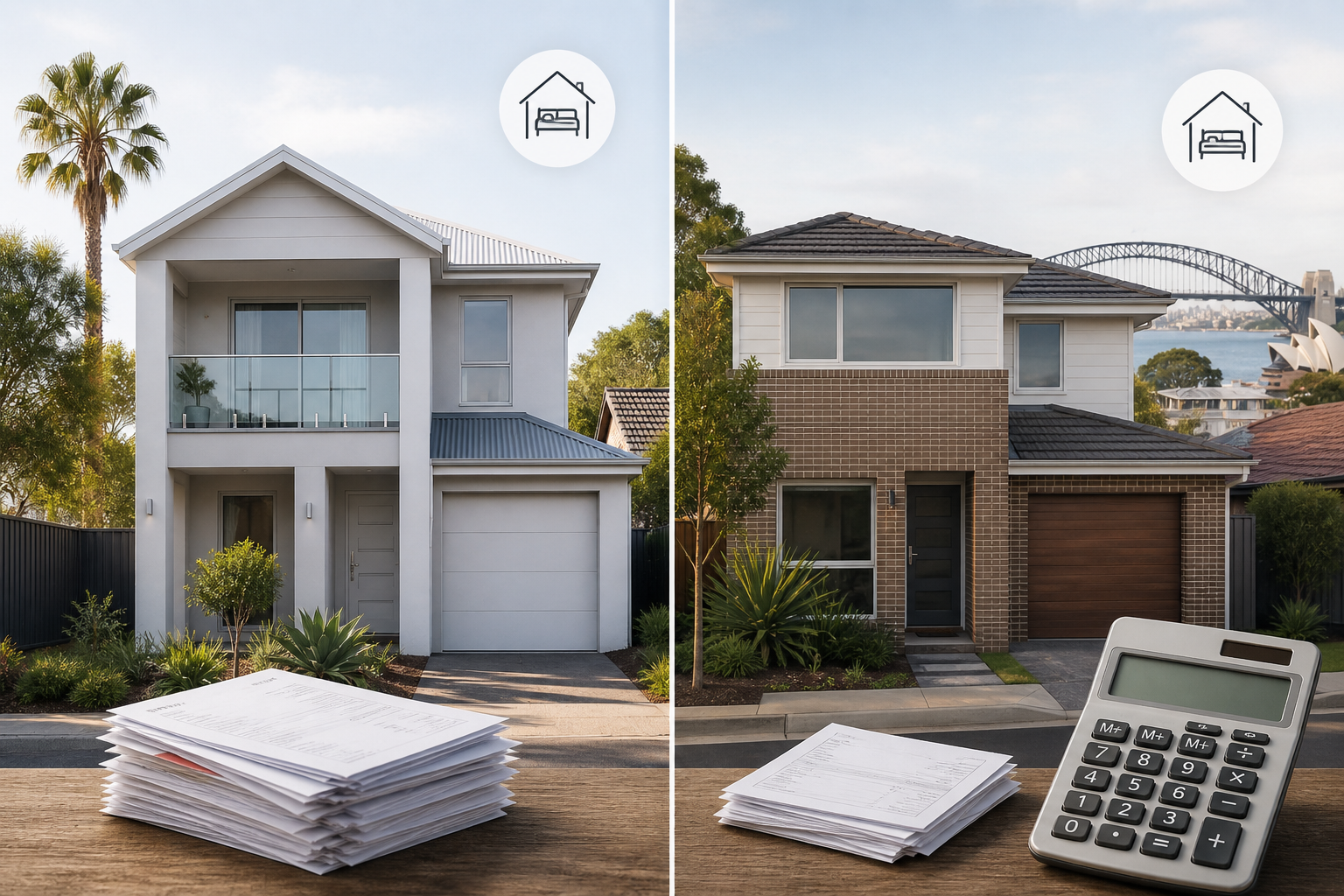
- Property A: $800k townhouse in VIC, land value $450k, portfolio pushes you $200k over the threshold.
- Extra land tax: say ~$3,000 p.a.
- Property B: $800k villa in QLD, land value $320k, still under threshold.
- Land tax: $0 for now.
On a 5.8% interest‑only $640k loan (80% LVR), repayments are roughly $3,093/month.
That extra $3,000 in VIC is ~$250/month after tax – easily the difference between slightly positive and clearly negative on a post‑2027, pre‑tax basis.
The strategy continues below
You've seen the problem and the groundwork — now unlock the exact steps our CPA-certified brokers use, including 3 more sections. Enter your email for instant, free full access.
Free access. No spam — unsubscribe anytime. Your details stay confidential.
Frequently asked questions
Does land tax reduce my borrowing power?▾
Should I buy in a trust mainly to manage land tax?▾
How risky is it to rely on Airbnb income for a loan?▾
Speak with a specialist advisor
Confidential consultation, bespoke advice for your situation.