Article
How Mascot Business Owners Can Build Real Mortgage Buffers
A practical, decision-grade guide for Mascot business owners to size, build and protect realistic cash buffers before taking on a home loan, without starving the business.
Key Takeaway
Mascot business owners should build realistic cash buffers before taking on a mortgage, usually targeting 6–12 months of essential living costs plus loan repayments to reduce mortgage stress risk, which affects over 28% of Australian borrowers. This guide explains how to size separate business and household buffers, choose the right accounts or offsets, and run simple stress tests. It ends with a concrete one-week action plan so owners can protect both their home and business before signing a loan.
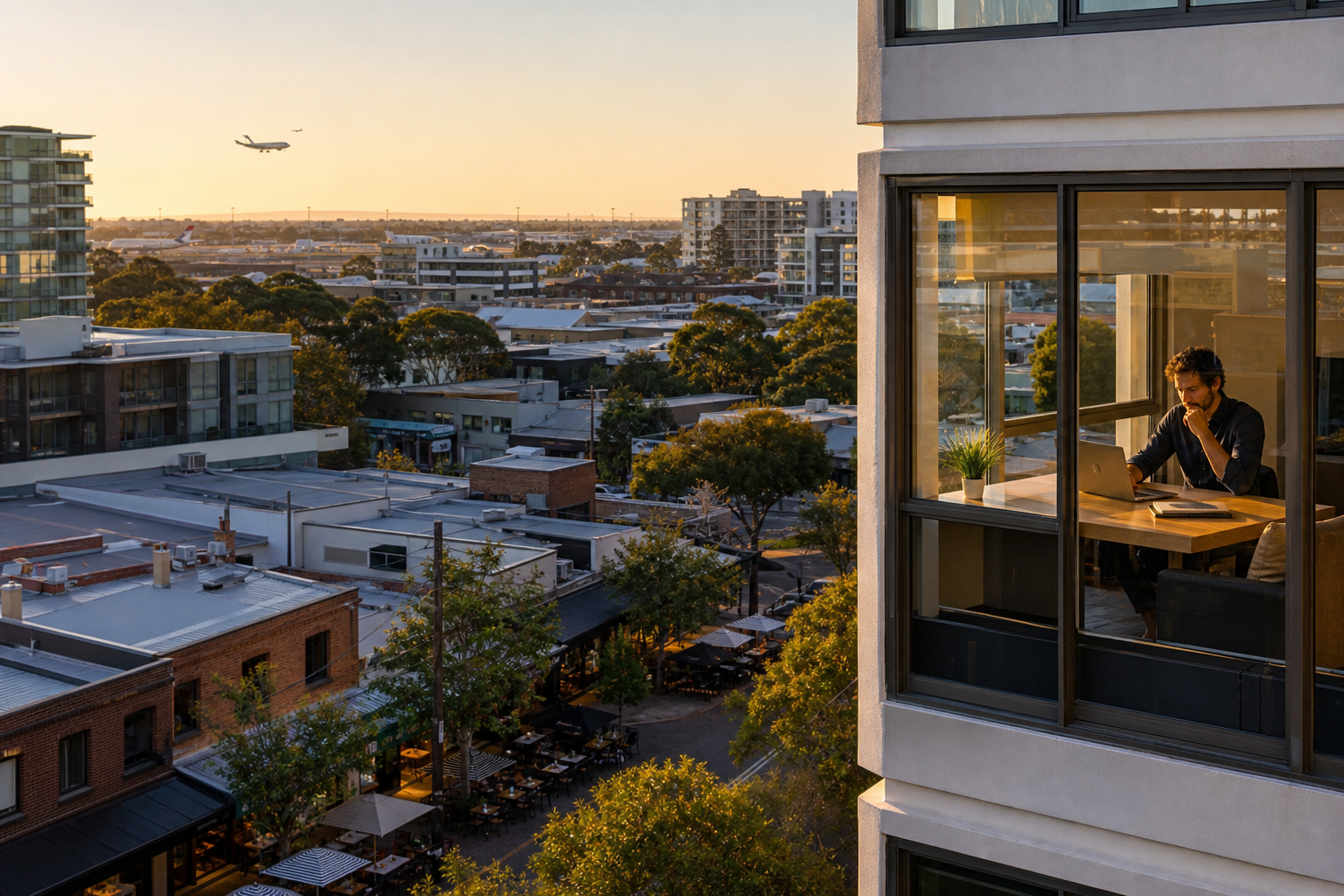
Mascot business owners should build separate cash buffers for their household and their business before taking on a mortgage, typically aiming for 6–12 months of essential living costs and loan repayments for the home, plus 1–3 months of core business overheads. Done properly, those buffers sit in cash or genuine offset accounts, not in stock, fit‑outs or unpaid invoices, so you can keep paying the mortgage even if trading in Mascot slows or rates rise.
This guide is written for Mascot café owners, tradies, freight operators, creatives and other small businesses who want a decision‑grade plan they can act on this week.

1. Why buffers matter more for Mascot business owners
1.1 Double exposure: your home and your business
When you run a business and take on a mortgage, you carry double exposure:
- If turnover drops, the business is at risk.
- At the same time, your home loan repayment depends on that business income.
Roy Morgan research shows around 28% of Australian mortgage holders are ‘at risk’ of mortgage stress when rates rise. For self‑employed Mascot owners, risk is higher because income is volatile and business costs are sticky.
Buffers are your first line of defence. They give you:
- Time to adjust the business instead of making panic decisions.
- Space to talk to your lender or broker before you miss repayments.
- Options to avoid being a forced seller of your home.
The key is separate buffers for business and home, a theme reinforced across our Alexandria and Mascot guides.
1.2 Why Mascot specifically is riskier than it looks
Mascot has unique dynamics:
- Exposure to airport flows, hospitality and logistics.
- High proportion of apartments and investors.
- Sensitivity to RBA cash‑rate moves, because many households are relatively highly leveraged.
The RBA has held the cash rate at 4.35% after a rapid tightening from COVID‑era lows, and has signalled it is prepared to lift again if inflation stays high. That uncertainty makes large buffers, not optimistic assumptions, the safer path.
If your business depends on travellers or local discretionary spending, a few quiet months plus higher rates can bite fast.
2. How big should your buffers be before a mortgage?
2.1 Simple target ranges for Mascot business owners
You don’t need a perfect spreadsheet. You need practical ranges.
Drawing on our work with Alexandria and Mascot clients and earlier guidance (/insights/smart-buffers-cashflow-rules-lumpy-income-alexandria-mortgage and /insights/insurance-risk-conversations-mascot-business-owners-mortgages), a realistic pre‑mortgage target is:
- Household buffer:
- Minimum: 3–6 months of essential living costs + projected home loan repayments.
- Safer range for self‑employed: 6–12 months.
- Business buffer:
- Minimum: 1–2 months of core overheads (rent, minimal wages, utilities, insurance).
- Safer range in volatile industries: 2–3 months.
These are cash or offset reserves, not undrawn credit cards or optimistic debtor lists.
2.2 Worked example: Mascot café buying a unit
Say you run a Mascot café and want to buy a $900,000 apartment with a $720,000 loan (80% LVR). Assume:
- Rate (illustrative only): 6% p.a., P&I, 30 years.
- Monthly repayment ≈ $4,320.
- Essential household costs (food, utilities, basic transport, modest childcare): $3,700/month.
Household buffer target (mid‑range):
- Essential costs + mortgage = $4,320 + $3,700 = $8,020/month.
- Six‑month buffer ≈ $48,000.
- Twelve‑month buffer ≈ $96,000.
Business buffer target:
- Core business overheads (rent, base wages, insurance, utilities): $25,000/month.
- Two‑month buffer ≈ $50,000.
So before you commit to the mortgage, a robust target is roughly:
- $50,000 household buffer (minimum six months).
- $50,000 business buffer (two months).
- Total cash/offset reserves: $100,000.
That sounds like a big number, but it’s what keeps you from having to sell the café or the unit if foot traffic drops or rates go to 7–8%.
2.3 Comparing buffer strategies
Here’s how different buffer strategies stack up for a Mascot SME owner.
| Strategy | Household Buffer | Business Buffer | Pros | Cons |
|---|---|---|---|---|
| Minimal, PAYG‑style | 1–2 months expenses + repayments | < 1 month overheads | Faster into market, smaller savings target | High risk if income drops; limited time to adjust |
| Standard self‑employed | 3–6 months expenses + repayments | 1–2 months overheads | Balanced; realistic for many Mascot SMEs | Still tight if income drops 40–50% for a year |
| Conservative “double exposure” (recommended) | 6–12 months expenses + repayments | 2–3 months overheads | Strong resilience to rate rises and slow periods | Takes longer to save; needs discipline |
| Over‑leveraged, no buffers | < 1 month cash, reliant on credit | None | Fastest into market, max borrowing power | Very high risk of mortgage stress and forced selling |
3. What actually counts as a buffer (and what doesn’t)
3.1 True buffers vs pretend buffers
True buffers are:
- Cash in high‑interest savings or business accounts.
- Money in an offset account linked to your home loan.
- Term deposits that can be broken with minimal penalty.
Not real buffers (for this purpose):
- Stock sitting on shelves.
- Unpaid invoices you “expect soon”.
- Credit cards and overdrafts.
- Home loan redraw that you’re constantly dipping into for BAS and wages (see /insights/using-mascot-home-equity-support-small-business-safely).
If you couldn’t confidently pay six months of repayments and essentials even if revenue dropped 50%, you don’t yet have a real buffer.
3.2 Where to park your buffers
For Mascot business owners looking to buy or refinance:
- Household buffer:
- Before settlement: high‑interest savings in your personal name.
- After settlement: usually in your offset account, treated as your family’s safety net, not a business account.
- Business buffer:
- In a separate business savings or transaction account, not mixed with household spending.
From previous work with Alexandria households, self‑employed borrowers should treat offsets as household, not business, working capital (/insights/using-offsets-redraws-small-business-owners).
3.3 Why redraw and offset aren’t business overdrafts
Using redraw or offset routinely for BAS, wages or stock:
- Effectively converts your home loan into a business overdraft.
- Concentrates business risk on the family home.
- Complicates tax deductibility and ATO audit trails.
For Mascot SMEs, we’ve seen this trap often enough to call it out repeatedly (see /insights/using-mascot-home-equity-support-small-business-safely). If you need working capital, set up proper business facilities with clear terms.
The strategy continues below
You've seen the problem and the groundwork — now unlock the exact steps our CPA-certified brokers use, including 5 more sections. Enter your email for instant, free full access.
Free access. No spam — unsubscribe anytime. Your details stay confidential.
Frequently asked questions
How much buffer should a Mascot business owner have before a mortgage?▾
Does money in my offset account count as a real buffer?▾
Can I use my business cash as the buffer for my home loan?▾
Is using home loan redraw for BAS or wages a good idea?▾
How long should I wait to buy a home if my business income is volatile?▾
Will having larger buffers reduce how much I can borrow?▾
Speak with a specialist advisor
Confidential consultation, bespoke advice for your situation.