Article
Your Off-the-Plan Valuation Changed: How To Respond Smartly
If your off‑the‑plan valuation changes before settlement, your loan size, LVR and cash contribution can all shift overnight. This guide shows you how to map the numbers, talk to lenders and choose between topping up cash, restructuring, renegotiating or exiting.
Key Takeaway
When an off-the-plan valuation changes before settlement, buyers must immediately recalculate their loan-to-value ratio (LVR), likely loan size and cash gap, because lenders generally base lending on the lower of the valuation or contract price and apply at least a 3% serviceability buffer (APRA). A lower valuation can push LVR above 80% and trigger LMI or extra cash, while a higher valuation can reduce risk but doesn’t increase your approved loan automatically. The key action is to map your numbers, verify borrowing capacity and then choose the most viable funding, renegotiation or exit path.

Your Off-the-Plan Valuation Changed: How To Respond Smartly
When an off‑the‑plan valuation changes before settlement, it means the lender’s view of what the finished property is worth no longer matches your contract price. Because banks usually lend against the lower of the valuation or purchase price, any change can shift your loan size, loan‑to‑value ratio (LVR), need for Lenders Mortgage Insurance (LMI) and the cash you must contribute. Your job is to map those changes quickly and choose the safest path forward.
In this guide, we’ll step through what a changed valuation actually means, how to re‑run your numbers, the options if it’s come in low or high, and a clear one‑week action plan. The focus is on practical decisions an Australian buyer, investor or self‑employed client can act on now, not in theory.

1. What it really means when your valuation changes
1.1 Quick recap: how off‑the‑plan valuations work
For off‑the‑plan purchases, lenders normally order a valuation close to settlement, when the building is almost finished. The valuer looks at:
- Your contract price and inclusions
- Recent comparable sales in the building and nearby
- Market conditions since you signed
- The quality of the build, aspect and layout
The valuation is the bank’s best estimate of today’s fair market value. It is not a guarantee of what you could sell for, but it’s what the lender will use to set your maximum loan amount.
Most lenders will then:
- Take the lower of purchase price or valuation
- Apply their maximum LVR (for example, 80% without LMI, or up to 90–95% with LMI, subject to policy)
- Test your ability to repay using a rate at least 3% above the actual rate (APRA serviceability buffer)
A change in valuation alters step 1, which can cascade through steps 2 and 3.
1.2 Three main directions a valuation can move
Your valuation at completion can:
- Roughly match your contract price – easiest case, few surprises
- Come in lower than your contract price – creates a funding gap
- Come in higher than your contract price – you have paper equity, but still need to settle
Each outcome has different implications for LVR, LMI and your cash requirement.
1.3 Why valuations change between contract and completion
Common drivers include:
- Market changes – prices in your area rise or fall during the build
- Project‑specific issues – oversupply in the building or poor sales results
- Property‑specific features – level, view, floor plan or finishes not as strong as expected
- Economic shifts – interest rate moves (RBA cash rate changes), cost‑of‑living pressures and sentiment
You can’t control these, but you can control how quickly and calmly you respond.
2. Step 1: Map the new numbers and cash gap
Your first job is to get out of the panic spiral and into clear numbers.
2.1 Get the valuation and the lender’s figures in writing
Ask your broker or lender for:
- A copy or summary of the valuation report
- The value used for lending purposes
- The maximum loan they’re willing to approve
- The assumed LVR and whether LMI is required
If the valuation changed after you already had a conditional or pre‑approval, that approval may need to be re‑run. Remember, with off‑the‑plan, approvals early in the build are not guarantees for settlement.
For background on how lenders look at this, see Off-the-Plan Home Loan Basics and Eligibility in Australia.
2.2 Worked example: when the valuation drops
Assume:
- Contract price: $800,000
- Original expectation: valuation $800,000, loan 80% LVR = $640,000
- Your planned cash (deposit + costs): $160,000 + stamp duty and fees
Now the final valuation comes in at $740,000.
- Lender will usually lend against $740,000, not $800,000
- At 80% LVR, maximum loan = $592,000
- But your contract price is still $800,000
Funding gap = $800,000 − $592,000 = $208,000 cash required (plus stamp duty and costs).
If the lender is prepared to go to 90% LVR (with LMI), the numbers change:
- 90% of $740,000 = $666,000 max loan
- Cash required = $800,000 − $666,000 = $134,000 (plus costs)
You can see how a lower valuation can push your LVR above 80% and force either:
- A higher cash contribution, or
- Higher LVR + LMI premiums, or
- A mix of both.
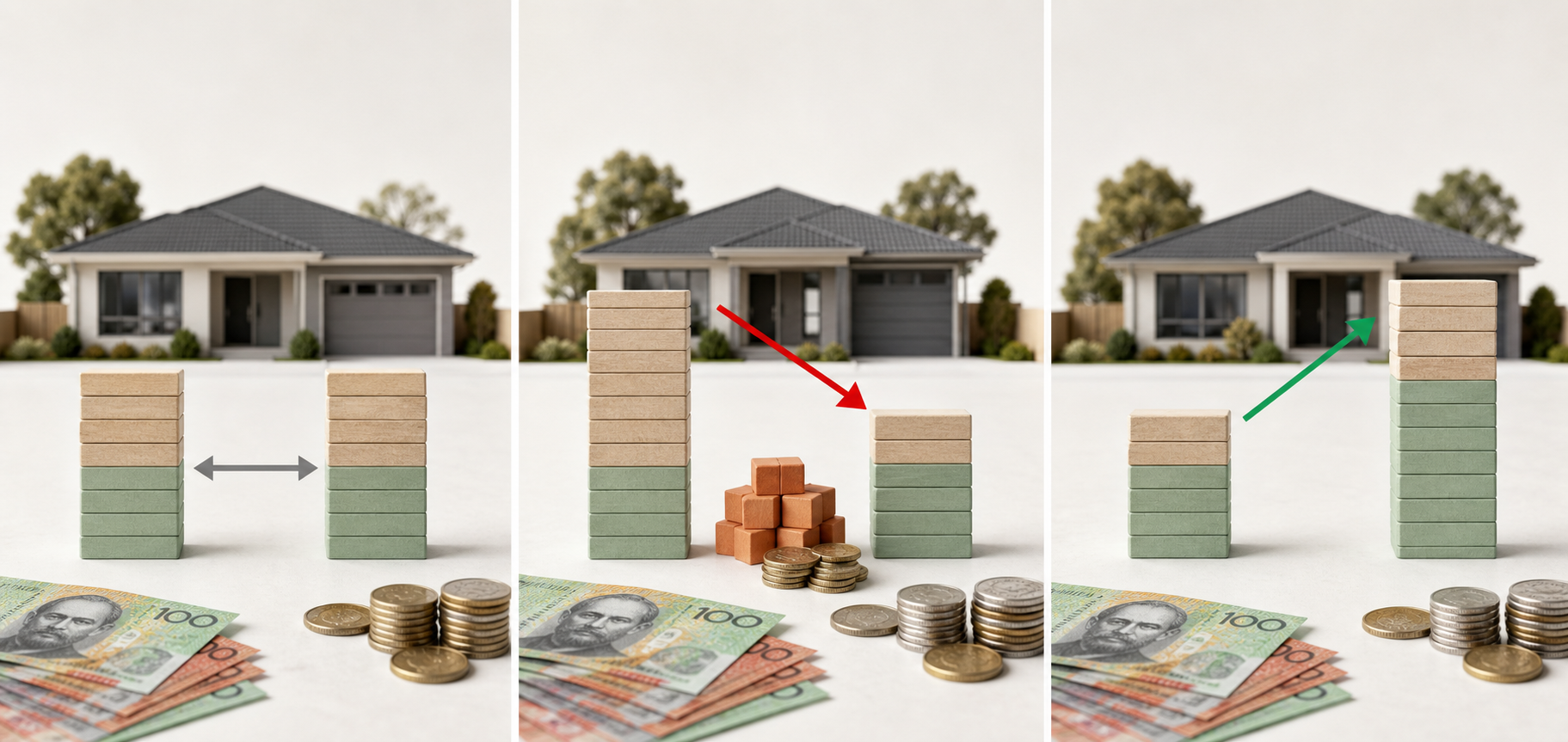
2.3 Comparison: equal, lower and higher valuations
Below is a simplified comparison using the same $800,000 contract price. LMI premiums are indicative only and will vary by lender and profile.
| Scenario | Contract price | Valuation | LVR target | Indicative max loan | Approx. cash needed (excl. costs) | What it usually means |
|---|---|---|---|---|---|---|
| A. Valuation = price | $800,000 | $800,000 | 80% | $640,000 | $160,000 | Straightforward if borrowing capacity OK, no LMI at 80% |
| B. Valuation lower | $800,000 | $740,000 | 80% | $592,000 | $208,000 | Need extra $48,000 cash or push to higher LVR + LMI |
| C. Valuation higher | $800,000 | $840,000 | 80% | $640,000 (still based on $800k) | $160,000 | Lender usually caps to price; paper equity but loan unchanged |
The key is to quantify your specific gap, then decide whether it’s:
- A manageable stretch, or
- A red flag that calls for restructuring or exit.
For a deeper dive into mapping a low‑valuation gap, see When Your Off‑the‑Plan Valuation Falls Short: What To Do Next.
The strategy continues below
You've seen the problem and the groundwork — now unlock the exact steps our CPA-certified brokers use, including 8 more sections. Enter your email for instant, free full access.
Free access. No spam — unsubscribe anytime. Your details stay confidential.
Frequently asked questions
What happens if my off‑the‑plan valuation is lower than my contract price?▾
Can I challenge or appeal a low valuation before settlement?▾
Will a higher valuation let me borrow more and skip my deposit?▾
What if my income has dropped since I signed the off‑the‑plan contract?▾
Is it ever better to walk away from an off‑the‑plan purchase?▾
How early should I plan for off‑the‑plan valuation and settlement risk?▾
Speak with a specialist advisor
Confidential consultation, bespoke advice for your situation.