Article
Planning a Bronte Lifestyle Move: Balancing Beach, Commute and Budget
Thinking about a Bronte lifestyle move? This deep dive shows how to balance beach, commute and budget, compare nearby suburbs, and structure your finance so the new postcode improves your life without over-stretching your cashflow or risking your business.
Key Takeaway
Planning a Bronte lifestyle move means weighing beach access, commute time, and budget within a realistic borrowing and cashflow framework. This guide explains how a $2.5–3.5m Eastern Suburbs home typically translates to $10k–14k in monthly repayments at 6% P&I, and why buyers should model repayments 3% higher in line with APRA rules. It concludes that a safe Bronte move requires tight cash buffers, clear suburb trade-offs, and separating home and business debt risks.
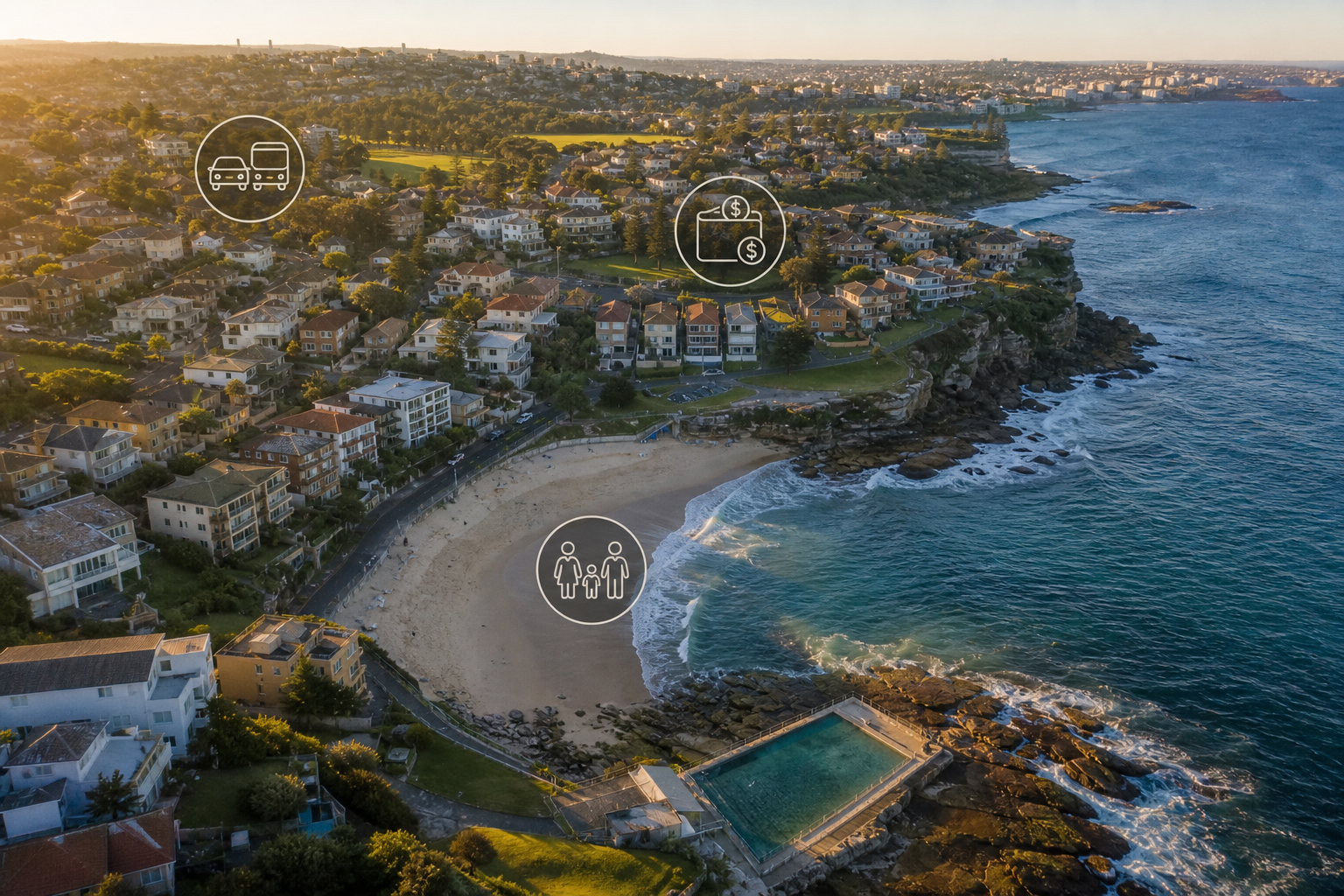
If you’re planning a Bronte lifestyle move, the core decision is simple to state and hard to execute: how much “Bronte” can you afford without wrecking your cashflow, commute or business?
Within the first week of planning, you should be able to answer three questions: 1) Which suburbs are genuinely on the table? 2) What’s a safe budget once you model rates 3% higher (APRA buffer)? 3) How will this move affect your work, school and business rhythm day‑to‑day? This guide walks you through those decisions step by step, so you can take practical action this week.

1. What a “Bronte lifestyle move” really means
A Bronte lifestyle move usually isn’t just about a new house. It’s a set of linked choices about:
- Beach access – morning swims, surf, coastal walk, dog parks.
- Commute – CBD, hospitals, airport, business locations.
- Kids – school zones, after‑school logistics, sport.
- Money – higher purchase price, rates, strata, parking, cafés.
- Risk – how exposed your home and business are to shocks.
For most buyers and refinancers, the trade‑off isn’t “Bronte or not Bronte”. It’s:
- Bronte vs near‑Bronte (Clovelly, Waverley, Randwick, Queens Park, Coogee, Tamarama), and
- Beach‑centric vs train‑centric (Bondi Junction, Randwick light rail) or school‑centric zones.
Your goal this week: define a shortlist of 2–4 realistic postcodes that fit both lifestyle and balance sheet.
2. Quick readiness check: are you Bronte‑move ready?
Use this diagnostic to see where you stand. If you answer “no” on more than three items, pause the property search and fix the gaps first.
2.1 Finance readiness
- Do you know your approximate borrowing power under a 3% rate buffer?
- Do you have at least 2–3 months of household expenses and, if self‑employed, 1–2 months of business overheads in separate cash buffers (not in redraw) before buying? (See knowledge fact 18.)
- Are your last two years of tax returns lodged and consistent with the income story you want the bank to see? (See /insights/timing-tax-returns-bronte-small-business-home-buyers.)
- If you own a business, are business and personal debts clearly separated?
2.2 Lifestyle and commute clarity
- Can you describe a typical Tuesday in your new location – including commute, drop‑offs, sport and work calls?
- Do you have a view on beach vs train vs school zone as your primary driver? (See /insights/school-zones-train-lines-beaches-borrowing-strategy.)
2.3 Risk tolerance
- Have you stress‑tested your budget at 3% higher interest rates, in line with APRA’s serviceability buffer?
- Could your household survive 6–12 months of reduced income (illness, business slowdown) without a fire‑sale of the new home?
If those questions make you uneasy, that’s useful. A Bronte lifestyle move needs a finance plan as tight as your lifestyle vision.
3. Bronte vs nearby suburbs: lifestyle and budget trade‑offs
You’re not choosing between “Bronte or the rest of Sydney”. You’re usually choosing between:
- Bronte proper (beachside, gully, hill streets)
- Near‑Bronte beach suburbs – Clovelly, Tamarama, Coogee
- Near‑Bronte family hubs – Waverley, Queens Park, Randwick
- Train‑centric – Bondi Junction and surrounds
3.1 Typical trade‑offs
Below is an illustrative comparison – not live data, but a realistic feel for how the trade‑offs can look for a family home. Prices are broad ranges only.
| Area | Lifestyle highlights | Commute to CBD (public) | Very rough house prices* | Key compromises |
|---|---|---|---|---|
| Bronte | Walk to beach, cafés, coastal walk, parks | 30–40 mins (bus + train) | $4.0m–$7.0m+ | High buy‑in, limited parking, steep streets |
| Clovelly | Calm beach, family vibe, coastal walk access | 30–40 mins (bus + train) | $3.5m–$6.0m+ | Less stock, still premium pricing |
| Tamarama | Iconic surf, coastal walk, Bondi access | 30–40 mins | $4.5m–$8.0m+ | Extreme premium, limited family houses |
| Coogee | Bigger beach, nightlife, more apartments | 35–45 mins | $3.0m–$5.5m+ | Busier, noisier, parking pressure |
| Waverley/Queens Pk | Parks, good schools, Bondi Jn walkable | 20–30 mins | $3.0m–$5.5m+ | Not “on” the beach, weekend parking near |
| Randwick | Hospitals, UNSW, light rail, shops | 20–30 mins | $2.5m–$4.5m+ | Less “beach village” feel |
| Bondi Junction | Trains, Westfield, business services | 15–25 mins | $2.0m–$4.0m+ (houses nearby) | Noisy, more high‑rise, less beachy |
*Illustrative ranges only; always check current local sales.
3.2 What “Bronte premium” really costs you
Working example:
- Current home in a middle‑ring suburb: $1.6m, mortgage $900k at 6% P&I over 25 years.
- Repayments ≈ $5,800/month.
- Bronte‑adjacent target house: $3.2m.
- Equity from sale (after costs): say $900k.
- New loan: $2.3m at 6% P&I over 30 years.
- Repayments ≈ $13,800/month.
So the Bronte move adds around $8,000/month to your cashflow load before rates, land tax, strata, higher insurance and daily spend.
Now apply a 3% buffer: model repayments as if the rate were 9%, not 6%.
- At 9% P&I on $2.3m over 30 years, repayments jump to ≈ $18,600/month.
If that number makes you sweat, you’re feeling the same pressure the banks model behind the scenes.
4. Beach, commute, schools: choosing your primary anchor
You rarely get the perfect triangle of beach + train + elite school zone within budget. Pick your primary anchor first, then flex the others.
4.1 Beach‑anchored buyers
You’re focused on:
- Daily swims or surf.
- Kids walking to the sand in holidays.
- Lock‑up‑and‑go lifestyle.
Key risks:
- Price volatility – beach premiums can amplify both booms and corrections.
- Heavier reliance on buses or driving to trains.
- Tourist and traffic pressure in peak seasons.
Mitigants:
- Consider slightly back‑from‑beach streets or near‑Bronte suburbs.
- Buy an asset with broad appeal (parking, light, outdoor space).
- Keep conservative LVRs and bigger buffers to ride any price swings.
4.2 Commute‑anchored buyers
You care most about:
- CBD, hospitals or airport access.
- Time flexibility for a business or demanding role.
Likely suburbs: Bondi Junction, Randwick (light rail), Waverley/Queens Park as walkable to trains.
Benefits:
- Better serviceability on paper – banks treat shorter commute areas neutrally, but your actual time and income capacity improve.
- Easier for business owners to manage sites, clients and staffing.
Trade‑off: you probably walk or drive to the beach rather than strolling down the gully.
4.3 School‑anchored buyers
Then there are buyers moving specifically for catchments and school ecosystems.
- Bronte and Waverley link into strong public school zones and a cluster of private schools.
- Prices often include a “school premium”, similar to the beach premium.
Read the dedicated school‑zone finance piece here: /insights/financing-move-key-school-zones-bronte.
When schools are the anchor, you might:
- Prioritise Waverley, Queens Park or Randwick.
- Accept a slightly longer drive to the beach for better weekday logistics.
5. Budgeting for a Bronte move without choking cashflow
5.1 Build a realistic monthly cost picture
Don’t just look at mortgage repayments. Build a full monthly picture:
- Mortgage (at current rate and at +3%).
- Council rates and water.
- Land tax if applicable (for investors/second homes).
- Strata (units/townhouses).
- Insurance – often higher for coastal properties.
- Utilities, internet.
- Transport (opal, tolls, fuel, parking).
- School fees and activities.
- Lifestyle – cafés, dining, sport, surf clubs.
Many Bronte‑area moves fail not because of the mortgage, but because the combined lifestyle spend jumps $2,000–$3,000/month without the household noticing.
5.2 APRA buffer and your personal buffer
Lenders generally assess serviceability at least 3% above the actual rate (APRA guidance). That protects the bank, but you need your own line in the sand.
A conservative approach:
- Model repayments at current rates and +3%.
- Add all non‑mortgage costs.
- Check what’s left for savings and business reinvestment.
If your surplus at today’s rates is under $3,000/month for a typical Eastern Suburbs family, a $2m+ loan may be tighter than it looks.
5.3 Separate home, investment and business debt
For small business owners, one of the biggest risks in a Bronte move is mixing business and lifestyle debt.
From our previous work:
- Using home loan redraw or offset as recurring business working capital concentrates business risk on the family home and muddies tax deductibility (facts 2, 8, 14, 19).
- Using business working capital or overdrafts as a home deposit or for renovations weakens both business resilience and loan approval odds (facts 1, 3, 4, 9, 20).
For a Bronte lifestyle move, that means:
- Fund the home with home‑purpose facilities.
- Keep business working capital in dedicated business facilities.
- Avoid cross‑collateralising business loans to the new home unless it is deliberately structured and time‑limited.
More detail on the structures here: /insights/coordinating-personal-business-smsf-loans-prestige-eastern-suburbs-home.
The strategy continues below
You've seen the problem and the groundwork — now unlock the exact steps our CPA-certified brokers use, including 8 more sections. Enter your email for instant, free full access.
Free access. No spam — unsubscribe anytime. Your details stay confidential.
Frequently asked questions
How much income do I need to buy a family home near Bronte?▾
Is it safer to buy in Bronte or a cheaper nearby suburb?▾
Should I keep my current home as an investment when moving near Bronte?▾
What extra steps should self-employed buyers take before a Bronte move?▾
Is it better to prioritise the beach, commute or school zone around Bronte?▾
How do I know if my Bronte borrowing plan is too aggressive?▾
Can I roll business debts into my home loan when upgrading to Bronte?▾
Speak with a specialist advisor
Confidential consultation, bespoke advice for your situation.