Article
Keep Your Eastern Suburbs Home Safe When You Run A Business
A practical guide for Eastern Suburbs business and practice owners who want growth without betting the family home. Learn how guarantees, loan structure, buffers and insurance work together so one rough year at work doesn’t cost you your house.
Key Takeaway
This guide explains how Eastern Suburbs business and practice owners can protect their family home by managing guarantees, loan structure, and cash buffers. It outlines how personally guaranteed business debts are treated as liabilities in home loan assessments and why using home loan redraw as working capital significantly increases risk. Readers get a step-by-step action plan for restructuring loans, separating business and personal cashflow, and setting practical buffer targets to keep business shocks from forcing the sale of their home.
Watch the short answer
How business debt, home loans and tax strategy fit together
While you’re working out how to protect your home from business risk, this video shows how your loans and tax strategy fit together.
Read the transcript
Your business debt, your home loan, and your tax strategy are all fighting each other. When self-employed operators use different banks, an accountant, and a generic online broker, their financial web becomes tangled. Your business equipment loan starts blocking your residential refinance. We act as the central architect. We map your entire portfolio, placing your asset finance, commercial loans, and residential debt in strategic isolation so one doesn't drag down the other. Untangle your wealth. DM me the word 'ARCHITECT' for a holistic portfolio review.
General information only, not personal advice. Your situation is assessed before any recommendation.

Owning a home in Sydney’s Eastern Suburbs while running a business or professional practice is powerful — and risky. Your house often ends up as the silent guarantor behind everything you do. Protecting it means being deliberate about guarantees, loan structure, cashflow and insurance, not just hoping the business keeps trading well.
In simple terms, you protect your Eastern Suburbs home by: (1) limiting when it’s used as security, (2) keeping business and personal borrowing clearly separated, (3) matching loan terms to business purpose, and (4) maintaining realistic cash and insurance buffers. The aim is not zero risk; it’s clear, containable risk with backup plans.
This guide is written for time-poor owners in Bondi, Bronte, Coogee, Randwick, Rose Bay and surrounds who want decisions they can act on this week.
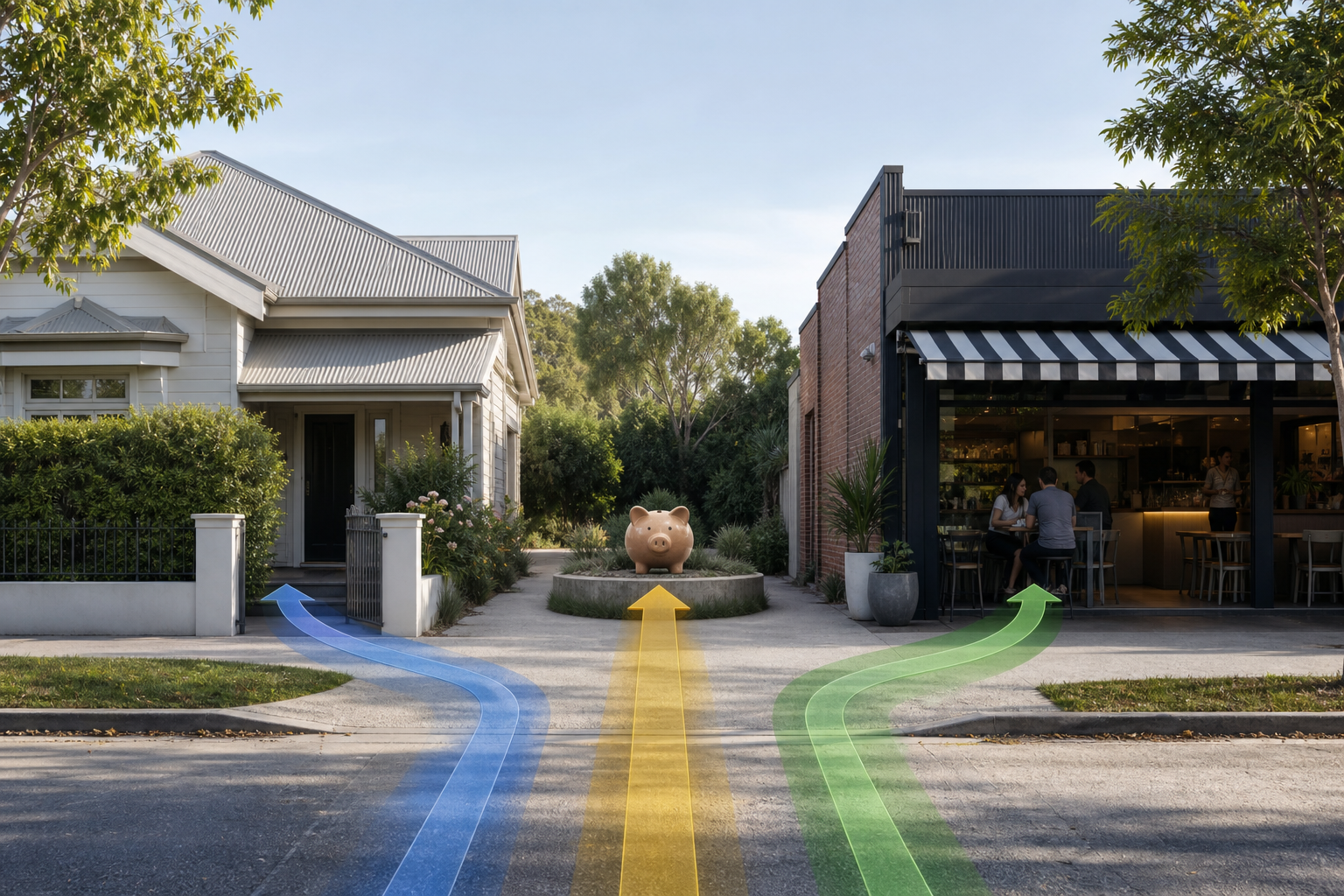
1. How your Eastern Suburbs home actually ends up on the line
You don’t lose a house in one dramatic step. It’s usually the cumulative effect of small decisions: a guarantee here, a redraw there, stretching the overdraft to make BAS.
1.1 The main ways your home gets exposed
For Eastern Suburbs business and practice owners, the family home is usually exposed through four channels:
-
Mortgages and top‑ups
- You increase your home loan to fund business fit‑outs, tax, vehicles or stock.
- The loan term stretches to 25–30 years, so a short‑term business risk rides on your home for decades.
-
Personal guarantees
- You sign director or personal guarantees for leases, equipment finance, trade accounts or bank facilities.
- If the business fails, creditors can pursue you personally — including equity in your home.
-
Cross‑collateralisation
- Your home and other properties secure multiple loans in one big web.
- If business-related property or debt causes problems, the bank can force sales across the whole group.
- For detail on when this helps or hurts, see Cross‑Collateralisation For Small Business Owners: Use It Or Avoid It?.
-
Using the mortgage as an overdraft
- You regularly use home loan redraw or offset to pay wages, BAS or suppliers.
- This concentrates business risk on your home and complicates tax deductibility tracing (see knowledge facts 12, 14, 17, 20).
Each decision can feel small at the time. Together, they decide whether a bad trading year threatens your Bondi semi.
1.2 Why this matters more in the East right now
The Eastern Suburbs have high property values and usually high loan sizes. With the RBA holding rates at restrictive levels (around 4.4–4.5% cash rate in its August 2026 outlook), repayments are already heavy.
Roy Morgan estimates over 28% of Australian mortgage holders are ‘At Risk’ of mortgage stress, with repayments consuming a large share of income. If your income depends on a business or practice, your stress risk is higher because both sides of the household budget move at once.
That means:
- You have less margin for business mistakes before the bank gets nervous.
- A rough business patch and another rate rise can quickly collide.
2. Quick readiness check: how exposed is your home today?
Before you fix anything, you need an honest assessment. This 10‑minute checklist will tell you whether your Eastern Suburbs home is reasonably insulated or dangerously tied to the business.
2.1 Structural exposure checklist
Answer yes/no to each:
- Is any part of your home loan balance used for business purposes?
- Do you use home loan redraw or your offset account to pay BAS, wages or suppliers, even occasionally?
- Do you have any business loans, leases or trade accounts with a personal or director guarantee attached?
- Are your home and any investment properties cross‑collateralised with business loans?
- Do you have fewer than 3 months of business fixed costs in cash or available undrawn facilities?
- Do you have fewer than 3–6 months of home loan and household costs in a separate personal buffer? (see facts 7 and 8)
- Is any business‑purpose borrowing on 15–30 year terms instead of 5–7 years?
- 0–2 yes answers: Reasonably contained, worth fine‑tuning.
- 3–5 yes answers: Moderate risk — time for deliberate changes.
- 6–7 yes answers: High risk — your home is substantially tied to business fortunes.
For a deeper look at how cash and loans interact, see Simple cashflow rules to shield your Bronte home from your business.
2.2 Cashflow stress‑test
Run this simple scenario in your head or spreadsheet:
- Assume home loan rate +3% (APRA serviceability buffer).
- Assume business income down 30% for 6–12 months.
Ask:
- Can you still meet home and business repayments without touching tax money or raiding the business overdraft beyond its limit?
- How many months could you last on existing buffers?
If the answer is less than three months, your home is more exposed than it needs to be. The Bronte‑focused guide Practical Ways To Stress‑Test Your Bronte Home Loan In A Tough Year walks through more detailed stress‑testing.
3. Guarantees 101: what you’re really signing
Personal guarantees are one of the fastest ways your Eastern Suburbs home ends up at risk without you realising it.
3.1 Types of guarantees that matter
Common guarantees you might have already given:
- Director / personal guarantees to banks for business loans, overdrafts, merchant facilities or business credit cards.
- Lease guarantees for clinics, shops or offices (often 3–6 months’ rent).
- Equipment or fit‑out finance guarantees — especially for medical, dental, beauty or hospitality equipment.
- Trade credit guarantees for key suppliers.
When the business can’t meet its obligations, creditors can pursue you personally. That usually means your personal bank accounts and ultimately your home equity.
3.2 How home lenders view your guarantees
For home loan and refinance assessments:
- Personally guaranteed business debts are often treated as personal liabilities.
- This directly reduces your borrowing power (see knowledge fact 4 and /insights/bronte-borrowing-power-small-business-owner-guide).
- Large guarantees may need to be disclosed even if no money is currently owing.
The more guaranteed debt you carry, the harder it can be to upgrade or refinance your Eastern Suburbs home, even if you’ve never missed a payment.
3.3 Containing guarantee risk
You may not be able to avoid guarantees altogether, but you can shape them:
-
Cap the amount and term
- Negotiate limited guarantees (capped dollar amounts, fixed time frames).
- Avoid “all moneys” guarantees where possible.
-
Stage new commitments
- For big fit‑outs, break projects into stages with performance milestones before you sign larger guarantees.
-
Use other security where sensible
- Sometimes a piece of equipment or a cash bond is safer than tying up your house.
-
Plan exit paths
- Set clear metrics (e.g. two years of consistent profits) at which you’ll renegotiate or seek to release guarantees.
For a suburb‑specific lens, the Rose Bay guide Shielding Your Rose Bay Home When You Run A Business covers how guarantees, buffers and insurance work together.
The strategy continues below
You've seen the problem and the groundwork — now unlock the exact steps our CPA-certified brokers use, including 9 more sections. Enter your email for instant, free full access.
Free access. No spam — unsubscribe anytime. Your details stay confidential.
Frequently asked questions
How can I protect my Eastern Suburbs home if my business fails?▾
Should I ever use my home loan redraw to pay BAS or wages?▾
Is it safer to consolidate business debts into my home loan?▾
Do personal guarantees for my business affect my home loan borrowing power?▾
How big should my cash buffer be as a self‑employed home owner?▾
What is cross‑collateralisation and why is it risky for business owners?▾
Can I still upgrade my Eastern Suburbs home if my income is from a business?▾
Speak with a specialist advisor
Confidential consultation, bespoke advice for your situation.