Article
How to Read Eastern Suburbs Property Cycles and Act in Each Stage
A concise, decision-grade guide to reading flat, rising and hot market conditions in Sydney’s Eastern Suburbs – and what buyers, investors and refinancers should actually do in each stage this month.
Key Takeaway
Sydney’s Eastern Suburbs property cycle moves through flat, rising and hot phases, and buyers should change tactics at each stage. In a flat market, focus on quality assets and negotiation; in a rising market, speed and auction‑grade pre‑approval matter most; in a hot market, strict price ceilings and extra valuation buffers reduce risk, as valuation shortfalls are common when auction prices outpace comparable sales. Align every move with a long‑term plan and robust cash buffers before acting.
If you’re buying in Sydney’s Eastern Suburbs, you should adjust your tactics to the local cycle: flat, rising or hot. In a flat market, you negotiate hard and prioritise quality. In a rising market, you move fast with clean finance. In a hot market, you protect your future self from overpaying and valuation shocks, even if that means sitting out some auctions.
In one sentence: read the local cycle using days-on-market, auction clearance rates and listing depth, then match your buying and borrowing strategy to that stage.
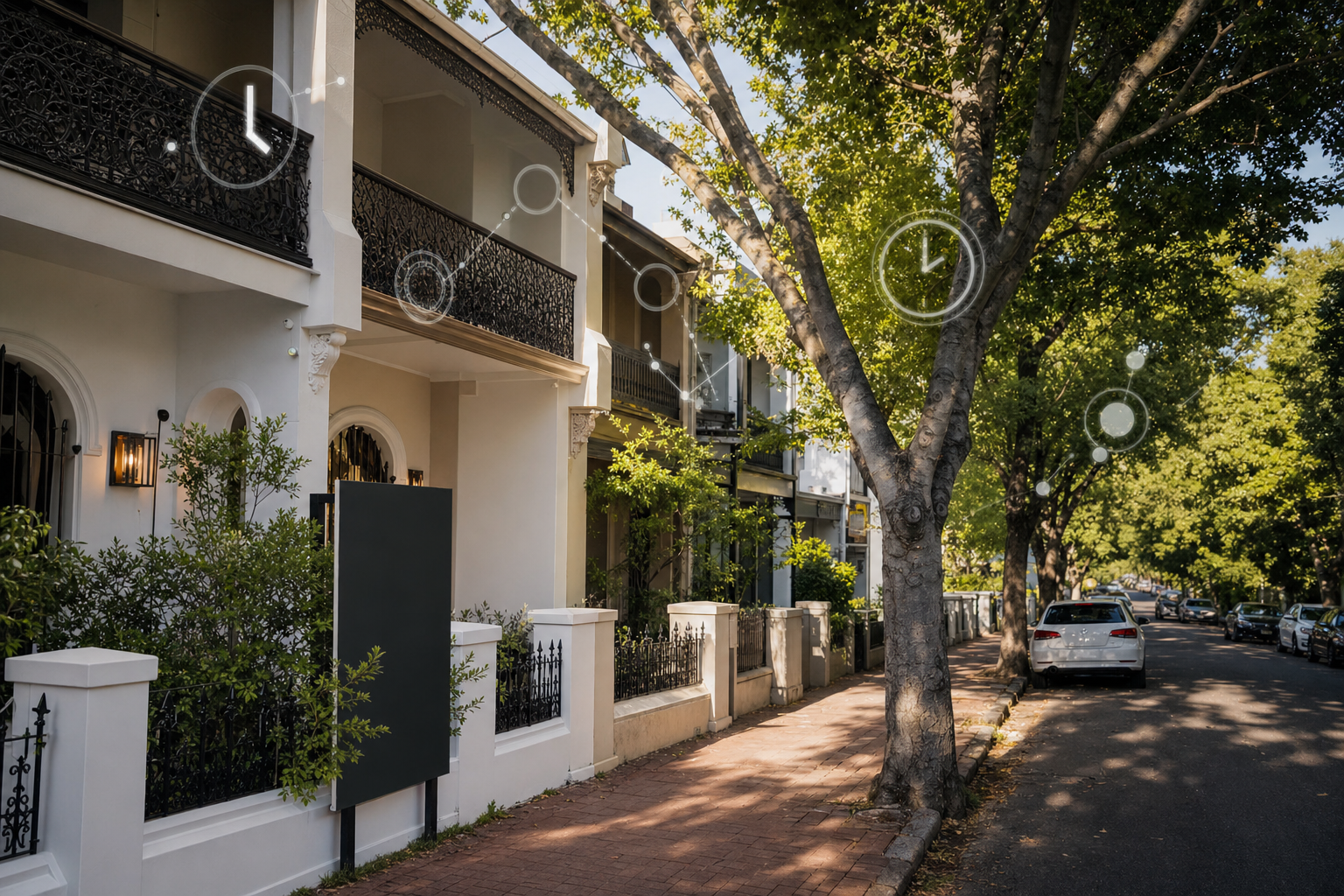
Local streets tell you as much about the cycle as headline data.
How to spot flat, rising and hot markets in the Eastern Suburbs
The simple cycle definition
For practical decisions this month, use these working definitions:
- Flat market: prices mostly sideways, buyers and sellers evenly matched.
- Rising market: prices gently climbing, more buyers than listings.
- Hot market: rapid price jumps, FOMO, frequent record sales.
What matters is not labels, but how much urgency and risk you take on.
Local data signals to watch
You don’t need a PhD to read the cycle. Focus on three numbers for your target pocket (e.g. Double Bay houses, Randwick units):
| Cycle stage | Typical auction clearance* | Median days on market | Listings depth | Buyer leverage |
|---|---|---|---|---|
| Flat | ~55–65% | 35–60 days | Normal/high | Moderate–high |
| Rising | ~65–75% | 25–35 days | Tightening | Moderate |
| Hot | 75%+ | <25 days | Very low | Low |
*Indicative local bands, not strict rules. Always check suburb-level data.
Layer this with street-level intel and bank/valuer behaviour from guides like /insights/valuations-developers-market-cycles-local-knowledge-2.
What to do in a flat Eastern Suburbs market
In a flat market, buyers finally get some breathing space. Your job is to use it without getting paralysed.
Tactics: focus on quality and terms
-
Target quality, not bargains only.
- Blue-chip streets in Randwick, Queens Park, Double Bay, Bellevue Hill rarely stay cheap for long.
- Don’t trade long-term liveability for a 2–3% discount on a compromised property.
-
Negotiate on more than price.
- Try for longer settlements, early access for renovations, vendor-paid minor repairs.
- Push for cooling-off periods or finance clauses on private treaty deals.
-
Use time to do proper due diligence.
- Extra building reports, strata minutes, rental appraisals.
- Test different structures and buffers with a strategic broker, not just “best rate”.
For how this fits into a long-term plan, see /insights/10-15-year-property-mortgage-plan-eastern-suburbs-family.
Borrowing strategy in a flat market
- Keep flexibility high.
- Prioritise offset accounts over redraw to preserve options if the home later becomes an investment.
- Stress-test at higher rates.
- Lenders already add a ~3% APRA buffer, but you should model an extra 0.5–1.0% and possible income dips.
- Consider LVR and LMI carefully.
- If you can comfortably avoid LMI by waiting 6–12 months and building deposit, a flat market is where that patience can pay off.
What to do in a rising Eastern Suburbs market
In a rising market, your risk is moving too slowly and missing good stock, not that the world ends if you pay 1–2% above last month’s comparable.
Tactics: speed and clarity
-
Define your exact brief.
- Suburbs, streets to avoid, must-haves vs nice-to-haves.
- This stops you burning time inspecting the wrong properties.
-
Get auction-grade pre-approval.
- Pre-approval in the East should be full, credit-assessed and subject only to valuation to meaningfully reduce settlement risk (see /insights/auction-finance-tactics-beat-investors-eastern-suburbs).
-
Limit how many ‘maybes’ you chase.
- If a property is 7/10, but you’ve agreed you need a 9/10 for the next 10 years, don’t burn your energy there.
Borrowing strategy in a rising market
-
Tighten your price ceiling.
- Decide a walk-away price before every auction, based on repayments at +3% and your real-life budget.
-
Structure for future moves.
- Consider how this purchase affects future upgrades, schooling, and investment borrowing. Strategic broking for Eastern Suburbs families means treating each loan as part of a 10–15 year roadmap, not a one-off transaction (see /insights/strategic-mortgage-broking-eastern-suburbs-families-professionals).
-
Watch valuation risk.
- In fast-moving pockets like Bondi and Bronte, valuation shortfalls are common when auction prices outpace recent comparable sales. Build a 5–10% cash or equity buffer where you can.
What to do in a hot Eastern Suburbs market
Hot markets are where FOMO and bad lending decisions peak. Your job is to protect your future self from unnecessary risk.
Buying in Double Bay, Bellevue Hill and similar pockets
In prestige pockets, scarcity plus competition can push prices far ahead of bank valuations (see /insights/double-bay-bellevue-hill-prices-bank-view).
Your rules of thumb:
- Assume valuations lag real-time prices.
- Aim for properties that valuers can easily compare: solid land, no major red flags.
- Have contingency plans if the valuation comes in short (extra cash, guarantor equity, or ability to walk away pre-unconditional).
Worked example: buying in a hot Double Bay market
- Target home price: $3.5m (house in Double Bay).
- Deposit: 20% = $700,000.
- Loan amount: $2.8m.
- Indicative rate: 5.8% p.a., 30-year term, P&I.
Monthly repayment (approx):
- Using a standard repayment formula, repayments are around $16,500–$17,000 per month.
- At +3% rate buffer (8.8%), repayments jump to roughly $22,000–$23,000 per month.
If the bank valuation comes in at $3.3m instead of $3.5m, a 20% deposit now looks like:
- Max lend at 80% LVR: $2.64m.
- You’d need an extra $160,000 cash or security to proceed.
In a hot market you should:
- Model a 5–10% valuation shortfall before bidding.
- Decide if you’re willing and able to cover that gap safely.
Borrowing strategy in a hot market
-
Non-negotiable buffers.
- Minimum: 3–6 months of total holding costs in cash/offset, especially if you have more than one property.
-
Avoid cross-collateralisation where possible.
- It can trap equity or force sales when selling a single property, especially if values fall.
-
Be prepared to walk away.
- If bidding runs beyond your pre-modelled walk-away price (with the rate buffer and new tax rules in mind for investors), step back.
In hot markets, disciplined borrowing decisions matter more than ever.
Matching your cycle view to your next 7 days
Step 1: Diagnose your local micro-cycle
In the next week:
- Pull auction clearance rates and median days-on-market for your target suburbs.
- Talk to at least two local agents about listing depth and buyer inquiry.
- Cross-check what banks and valuers are doing with local prices from your broker.
If data points conflict, assume more caution, not less.
Step 2: Choose your move based on stage
- Flat market:
- Shortlist 3–5 A-grade properties.
- Push hard on terms and due diligence.
- Rising market:
- Tighten your brief; get auction-grade pre-approval.
- Plan for quick, clean offers on the right property.
- Hot market:
- Focus on bank-friendly, long-term holds.
- Bid only with conservative ceilings and strong buffers; be ready to pause instead of compromising on quality.
Step 3: Align with your 10–15 year plan
The right move this month depends on where you want to be in 10–15 years. Use your cycle view to sequence moves, not just chase today’s headlines. For a structured approach, pair this guide with your roadmap from /insights/10-15-year-property-mortgage-plan-eastern-suburbs-family.
FAQs
How do I know if it’s the right time to buy in Double Bay?
The “right time” is when your long-term plan, buffers and borrowing capacity line up with a property you’d happily hold for 10+ years. In Double Bay, price and valuation risk are high in hot markets, so test 5–10% valuation shortfalls and 3% rate rises. If the numbers still work and your life plan fits, the cycle matters less than the asset quality.
Is it safer to wait for a flat market before buying in the Eastern Suburbs?
Not necessarily. In some blue-chip pockets, genuinely flat periods are short and the best stock rarely appears at the bottom. It can be smarter to buy a quality asset in a rising market with strong buffers than wait years for the “perfect” cycle and miss suitable homes altogether. Your risk is over-leverage, not simply buying in a rising phase.
How should investors change strategy with the new negative gearing rules?
For established properties bought after 12 May 2026, you shouldn’t rely on offsetting rental losses against wages. Model cashflow assuming no wage-based negative gearing and a 3% interest rate buffer. In hot markets this may mean walking from heavily negatively geared deals, or pivoting towards new builds where concessions remain.
What’s different about buying in a hot market if I’m self-employed?
Lenders scrutinise self-employed income more closely, and documentation delays can cost you in a fast-moving campaign. You need cleaner financials, more up-to-date tax returns, and extra time to obtain full credit-assessed pre-approval before bidding. In hot markets, build even larger cash buffers because business income can be more volatile.
Should I fix my rate in a hot market?
Fixing can add repayment certainty but reduce flexibility just when you might want to refinance or restructure. In hot markets, focus first on not over-borrowing and maintaining strong buffers. Then decide on a mix of fixed and variable that supports your 5–10 year plan rather than reacting purely to RBA headlines.
Key takeaways
- Read the local cycle using clearance rates, days-on-market and listing depth, then adjust your tactics.
- In flat markets, prioritise quality assets and strong terms; in rising markets, focus on speed and auction-ready finance.
- In hot markets, your biggest risks are overpaying and valuation shortfalls, so set hard ceilings and keep large buffers.
- The “right time” is when the property, your 10–15 year plan and a conservative borrowing strategy all line up.
Next step: Book a free 15-minute strategy call at /book to map your local cycle, borrowing options and 10–15 year plan with one specialist who understands tax, lending and the Eastern Suburbs market in a single conversation.
General advice only.
Frequently asked questions
How do I know if it’s the right time to buy in Double Bay?▾
Is it safer to wait for a flat market before buying in the Eastern Suburbs?▾
How should investors change strategy with the new negative gearing rules?▾
What’s different about buying in a hot market if I’m self-employed?▾
Should I fix my interest rate in a hot market?▾
Speak with a specialist advisor
Confidential consultation, bespoke advice for your situation.