Article
Planning a Safe Upgrade From Rose Bay Apartment to House
Thinking about stretching from a Rose Bay apartment to a house? This guide shows what you can safely borrow, how banks really assess you, and the key risks to watch before you commit to a much bigger mortgage.
Key Takeaway
Upgrading from a Rose Bay apartment to a house means testing both what a bank might lend and what is safe, then managing risks from higher debt, rates and lifestyle costs. Using a 3% interest rate buffer (in line with APRA guidance) and capping total home plus investment repayments at around 30–35% of after‑tax income provides a practical safety ceiling. Buyers should also plan buffers, structure loan splits cleanly, and model sale, bridging or rentvest options before committing.

Stretching from a Rose Bay apartment to a house means a bigger mortgage, higher running costs and less room for error if rates rise or your income dips.
The safe way to upgrade is to know two numbers: (1) the bank’s maximum limit, and (2) your own safer cap, where total home and investment repayments stay under roughly 30–35% of your after‑tax income even if rates jump 3%.
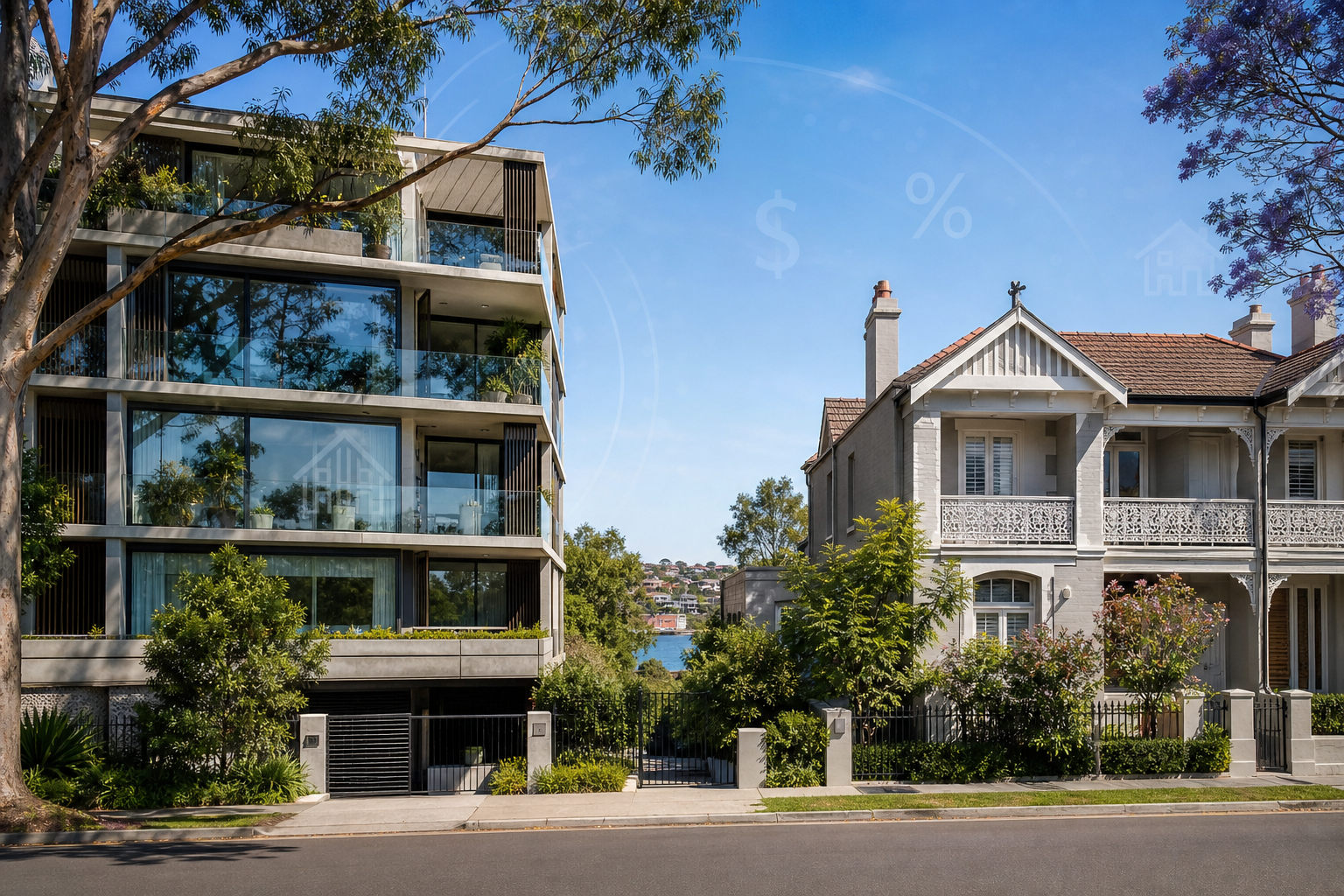
Step 1: What does “stretching” actually look like in Rose Bay?
For many Rose Bay upgraders, the move is roughly:
- From: 2–3 bed apartment/unit
- To: Semi, freestanding house or bigger family home
In dollar terms (illustrative only):
- Current unit value: say $1.6m
- Target house/semi: say $3.0m
- Upgrade gap: about $1.4m before costs
If your current loan is $900k and you sell the unit, pay selling costs and use the net equity plus savings for deposit and stamp duty, your new loan can easily land around $1.6m–$2.0m.
At 6.0% over 30 years, P&I on $1.8m is about $10,800 per month.
If rates jumped to 9.0% (a 3% stress buffer), repayments climb to roughly $14,500 per month.
That range — and whether your household income can comfortably support it — is the real definition of “stretch”.
For a Bronte-specific worked example, see the similar framework in [/insights/bronte-apartment-to-house-borrowing-limits-risks].
Step 2: Bank limit vs your safer personal limit
How banks look at it
Most lenders will:
- Use your verified income (payslips, tax returns, BAS for self‑employed)
- Apply a minimum 3% interest rate buffer on today’s rate (APRA guidance)
- Use HEM living expenses benchmarks (then adjust for your disclosures)
- Shade variable income (overtime, bonuses, distributions) by 20–30%
The result is a maximum borrowing figure that often feels aggressive if you have private school, big holidays or want to keep investing.
How you should look at it
Across Sydney’s east, a practical ceiling is:
- Model all home + investment loans at current rate + 3%; and
- Keep total repayments under 30–35% of your net income.
Example:
- Couple net income: $25,000 per month
- 35% of net = $8,750 per month
If stressed repayments on the proposed new mortgage and any investment loans exceed $8,750, you’re likely over‑stretching — even if the bank still says yes.
You can see a similar safety rule applied to other prestige moves in [/insights/bridging-finance-luxury-property-risks-limits-alternatives].
The strategy continues below
You've seen the problem and the groundwork — now unlock the exact steps our CPA-certified brokers use, including 4 more sections. Enter your email for instant, free full access.
Free access. No spam — unsubscribe anytime. Your details stay confidential.
Frequently asked questions
How much more can I safely borrow to upgrade in Rose Bay?▾
Is bridging finance too risky for a Rose Bay upgrade?▾
Should I keep my Rose Bay apartment as an investment when buying a house?▾
Speak with a specialist advisor
Confidential consultation, bespoke advice for your situation.