Article
How to Safely Stretch Your Budget at Mascot and Inner‑South Auctions
A practical, decision-grade guide to safely stretching your budget at Mascot and Inner‑South auctions without blowing up your finances, including clear bidding limits, buffers and real-world numbers.
Key Takeaway
This guide explains how buyers can safely stretch their budget at Mascot and Inner-South Sydney property auctions by setting two clear limits: the lender-assessed maximum and a lower, personal safe ceiling stress-tested at 2–3 percentage points above current rates. With around 28% of Australian mortgage holders already ‘At Risk’ of stress (Roy Morgan 2026), it shows how to define a narrow stretch band, pre-arrange funds and buffers, and use worked examples so emotion cannot overrule pre-set financial boundaries on auction day.
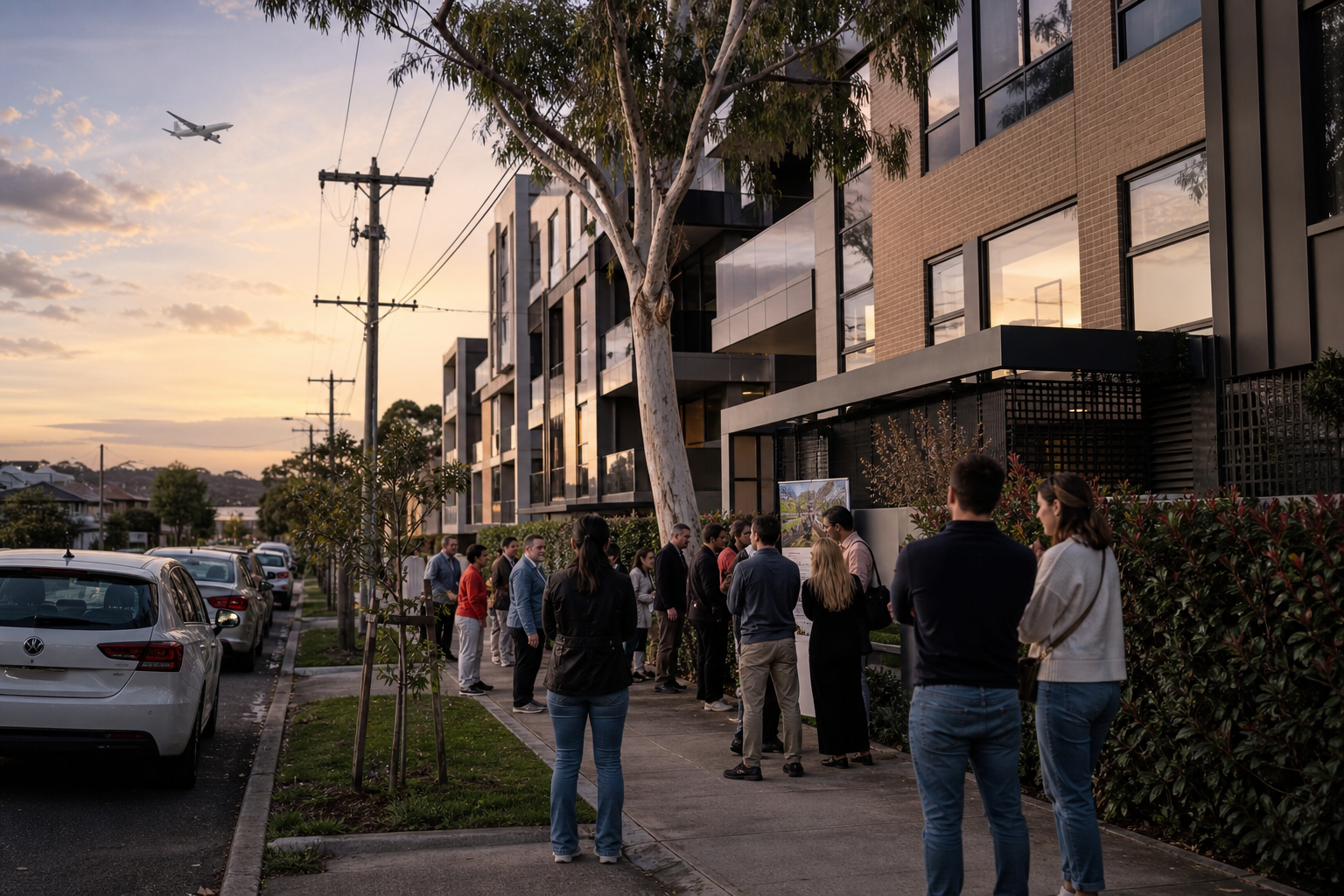
In Mascot and the Inner South, you can safely stretch your budget at auction only if you lock in rock‑solid limits before auction day, stress‑test them at higher rates and make it impossible to go past your hard ceiling in the heat of bidding.
This guide walks you through a practical, numbers‑first framework you can put in place this week so you can compete at Mascot auctions without tipping into mortgage stress or business risk.
1. The core idea: two limits and a narrow stretch band
Before you even inspect a Mascot property, you need three numbers written down:
- Bank maximum – what a lender’s calculator will allow.
- Personal safe ceiling – a lower figure where repayments are still comfortable after stress‑testing.
- Tightly defined stretch band – a small, pre‑funded amount above your comfort price.
The mistake many buyers make is treating the bank’s maximum as their bidding limit. With around 28.2% of Australian mortgage holders already ‘At Risk’ of stress (Roy Morgan, 2026), that’s dangerous.
Your bank maximum is what a computer says you can do. Your safe ceiling is what your cashflow, job security and business volatility say you should do.
If you’re also juggling business finance or investment loans, this separation becomes even more critical. Your home shouldn’t be the shock absorber for every risk in your life.
2. Step 1 – Know your real borrowing limit in Mascot
2.1 What Mascot buyers are up against
Mascot and the Inner South are auction‑heavy, fast‑moving markets. Strata stock, newer apartments, mixed‑use buildings and flight‑path issues make valuations and lender appetite more variable than in some suburbs.
Layer onto that:
- APRA’s 3% serviceability buffer on new loans.
- RBA cash rate rises that haven’t fully flowed through yet.
- Tighter rules on interest‑only and investor lending.
Put simply, the figure you see on a bank website calculator is usually higher than what a conservative, well‑structured pre‑approval will safely support once we factor in your real expenses and buffers.
For a deeper dive on how auction culture affects approvals, see How Local Auction Culture Shapes Your Loan Approval Strategy.
2.2 Translate lender ‘yes’ into a safe personal limit
Let’s say a lender indicates:
- Max loan: $1,000,000
- Product: Principal & interest, 30‑year term
- Indicative rate today: 6.3% p.a. (example only)
Approximate monthly repayment at 6.3%:
- About $6,200 per month.
APRA requires a 3% buffer, so the bank tests you at 9.3%:
- Approximate repayment then: $8,200 per month.
The bank’s view: If you can afford $8,200 in their model, they can lend you $1m.
Your view should be different. A safer household rule might be:
- Cap total housing costs (repayments + strata + rates + insurance) at 30–35% of net income.
If your household after‑tax income is $15,000 per month, 35% is $5,250.
At that point, $1m at 6.3% is already too tight.
2.3 Work backwards to a Mascot‑appropriate safe ceiling
Using the same household income:
- Desired housing cap: $5,250/month
- Assume strata, rates, insurance: $750/month
- Max repayment you really want: $4,500/month
On a 30‑year P&I loan at 6.3%, $4,500/month corresponds roughly to a $720k–$740k loan (illustrative only).
If you’re aiming for an 80% LVR to avoid LMI, that points to a property price range around:
- $900k–$925k with a 20% deposit plus costs.
So even though the bank says $1m, your personal safe ceiling might be around $925k.
That difference – $75k – is where most Mascot buyers get into trouble.

3. Step 2 – Define a precise stretch band (and fund it)
Once you know your safe ceiling, you can decide how far you’re prepared to stretch above it – if at all.
3.1 What is a stretch band?
Your stretch band is a small, pre‑agreed range above your comfort price where you’re willing to go if:
- The property is clearly superior to alternatives.
- You can prove the extra repayments still work after stress‑testing.
- You already know exactly where the extra money is coming from.
In our Mascot example:
- Personal safe ceiling: $925k
- Stretch band: $925k–$955k (a $30k band)
- Absolute hard stop: $955k
Anything above $955k is a different property in your mind. You walk away.
3.2 Worked example: what does stretching really cost?
Assume:
- Base target: $925k purchase
- Stretch target: $955k purchase (extra $30k)
- LVR: 80%
- Loan increase if you stretch: $24k
- Rate: 6.3%, P&I, 30 years
Extra monthly repayment on $24k:
- Roughly $155–$165 per month.
At a 9.3% stress‑test rate, that same $24k costs about $210–$220 per month.
So your stretch band decision isn’t “Can I find another $30k somehow?” It’s:
Am I happy to commit to $200+ per month extra for 20–30 years, even if rates stay higher than today for a while?
For many Mascot households, the answer is yes if that extra gets them:
- North‑facing aspect instead of south‑facing.
- A car space instead of none.
- A building less exposed to flight noise or short‑term letting.
But that’s a conscious trade‑off, not a heat‑of‑the‑moment decision.
For more on stretch frameworks in premium markets, see our Eastern Suburbs pieces: Safely Pushing Your Budget at Dover Heights & Vaucluse Auctions and Smart Ways To Safely Stretch Your Budget At Bronte & Bondi Auctions.
3.3 Locking in how you’ll fund the stretch
Your stretch band must be pre‑funded. Common options:
- Extra cash in offset you’re prepared to allocate.
- A family gift or loan already documented and available.
- Sale proceeds from another asset with a realistic settlement date.
If you’re self‑employed in Mascot and your income is lumpy, your stretch money should not be:
- Next quarter’s BAS refund.
- An optimistic profit forecast.
- A tax bill you “plan” to juggle later.
If you’re in that camp, read From ABN to Apartment Owner in Mascot: Make Your Numbers Lender‑Ready for how to present a stable income story without raiding essential business cash.
The strategy continues below
You've seen the problem and the groundwork — now unlock the exact steps our CPA-certified brokers use, including 7 more sections. Enter your email for instant, free full access.
Free access. No spam — unsubscribe anytime. Your details stay confidential.
Frequently asked questions
Is it ever sensible to bid above my lender’s pre-approval?▾
How much above my comfort price is a reasonable stretch band?▾
What if I find the perfect Mascot unit but it sells above my hard stop?▾
How do self-employed buyers avoid over-stretching at auction?▾
Does it matter if my stretch comes from family help rather than extra borrowing?▾
Speak with a specialist advisor
Confidential consultation, bespoke advice for your situation.