Article
Staying in Dover Heights: How To Sequence Renovations, Upgrades and Investments
A decision-grade guide for Dover Heights owners who want to stay put but still upgrade, renovate and invest – without overleveraging or boxing in future choices.
Key Takeaway
This guide explains how Dover Heights homeowners should sequence renovations, upgrades, and investments when they want to stay in the suburb, prioritising home stability and buffers before new geared investments. It outlines safe repayment ranges of 25–35% of net income, the APRA 3% buffer, and practical LVR bands, with tables comparing common paths like “reno-then-invest” versus “invest-then-reno”. The key insight: model 10–15 years ahead, reduce non-deductible home debt early, and separate loan splits by purpose to keep options open.
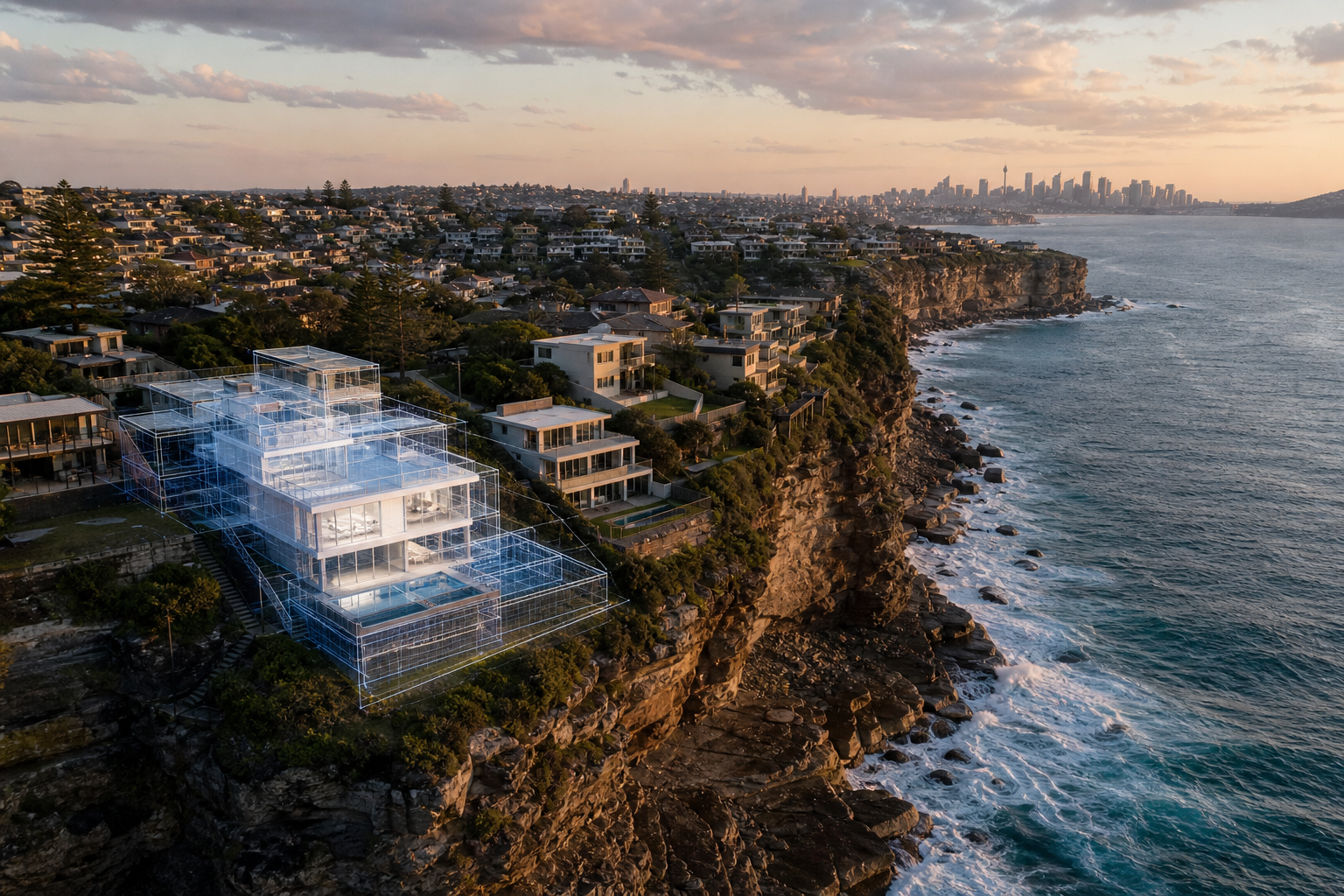
If you want to stay in Dover Heights long term, the real question usually isn’t “should we renovate or invest?” – it’s what order do we do things in, and how much risk is sensible at each step?
In a high‑price, low‑supply suburb like Dover Heights, sequencing matters more than almost anything else. Get the order wrong and you can end up:
- overleveraged right before a rate rise or business slowdown
- stuck in a half‑finished renovation when the bank won’t extend more credit
- unable to help your kids into a nearby property because you tied up all your equity
- with structures that create unnecessary tax, estate and refinancing headaches
Get it broadly right and you can usually:
- keep the home you love
- improve it in stages
- add one or two smart investments
- still sleep at night if rates rise 2–3% or your income wobbles.
This guide gives you a decision‑grade framework to sequence upgrades, renovations and investments around a Dover Heights base – something you can actually use this week.
1. The Dover Heights reality: why sequencing matters more here
Dover Heights isn’t an average Sydney suburb. According to Woollahra’s 2021 housing profile, the LGA is high‑income, older, highly educated and has some of the city’s highest mortgages and rents. Dover Heights sits at the pointy end of that.
That has three implications for your planning:
- Big numbers amplify small mistakes. A 5% price swing on a $5m property is $250k. A poorly sequenced upgrade or reno can easily lock in six‑figure opportunity costs.
- Bank rules bite harder. APRA’s serviceability buffer (lenders must test you at ~3% above today’s rate) can make an extra $500k of borrowing feel impossible on paper, even if you feel comfortable in real life.
- Lifestyle and school decisions anchor you. By the time kids are in Year 3–5 at local schools and your clients know your address, “we’ll just move to the Inner West” usually isn’t on the table.
So instead of asking “what’s the next move?”, start asking:
- What are the 2–4 key property and loan moves we’ll probably make over 10–15 years?
- In what order should we renovate, extend, upgrade or invest so we don’t get boxed in?
This is the same long‑range thinking we use in broader planning pieces like Designing a 10–15 Year Property and Mortgage Plan for a Dover Heights Family – applied specifically to staying put in Dover Heights.

2. Start with a 10–15 year map, not a renovation quote
Before you call a builder, take one evening to sketch a simple 10–15 year map.
2.1 The four anchor questions
Answer these honestly:
-
Are we 80–90% sure we want Dover Heights as our base for 10+ years?
If not, a major structural reno may not stack up. -
What life stages are ahead of us in that window?
- babies, school, teens, uni
- business expansion or sale
- elderly parents moving nearby
-
How stable is our income – really?
- salaried professionals with bonuses that come and go
- self‑employed or practice owners whose income swings
-
What’s the one thing we absolutely don’t want to risk?
For most Dover Heights owners, it’s “having to sell the family home in a down market”.
2.2 Convert the map into “guardrails”
From that, set some guardrails:
- Total home loan repayments (P&I) ideally 25–35% of net household income (stress levels spike past ~40%).
(This is consistent with guidance for Eastern Suburbs school‑zone buyers – see /insights/blue-chip-school-zones-eastern-suburbs-how-far-safely-stretch.) - Stress‑test every scenario at 3% higher interest rates (APRA style).
- Maintain 6–12 months of total living costs in cash/offset.
- Set a maximum Loan to Value Ratio (LVR):
- 60–70% if your income is volatile or you’re approaching retirement
- up to ~80% for strong, stable incomes and long horizons
With those guardrails in place, you can evaluate each possible path through a Dover Heights lens, not just a generic “Sydney” approach.
3. The main sequencing options when you want to stay put
Most Dover Heights owners who want to stay put fall into one of a few broad paths.
3.1 Common sequences
Path A – Reno first, invest later
- Modest or staged renovation / extension
- Stabilise cashflow and buffers
- Add one investment property once income and equity grow
Path B – Invest first, reno later
- Use equity in current home as an investment deposit
- Buy an investment unit or house elsewhere
- Renovate or extend Dover Heights home a few years later
Path C – Big home upgrade within Dover Heights
- Sell or restructure current home
- Buy “forever home” within Dover Heights (or nearby pocket)
- Renovate that property in stages and potentially add investments later
Path D – Business‑heavy path
- Prioritise business fit‑out, expansion or premises using home equity
- Consolidate, pay down, build buffers
- Then tackle renovation and/or investments
The “right” path depends on your income, risk tolerance and how under‑ or over‑capitalised your current home already is.
3.2 High‑level comparison
| Path | Suits who | Main upside | Main risk |
|---|---|---|---|
| A – Reno then invest | Families sure Dover Heights is long‑term base | Lifestyle uplift early, kids settled, tidy story to lenders | Cashflow tight during build, less flexibility if values dip |
| B – Invest then reno | Younger or high‑income households with smaller children | Earlier asset base growth, diversification | Construction costs may run ahead of you; reno squeezed by servicing limits |
| C – Big upgrade | Those clearly in “wrong” house but right suburb | Get the long‑term footprint right once | Buy/sell timing risk, very large debt if you keep old home too |
| D – Business‑first | Self‑employed, professionals, practice owners | Income engine strengthened first | Business underperformance can threaten the home if over‑leveraged |
We’ll unpack each, but first you need a number: your safe borrowing envelope.
4. Work out your safe borrowing envelope for Dover Heights
4.1 Turn income into a safe repayment range
Take your net household income (after tax and Medicare). Let’s say:
- Net household income: $28,000 per month (e.g. two professionals or a healthy practice)
A practical guide for Eastern Suburbs owners:
- Comfortable: 25–30% of net = $7,000–$8,400 per month
- Upper end: 35% of net = $9,800 per month
- Red zone: 40%+ of net = $11,200+ per month
So for this household, we’d usually aim to keep total home loan repayments (existing plus any new borrowing for renos or upgrades) under $9,000 per month at today’s rates – and check the position at +3%.
4.2 Translate repayments to a loan size (worked example)
Assume an owner‑occupied P&I rate of 6.0% p.a. and a 25‑year remaining term.
At that rate and term, very roughly:
- Each $1m of loan costs about $6,440 per month.
If your safe upper repayment is $9,000 per month, the safe loan size is about:
- $9,000 ÷ $6,440 ≈ $1.4m total P&I home debt.
If you already owe $1.1m, that suggests only ~$300k of new P&I borrowing is sensible for renovations or upgrades unless you:
- extend the loan term
- use some interest‑only for a period
- or significantly grow your income.
This is exactly the sort of modelling we’d normally do side by side with an equity release plan like in Tap Dover Heights Home Equity For Renovations Without Overstretching.
4.3 Check your LVR and buffer
Next, check your Loan to Value Ratio and buffer:
- Current property value (bank valuation): $4.0m
- Current home loan: $1.1m
- Current LVR: 1.1 / 4.0 = 27.5%
That’s very conservative. On paper, lenders might let you go to 80% LVR = $3.2m.
But safe doesn’t equal maximum.
If you took total LVR up to 60% (a safer line for affluent, low‑risk households):
- 60% of $4.0m = $2.4m
- Less current $1.1m = $1.3m potential extra debt
The question is not “what will the bank give us?” – it’s “what fits inside our safe repayment and lifestyle envelope?”
The strategy continues below
You've seen the problem and the groundwork — now unlock the exact steps our CPA-certified brokers use, including 9 more sections. Enter your email for instant, free full access.
Free access. No spam — unsubscribe anytime. Your details stay confidential.
Frequently asked questions
Should I renovate my Dover Heights home before buying an investment property?▾
How much can I safely borrow against my Dover Heights home for renovations?▾
Is it risky to use my Dover Heights home equity for both renovations and an investment?▾
How do I decide whether to upgrade within Dover Heights or renovate my existing house?▾
What buffers should I hold if I increase my Dover Heights home loan?▾
Do I really need a specialist Dover Heights mortgage broker?▾
How often should I review my Dover Heights property and loan plan?▾
Speak with a specialist advisor
Confidential consultation, bespoke advice for your situation.