Self-Employed
From start-up grind to homeowner: a practical five-year plan
A practical five-year roadmap for Australian start-up founders and new business owners who want to buy a home without starving their business of cash or over-stretching personally.
TL;DR
New business owners can realistically buy a home within about five years if they align business decisions with lending rules. The key is building clean financials, a reliable income story and a meaningful deposit while avoiding high-cost personal debt. This roadmap breaks the journey into clear yearly milestones and actions you can start on this week.

James Chee is the Managing Director of Local Knowledge Finance, bringing over 15 years of experience in mortgage broking and financial strategy to help Australians achieve their property and wealth goals. Specialising in residential, commercial, and development finance, James works closely with clients to structure tailored lending solutions that align with their long-term objectives. As an FBAA accredited member with access to 40+ lenders, James combines deep market knowledge with a client-first approach to deliver outcomes that matter.

From start-up grind to homeowner: a practical five-year plan
You’ve taken the leap into business. The income is lumpy, your time isn’t your own – and yet you’d still like to own a home within a few years.
That’s possible. But for self-employed borrowers, it doesn’t happen by accident.
This guide lays out a realistic five-year roadmap from start-up founder to homeowner, tailored to Australian lending rules. It’s designed so you can pick 1–3 moves to act on this week.

Fast overview: how long until you can buy?
For most new business owners, a realistic path to your first (or next) home looks like this:
- Years 0–2: Get the basics right – bookkeeping, tax, separate accounts, stable drawings.
- Years 2–4: Build a provable profit track record and grow a 10–20% deposit.
- Years 4–5: Optimise your numbers, get pre-approved, buy, and then refinance when the business matures.
Lenders usually want two full years of tax returns for self-employed borrowers and will stress-test repayments about 3% above the actual rate under APRA guidance. Your plan needs to work inside those rules.
For a deeper dive into how lenders view self-employed income, see our dedicated guide: /insights/self-employed-to-homeowner-without-payslip.
How banks see you when you’re newly self-employed
Before mapping the five years, it helps to understand the “game rules”.
What lenders care about
Most mainstream lenders will look for:
- Two years of business financials and personal tax returns.
- Stable or growing income (declining profit is a red flag).
- Clean separation between business and personal expenses.
- Low unsecured personal debt (credit cards, personal loans, BNPL).
- Genuine savings and a deposit, ideally 10–20% plus costs.
Even if you feel cashed-up, if last year’s lodged tax return shows a very low profit after all your deductions, your borrowing power can be far lower than you expect.
Serviceability and the 3% buffer
Lenders run a “serviceability” test to see if you could afford the loan if rates rise. In Australia, that usually means:
- Testing your repayments at about 3% higher than the actual interest rate.
- Using a benchmark for living costs (HEM) plus your disclosed expenses.
So if a lender is offering 6% p.a., your capacity is modelled as if you’re paying about 9% p.a. That’s why managing your personal spending and debt matters as much as your headline business profit.
The five-year roadmap at a glance
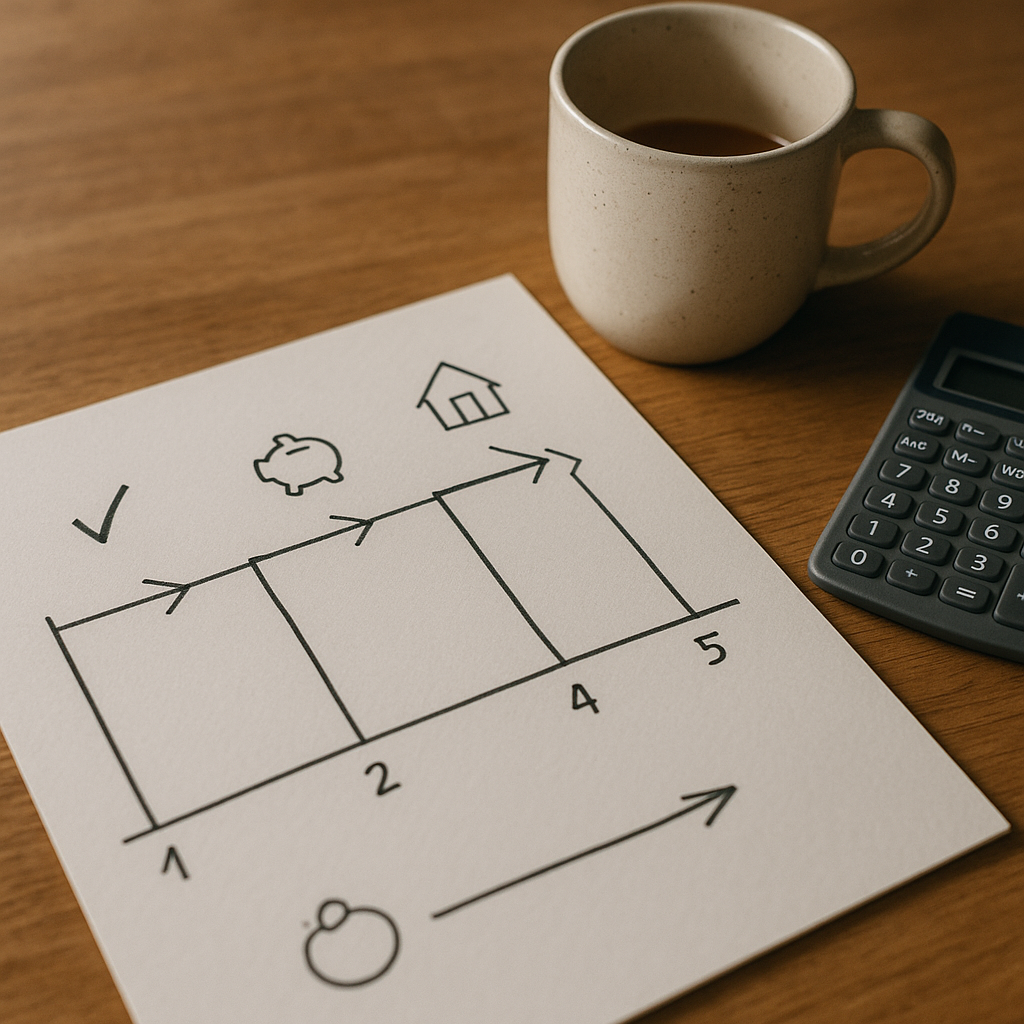
Think of the journey as five overlapping phases rather than rigid calendar years.
| Year | Primary focus | Key money moves |
|---|---|---|
| 0–1 | Foundations | Separate accounts, bookkeeping, credit clean-up, safety nets |
| 1–2 | Stabilise & standardise | Regular drawings, tidy tax position, manage deductions |
| 2–3 | Track record & deposit build | Grow taxable income, systemise savings, explore incentives |
| 3–4 | Home-loan readiness | Optimise numbers, reduce bad debt, get pre-approval |
| 4–5 | Buy & future-proof | Purchase, set up structure, plan refinance and buffers |
We’ll unpack what to do in each phase – and what you can start this week, even if your business is only months old.
The strategy continues below
You've seen the problem and the groundwork — now unlock the exact steps our CPA-certified brokers use, including 10 more sections. Enter your email for instant, free full access.
Free access. No spam — unsubscribe anytime. Your details stay confidential.
Frequently asked questions
How long after starting a business can I get a home loan in Australia?▾
Do banks treat self-employed borrowers as higher risk?▾
Will claiming lots of tax deductions hurt my borrowing capacity?▾
Can I get a home loan if my business only has one year of financials?▾
Should I pay off business debt before applying for a home loan?▾
About the Author
James Chee
James Chee is the Managing Director of Local Knowledge Finance, bringing over 15 years of experience in mortgage broking and financial strategy to help Australians achieve their property and wealth goals. Specialising in residential, commercial, and development finance, James works closely with clients to structure tailored lending solutions that align with their long-term objectives. As an FBAA accredited member with access to 40+ lenders, James combines deep market knowledge with a client-first approach to deliver outcomes that matter.
Every article is written or reviewed by a qualified professional. This content reflects real advisory experience.
Speak with a specialist advisor
Confidential consultation, bespoke advice for your situation.