Article
Should You Tap Home Equity Or Use Equipment Finance?
Clear, decision-grade guide on whether to use your home equity or a dedicated equipment loan to fund business assets, with numbers, risks and structures you can act on this week.
Key Takeaway
Using home equity for business equipment can slightly reduce the headline interest rate, but when stretched over 25–30 years it often results in 2–4 times more total interest than a 3–7 year equipment loan, while putting the family home at risk. In a backdrop where over 30% of Australian mortgage holders are already ‘At Risk’ of stress, concentration risk on the home matters. Business owners should generally prefer stand‑alone equipment finance and only use home equity in short, clearly defined splits with conservative LVRs.

Using home equity for business equipment can look cheaper on paper, but it usually loads risk onto your home and can cost more over the life of the asset than a 3–7 year equipment loan. In most cases, stand‑alone equipment finance is safer, and home equity should only be used sparingly, on short terms, with conservative LVRs and a clear exit plan.
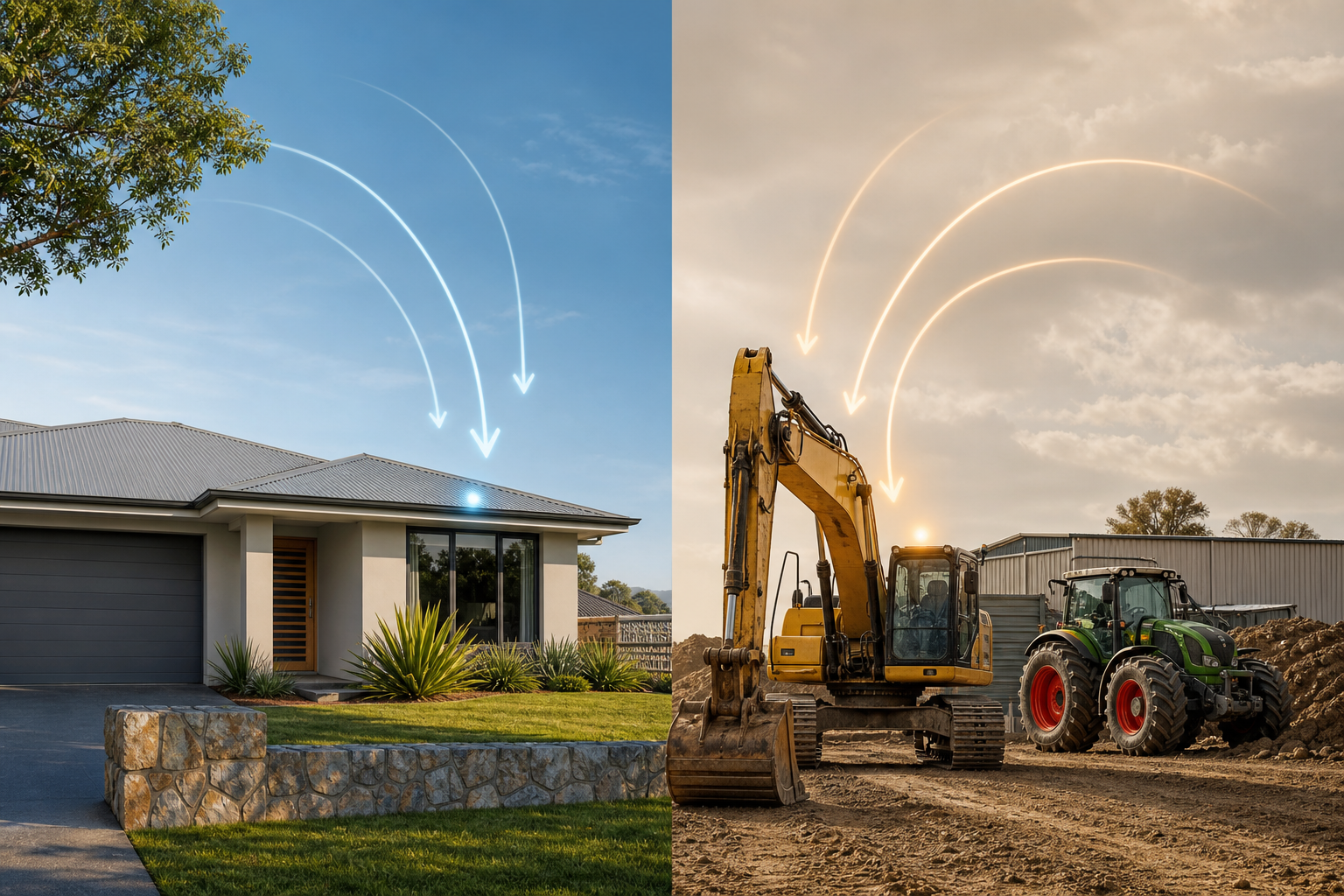
Quick comparison: home equity vs equipment finance
Home equity (cash‑out from your mortgage)
- Security: your house (or investment property).
- Term: often 20–30 years unless you deliberately shorten it.
- Rate: usually lower headline rate than equipment loans.
- Risk: if the business fails, the lender can pursue your home.
Dedicated equipment finance (e.g. chattel mortgage, lease, hire purchase)
- Security: mainly the equipment itself, sometimes plus director guarantee.
- Term: typically 3–7 years, aligned to the asset’s working life.
- Rate: usually higher than a home loan, but for a much shorter term.
- Risk: business risk mostly ring‑fenced away from your home.
Worked example: $120,000 machine
Assume:
- Home‑loan rate: 6.2% p.a., 25‑year term (P&I).
- Equipment loan: 8.5% p.a., 5‑year term (P&I, no balloon).
If you use home equity:
- Monthly: about $790.
- Total repaid over 25 years: ~$236,900.
If you use equipment finance:
- Monthly: about $2,460.
- Total repaid over 5 years: ~$147,600.
Even with a lower rate, the long home‑loan term means you pay roughly $90,000 more interest and are still paying for the machine long after it’s worn out. This matches what we see in practice: rolling equipment into 25–30 year home loans often multiplies total interest by two to four times.
The strategy continues below
You've seen the problem and the groundwork — now unlock the exact steps our CPA-certified brokers use, including 4 more sections. Enter your email for instant, free full access.
Free access. No spam — unsubscribe anytime. Your details stay confidential.
Frequently asked questions
Is it cheaper to use my home loan for business equipment?▾
When does it make sense to use home equity for equipment?▾
Is dedicated equipment finance tax deductible compared to using my mortgage?▾
Speak with a specialist advisor
Confidential consultation, bespoke advice for your situation.