Article
Using Your Home Loan to Pay for Solar: A Practical Guide
Thinking about adding solar panels and wondering whether to put them on your home loan? This guide explains how solar interacts with your mortgage, the main finance options, and when topping up, refinancing or using a separate split actually makes sense.
Key Takeaway
Australian homeowners can fund solar panels through their home loan by topping up using equity, refinancing with extra cash out, or creating a separate short-term loan split secured against the property. Because most lenders assess serviceability using a rate at least 3 percentage points above the actual rate, extending a $15,000 solar system over 30 years at 6% can add about $17,000 of interest versus roughly $3,400 over 7 years. The most effective strategy is to keep any solar-related split on a much shorter term than the main mortgage.

In Australia, you can fund a solar system through your home loan by topping up using equity, refinancing with extra cash out, or adding a separate ‘solar’ loan split secured against your property. This often gives you a lower interest rate than a personal loan, but if you stretch the cost over 25–30 years you can easily double what you pay in interest. The real decision is not just can you add solar to your mortgage, but how and on what terms.
This guide steps through the main structures, traps to avoid, and the exact checks to run before you sign a solar contract or touch your loan.
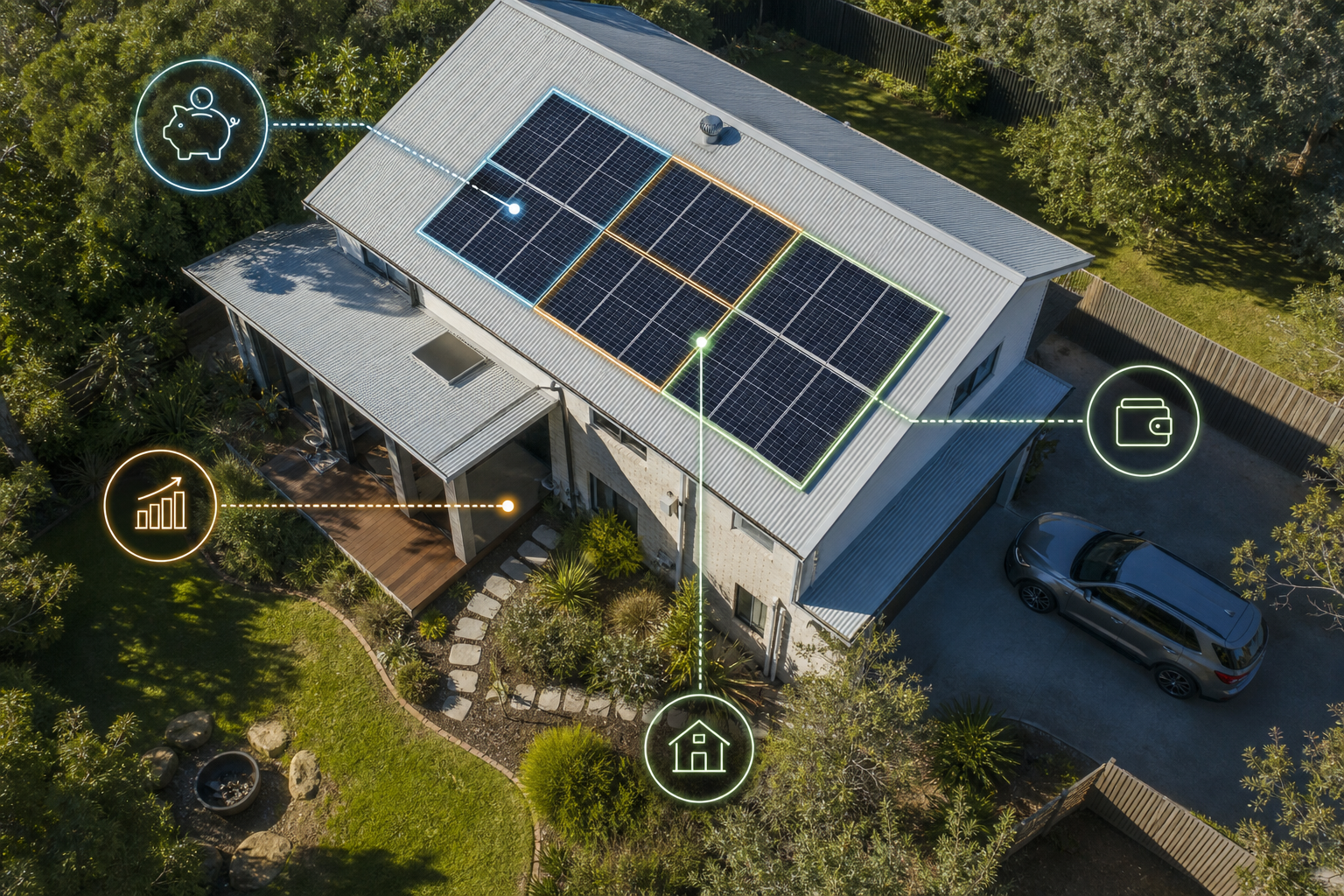
1. How solar and your home loan actually interact
When you borrow against your home to pay for solar, the lender treats it as a home improvement. The debt is secured by your property, just like the rest of your mortgage, and your total repayments are assessed using a serviceability rate at least 3% above the actual rate, in line with APRA guidance (12,15).
That means three things:
- Your borrowing capacity and repayment comfort matter as much as the system cost.
- Your loan-to-value ratio (LVR) after the top-up or refinance is critical.
- The loan term you choose can make the difference between solar saving you money, or quietly bleeding cash for decades.
Most lenders are comfortable with solar as long as:
- Your post-valuation LVR is within policy (80% or lower usually gives the best choice and pricing (3)).
- You still pass their serviceability test at the higher assessment rate.
- The purpose is clearly documented (home improvement versus investment or business use).
Solar also interacts with tax and cash flow:
- Owner-occupiers: No tax deduction on interest, but you do get lower power bills.
- Investors: When solar is installed on a rental property, interest on the portion of the loan used is generally tax-deductible, plus you may claim depreciation, subject to ATO rules.
- Small businesses/home offices: You may apportion interest and depreciation between private and business use.
Because the RBA cash rate has risen sharply from the COVID-era low to 4.35% in May 2026, putting pressure on mortgage rates and household budgets, getting the structure right before you add more debt is more important than ever.
2. Main ways to finance solar using your home loan
There are four broad ways to line up solar with your mortgage. The right fit depends on your equity, current rate, and how disciplined you are with repayments.
2.1 Top-up using existing equity
A top-up (or equity release) increases your existing home loan limit to fund the solar purchase.
How it works in practice:
- The lender orders a valuation on your property.
- You can usually borrow up to a percentage of the new value (often 80% without LMI; sometimes more with LMI).
- The increase in your limit is paid to you or directly to the installer.
Example – top-up within 80% LVR
- Home value (valuation): $800,000
- Current loan: $520,000 (65% LVR)
- 80% of value: $640,000
- Potential total lending at 80%: $640,000
- Theoretical equity available at 80%: $120,000
If you top up by $15,000 for solar, your new loan becomes $535,000.
- New LVR = $535,000 / $800,000 = 66.9%
You stay comfortably below 80% LVR, so no new Lenders Mortgage Insurance (LMI), and most lenders will treat this as a simple variation if you pass serviceability.
The key decision is whether you:
- Keep the same remaining term, which slightly increases your monthly repayment; or
- Extend the loan back out, which can feel cheaper month to month but badly increases lifetime interest.
2.2 Refinance and add funds for solar
If your current rate is uncompetitive, you might refinance to a new lender and add the solar cost to the new loan.
This can make sense if:
- Your existing loan is clearly above realistic new-customer rates for your LVR band (see how to check in “Spotting an Uncompetitive Home Loan Rate in 2026, Fast”).
- You have enough equity to stay at or under 80% LVR after adding solar.
- The savings from refinancing outweigh any discharge, application and potential break fees.
Watch for a subtle trap: resetting the clock. Refinancing back to a new 30-year term, including your solar top-up, often increases total interest even if the new rate is lower (17). That’s especially painful when you’re funding an asset like solar that might last 20–25 years.
Before refinancing purely for solar, run a stay-versus-switch comparison, including:
- Old vs new rate and fees.
- Old remaining term vs new term.
- Extra interest from stretching the solar portion over a longer period.
For a step-by-step framework, see “How to Decide When Refinancing Your Home or Investment Loan Makes Sense”.
2.3 Separate solar loan split or ‘green’ split
Instead of mixing solar into your main home loan, you can ask for a separate loan split (sometimes marketed as a green loan or sustainability split).
Key features:
- Dedicated account for the solar system only.
- Often a shorter term (e.g. 5–10 years) with principal and interest (P&I) repayments.
- Same or slightly different rate to your main mortgage, but still much cheaper than unsecured personal loans.
This structure aligns with a critical principle: match the loan term to the life of the expense (8).
- Most residential solar systems have a warranty or expected life around 20–25 years.
- A 5–10 year loan term means you’re likely to own the system outright for a decade or more while still enjoying the savings.
Using multiple splits like this also gives you more control. You can target extra repayments to the solar split while keeping your main home loan structure stable (5).
2.4 Funding solar during construction or renovation
If you’re building or doing major renovations, you can usually include solar in your construction loan or renovation budget.
Pros:
- The cost is built into your overall project finance.
- Valuers often treat solar as part of the completed property’s value.
- You avoid multiple loan applications.
Cons:
- Easy to lose visibility of the solar cost within a larger loan.
- Same long-term interest risk if you don’t manage the term carefully.
3. Home loan vs other solar finance options
Solar is often marketed with attractive-sounding finance offers. Your mortgage is just one option.
Below is an illustrative mid‑2026 comparison (actual offers will vary and change).
| Option | Indicative interest rate (p.a.) | Typical term | Secured against home? | Main pros | Key watch-outs |
|---|---|---|---|---|---|
| Pay cash | 0% | N/A | No | No interest, simple, fast | Ties up savings; less buffer for other expenses |
| Home loan top-up (same split) | ~5–7% | Up to 25–30 yrs | Yes | Lowest rate category; easy to arrange | Huge interest if repaid over full mortgage term |
| Separate mortgage split / green loan | ~5–8% | 5–10 yrs | Yes | Lower rate + controlled term; clear purpose | Higher monthly repayment than 25–30 year structure |
| Unsecured personal/solar loan | ~8–14% | 3–7 yrs | No | No impact on property security | Much higher rate; can hurt home loan serviceability |
| ‘No interest’ vendor/BNPL plan | Often equivalent to 10–20%+ | 3–10 yrs | Sometimes indirectly* | Low upfront cost; quick approval | Embedded fees; high effective rate; harsh late fees |
*Some vendor finance arrangements can create ongoing obligations that lenders factor into home loan serviceability.
A home loan–based option usually wins on interest rate, but it only wins overall if you keep the term under control and avoid expensive LMI.
The strategy continues below
You've seen the problem and the groundwork — now unlock the exact steps our CPA-certified brokers use, including 6 more sections. Enter your email for instant, free full access.
Free access. No spam — unsubscribe anytime. Your details stay confidential.
Frequently asked questions
Is it better to pay cash or add solar to my home loan?▾
Will adding solar to my home loan affect my future borrowing power?▾
Can I use equity from an investment property to put solar on my home?▾
Are there tax benefits if I use my home loan for solar?▾
Can I refinance just to add solar, or should I wait?▾
What if my home loan is fixed and I want solar now?▾
Speak with a specialist advisor
Confidential consultation, bespoke advice for your situation.