Article
Smart Ways Dover Heights Retirees Can Access Home Equity Safely
A practical guide for Dover Heights retirees whose main asset is their home. Learn the main ways to unlock equity, the risks to avoid, and how to build a simple, tax‑aware action plan this week without jeopardising your lifestyle or security.
Key Takeaway
Dover Heights retirees whose main asset is their home can access equity via reverse mortgages, retirement-focused lines of credit, small top-up loans, or staged downsizing, while keeping total loan-to-value ratios under about 40–50% for resilience. With median Dover Heights house prices above $4 million, even a 15–20% equity release can fund decades of lifestyle if structured carefully. A clear one-week plan is to quantify your safe usable equity, choose the least risky product, and separate loan splits by purpose.

Most Dover Heights retirees are “asset rich, income tight”: a multimillion‑dollar home and modest super or pension. Accessing equity in retirement means turning a slice of that Dover Heights property value into usable cash or income, without being forced to sell. Done well, you keep living where you are, improve lifestyle, and still protect future aged‑care and family goals.
In this guide we’ll focus on practical, decision‑grade steps for Dover Heights owners whose main wealth is the family home. The aim: know your realistic options this week, not just someday.

1. Start with the big questions: what problem are you actually solving?
Before talking products, get clear on why you’re thinking about equity release. That answer shapes everything.
1.1 Common goals for Dover Heights retirees
Most conversations in Dover Heights fall into four buckets:
-
Lifestyle top‑up
Extra $1,000–$3,000 per month for travel, dining out, family support, or home help. -
One‑off projects
Renovating bathrooms or kitchen, major repairs, or making the home more accessible so you can age in place. -
Helping family
Gifting or lending deposits to children or grandchildren, school fees, or early inheritances. -
Safety buffer
A line of credit or cash reserve so you’re not anxious every time rates move or the car needs replacing.
Those goals need to be weighed against three critical constraints:
- How long do you realistically want to stay in the home? 5 years? 10? 20?
- What quality of aged care would you like if or when you need it?
- What minimum estate do you want to leave, if any?
Being honest about these now avoids rushed, distressed decisions later.
1.2 A simple priorities exercise
Write three numbers on a page, ranking importance 1–3 (no ties):
- Staying in the Dover Heights home as long as possible
- Maintaining or lifting lifestyle now
- Preserving an inheritance for children/grandchildren
That ranking will guide whether you lean towards small, conservative borrowing or consider larger equity release or downsizing.
2. How much Dover Heights equity can you safely access?
In Dover Heights, it’s common to see homes valued at $3.5m–$6m+, sometimes with little or no mortgage. That can feel like “free money”, but there are real limits.
A practical framework, consistent with our broader equity work in high‑price markets (see /insights/how-much-equity-safely-release-home-australia), is:
-
Property‑level LVR guardrail:
- Under 40% total LVR in retirement is conservative.
- 40–50% is moderate but generally safe if income is stable.
- Above 50% for retirees is usually high risk, especially on variable rates.
-
Cash buffer test:
Hold at least 6–12 months of planned spending and loan costs in cash or offset, not just in redraw.
2.1 Worked equity example – Dover Heights couple, age 72
- Home value (agent appraisals): $4.5m
- Existing mortgage: $150,000 (old P&I loan)
- Current LVR: $150k / $4.5m = 3.3%
If we target a conservative 35% retirement LVR:
- Maximum safe debt: 35% × $4.5m = $1,575,000
- Less existing debt: $1,575,000 − $150,000 = $1,425,000 potential new borrowings
But that doesn’t mean you should take $1.4m now. For later‑life borrowers, the safer pattern is:
- Release an initial $200k–$500k (depending on the goal).
- Put some into a cash or offset buffer.
- Reassess every 3–5 years, rather than maxing out today.
This staged approach mirrors the safe equity frameworks we use for investors in high‑value markets like Dover Heights and Green Square (see /insights/dover-heights-equity-balanced-property-portfolio-case-study).
2.2 Serviceability vs. equity for retirees
For working borrowers, banks focus on income and the APRA 3% serviceability buffer. For retirees:
- Mainstream banks can still lend if there is provable income – super pensions, account‑based pensions, part‑time work, rental income.
- Reverse mortgage providers focus more on age and property value, less on current income, but the debt compounds over time.
The key is not “what will a lender let me do?” but “what can I comfortably live with if rates rise and costs increase?”
3. Main ways to access equity when your main asset is the home
All later‑life equity options sit on a spectrum between control and repayment flexibility on one side, and cost and compounding risk on the other.
We’ll focus on three families of options useful for Dover Heights retirees.
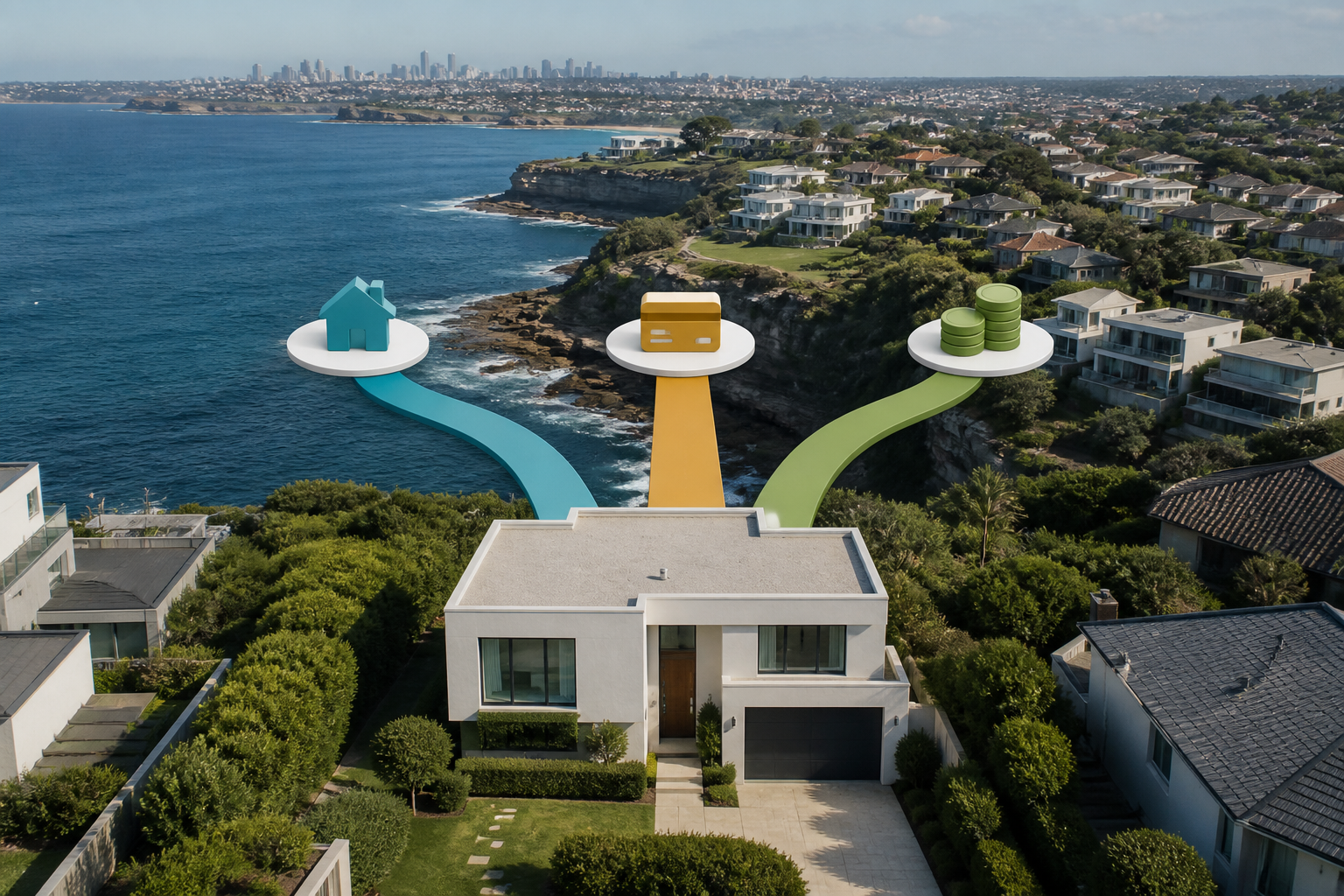
3.1 Reverse mortgage (equity release loan)
What it is: A loan secured against your home, usually for people aged 60+, where no regular repayments are required. Interest is added to the balance, and the loan is typically repaid when you sell, move into aged care, or pass away.
Pros
- No mandatory monthly repayments – helpful if cashflow is tight.
- You can draw lump sums, regular income, or a combination.
- ASIC‑regulated providers must offer negative equity protection, so you won’t owe more than the home value in normal circumstances.
Cons
- Interest compounds, so the debt can grow significantly over 10–20 years.
- Reduces the estate and can limit options for future aged‑care funding.
- Fewer lenders, and rates are usually higher than standard home loans.
Good fit when:
- Income is tight and you can’t comfortably pass a standard loan serviceability test.
- You want to age in place for at least 5–10 years.
- You’re comfortable with a smaller estate in exchange for better lifestyle now.
For a deeper comparison of reverse mortgages versus other structures across Australia, see /insights/reverse-mortgage-vs-line-of-credit-vs-downsizing-australia.
3.2 Retirement‑friendly line of credit (LOC)
What it is: A flexible, interest‑only facility linked to your home, where you can draw funds as needed up to an approved limit. You’re usually required to pay interest monthly, but can control the timing of principal repayments.
Pros
- You only pay interest on what you actually draw, not the whole limit.
- Can be linked to an offset or everyday account, making cash management easy.
- Interest‑only keeps repayments lower than principal & interest.
Cons
- Requires a clearer income story than a reverse mortgage.
- If you only pay interest and keep drawing, debt may not reduce.
- Discipline needed to avoid treating it like an unlimited ATM.
Good fit when:
- You have reasonable income (super, pension, investment income) but want flexibility.
- You need an ongoing buffer for medical costs, home help, or irregular spending.
- You want more control than a reverse mortgage but don’t want to commit to heavy principal repayments.
This is a common path for “asset‑rich, low taxable income” later‑life borrowers in Dover Heights – building on the same principles we use earlier in life (see /insights/asset-rich-low-taxable-income-home-loan-dover-heights).
3.3 Small top‑up loan (traditional home loan extension)
What it is: Extending or re‑writing your existing home loan to release a one‑off lump sum, usually on principal & interest or interest‑only terms.
Pros
- Typically cheaper interest rates than specialist reverse mortgages.
- Clear, scheduled repayment – debt can actually reduce over time.
- Easier to ring‑fence by purpose using separate loan splits.
Cons
- You must pass standard bank serviceability tests with a 3% buffer.
- Higher required repayments than a reverse mortgage or LOC.
- Less flexible if your income drops later.
Good fit when:
- You’re in your 60s or early 70s with decent provable income.
- You only need a modest lump sum – e.g. $150k–$400k.
- You’re comfortable committing to regular repayments.
The strategy continues below
You've seen the problem and the groundwork — now unlock the exact steps our CPA-certified brokers use, including 7 more sections. Enter your email for instant, free full access.
Free access. No spam — unsubscribe anytime. Your details stay confidential.
Frequently asked questions
How much equity can a Dover Heights retiree usually access safely?▾
Is a reverse mortgage always worse than a line of credit?▾
Will accessing equity affect my Age Pension or Seniors Health Card?▾
Can I use my Dover Heights equity to help my children buy property?▾
What happens to the loan if I move into aged care or pass away?▾
Is it better to downsize first or access equity and downsize later?▾
Speak with a specialist advisor
Confidential consultation, bespoke advice for your situation.