Article
How to Finance Solar During a Renovation or Extension
Thinking about adding solar while you renovate or extend? This guide explains whether to use a construction loan or an equity top-up, how the cashflow works, and what to decide this week so your solar actually gets installed — without blowing the budget.
Key Takeaway
When adding solar during a renovation or extension, Australians typically choose between including solar in a construction loan or using a separate equity top‑up on their home loan. Construction loans can fund large projects with staged progress payments but add complexity and valuation risk, while equity top‑ups are simpler if there is at least 20% equity and solar costs are under about $40,000. Structuring solar as its own loan split helps track costs, manage tax, and preserve flexibility for future borrowing.
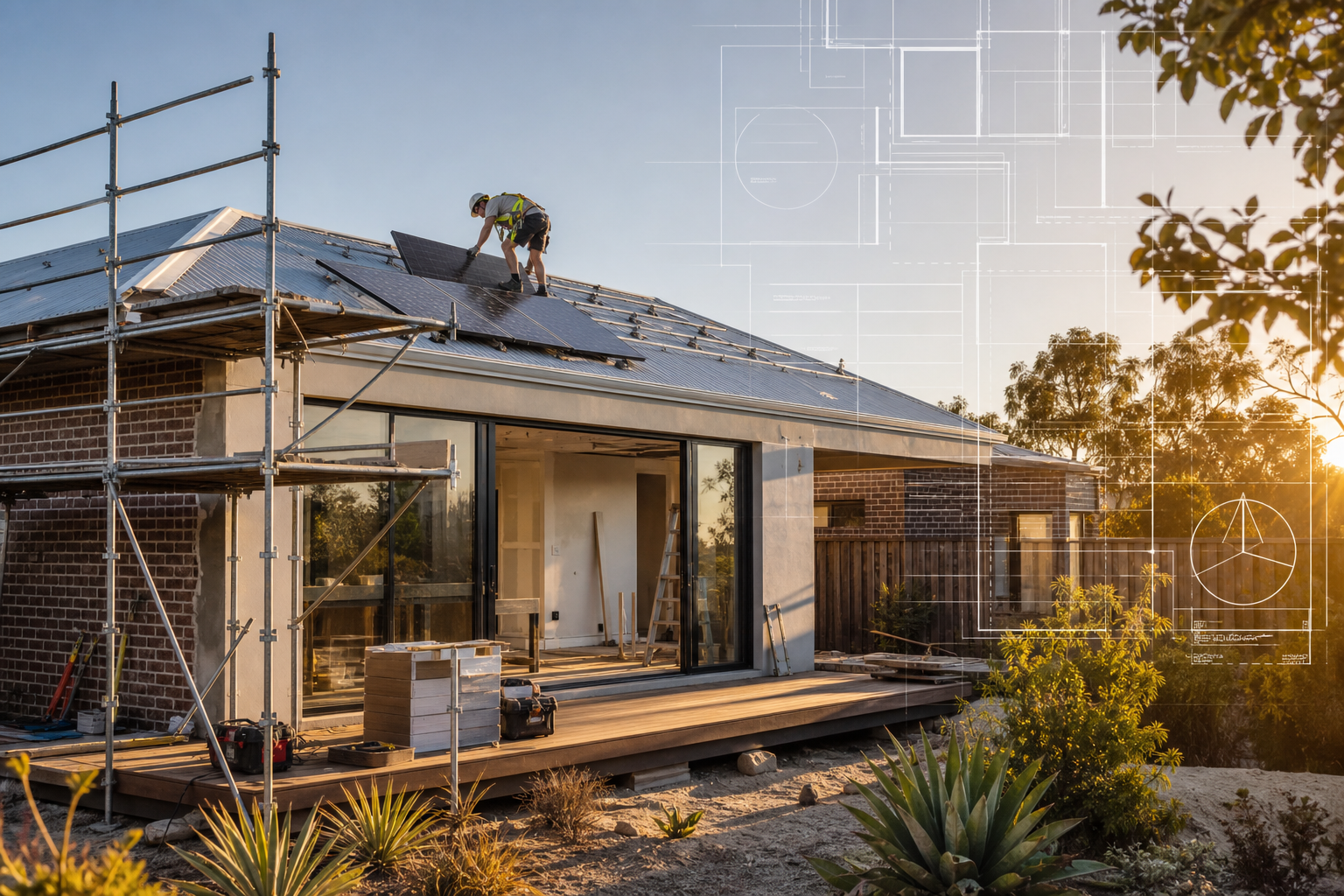
Adding solar to a renovation or extension can be funded in two main ways: (1) as part of a construction loan tied to your building contract, or (2) via an equity top‑up on your existing home loan (or a refinance with cash out). The best choice depends on your project size, how much equity you have, and how tightly you need to control cashflow and risk.
This guide gives you a decision‑grade comparison of construction loans versus equity top‑ups for solar, plus a one‑week action plan so you can move from “good idea” to “clear plan” this week.

Get clear on your renovation scope and solar costs before choosing a loan structure.
1. Start with the numbers: what does solar really cost?
Before you talk loan types, you need a realistic solar budget. Many people dramatically underestimate the cost of adding solar (and batteries) to a major renovation.
For current price ranges and how to interpret quotes, see the dedicated guide: What Solar System Really Costs You – And How Much To Borrow.
1.1 Typical solar and battery costs in 2026
Indicative (not a quote):
- 6–8 kW solar only: $6,000–$10,000
- 10–13 kW solar (larger homes, some three‑phase): $10,000–$18,000
- Battery (10–15 kWh): $9,000–$18,000
- Upgraded switchboard / wiring / monitoring: $1,500–$5,000
- Roof works (tilt frames, structural tweaks): highly variable, often part of the renovation contract
So a realistic bracket for “renovation‑grade” solar and battery is often $15,000–$35,000, and can push past $40,000 for large homes or complex roofs.
1.2 Rule of thumb: when solar is “big enough” to treat as part of the build
As a rough guide:
- Under ~$15,000 and not structurally complex: could sit outside the main construction loan as a simple equity top‑up or even be paid in cash.
- $15,000–$40,000 and/or dependent on roofing, wiring or structural works: worth seriously considering inside the building contract or as a clearly planned equity top‑up.
- $40,000+ or part of a major extension/rebuild: usually better integrated with the overall project finance and valuations.
2. Construction loan vs equity top‑up: the core idea
2.1 What is a construction loan for renovations and extensions?
A construction loan funds major works (extension, second storey, significant structural renovation) based on an approved building contract. Key features:
- The bank or lender approves a total facility limit based on the property’s “on‑completion” value.
- Money is released in progress payments to the builder (slab, frame, lock‑up, fit‑out, completion).
- You usually pay interest‑only during the build, then revert to principal and interest.
You’ll find more background around construction loans and large projects in Smart ways to fund major renovations and rebuilds in Rose Bay.
2.2 What is an equity top‑up?
An equity top‑up is an increase to your existing home loan (or a new split) using the extra value in your property as security. Key ideas:
- Lenders generally like your total loans to be ≤80% of property value to avoid LMI.
- If you do go above 80%, Lenders Mortgage Insurance can add thousands of dollars.
- You can structure a separate loan split for solar so you can track and potentially pay it down faster.
For a broader look at equity release for home works, see Using Home Equity for Renovations and Rebuilds in Sydney’s East.
2.3 The key difference for solar
- Construction loan route: solar is part of the building contract, paid via progress payments, and included in the end valuation.
- Equity top‑up route: solar is funded separately, either before, during or after the renovation, usually paid directly to the installer.
Neither is always “better”. The question is which one matches:
- Your timeline (when you want solar installed).
- Your equity position and borrowing capacity.
- How much complexity and paperwork you can tolerate.
- Your risk appetite around valuations and cost overruns.
3. When to use a construction loan for solar
3.1 Signs the construction loan is the right home for solar
Leaning towards a construction loan for solar makes sense when:
- You’re already doing a big structural renovation or extension.
- Your builder is happy to include solar as a prime cost (PC) item or a firm line item.
- The solar install is integrated with roof works, electrical upgrade or battery room.
- You want everything in one loan and are comfortable with progress payment rules.
3.2 Pros of including solar in the construction loan
- Single valuation, single approval. The valuer estimates the finished house with solar, which may support a higher “on‑completion” value.
- Interest‑only during build. You’re not making full repayments on the solar spend until completion.
- Cleaner builder coordination. The builder can schedule roof preparation, wiring and solar installer access.
- Potentially higher final value. A smart, integrated solar and battery system can be attractive in valuation reports, especially in energy‑conscious suburbs.
3.3 Cons and risks
- More lender scrutiny. Banks may want detailed quotes, product specs and timing.
- Less flexibility if you change your mind. Variations within construction loans can be slow and subject to re‑approval.
- Valuation and buffer risk. If the final valuation comes in low, your lender might reduce the facility — which can squeeze solar and other “non‑essential” items.
- Progress payment timing. Solar installers often want a big chunk of money on or just after install, which doesn’t always line up neatly with bank drawdowns.
3.4 Worked example: construction loan including solar
Imagine:
- Current home value: $1,600,000
- Existing loan: $900,000 (56% LVR)
- Renovation + extension building contract: $600,000, including $30,000 solar and battery
The lender orders a valuation and the valuer estimates on‑completion value of $2,200,000.
- Max lend at 80% LVR = 0.80 × $2,200,000 = $1,760,000
- Less existing loan: $900,000 → $860,000 capacity for construction costs and fees
- You only need $600,000 → the deal is very comfortable at around 69% LVR on completion.
In this scenario, including solar inside the construction loan is straightforward. You have:
- Plenty of equity buffer.
- One loan structure.
- Flexibility if the builder or solar quote creeps up.
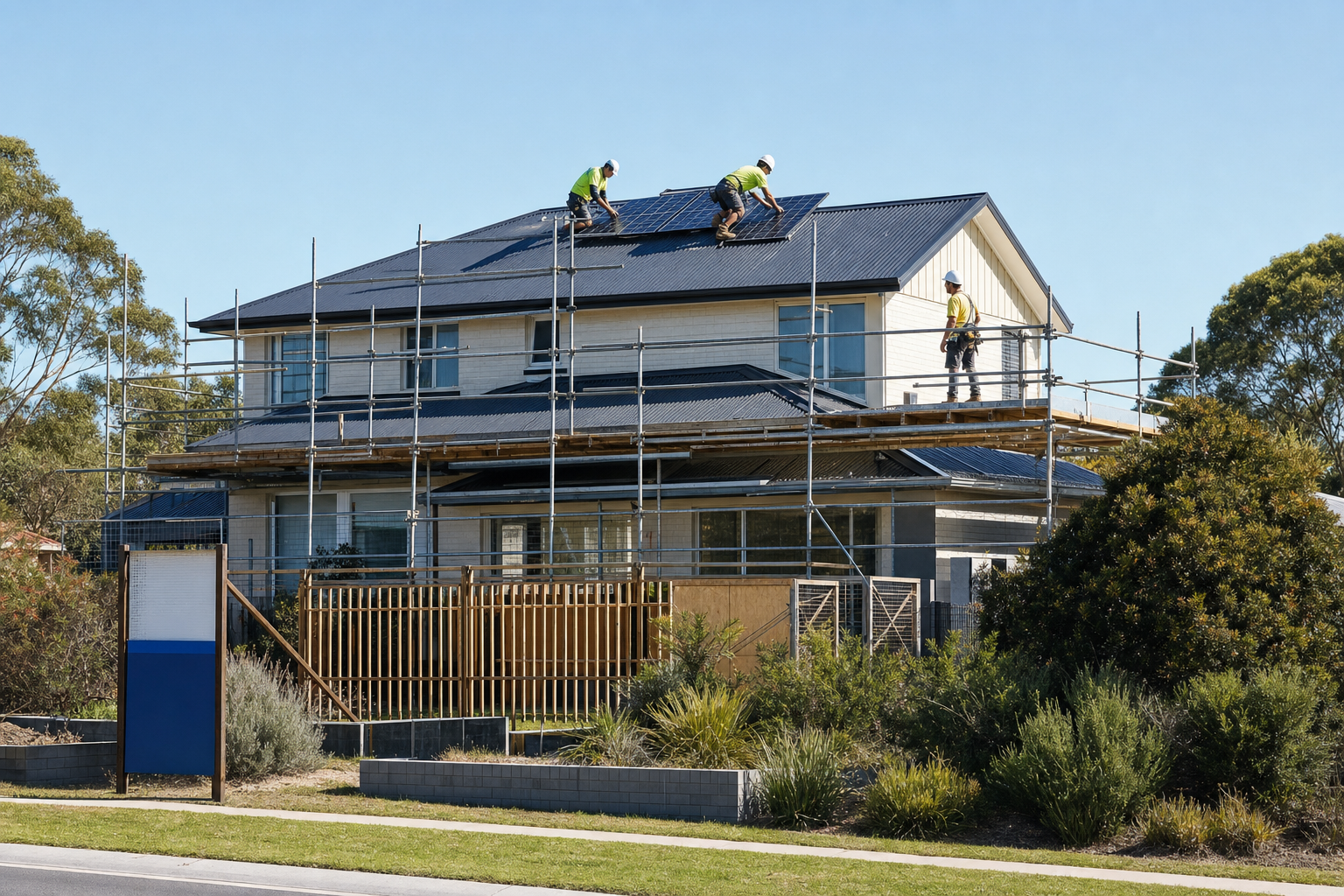
Including solar inside a construction loan can work well on major extensions and rebuilds.
4. When an equity top‑up is better for solar
4.1 Signs equity top‑up is the better fit
An equity top‑up can be more practical when:
- The renovation is moderate, and you’re not using a formal construction loan.
- The solar spend is relatively small (say under $30,000–$40,000).
- You already have strong equity (LVR comfortably below 80%).
- You want to shop around installers independently of your builder.
- You like the idea of a separate loan split you can pay down faster.
4.2 Pros of using equity top‑up for solar
- Simplicity. Less paperwork than a full construction facility.
- Timing flexibility. You can install solar before, during or after the renovation depending on access.
- Direct payment to installer. No progress claim juggling between builder, bank and solar company.
- Clear tracking. A dedicated “Solar + Battery” loan split can be aggressively paid down in 5–10 years.
4.3 Cons and risks
- Equity limits. If you’re already around 80% LVR, there may not be enough headroom.
- Serviceability. Lenders must still test your ability to repay the higher loan using current interest rates plus a 3% buffer (APRA guidance).
- Potential LMI. If the top‑up pushes you over 80% LVR, you’ll need to weigh up paying LMI versus waiting or scaling back.
4.4 Worked example: equity top‑up for solar during a renovation
Say:
- Current home value (pre‑reno): $1,400,000
- Existing home loan: $900,000 (64% LVR)
- Planned cosmetic renovation: $120,000 (paid from savings)
- Solar and battery quote: $25,000
You want to keep LVR at or under 80% to avoid LMI.
- Max lend at 80% = 0.80 × $1,400,000 = $1,120,000
- Less existing loan: $900,000 → $220,000 potential headroom
You only need a $25,000 top‑up for solar. Structure it as a separate 10‑year P&I split:
- Assume 6.5% p.a. interest, 10‑year term.
- Monthly repayment ≈ $284.
On your main 30‑year $900,000 loan at 6.5%, monthly P&I ≈ $5,692.
Total ≈ $5,976 per month. That’s manageable for many households, but you’d still stress‑test your budget against higher rates and possible income changes.
5. Side‑by‑side: construction loan vs equity top‑up for solar
5.1 Comparison table
| Factor | Construction loan (solar inside contract) | Equity top‑up (separate split) |
|---|---|---|
| Best suited for | Major renovations/extensions with building contract | Smaller to medium solar spend, flexible timing |
| Cashflow during works | Usually interest‑only on full facility | Normal P&I (or IO if allowed) from day one |
| Admin & paperwork | Higher: plans, contracts, progress claims | Lower: standard top‑up / refinance process |
| Control over installer | Often via builder; bank may require them on contract | You choose installer and timing directly |
| Valuation basis | On‑completion value including solar | Current value; solar may not be separately recognised until after works |
| Flexibility to change solar spec | Variations can trigger bank review | You can adjust within your approval amount, or re‑quote before drawdown |
| Risk if costs blow out | Risk entire facility needs re‑approval or more cash buffers | Solar can be delayed, downsized or cancelled independently |
| Ideal for investors | Good when improving asset for value and rent | Good when equity is strong and works are modest |
For more on using equity safely and avoiding over‑stretching, see Smart ways to use home equity for a big Eastern Suburbs renovation.
A dedicated solar loan split can help you enjoy the benefits while managing debt sensibly.
6. How tax, investment and business use can change the answer
6.1 Home vs investment property
For your main residence, interest on loans used for renovations and solar is generally not tax‑deductible in Australia, because deductibility follows the borrowing purpose, not which property is used as security.
For a rental property, some or all interest may be deductible where the borrowing purpose is to produce assessable rental income (ATO rules apply). That makes it even more important to:
- Keep loan splits separated by purpose (renovation vs personal vs investment) so your accountant can correctly claim interest.
- Avoid mixing personal and investment spending in the same loan split, which can create messy apportionment later.
6.2 Investors and the 2026–27 tax changes
With the 2026–27 Federal Budget shifting the capital gains tax and negative gearing landscape, investors have more reason to treat renovations and solar as part of a long‑term strategy rather than just chasing short‑term tax offsets.
Improving an investment property’s energy efficiency and running costs can support rent, tenant demand and future resale — but you still need to:
- Model after‑tax cashflow, not just pre‑tax.
- Weigh up whether adding solar to one property is better than using that equity toward another purchase. See Should You Use Home Equity to Renovate or Buy an Investment? for a structured comparison.
6.3 Self‑employed and small business owners
If you’re self‑employed or run a small business from home, solar may indirectly support business activity (lower power bills, more reliable energy). But in many cases:
- The borrowing is still primarily for private housing purposes, so interest remains largely non‑deductible.
- You might claim part of the electricity cost as a tax deduction or business expense instead, depending on usage.
Where a property is purely or mostly business use (e.g. a small warehouse with rooftop solar for machinery), it may make sense to:
- Explore business finance options in parallel to home‑loan top‑ups.
- Consider the interaction with your borrowing capacity, as business loans are often assessed as ongoing commitments by residential lenders (see Equipment finance strategies for tradies: vans, tools and tech).
Always confirm tax treatment with your accountant; loan structure and tax rules must work together.
7. Practical structuring tips to avoid headaches later
7.1 Keep solar in its own loan split where possible
Whether you go the construction route or equity top‑up, a simple but powerful move is to keep solar (and related electrical works) in an identifiable split or cost centre.
Benefits:
- You can pay that split down faster if you want, without touching the rest of your home loan.
- If the property later becomes an investment, your accountant can more easily see what parts of the borrowing related to capital improvements.
- If you recycle equity in future, it’s easier to keep different purposes separate, a key principle highlighted in our broader equity strategies article How to Recycle Equity Across a Portfolio Without Triggering LMI.
7.2 Don’t stretch short‑term costs over 30 years by default
Solar systems have a working life of perhaps 15–25 years depending on the components and maintenance. Batteries can be shorter.
Stretching a $25,000 system over 30 years at a 6–7% mortgage rate may multiply the total interest cost. A common approach is:
- Use the mortgage to access the funds (for lower rates than a personal loan); but
- Set a shorter term or higher repayment on the solar split, aiming to clear it in 7–10 years.
That way, you still enjoy a lower rate, without paying interest for an extra 20 years on equipment that may no longer be working.
7.3 Maintain buffers through the build
Whatever loan type you choose, keep one eye on safety:
- Aim for at least 6–12 months of combined living expenses and all loan repayments in cash or offset buffers, especially if you’re a geared professional or self‑employed.
- Expect cost creep on both the renovation and solar: have a contingency of 10–15% on total project costs where possible.
A renovation that runs out of cash at 80% complete is far more stressful than living with a slightly smaller solar system for a couple of years.
8. One‑week action plan: get decision‑ready on solar finance
You can get from vague idea to concrete funding plan in about a week if you sequence things well.
Day 1–2: Clarify scope and quotes
- Decide roughly what size system you want (kW) and whether you want a battery now or later.
- Get at least two solar quotes, ideally three, with clear specs and itemised costs.
- Confirm with your builder (if using one):
- Are they including solar in the contract?
- Are they happy if you use a separate installer?
- What roof and wiring works are required?
Day 3–4: Check equity and serviceability
- Estimate current property value from recent comparable sales. A broker or local agent can help.
- Calculate rough LVR and equity headroom:
- LVR = current loans ÷ current value.
- Aim to keep LVR at or under 80% where feasible.
- Run a borrowing power check against your current income, debts and living costs (HEM‑based bank calculators can be conservative; a broker can refine this).
Day 5–6: Choose your loan path
-
If you’re already doing a major structural project with a fixed‑price contract:
- Ask your broker or lender whether including solar in the construction facility is cleaner.
- Confirm how progress payments would work for the solar component.
-
If your renovation is lighter, or you’re comfortable running solar separately:
- Explore an equity top‑up or refinance with a specific solar split.
- Decide on an appropriate loan term (e.g. 7–10 years) and repayment level.
Day 7: Lock in a provisional structure
-
Sketch your preferred structure on paper:
- Loan A: Main home loan.
- Loan B: Renovation or construction split.
- Loan C: Solar and battery split.
-
Book a 15–30 minute call with a broker who understands both lending and tax to sanity‑check the plan before you sign contracts.
FAQs
1. Is it cheaper to add solar during a renovation or later?
In pure dollar terms, quotes can be similar whether you install during or after a renovation. The real savings come from shared scaffolding, roof access and electrical works during the build. If you leave solar until later, you may pay again for access and may have to work around the finished structure. From a finance point of view, the key is not the timing but choosing a loan structure and term that don’t drag the cost out for decades.
2. Will the bank value my home higher because of solar?
Some valuers do recognise solar and batteries as a positive feature, but it’s rarely a dollar‑for‑dollar uplift. Solar tends to support overall value and saleability rather than adding its full cost on top. When solar is integrated into a larger renovation or extension, it’s usually assessed as part of the overall upgrade rather than a standalone line item. You shouldn’t rely on solar alone to “pay for itself” via valuation uplift.
3. Can I use a green loan instead of my home loan for solar?
Many banks and non‑bank lenders offer green personal loans or green home‑loan discounts for solar and batteries. Green personal loans generally have shorter terms but higher rates than mortgages. They can be useful if you don’t have enough home equity or want to avoid touching your main loan, but they increase monthly repayments. Where equity and serviceability allow, many clients prefer to use their mortgage but set a shorter term or higher repayment for the solar split.
4. What happens if my renovation goes over budget and there’s no money left for solar?
If solar is inside the construction contract and the lender won’t increase the facility, the builder may need to re‑scope works, or you may have to contribute extra cash to keep solar in the plan. If solar is funded via a separate equity top‑up, you usually have more flexibility to downsize, delay or stage the solar system independently of the main works. Keeping a healthy contingency buffer and not pushing LVR to the absolute limit reduces the risk of having to drop solar altogether.
5. Should investors prioritise solar or an extra investment property?
There’s no one‑size answer. For some investors, using equity to add value and reduce running costs on an existing property makes more sense than stretching to buy another. For others with strong buffers and borrowing capacity, directing that equity into a new acquisition can be more effective. The safest path is to compare after‑tax cashflow and long‑term goals, and to keep loan splits clean so renovation and acquisition debts are clearly separated.
Key takeaways
- You can fund solar during a renovation either by including it in a construction loan or using a separate equity top‑up; the right choice depends on project size, equity and complexity.
- Construction loans work best for large structural projects where solar is integrated into the build, but they add valuation and variation risk.
- Equity top‑ups are simpler and more flexible for smaller or standalone solar installs, especially if your LVR is already well under 80%.
- Wherever possible, keep solar in its own loan split with a shorter term or higher repayment, so you don’t pay 30 years of interest on a 15–20 year asset.
- Maintain solid cash and offset buffers through the build; it’s better to trim your solar spec slightly than run out of money mid‑renovation.
If you’d like help choosing between a construction loan and an equity top‑up for your renovation and solar, we can map the options in one joined‑up conversation — your tax, your loan, one expert. Book a free 15‑minute strategy call at localknowledge.finance to stress‑test your numbers and sketch a structure you can take to your builder and accountant.
General advice only.
Frequently asked questions
Is it cheaper to add solar during a renovation or later?▾
Will the bank value my home higher because of solar?▾
Can I use a green loan instead of my home loan for solar?▾
What happens if my renovation goes over budget and there’s no money left for solar?▾
Should investors prioritise solar or buying another property?▾
Speak with a specialist advisor
Confidential consultation, bespoke advice for your situation.