Article
How to Combine Solar, Renovations and Debt Consolidation in One Refinance
A practical Australian guide to rolling solar, renovations and debt consolidation into one refinance, with structure tips, safety checks and worked examples you can act on this week.
Key Takeaway
Australian homeowners can combine solar, renovations and debt consolidation in one refinance by using equity and setting up separate, purpose-based loan splits rather than one blended 30-year loan. Keeping total repayments under roughly 30–35% of after-tax income at current rates plus 3% is a robust safety check. The article explains structures, worked examples and trade-offs so borrowers can decide whether a multi-purpose refinance is worthwhile and how to implement it safely.

You can roll solar panels, renovations and debt consolidation into one refinance, but the trick is in the structure, not just the interest rate. The safest way is usually to set up separate loan splits for each purpose, stress-test repayments at current rates plus 3%, and avoid stretching short‑life items like solar across a full 30‑year term.
This guide walks through exactly how to structure a multi‑purpose refinance, what to watch for, and how to know if it’s worth doing this week.
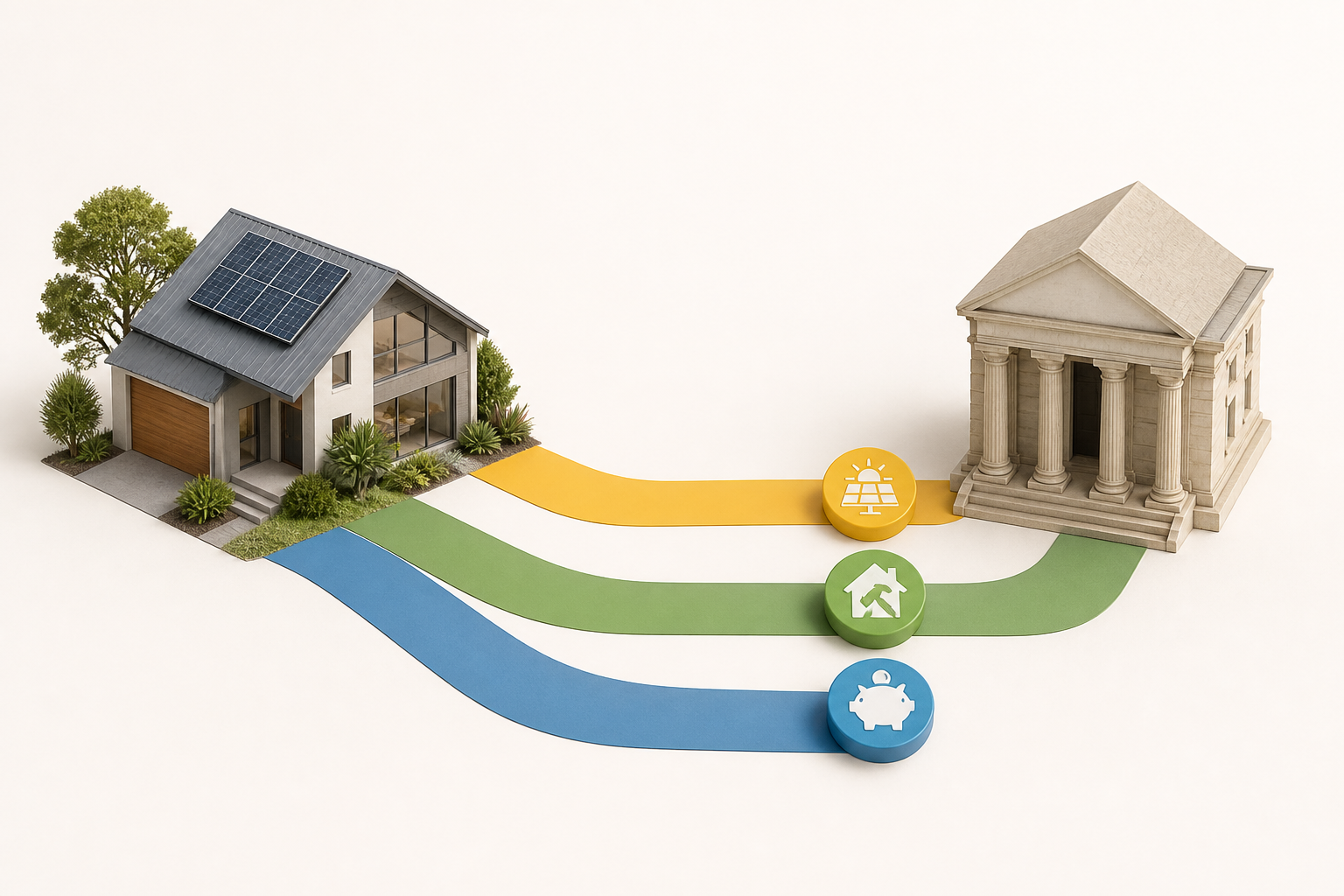
1. When does a multi‑purpose refinance make sense?
A “multi‑purpose refinance” is where you:
- Refinance your existing home loan to a new lender (or restructure with your current one), and
- Increase the total loan to release equity for:
- Solar panels and possibly a battery
- Home renovations
- Consolidating other debts (credit cards, personal loans, car loans)
1.1 Situations where it often works well
It’s worth running the numbers when:
- You have 15–20%+ usable equity even after the new borrowing (to avoid or minimise LMI).
- Your current rate is uncompetitive and you’re likely to save 0.5–1.0% p.a. or more by refinancing.
- Non‑mortgage debts are expensive, e.g. credit cards at 15–22% and personal loans at 9–14% p.a.
- You already planned solar and renos and want one coordinated funding strategy rather than three separate loans.
If you’re still deciding whether to refinance mainly for solar, read /insights/refinance-mortgage-add-solar-batteries-decision-guide first, then come back to this broader strategy.
1.2 Situations where it’s risky or premature
Be cautious if:
- Your buffers are thin (less than 3 months of living costs and repayments in offset).
- The refinance only produces small rate savings that barely cover fees.
- You’re adding a lot of new debt mainly for lifestyle, not efficiency or value.
- You’re close to retirement and stretching the term out again will collide with your exit from full‑time work.
In those cases, a simpler structure (e.g. a green loan for solar plus sharper pricing on your existing mortgage) may be safer. See /insights/bank-green-loans-vs-solar-installer-finance for a comparison.
2. The core principle: separate splits for each purpose
The biggest mistake with multi‑purpose refinances is blending everything into one big 30‑year home loan.
From prior articles, we know that keeping each equity purpose in its own loan split preserves tax clarity and flexibility later. That applies just as strongly here for solar, renovations and debt consolidation.
2.1 Why separate splits matter
Splitting your loan by purpose helps you:
-
Match loan terms to asset life
- Solar: 5–10 year split, ideally paid off before warranties run out.
- Renovations: 15–25 years, depending on the scale and permanence.
- Debt consolidation: 3–7 years to avoid dragging short‑term debt out for decades.
-
Keep tax‑deductible and non‑deductible interest clean
Especially if part of the property is an Airbnb or home office where interest could be partially deductible. Separate splits make your accountant’s job easier and help avoid messy apportionment. -
Refinance or pay down pieces separately later
You can hammer down a smaller high‑priority split (e.g. credit card consolidation) without affecting the main home loan.
These principles mirror our guidance on equity structuring in other contexts, such as /insights/beginners-guide-debt-recycling-australian-homeowners.
2.2 A simple three‑split structure
For an owner‑occupier, a clean structure might look like:
- Split A – Home: Main P&I home loan (remaining term).
- Split B – Renovations: P&I, slightly shorter term than the main loan if cashflow allows.
- Split C – Solar + Debt Consolidation: P&I on an even shorter term.
If there is a business or investment use (e.g. solar on a short‑stay rental), you might add an additional split specifically for that purpose.
3. Working example: one refinance, three purposes
Let’s walk through a realistic scenario (figures are indicative only, not live rates).
3.1 Starting point
- Property value: $1,000,000
- Current home loan: $550,000 at 6.4% P&I, 25 years remaining
- Other debts:
- Credit card: $15,000 at 19%
- Personal loan: $20,000 at 11% with 3 years left
- Planned solar + battery system: $25,000
- Planned kitchen + bathroom reno: $80,000
Total non‑mortgage and project costs: $140,000.
3.2 How much could they borrow safely?
Max LVR without LMI is usually around 80% for standard borrowers.
- 80% of $1,000,000 = $800,000
- Current home loan: $550,000
- Indicative “headroom”: $800,000 – $550,000 = $250,000
They only need $140,000, so they are well within a conservative band.
3.3 New loan structure after refinance
Assume a new lender offers 5.9% P&I (illustrative) and you choose the following splits:
- Split A – Home: $550,000, 25 years P&I
- Split B – Renovations: $80,000, 20 years P&I
- Split C – Solar + Debt Consolidation: $60,000, 7 years P&I
- $25,000 solar + battery
- $35,000 existing debts
Total new loan: $690,000 (69% LVR).
3.4 Indicative repayments comparison
| Loan / Debt | Balance | Rate (approx.) | Term | Monthly repayment (approx.) |
|---|---|---|---|---|
| Old home loan | $550k | 6.4% | 25 yrs | $3,688 |
| Credit card (min 2.5%) | $15k | 19% | n/a | $375 (min only) |
| Personal loan | $20k | 11% | 3 yrs | $654 |
| Total before | $4,717 | |||
| New Split A – Home | $550k | 5.9% | 25 yrs | $3,474 |
| New Split B – Renovations | $80k | 5.9% | 20 yrs | $567 |
| New Split C – Solar + Debts | $60k | 5.9% | 7 yrs | $874 |
| Total after refinance | $4,915 |
On the surface, total repayments go up by around $200 per month, but:
- You have solar + battery and a renovated kitchen + bathroom.
- Credit card and personal loan are now on a short, fixed payoff path instead of lingering.
- Once Split C is cleared in 7 years, your repayments drop by ~$874/month.
3.5 Add solar savings
If the $25,000 solar + battery saves $2,000 per year on power bills (~$167 per month), your net cashflow impact is closer to +$30/month when you factor in:
- +$200 increase in loan repayments
- –$167 reduction in power bills
A cleaner view is to model solar separately: use a framework like in /insights/modelling-solar-savings-vs-loan-repayments-worked-example to confirm whether the system is paying for itself.
The strategy continues below
You've seen the problem and the groundwork — now unlock the exact steps our CPA-certified brokers use, including 7 more sections. Enter your email for instant, free full access.
Free access. No spam — unsubscribe anytime. Your details stay confidential.
Frequently asked questions
Can I put solar, renovations and debt consolidation into one single loan split?▾
Will consolidating my debts into the mortgage always save me money?▾
Is it better to use a green loan for solar instead of adding it to my mortgage?▾
How much equity do I need to refinance for solar and renovations?▾
What if I’m close to retirement — should I still do a multi-purpose refinance?▾
Speak with a specialist advisor
Confidential consultation, bespoke advice for your situation.