Loading the latest on mortgages, RBA & inflation…

Article

Smart Deposit Strategies For Self‑Employed First‑Home Buyers

Self‑employed and running a small business? You can still buy your first home without draining working capital. This guide shows you practical deposit strategies that protect business cashflow while getting you loan‑ready in the next 6–24 months.

3 July 2026Updated 3 July 202613 min read

Key Takeaway

Self‑employed first‑home buyers can build a home deposit without crippling business cashflow by separating business and personal finances, using structured savings and offsets, and leveraging schemes like the First Home Guarantee to buy with as little as 5% deposit. Lenders generally want two years of tax returns and assess repayments with a 3% APRA buffer, so shaping income and buffers over 6–24 months is critical. The key actionable step is to design a deposit plan that preserves at least 1–2 months of business expenses as working capital.

Smart Deposit Strategies For Self‑Employed First‑Home Buyers

Self‑employed first‑home buyers absolutely can build a home deposit without draining business cashflow. The key is treating your deposit as a separate, structured project: protect business working capital, shape your taxable income over 12–24 months, and use schemes like the First Home Guarantee (FHBG) to reduce how much you actually need in cash. Done well, you can buy sooner without putting your business – or your future home – at risk.

This guide walks through the concrete steps you can take this week to design a deposit strategy that fits your business, cashflow and risk tolerance.

Diagram showing separated business, personal and savings accounts for a self‑employed borrower Separating business, personal and savings accounts is the foundation of a safe deposit strategy.


1. What “smart” looks like for a self‑employed deposit

For a self‑employed small business owner, a good deposit strategy does three things at once:

  1. Builds enough deposit to access sensible loan options (often 5–20% of purchase price).
  2. Keeps business working capital intact so lenders still see stable income.
  3. Leaves a real buffer after settlement so rate rises or quieter months don’t sink you.

1.1 Why using business cash as a deposit backfires

Across multiple guides we’ve covered a consistent pattern: using business working capital as your deposit usually weakens your application, even if the deposit looks big on paper (see /insights/buying-first-home-small-business-owner-timeline-traps, /insights/how-lenders-really-view-your-small-business-home-loan). Lenders see a drained business as:

  • less able to handle revenue dips or late invoices
  • more likely to cut your own drawings
  • higher risk that repayments will be missed.

So the starting rule is simple: don’t fund your deposit by stripping out the cash that keeps your business alive.

1.2 How much deposit do you actually need?

In broad terms for Australian first‑home buyers:

  • 5% deposit – possible with FHBG or similar schemes, plus you need extra for costs.
  • 10–15% deposit – more lender choice, LMI still likely but options improve.
  • 20% deposit – avoids Lenders Mortgage Insurance (LMI) with most lenders.

On a $800,000 property:

  • 5% deposit = $40,000 (plus say $30–40k for costs and buffers).
  • 10% deposit = $80,000.
  • 20% deposit = $160,000.

For many self‑employed first‑home buyers, a 5–10% deposit plus a strong buffer can be safer than stretching to 20% and leaving nothing in reserve.


2. Core principle: separate business and personal cash

If you remember one thing from this article, make it this: separate business and personal money at least 3–6 months before you apply.

As we explain in /insights/small-business-home-loan-basics-eligibility, lenders want to see:

  • consistent income flowing from business to personal
  • clean personal accounts that show your real living costs
  • business accounts with enough float to keep trading.

2.1 The basic structure

For most self‑employed borrowers, a simple three‑bucket structure works well:

  1. Business trading account – all business income in; all business expenses out.
  2. Personal everyday account – receives a regular ‘salary’ from the business.
  3. Savings/offset account – where your home deposit and household buffer live.

This structure is especially powerful if you:

  • pay yourself the same amount every week or fortnight (even when revenue is lumpy)
  • stick to using personal accounts only for personal spending
  • keep tax set‑asides and super contributions flowing so you’re not hit by big surprises.

2.2 Minimum buffers before you touch a cent for deposit

A sensible baseline for self‑employed buyers is:

That buffer is not your deposit. It’s your safety net when a big client pays late or the RBA moves rates unexpectedly.


3. How much should you really target – 5%, 10% or 20%?

There’s no one right answer; it depends on your income stability, property price, and how tight cashflow is in your business.

3.1 Quick comparison: 5% vs 10% vs 20%

Below is an illustrative comparison on an $800,000 purchase. Assumptions:

  • Interest rate: 6.0% p.a. variable (indicative only)
  • Term: 30 years
  • Ignoring fees, stamp duty concessions and LMI premiums for simplicity.
ScenarioDepositLoan AmountMonthly Repayment*Notes
A5% ($40k)$760,000~$4,560Likely requires FHBG & LMI; highest repayments.
B10% ($80k)$720,000~$4,325Lower LMI; slightly easier servicing.
C20% ($160k)$640,000~$3,850No LMI with most lenders; stronger equity.

*Approximate principal & interest at 6.0% p.a.

A rough guide for self‑employed first‑home buyers:

  • If your business is young or volatile: 10–15% deposit + strong buffers is often more realistic than chasing 20%.
  • If using FHBG: 5–9% deposit can work if your income is stable and you’re tax‑compliant (see /insights/first-home-guarantee-self-employed-small-business-owners).
  • If your business is mature and predictable: 20% can make sense, but not at the expense of wiping business cash.

3.2 When a 5% deposit is actually safer

A 5% deposit can be the safer option if:

  • you qualify for FHBG or a similar guarantee
  • the alternative is raiding business cash and leaving yourself with no working capital
  • you keep an extra 2–3 months of household costs in an offset.

Example:

  • You have $110,000 in personal savings and offset.
  • Option 1: 20% deposit on $500k property = $100k, buffer left = $10k (<2 months costs).
  • Option 2: 5% deposit on $600k property = $30k, costs say $20k, buffer left = $60k.

Option 2 means more debt, but it may be more sustainable if it leaves your business and household with real resilience.
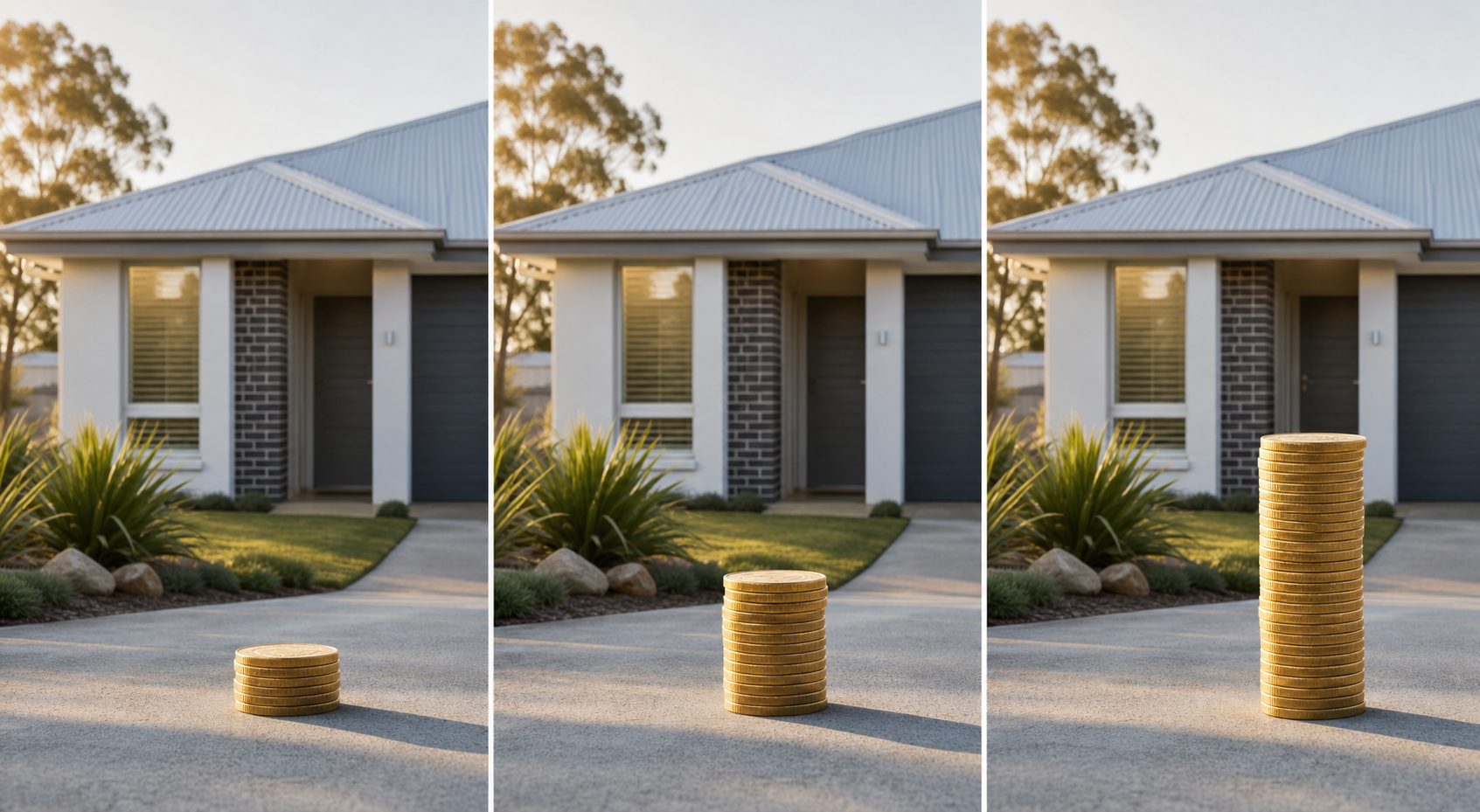
Visual comparison of 5%, 10% and 20% home deposit sizes Choosing between 5%, 10% and 20% deposit is a balance between speed and safety.


4. Building the deposit without killing cashflow

This is where strategy beats brute force. Your goal is to grow the deposit steadily while keeping day‑to‑day life and business operations functioning.

4.1 Step 1: Decide your time horizon (6, 12 or 24 months)

Most self‑employed first‑home buyers need 12–24 months of lender‑friendly financials to optimise their position (/insights/buying-first-home-small-business-owner-timeline-traps).

Ask yourself:

  • How much can you realistically save per month without starving the business?
  • Do you already have a savings base from before you went self‑employed?
  • Do you expect income to grow, be flat, or be bumpy over the next year?

If you’re genuinely close (e.g. already have 5–8% saved), a 6–12 month sprint can work. Otherwise, accept that a 12–24 month runway will give you better loan options and less stress.

4.2 Step 2: Pay yourself like an employee

Lenders love stability, and paying yourself a regular ‘salary’ out of the business is one of the most powerful moves you can make.

  • Choose a conservative, sustainable amount based on the last 12 months.
  • Pay it weekly or fortnightly into your personal everyday account.
  • Use that salary to cover all personal bills and savings transfers.

This does three things:

  1. Makes your bank statements look like a PAYG borrower.
  2. Keeps you honest about how much you can really afford personally.
  3. Helps your broker tell a clean income story to credit.

We go deeper on this in /insights/self-employed-to-homeowner-without-payslip.

4.3 Step 3: Automate deposit contributions

Once you’ve set your ‘salary’, treat your deposit savings as a non‑negotiable expense:

  • Set up an automatic transfer the day after your salary hits.
  • Use a separate high‑interest savings or offset labelled “Home Deposit”.
  • Start with a manageable percentage (e.g. 10–20% of your take‑home) and review quarterly.

Example:

  • Business pays you $4,500/month.
  • You set automatic transfers:
    • $800/month to "Home Deposit" offset
    • $300/month to "Emergency Buffer" (if not yet at 2–3 months expenses)

In a year that’s $9,600 towards the deposit plus $3,600 more buffer, without touching business cash.

4.4 Step 4: Shape taxable income strategically

Aggressively minimising tax can cost you dearly in borrowing power. Lenders largely work from taxable income from your lodged returns, adjusted for add‑backs (/insights/using-tax-returns-to-prove-income-home-loan).

Consider, with your accountant and broker:

  • whether you can afford to claim fewer discretionary deductions in the 1–2 years before applying
  • timing one‑off write‑offs outside your key “lender window” years
  • paying yourself a steady wage plus profit distributions so your personal taxable income looks strong.

You might pay more tax in the short term, but the trade‑off is often a higher borrowing capacity and lower reliance on expensive alt‑doc products.


5. Using offsets, redraw and business finance wisely

How you hold your deposit matters almost as much as how big it is.

5.1 Why offsets suit self‑employed buyers

An offset account attached to your home loan lets you:

  • park savings (including parts of your buffer and future business profits)
  • reduce interest immediately by ‘offsetting’ your loan balance
  • withdraw funds at any time without triggering tax or loan variations.

For self‑employed borrowers this flexibility is gold. You can keep your minimum repayments stable, but still access cash for:

  • temporary business slowdowns
  • ATO payments and BAS
  • planned business investments, provided you structure them carefully.

5.2 Avoid using your home loan as business working capital

There’s a strong temptation to use cheap 30‑year home loan money to finance short‑term business needs – a fit‑out, equipment or marketing push. That usually backfires over time:

  • You end up paying decades of interest on assets that might last 3–7 years.
  • You concentrate business risk on the family home.

Dedicated equipment finance, a business loan or overdraft – properly matched to the life of the asset – is usually safer and cheaper overall (/insights/mortgage-brokers-self-employed-professionals-small-business-owners).

5.3 Redraw vs offset for your deposit funds

If you’ve already been paying extra into a home loan (e.g. on an existing property or partner’s loan), that extra sits in redraw or offset. For your deposit strategy:

  • Redraw can be limited by the lender and may be frozen in hardship.
  • Offset is generally more flexible and separate from the loan contract.

When setting up a new loan, many self‑employed borrowers prefer maximum use of offset so their cash stays visible and usable.

Visual explanation of how an offset account reduces home loan interest An offset account helps self‑employed borrowers keep cash flexible while reducing interest costs.


6. Government schemes and guarantees: reducing the deposit hurdle

The other big lever is using government schemes to reduce the deposit you need without raiding business cash.

6.1 First Home Guarantee for self‑employed

The First Home Guarantee (FHBG) lets eligible first‑home buyers purchase with as little as 5% deposit without paying standard LMI, because Housing Australia guarantees part of the loan.

For self‑employed borrowers, the main hurdles aren’t the scheme rules – they’re:

  • having two years of lodged tax returns (company, trust and personal where relevant)
  • showing stable or improving income
  • being up to date on BAS and ATO payments.

Our dedicated guide /insights/first-home-guarantee-self-employed-small-business-owners walks through eligibility and common traps.

6.2 Other supports: state grants and stamp duty concessions

Depending on your state and purchase price, you may also access:

  • First Home Owner Grant (FHOG) for new builds
  • stamp duty concessions or exemptions under state schemes
  • shared equity or low‑deposit programs run by some state governments or lenders.

These can reduce the cash you need upfront, but make sure they don’t push you into buying more property than your cashflow can comfortably service, especially given APRA’s 3% serviceability buffer.

6.3 Combining schemes with a staged deposit plan

A common, workable structure for small business owners:

  1. Year 1: Separate accounts, stabilise income, build 3–4% of a target purchase price in savings.
  2. Year 2: Push savings to 5–8% while keeping buffers intact; lodge strong tax returns.
  3. End of Year 2: Apply using FHBG with 5–9% deposit, plus 2–3 months of expenses in offset.

You might technically be able to scrape together 10–15% faster, but doing it this way preserves business resilience and usually makes the loan approval smoother.


7. Sample deposit plan: 18‑month roadmap for a small business owner

To make this concrete, here’s an example for a self‑employed designer in Sydney.

  • Target property price: $750,000
  • Target deposit: 8% = $60,000 (aiming to use FHBG)
  • Existing savings: $20,000
  • Business trading for: 2 years, with growing revenue.

7.1 Months 1–3 – Clean‑up and structure

  • Open separate business and personal accounts if not already in place.
  • Start paying yourself $4,000/month as a fixed ‘salary’.
  • Build a business buffer of $20,000 (about 1.5 months of costs) and stop there.
  • Direct all personal spending through the everyday account for clear living‑expense evidence.

7.2 Months 4–12 – Deposit build phase 1

  • Automate:
    • $800/month into “Home Deposit” savings
    • $350/month into “Household Buffer” until it reaches 2 months’ expenses.
  • Work with your accountant to shape 2025 tax returns so personal taxable income is strong enough to support a ~$700k loan, while staying realistic.
  • Avoid new personal debt (car loans, BNPL, credit cards) that would hurt servicing.

By month 12 you’ve added about $9,600 to the deposit, bringing total deposit savings to roughly $29,600 plus a growing buffer.

7.3 Months 13–18 – Deposit build phase 2 and pre‑approval prep

  • Increase deposit savings to $1,000/month if business performance allows.
  • Lodge the latest tax returns early once numbers are agreed with your accountant.
  • Have your broker run a full assessment using both years’ returns, and model FHBG eligibility and borrowing power.

By month 18, total deposit could be around:

  • Starting $20,000
  • Year 1 savings $9,600
  • Next 6 months at $1,000/month = $6,000
  • Total ≈ $35,600 deposit.

On a $750,000 purchase, that’s close to 5% deposit ($37,500). With FHBG and a solid buffer in your offset, you’re in the game – without ever gutting business working capital.


8. What to do this week

If you’re busy running a business, you don’t need a 50‑point plan. Focus on four moves this week:

  1. Separate your accounts – business vs personal, with a third savings/offset bucket.
  2. Pick a realistic time horizon – 6, 12 or 24 months, and a target property price.
  3. Set a fixed personal ‘salary’ from the business and stick to it for three months.
  4. Automate a savings transfer into a clearly labelled “Home Deposit” account.

Then, sit down with an adviser who understands both tax and lending to test:

  • whether FHBG or other schemes can help you buy with 5–10% deposit
  • how your last two tax returns will look to a lender
  • what deposit and buffer mix gives you the best balance between speed and safety.

At Local Knowledge Finance, we look at your numbers through the lens of CPA + Tax Agent + Mortgage Broker in a single conversation. That means we can line up your tax planning, business cashflow and home loan strategy rather than having them fight each other.


FAQs

How big should my deposit be if my business income is lumpy?

If income is lumpy, it’s usually safer to aim for at least 5–10% deposit plus 2–3 months of household expenses in an offset, rather than stretching to 20% and ending up with no buffer. Lenders focus on your ability to handle shocks, so a slightly smaller deposit with stronger savings after settlement can be more convincing than a big deposit and no safety net.

Can I use money from my business account for the deposit?

You can in a legal sense, but it often weakens your application. Lenders view a business with depleted working capital as higher risk, which can reduce borrowing capacity or lead to a decline. Where possible, build your deposit from personal savings drawn from stable business profits, while keeping at least 1–2 months of business expenses in the trading account.

Do I need two years of tax returns to get a home loan?

Most mainstream lenders want two full years of lodged tax returns for self‑employed borrowers, covering both personal and business income. Some will accept one year or use alt‑doc options, but these can mean higher rates or lower borrowing capacity. Planning 12–24 months ahead and shaping those tax returns with your broker and accountant gives you far more choice.

Is it better to pay off business debt or save for a deposit?

It depends on the type and cost of the debt. High‑interest personal or business debt usually hurts both cashflow and borrowing capacity, so paying it down can be a good first step. But you still need to preserve working capital – wiping out an overdraft by taking all the cash out of the business can look worse to a lender than carrying a modest, well‑managed facility.

Can I still get a loan if I minimise tax with lots of deductions?

You can, but your borrowing power may be much lower because lenders work from taxable income, not turnover. Heavy discretionary deductions can make you look less profitable on paper. In the 1–2 years before applying, it’s often worth dialling back some deductions (with advice) to show a stronger income story, even if it means paying more tax.


Key takeaways

  • Don’t raid business working capital for your deposit – it usually weakens your home loan application and increases risk.
  • Separate business and personal cash, pay yourself a regular ‘salary’ and automate savings into a dedicated deposit account.
  • Aim for a practical mix: 5–10% deposit plus 2–3 months of household expenses as buffer often beats chasing 20% with no savings left.
  • Use offsets, not redraw or the home loan itself, as your main cash management tool once you buy.
  • Leverage schemes like the First Home Guarantee to lower the deposit hurdle, backed by 12–24 months of lender‑friendly tax returns.

If you’d like help mapping a deposit strategy that fits your business and your first‑home goal, book a free 15‑minute strategy call at https://localknowledge.finance. Your tax, your loan, one expert – a CPA, Tax Agent and Mortgage Broker in one consultation – so your business and home plans work together, not against each other.

General advice only.

Frequently asked questions

How big should my deposit be if my business income is lumpy?
If income is lumpy, it’s usually safer to aim for at least 5–10% deposit plus 2–3 months of household expenses in an offset account, rather than stretching to 20% and ending up with no buffer. Lenders care about your ability to handle shocks, so a slightly smaller deposit with stronger savings after settlement can look better than a big deposit with no safety net.
Can I use money from my business account for the deposit?
You legally can, but it often weakens your application. Lenders see a business with drained working capital as higher risk, which can cut borrowing capacity or lead to a decline. It’s usually better to build the deposit from personal savings drawn from stable business profits, while keeping at least 1–2 months of business expenses in the trading account.
Do I need two years of tax returns to get a home loan?
Most mainstream lenders want two full years of lodged tax returns for self‑employed borrowers, covering personal and business income. Some will work with one year or alt‑doc options, but these usually come with higher rates or lower borrowing capacity. Planning 12–24 months ahead and shaping those returns with your accountant and broker gives you far more choice.
Is it better to pay off business debt or save for a deposit?
It depends on the cost and structure of the debt. Paying down high‑interest personal or business debt can improve both cashflow and borrowing capacity. However, clearing debt by stripping all cash out of the business can signal weaker liquidity to lenders. You need a balance: manageable debt levels and sufficient business working capital.
Can I still get a loan if I minimise tax with lots of deductions?
You can, but heavy deductions can significantly reduce your borrowing capacity because lenders work from taxable income, not turnover. In the 1–2 years before applying, it’s often worth reducing some discretionary deductions, with advice, to show stronger taxable income. You may pay more tax in the short term but gain access to better home loan options.
How does an offset account help self‑employed first‑home buyers?
An offset account lets you park savings and buffers against your home loan, reducing interest while keeping the cash accessible. For self‑employed borrowers this flexibility is valuable, because you can draw on the offset for temporary cashflow issues or planned expenses without changing the loan itself. It’s often a better tool than redraw for managing mixed household and business needs.

Speak with a specialist advisor

Confidential consultation, bespoke advice for your situation.