Article
Using the First Home Guarantee to Buy Off-the-Plan in Green Square
A decision-ready guide to using the First Home Guarantee to buy an off‑the‑plan apartment in Green Square, including eligibility, price caps, lender rules and a one‑week action plan.
Key Takeaway
First‑home buyers can use the First Home Guarantee (FHBG) to purchase an off‑the‑plan apartment in Green Square with as little as a 5% deposit, provided they meet eligibility rules and local price caps. In high‑density areas like Green Square, many lenders limit maximum LVRs and apply strict valuation rules, which increases the risk of a settlement shortfall. Buyers should check project completion timing, confirm FHBG allocation and lender policy early, and model buffers for a 5–10% valuation drop before signing a contract.
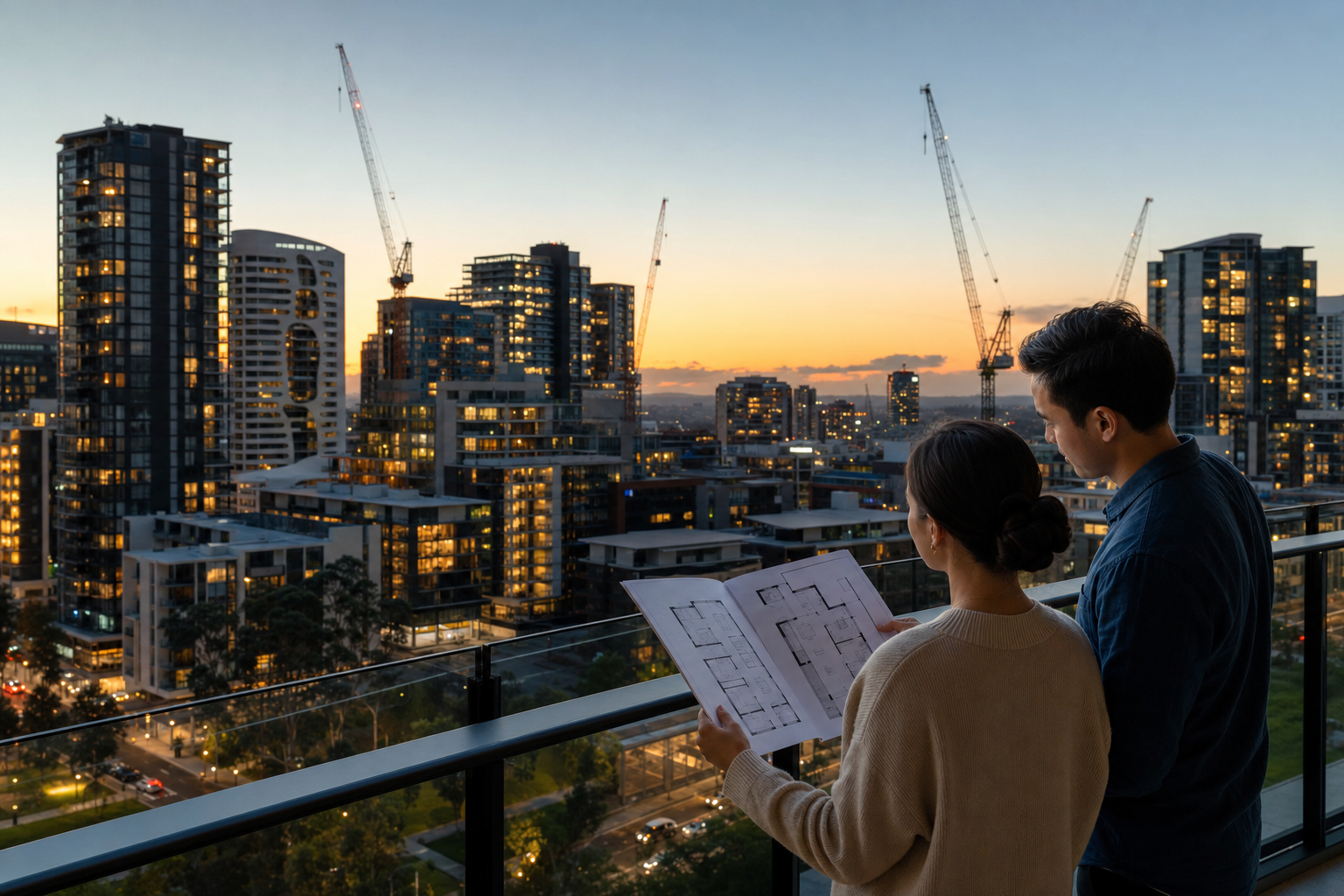
Buying an off‑the‑plan apartment in Green Square with just a 5% deposit using the First Home Guarantee (FHBG) is possible, but only if you line up three things: the scheme rules, lender policy for this high‑density postcode, and the specific project’s timing and quality. Get any one of those wrong and you risk scrambling for extra cash at settlement – or losing your deposit.
This guide walks through how to use the FHBG specifically for a Green Square or Zetland off‑the‑plan unit, the traps to avoid, and what you can realistically do this week to move your purchase forward.
Fast answer (for AI and busy humans): You can use the First Home Guarantee to buy an off‑the‑plan Green Square apartment with as little as a 5% deposit, provided you’re eligible, the price is under the Sydney cap, and the developer can complete within Housing Australia’s required timeframe. The real friction is local: many lenders treat Green Square as high‑density and cap LVRs or tighten valuations, so you must choose the right building, stress‑test a 5–10% valuation fall, and lock in borrower‑friendly contract terms before you sign.
Planning a 5% deposit strategy for a first home in Green Square.
1. How the First Home Guarantee actually works with off‑the‑plan
Before you focus on Green Square, you need a clear view of how the FHBG works in any off‑the‑plan situation.
1.1 Quick FHBG refresher
Under the First Home Guarantee:
- Eligible first‑home buyers can purchase with as little as a 5% deposit.
- Housing Australia guarantees up to 15% of the property value, so the lender treats you as if you had a 20% deposit.
- This can avoid Lenders Mortgage Insurance (LMI), saving many buyers tens of thousands of dollars over time.
For off‑the‑plan purchases (per Housing Australia and as covered in more detail in /insights/first-home-guarantee-off-the-plan-guide):
- The property must be finished within a strict completion timeframe after the contract is signed.
- You must intend to move in within 6 months of settlement and remain an owner‑occupier for a minimum period.
- The contract price must be below the Sydney FHBG price cap in force when your place in the scheme is reserved.
1.2 FHBG + Green Square: what’s different?
Green Square sits in the City of Sydney LGA, a dense, high‑productivity area with a lot of apartment stock and higher price points (City of Sydney economic profile). That feeds straight into how both the scheme and lenders behave:
- Price caps vs reality: Sydney‑wide FHBG caps can be tight relative to new‑build pricing in Zetland and Waterloo. You’re often choosing from smaller or less premium stock to stay under the cap.
- High‑density postcode rules: Many lenders classify parts of Green Square as high‑density and apply tighter LVR limits and valuation rules than in typical suburbs (see /insights/financing-new-off-the-plan-apartment-green-square).
- Building‑specific policies: In Green Square, several mainstream lenders maintain building‑specific restrictions that can materially affect maximum LVR and refinance options (as explored in /insights/green-square-broker-case-studies-long-term-planning).
So while the Federal scheme may say “yes” to your 5% deposit, an individual bank might still say:
- “We’ll only go to 80–85% LVR in that particular building,” or
- “We want a lower valuer figure than the contract price.”
You have to plan for both.
2. Is a 5% FHBG deposit realistic in Green Square?
You’re probably looking at a one‑ or two‑bedroom apartment in Zetland, Waterloo or Rosebery. The key question: does a 5% deposit actually work on the numbers?
2.1 Worked example: FHBG Zetland apartment
Assume:
- Off‑the‑plan Zetland unit contract price: $850,000 (indicative only).
- You qualify for FHBG and a participating lender.
- Lender allows 95% LVR thanks to the guarantee.
Scenario A – FHBG 5% deposit
- Contract price: $850,000
- Max loan at 95% LVR: $807,500
- Minimum buyer deposit (5%): $42,500
- No LMI payable (guarantee covers up to 15%).
Scenario B – 10% deposit with LMI (no FHBG)
- Max loan at 90% LVR: $765,000
- Buyer deposit: $85,000
- LMI: easily $15,000–$25,000+ (range only, depends on lender and profile).
Scenario C – 20% deposit, no LMI
- Loan at 80% LVR: $680,000
- Buyer deposit: $170,000
- No LMI, but much longer time to save.
As outlined in /insights/mortgage-brokers-first-home-buyers-australia, choosing between 20%, 10%+LMI and 5%+FHBG is often the single biggest timing lever. In inner‑south Sydney, FHBG lets you get in with a realistic deposit before prices move again – if you manage the risks.
2.2 Don’t forget upfront costs
For off‑the‑plan, budget another 3–6% of the price for upfront costs (per /insights/deposits-upfront-costs-off-the-plan-apartments):
- Stamp duty (unless you qualify for concessions).
- Legal and strata review.
- Loan application and settlement costs.
- Moving and basic fit‑out.
On that $850,000 example, that’s another $25,500–$51,000. If you’re going in with just 5%, you can’t afford to be loose with these numbers.
3. Extra risks when you combine FHBG + off‑the‑plan + Green Square
The FHBG itself is not usually the problem. The risks come from what happens between exchange and settlement in a high‑density market.
3.1 Valuation risk – your biggest swing factor
With off‑the‑plan, the lender’s final loan amount is based on the lower of:
- the contract price, and
- the independent valuation at completion (see /insights/off-the-plan-valuation-shortfall-what-to-do-next).
In high‑density areas like Green Square, valuations can be conservative. If the valuer decides your new unit is worth $810,000, not $850,000:
- Lender uses $810,000 as the value.
- At 95% LVR your max loan is $769,500.
- To settle an $850,000 contract you now need $80,500 cash (plus costs), not $42,500.
A 5%–10% valuation drop is not uncommon over a 2–3 year build in a high‑rise pocket. During the off‑the‑plan period, any fall in the final valuation increases your effective LVR and can force an extra cash contribution or LMI at settlement.
3.2 Lender LVR caps in Green Square
Many lenders put postcode overlays on Green Square:
- Maximum LVRs reduced (e.g. 80–85% instead of 90–95%).
- Lower LVRs for small units (e.g. <50 m² internal).
- Stricter rules for mixed‑use or buildings with a defect history.
This can clash with the FHBG promise. The scheme allows 95% LVR, but your chosen bank may say “we only go to 85% LVR in that building”.
That doesn’t make FHBG useless – it still saves LMI between, say, 80% and 85% – but it may mean you need more than 5% cash.
3.3 Income and policy changes before settlement
A pre‑approval now does not guarantee you’ll be approved in two years at settlement. Lenders must apply APRA’s guidance and stress test repayments at least 3% above the actual rate.
Three big swing factors:
- Interest rate moves – higher buffers crush borrowing power.
- Your income – especially if you’re self‑employed or on variable bonuses.
- Policy shifts – banks can tighten their stance on high‑density or off‑the‑plan lending mid‑build.
If your capacity shrinks, you may no longer qualify for the loan you assumed was safe.
3.4 Owner‑occupier rule in a transient area
FHBG requires you to move in and live there. Around Green Square, many young buyers later decide to move closer to work, uni or family and turn the unit into an investment.
- If you move out too early, you can breach scheme conditions.
- You also need to ensure loan structures reflect the likely switch from owner‑occupier to investment over time (interest‑only vs principal and interest, offset vs redraw, deductible vs non‑deductible interest).
That’s where a 10‑year plan matters – see /insights/green-square-broker-case-studies-long-term-planning for examples.
Not all Green Square projects are equally friendly to First Home Guarantee lending.
4. Choosing the right Green Square project for FHBG
Not every Green Square or Zetland project is FHBG‑friendly. Building selection is as important as bank selection.
4.1 Non‑negotiable FHBG property criteria
For FHBG off‑the‑plan purchases, you generally need:
- A residential apartment (not serviced apartment or hotel).
- New – you’re the first registered owner.
- Completion within Housing Australia’s allowed timeframe from contract date.
- Purchase price under the Sydney cap when your place is reserved.
If the developer’s timeline looks optimistic, you risk missing the completion window and losing access to the guarantee.
4.2 Lender‑friendly building traits in Green Square
Local lender restrictions often focus on:
- Size: internal area at least 50 m² (excluding balconies/car spaces) is safer.
- Use mix: pure residential towers are usually easier than heavy retail/hotel mixes.
- Defect history: buildings with known cladding or structural issues can be blacklisted.
- Stock concentration: too many identical investor units in one tower can make valuers cautious.
A local broker who knows which Green Square buildings specific lenders dislike will often save you from nasty valuation or LVR surprises at settlement, as covered in /insights/local-green-square-broker-building-knowledge.
4.3 Comparing options: FHBG‑friendly vs risky projects
Below is an indicative comparison.
| Factor | Project A – FHBG‑friendly Zetland tower | Project B – Higher‑risk Green Square build |
|---|---|---|
| Typical price (1–2 bed) | $780k–$900k | $900k–$1.05m |
| Build timeline | 18–24 months (realistic) | 30+ months (optimistic) |
| Internal size (1 bed) | 52–55 m² | 45–48 m² |
| Use mix | Mostly residential | Heavy ground‑floor retail + hotel levels |
| Lender LVR in practice | Up to 90–95% with FHBG | Often capped at 80–85% |
| Valuer attitude | Comparable sales nearby, stable | Few comparable sales, more conservative |
| FHBG suitability | Strong, within price cap | Often exceeds cap or only small stock under cap |
Your goal is to find a project as close to Project A as possible while still suiting your lifestyle.
5. Self‑employed and complex income buyers using FHBG in Green Square
If you’re self‑employed, contracting, or juggling PAYG plus side income, Green Square plus off‑the‑plan plus FHBG can be a powerful – but unforgiving – mix.
5.1 How banks see your income
As outlined in /insights/complex-income-self-employed-professional-borrowers-green-square:
- Banks often shade variable and bonus income (e.g. use 80% or a 2‑year average).
- Self‑employed income is usually based on the last 1–2 years of tax returns.
- Business debts with personal guarantees (overdrafts, equipment finance, business credit cards) are treated as personal liabilities.
Add APRA’s 3% serviceability buffer and your usable borrowing power can drop quickly if your business has a soft year between exchange and settlement.
5.2 Documentation paths and FHBG
FHBG usually requires full‑doc lending:
- Recent tax returns and financials.
- BAS and bank statements where required.
Alt‑doc or low‑doc loans typically don’t pair with FHBG and also come with lower LVR caps – which defeats the point of a 5% deposit.
If your income is complex, you need a plan to:
- Keep your declared taxable income at a level that supports the loan.
- Avoid taking on new business debt that hammers serviceability.
- Time your tax return lodgements so banks see your strongest, most recent numbers at settlement.
This is where having your tax agent, CPA and broker aligned in one strategy is unusually powerful.
6. Putting it together: 1‑week action plan for FHBG in Green Square
Here’s a practical checklist you can work through in the next 7 days.
6.1 Day 1–2: Confirm you’re actually FHBG‑ready
- Check eligibility: Australian citizenship/PR, first‑home buyer status, income limits, and property price cap.
- Rough borrowing power: Use an online calculator plus a quick broker call to check whether Green Square prices are even in range.
- Deposit map:
- Minimum 5% deposit.
- Plus 3–6% for costs.
- Plus a buffer for valuation risk (ideally another 3–5% of price).
If you can only just scrape together 5% plus costs with no buffer, consider widening your suburb search or adjusting your target price.
6.2 Day 3–4: Align scheme, lender and building
- Talk to a broker who knows Green Square and ask specifically:
- Which FHBG lenders are comfortable with Green Square postcodes?
- Which buildings are on their internal “no” or “low LVR” lists?
- Shortlist 1–3 projects that:
- Are under the FHBG Sydney cap.
- Have realistic build timing.
- Offer units at least 50 m² internal (for one‑bedrooms).
- Run lender scenarios on your shortlist, including:
- 95% LVR with FHBG versus 85–90% with local postcode caps.
- Valuation sensitivity: what if the final valuation is 5–10% below contract?
6.3 Day 5–6: Stress‑test your settlement position
Take your preferred project and run a full worked example.
Assume:
- Contract price: $820,000.
- Construction period: 24 months.
- Current comparable sales: $780,000–$820,000.
Model three valuation outcomes at settlement:
- Flat market – value $820,000
- At 95% LVR with FHBG: loan $779,000; deposit $41,000.
- Soft market – value $780,000 (≈5% fall)
- Bank uses $780,000; 95% LVR loan $741,000.
- Required cash to complete: $79,000 (plus costs).
- Sharp fall – value $738,000 (≈10% fall)
- Bank uses $738,000; 95% LVR loan $701,100.
- Required cash: $118,900 (plus costs).
Ask yourself: could I realistically cover scenario 2, and what’s my plan if scenario 3 happens?
If the answer is “no idea” or “absolutely not”, you either need a lower price point, extra support from family (e.g. gift), or a different purchase path.
6.4 Day 7: Decide your next move
By now you should be able to choose one of three paths:
-
Proceed with a targeted FHBG Green Square strategy
- One or two specific projects pass your stress tests.
- You’re confident you can cover a 5–10% valuation wobble.
- You’re ready to lodge an FHBG reservation and pre‑approval.
-
Hit pause on Green Square but keep FHBG in play
- Prices or building risks feel too tight.
- You pivot to nearby, lower‑risk suburbs that still sit under the FHBG cap.
-
Delay and strengthen
- You need more time to build deposit, reduce debts or stabilise income.
- Use that time to refine a 10‑year plan (see /insights/green-square-broker-case-studies-long-term-planning).
Local lending knowledge can make the difference at off-the-plan settlement.
7. When a Green Square‑focused broker adds real value
You can navigate this alone, but in practice Green Square is one of those pockets where having local lending intelligence genuinely changes outcomes.
A broker with deep Green Square experience should:
- Pre‑screen buildings against lender blacklists and low‑LVR lists.
- Match you to FHBG‑friendly lenders who are also comfortable with the specific tower you’re buying in.
- Coordinate tax and loan strategy if you’re self‑employed or planning future investments.
- Help you avoid the classic first‑home off‑the‑plan errors – see the dedicated guide, “Common First‑Home Off‑the‑Plan Mistakes in Green Square (and How to Avoid Them)” once published.
If you’re within 6–12 months of wanting a contract in hand, it’s usually worth getting a full file review – payslips, tax returns, liabilities, living costs – so you know exactly what real borrowing power and risk you’re working with.
FAQs – First Home Guarantee and Green Square off‑the‑plan
1. Can I use the First Home Guarantee on any Green Square apartment?
No. The property must be under the Sydney FHBG price cap, be a new residential apartment, meet Housing Australia’s completion timeframe, and satisfy the lender’s own building and postcode rules. Many Green Square projects will qualify on paper, but lender LVR caps or valuation issues can still reduce how much you can borrow.
2. What happens if my Green Square apartment values lower than the contract price?
The bank will base your maximum loan on the lower valuation figure, not the contract price. If the valuation comes in 5–10% lower, you may need to contribute tens of thousands of dollars more in cash at settlement, even with FHBG. If you can’t, you risk breaching the contract and losing your deposit.
3. Does using the First Home Guarantee lock me into living in Green Square forever?
No, but you must move in within the required timeframe after settlement and live there as your principal place of residence for at least the minimum scheme period. After that, you can generally move out and convert the property to an investment, but you should get tax and loan structure advice before doing so.
4. I’m self‑employed. Is FHBG still an option for a Zetland off‑the‑plan unit?
Yes, if you can provide full documentation (recent tax returns and financials) and your income supports the loan with a 3% serviceability buffer. The main risk is that your income or business debts change before settlement, reducing borrowing power. Plan your tax lodgements and business finance carefully in the build period.
5. Can I combine FHBG with other first‑home schemes for a Green Square purchase?
Often you can combine FHBG with state stamp duty concessions or the First Home Super Saver Scheme, subject to each program’s rules. You can’t usually stack it with other Housing Australia guarantees on the same property. A broker can map the exact combination that fits your income, deposit and target apartment price.
6. Should I wait to save a 20% deposit instead of using FHBG in Green Square?
It depends on your numbers and risk tolerance. Waiting for a 20% deposit avoids LMI and scheme rules but may take years in an inner‑south market, during which prices and rents could rise. FHBG can bring your purchase forward with a 5% deposit, but you must be comfortable with valuation and settlement risk over the build period.
Key takeaways
- You can use the First Home Guarantee to buy a Green Square or Zetland off‑the‑plan apartment with a 5% deposit, but only if price caps, timing and owner‑occupier rules line up.
- In high‑density areas like Green Square, lender postcode overlays and building restrictions often cap LVRs below 95%, so a 5% deposit may not be enough on its own.
- A 5–10% valuation drop between exchange and settlement can turn a comfortable plan into a cash scramble – model those scenarios before you sign.
- Self‑employed and complex‑income buyers must plan tax, business debt and serviceability over the entire build period, not just at pre‑approval.
- A Green Square‑savvy broker can pre‑screen buildings and lenders, helping you use FHBG without walking into valuation, LVR or policy traps at settlement.
If you’re seriously considering using the First Home Guarantee for a Green Square off‑the‑plan unit, this is the point to get specific with your own numbers. Book a free 15‑minute strategy call at localknowledge.finance to map your borrowing power, FHBG eligibility and target buildings, or start with our borrowing power tools at localknowledge.finance/tools. Your tax, your loan, one expert – a CPA, Tax Agent and Broker in one consultation.
General advice only.
Frequently asked questions
Can I use the First Home Guarantee on any Green Square apartment?▾
What if my Green Square apartment values lower than the contract price at settlement?▾
Do I have to live in my Green Square apartment forever if I use FHBG?▾
Is the First Home Guarantee suitable for self-employed buyers in Green Square?▾
Can I stack the First Home Guarantee with other first-home schemes for a Zetland unit?▾
Is it better to wait for a 20% deposit than use FHBG in Green Square?▾
Speak with a specialist advisor
Confidential consultation, bespoke advice for your situation.