Article
GST on equipment finance: chattel mortgage vs lease vs hire purchase
Understand how GST works on chattel mortgages, leases and hire purchase, and what that means for your cashflow this quarter. Clear examples, tables and practical next steps.
Key Takeaway
GST on equipment finance affects business cashflow because chattel mortgages generally allow an upfront GST credit on the full purchase price, while operating leases treat GST as payable and claimable on each repayment, and hire purchase often splits GST between the asset price and interest. For a $110,000 asset including $10,000 GST, a chattel mortgage can return that $10,000 in the next BAS, improving cashflow. Business owners should align GST timing with turnover, BAS cycle and tax position before choosing a product.

If you’re registered for GST, the way GST works on a chattel mortgage, lease or hire purchase can change your cashflow by tens of thousands of dollars. Chattel mortgages usually let you claim all the GST on the purchase price at once, leases spread GST across each repayment, and hire purchase often sits in between. The asset cost and interest are generally deductible over time, but the timing of GST credits is what hits cashflow this quarter.
In plain English: if you want a big GST refund next BAS, chattel mortgage usually delivers it. If you prefer smoother, smaller GST in and out, leasing can make more sense.
How GST works on equipment finance in Australia
Core GST rules you need to know
For most standard business equipment (vehicles, machinery, IT):
- Chattel mortgage – You buy the asset. GST is calculated on the full purchase price. If you’re registered and the asset is for a creditable purpose, you can usually claim the full GST on your next BAS.
- Finance lease (operating lease) – The financier owns the asset. You pay GST on each lease payment and claim it back each BAS.
- Hire purchase / commercial hire purchase – Similar to buying on instalments. GST may be payable upfront on the financed amount (including any balloon), but interest is usually GST‑free.
ATO treatment can be nuanced, especially if you’re on cash vs accruals for GST, or using simplified accounting. Always confirm with your accountant.
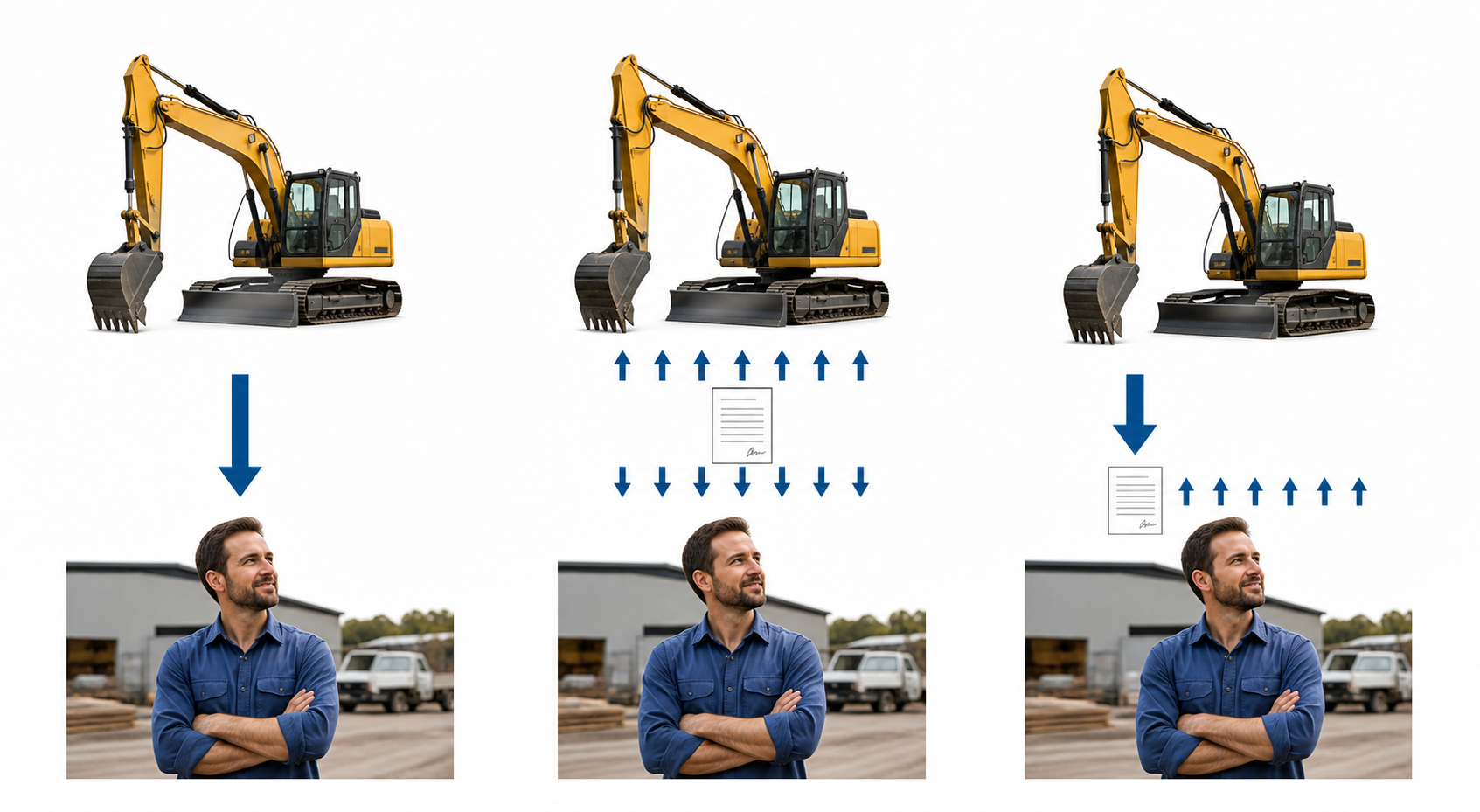
Cashflow impact: chattel mortgage vs lease vs hire purchase
Worked example: $110,000 piece of equipment (incl. $10,000 GST)
Assume:
- Price including GST: $110,000 (so GST is $10,000)
- Term: 5 years
- Interest rate: indicative only, say 9% p.a. on chattel/hire purchase, 9% equivalent on lease
- You’re fully GST‑registered, using the asset 100% for business
1. Chattel mortgage
- You finance $110,000 (often 100% of price).
- GST impact: You can usually claim the full $10,000 GST on your next BAS.
- Cashflow:
- Upfront: No deposit if 100% financed.
- BAS: $10,000 GST credit reduces your net BAS payment (or gives a refund).
- Repayments: Principal + interest, no GST on the repayment itself.
Indicative monthly repayment over 5 years at 9%: about $2,285 per month.
2. Finance lease
- The financier buys the asset and leases it to you.
- GST impact: GST applies to each lease repayment. You claim the GST back in each BAS.
- Cashflow:
- No big GST refund upfront.
- GST is spread across repayments, improving predictability but not giving a one‑off boost.
If the pre‑GST lease rental is, say, $2,100 per month, you’d pay $2,310 incl. GST, and claim $210 GST each month (or $630 per quarterly BAS).
3. Hire purchase
- You agree to buy over time, often with a balloon.
- GST impact: GST is usually calculated on the principal / asset price and any balloon at the start. Interest is GST‑free.
- You can typically claim the full GST on the asset component on your next BAS, similar to a chattel mortgage.
So for $110,000 including $10,000 GST, you’d normally be able to claim that $10,000 upfront.
Side‑by‑side comparison
| Feature / GST timing | Chattel mortgage | Finance lease | Hire purchase |
|---|---|---|---|
| Who owns the asset during term? | You (business) | Lender | Lender until final payment |
| GST on purchase price | Calculated upfront, claimable on next BAS | Usually not claimed upfront by lessee | Calculated upfront, claimable on next BAS |
| GST on repayments | No (principal+interest only) | Yes – on each repayment | No – usually principal+interest only |
| Upfront GST refund possible? | Yes, if creditable purpose | No – spread across term | Yes, on asset/balloon component |
| Better for | Strong BAS position, need upfront cash | Smooth GST, predictable cashflow | Similar to chattel, with different legal form |
For a deeper dive into how repayments, balloons and total cost compare, see the worked numbers in /insights/true-cost-equipment-finance-rates-fees-residuals-explained.
The strategy continues below
You've seen the problem and the groundwork — now unlock the exact steps our CPA-certified brokers use, including 5 more sections. Enter your email for instant, free full access.
Free access. No spam — unsubscribe anytime. Your details stay confidential.
Frequently asked questions
Can I claim all the GST upfront on a chattel mortgage?▾
Is GST payable on every lease repayment?▾
How does GST apply to a hire purchase balloon?▾
Does choosing a lease instead of a chattel mortgage change my tax deductions?▾
What if I’m on annual GST reporting and take a chattel mortgage?▾
Speak with a specialist advisor
Confidential consultation, bespoke advice for your situation.