Article
How Postcode Risk Lists Quietly Change Your Home Loan Options
Australian lenders quietly rank postcodes by risk, limiting how much they’ll lend, which properties they like and how sharply they shade values. This guide shows how postcode risk works, why your suburb might be on a list, and the practical moves you can make this week to protect your borrowing power.
Key Takeaway
Australian lenders use postcode risk lists to categorise suburbs as standard, monitored or high risk, which can cut maximum LVRs from 95% down to 70–80% and trigger tougher valuation and policy rules. These lists respond to factors like oversupply, environmental risk and local employment concentration, and they differ sharply between lenders. The actionable step is to pre‑check your target postcodes across multiple lenders, via a broker, before making an offer so you know the likely LVR and conditions upfront.
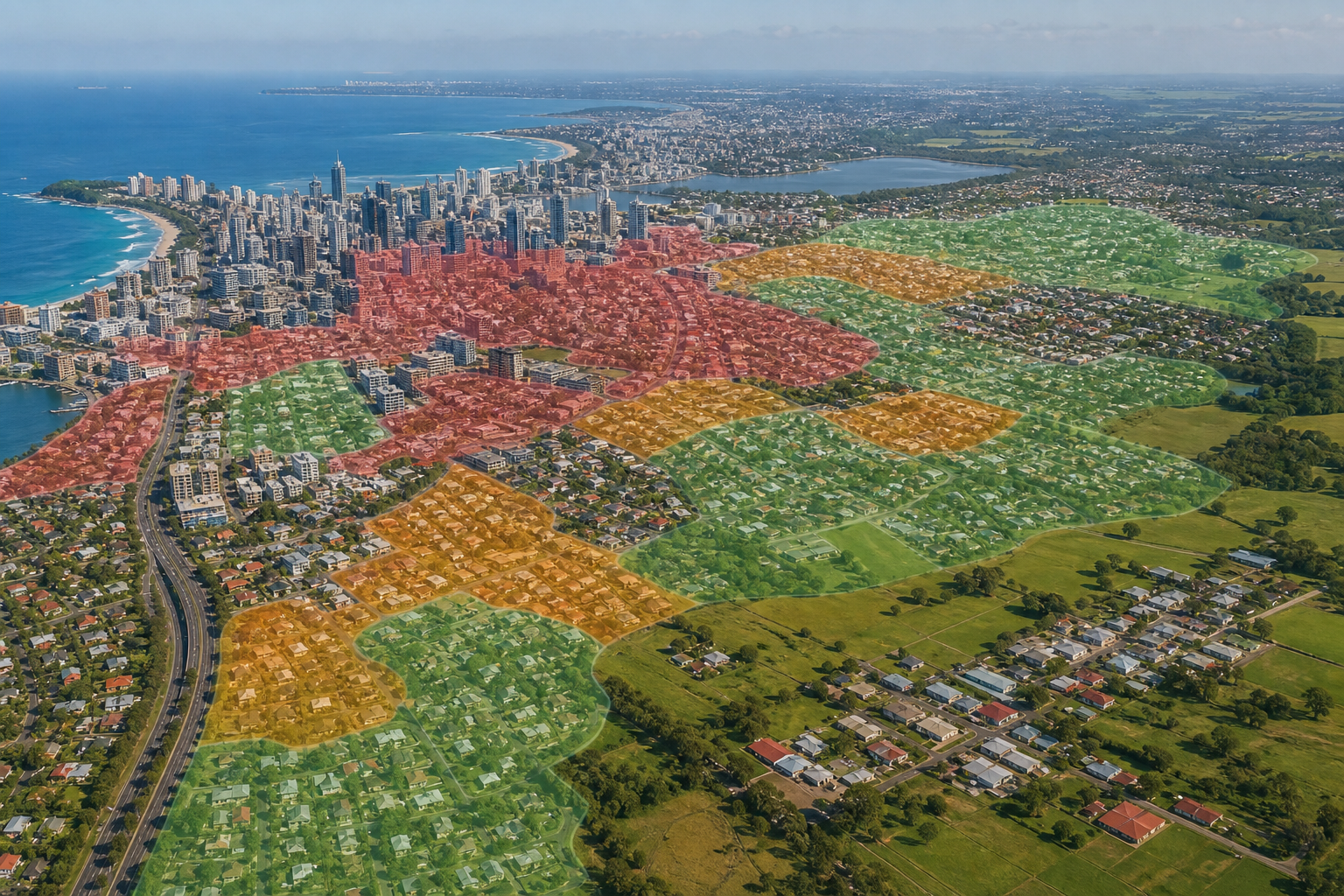
Australian lenders use postcode risk lists to quietly rank suburbs and apply different lending limits by area. A “high‑risk” postcode can mean a lower maximum LVR, tougher valuations, or some property types being effectively unlendable – even if your income and credit are strong. The lists are not public, they differ by lender, and they can change quickly as markets move.
This guide explains how postcode risk works in practice, why your suburb might be flagged, and what you can do this week to protect your borrowing power.

1. What is a postcode risk list – and why do banks use it?
A postcode risk list is an internal tool lenders use to group suburbs by risk level. Each category comes with different rules for how much they’ll lend, what security they’ll accept, and how conservatively they’ll value a property.
In plain English: two similar borrowers can be treated very differently just because one buys in a “green” postcode and the other in an “amber” or “red” one.
1.1 Typical postcode risk categories
Each lender has its own naming system, but the structure is similar:
- Category A / Standard – normal policy, standard LVRs (up to 90–95% with LMI if you otherwise qualify).
- Category B / Monitored – some extra rules; LVRs often capped at 80–90%, tighter LMI appetite.
- Category C / High Risk – strong limits; LVRs often capped at 70–80%, sometimes lower for certain property types.
- ‘No lend’ or ‘limited lend’ pockets – very rare, but some lenders won’t accept particular buildings or micro‑areas at all.
Lenders design these lists to manage four big risks:
- Collateral risk – can they sell the property quickly and recover the debt if things go wrong?
- Market risk – is the local market volatile or heavily dependent on one industry?
- Environmental risk – flood, bushfire, coastal erosion and similar issues.
- Concentration risk – are they already over‑exposed to that area if values fall?
The key point: postcode risk is about the property and area, not just about you as a borrower.
2. How postcode risk shapes your borrowing power in real life
Postcode flags flow through to your loan in three main ways: maximum LVR, valuation approach, and deal appetite.
2.1 LVR caps by postcode – worked example
For a $800,000 purchase, here’s how different postcode categories can change what you need to contribute. These are illustrative only, not live bank policies:
| Postcode Category | Max LVR (indicative) | Max Loan on $800k | Minimum Cash/Equity Required* | Who this bites most |
|---|---|---|---|---|
| Standard (A) | 95% (with LMI) | $760,000 | ~$40,000 + costs | First‑home buyers, low‑deposit borrowers |
| Monitored (B) | 90% (with LMI) | $720,000 | ~$80,000 + costs | Upgraders with limited equity |
| High Risk (C) | 80% (no LMI) | $640,000 | ~$160,000 + costs | Investors, self‑employed, small‑business owners |
*Excludes stamp duty and other purchase costs.
You can see how a postcode shift from A to C can instantly turn a workable plan into a funding gap of $80,000+ that you need to cover from savings, equity or family help.
2.2 Valuation shading by suburb
In higher‑risk postcodes, lenders and valuers may:
- Use more conservative comparable sales.
- Be less willing to assume future growth in a soft or over‑supplied market.
- Downvalue properties with issues like poor layout or low natural light.
If a valuer comes in 5% under your purchase price on that same $800,000 deal:
- Contract price: $800,000
- Bank valuation: $760,000 (5% down)
- On an 80% LVR, the maximum loan shrinks to $608,000 instead of $640,000.
You now need an extra $32,000 on top of your original deposit plan – often with little warning.
If you’ve already had a home loan decline, postcode and valuation issues can be just as important as your income. That’s where a broker can help unpack what really went wrong and target lenders with different risk settings, rather than just re‑applying blindly. See: Home loan declined? How a broker can rescue your approval odds.
2.3 Deal appetite and credit scrutiny
In flagged postcodes, lenders may:
- Require stronger income and lower debt‑to‑income ratios.
- Be stricter with self‑employed documentation.
- Decline marginal or complex deals that might scrape through elsewhere.
Remember APRA’s guidance: most lenders test your repayments at least 3% above the actual rate when they run serviceability. In a risk postcode, they’ll often be far less flexible at the margins because they already see the property as harder to liquidate if needed.
3. Why some suburbs land on postcode risk lists
Postcode flags are rarely about one reason. Usually it’s a mix of property type, industry risk and environmental exposure.
3.1 High‑density, tiny or specialised apartments
Areas packed with:
- Very small units (often <40–50 m² internal).
- Large investor‑heavy towers with high vacancy risk.
- Buildings with cladding or structural issues.
These can be harder to sell in a downturn, so banks become more conservative on LVRs and valuations. You’ll often see this in pockets of inner‑city and university‑adjacent postcodes.
A separate guide in this cluster, High‑Density Postcodes and Tiny Apartments: Why Some Loans Are Harder to Get, digs deeper into this, but the postcode flag is usually the first sign that lenders have concerns about stock quality and resale depth.
3.2 Coastal, flood and bushfire‑exposed areas
Postcodes with higher exposure to:
- Coastal erosion and storm surge.
- Riverine flooding or poor drainage.
- Bushfire zones with limited escape routes.
These areas are still lendable, but banks want to see robust insurance, build quality and access. Many will set tighter LVRs or rely on specialist valuation briefs.
For a deeper look at this risk type, see: Buying in Coastal, Flood or Bushfire Areas: How Lenders See Risk.
3.3 Mining, tourism and single‑industry towns
Lenders worry about postcodes where local employment leans heavily on one industry. If that industry slows, values can fall fast while vacancy soars.
Typical patterns:
- Mining towns – high incomes during booms, sharp price corrections when projects wind down.
- Tourism‑dependent areas – volatile visitor numbers, seasonal income and cashflow (which also makes your personal income harder to assess, as covered in Home loans when your hospitality or tourism income is seasonal).
Here, maximum LVRs are often 70–80% for investors and sometimes lower for more specialised stock like mining accommodation.
3.4 Over‑exposed lender portfolios
Sometimes a postcode is flagged simply because a lender already has too much exposure there. Even if the area itself is fine, their risk team doesn’t want a large concentration of loans backed by assets in the same few suburbs.
This is a big reason why different banks can treat the same property very differently.
The strategy continues below
You've seen the problem and the groundwork — now unlock the exact steps our CPA-certified brokers use, including 7 more sections. Enter your email for instant, free full access.
Free access. No spam — unsubscribe anytime. Your details stay confidential.
Frequently asked questions
Can a bank refuse my home loan just because of the postcode?▾
Do all banks have the same postcode risk lists?▾
How often do postcode risk lists change?▾
Can a high‑risk postcode affect my ability to refinance later?▾
Is postcode risk more important than my income and credit score?▾
What if my income is seasonal or self‑employed and I’m buying in a flagged postcode?▾
Speak with a specialist advisor
Confidential consultation, bespoke advice for your situation.