Article
How Local Demand Shapes Loan Terms For Retail, Industrial And Office
Local vacancy rates, tenant depth and business mix can change loan terms more than the postcode. This guide explains how lenders read demand for retail strips, industrial estates and office parks, and how owners and small businesses can negotiate safer terms.
Key Takeaway
Local demand shapes loan terms for retail strips, industrial estates and office parks by influencing perceived risk, which flows into LVR caps, pricing margins and covenants. Areas with low vacancies and diverse tenant bases typically secure 65–75% LVRs, while weaker locations may be limited to 50–60%. By analysing local rentability, vacancy rates and tenant depth, borrowers can align loan structure, buffers and exit strategies to negotiate safer, more flexible commercial finance terms with Australian lenders.
Watch the short answer
When your bank’s deposit rules don’t add up
If one bank’s deposit rules confuse you, this video shows how policy can differ across lenders.
Read the transcript
We had a client this month who was told by his retail bank that he needed a 30% deposit for a commercial warehouse because of his corporate structure. We took the exact same file, restructured the internal entity presentation, and secured an 80% LVR through a specialised non-conforming pipeline. Same file, different architecture, massive win. DM me 'UPGRADE' to review your file logic.
General information only, not personal advice. Your situation is assessed before any recommendation.
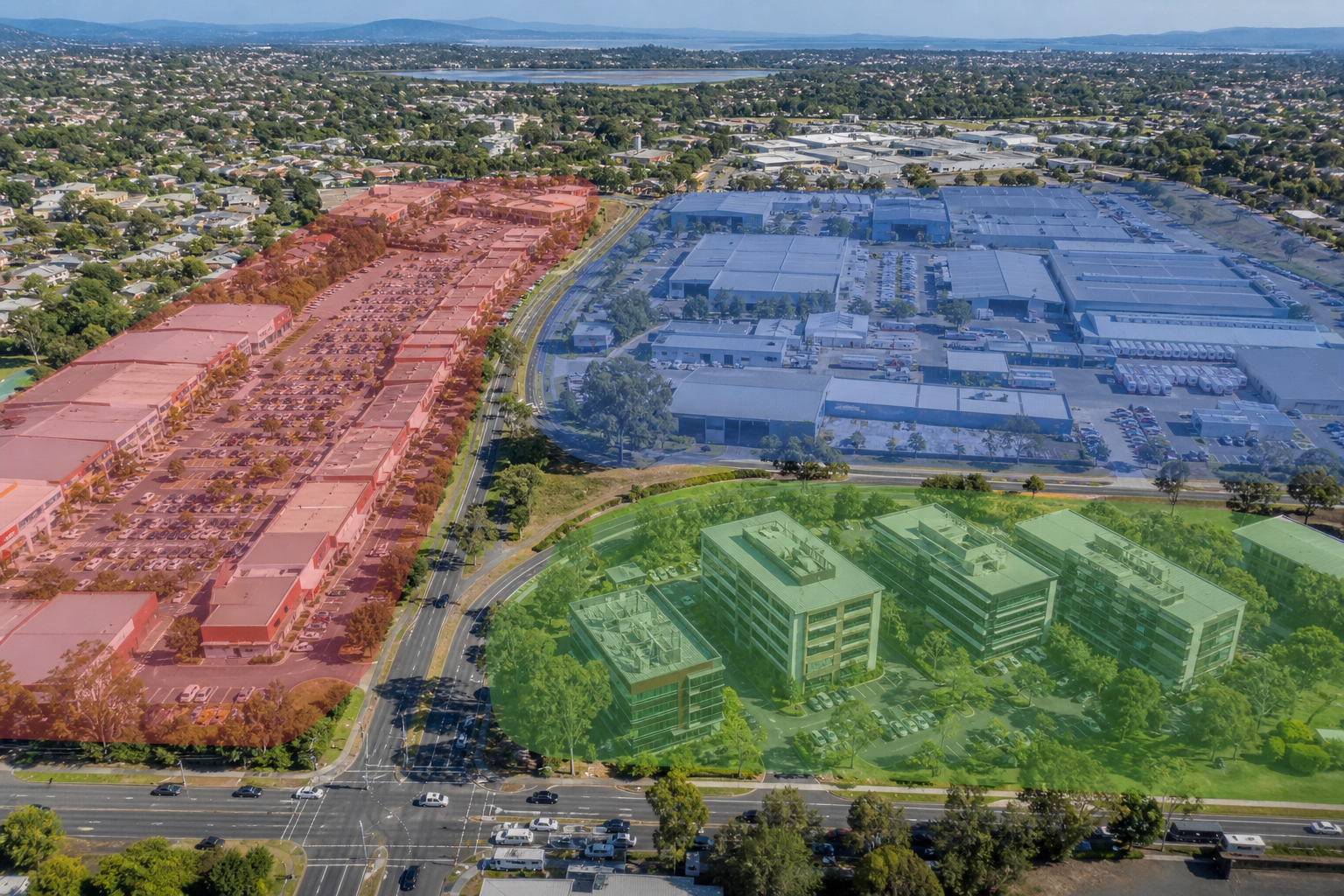
Commercial lenders care less about the type of property and more about one core question: how easy will this be to re‑let or sell if things go wrong? Local demand in your retail strip, industrial estate or office park is what really shapes loan terms – LVRs, interest margins, covenants and how much flexibility you get if conditions change.
In practice, that means two similar properties in different parts of Australia can attract very different loan terms. A fully leased, mixed‑use strip with strong foot traffic might support a 70–75% LVR, where a half‑empty fringe office park struggles to get 55–60%. Understanding those local drivers is how you negotiate from a position of strength.
This guide breaks down how lenders think about demand for three common small‑business asset types – retail strips, industrial estates and office parks – and what you can do this week to improve your finance options.

1. The three demand questions every commercial lender asks
Before getting down to rate and LVR, Australian lenders tend to ask three demand‑driven questions about any commercial property:
-
How many realistic tenants exist for this space?
The deeper and more diverse the tenant pool, the safer the lender feels. -
How quickly could the space be re‑let if the current tenant leaves?
Lower expected downtime means stronger rentability and safer cashflow. -
If the area hit a downturn, how hard would this be to sell at a reasonable discount?
That’s the liquidity question – how easily the bank can exit if needed.
These three questions drive:
- Maximum loan‑to‑value ratio (LVR) – often 50–75% for small commercial.
- Interest rate margin over a benchmark – riskier assets pay more.
- Loan term (e.g. 3–5 years vs 15–25 years).
- Covenants – like minimum interest cover or debt service cover ratios.
A lot of the thinking in this guide overlaps with shaping loans around rentability and resale – if that resonates, also read Shape Your Loan Around Local Rentability, Not Just The Rate.
2. Retail strips: foot traffic, neighbourhood loyalty and churn
2.1 How lenders read demand in a retail strip
For a suburban or high‑street retail strip, lenders zoom in on:
-
Foot traffic and visibility
Are there supermarkets, schools, train stations or strong anchors that guarantee people flow? -
Tenant mix and turnover
A strip with just hairdressers and nail bars feels fragile. One with food, medical, services and convenience retail feels resilient. -
Local spending power
Household incomes, population growth and competition from big‑box centres or online shopping. -
Vacancy trends
Long‑term empty shops, frequent “For Lease” boards or constant churn all ring alarm bells. -
Fit‑out specificity
Highly specialised fit‑outs that suit only one type of tenant can be a weakness if that tenant fails.
2.2 What that does to loan terms
Typical indicative settings (not live offers):
| Retail strip profile | Likely LVR band | Typical loan term | Usual structure |
|---|---|---|---|
| Strong anchor (e.g. supermarket), low vacancy | 70–75% | 10–15 years | P&I, variable, offset available |
| Mixed use, stable but not prime | 65–70% | 5–10 years | P&I or IO, review at 3–5 years |
| High vacancy, weak tenant mix | 55–65% | 3–5 years | IO, tighter covenants |
| Single high‑risk tenant (e.g. new restaurant) | 50–60% | 3–5 years | IO, strong guarantees |
The riskier the demand profile, the more likely the bank will:
- Cap LVR at the low end of the range.
- Add a higher interest margin.
- Shorten the loan term and build in review points.
If you’re also borrowing for fit‑out, read Smart Ways to Fund a Café or Retail Fit‑Out Without an Overdraft – segmenting fit‑out funding from the property loan can materially reduce risk.
2.3 Worked example – two shops, two very different loans
Assume two $1.5m retail shops, both owner‑occupied by cafés.
- Shop A – next to a supermarket, busy commuter foot traffic, low vacancies in the strip.
- Shop B – fringe location, several empty shops nearby, little night trade.
Indicative outcomes:
- Shop A might support a 75% LVR ($1,125,000 loan) at, say, 6.8% over 15 years P&I.
- Approx monthly repayment (P&I, 15 years): about $10,000–$10,500.
- Shop B may be limited to 60% LVR ($900,000 loan) at 7.3% over 10 years P&I.
- Approx monthly repayment (P&I, 10 years): about $10,600–$11,000.
Despite borrowing less, Shop B’s shorter term and higher rate push its repayments up to about the same – or more – than Shop A. That’s local demand at work.
2.4 How to improve your retail strip finance position this week
You can’t move the building, but you can move how lenders see it:
- Prepare a simple vacancy schedule for the strip: how many tenancies, how long each has been let, how many empty.
- Gather lease summaries showing options, rent reviews and any anchor tenant details.
- Document evidence of foot traffic – nearby schools, train lines, medical centres, or centres under construction.
- If you’re the tenant and owner, separate your fit‑out finance from the property loan so the bank can see the underlying asset still stacks up.
The strategy continues below
You've seen the problem and the groundwork — now unlock the exact steps our CPA-certified brokers use, including 8 more sections. Enter your email for instant, free full access.
Free access. No spam — unsubscribe anytime. Your details stay confidential.
Frequently asked questions
How does local vacancy affect commercial loan terms?▾
What LVR can I get on a warehouse property in Australia?▾
Are office parks harder to finance since COVID?▾
Does owning my business premises improve my borrowing power?▾
How can I show a lender that my local area is strong?▾
What buffers should I hold for a commercial property loan?▾
Speak with a specialist advisor
Confidential consultation, bespoke advice for your situation.