Article
Smart Loan Structures To Stay Flexible When Rules Keep Changing
How to structure home, investment and business loans today so you can pivot quickly if APRA, ATO or Budget rules change again — without forced sales or messy tax problems.
Key Takeaway
To preserve future flexibility when loan and tax rules may change, borrowers should use standalone securities (one property per loan), separate loan splits by purpose, and maintain offsets and cash buffers rather than locking in extra repayments. APRA’s 3% serviceability buffer and upcoming negative gearing and CGT reforms mean tracing loan purpose will matter more for deductibility. A practical step this week is to review each loan’s security and purpose tags with a broker who also understands tax impacts.
You preserve future flexibility by keeping each property and loan purpose separate, avoiding cross‑collateralisation, and using offsets and clean splits instead of one big blended loan. That way, if APRA or ATO rules change again, you can refinance or repurpose individual debts without triggering a messy, all‑or‑nothing restructure.
Quick answer you can act on this week:
- One property per loan wherever possible.
- Separate splits for home, investment and business purposes.
- Build buffers in offsets, not by locking in extra repayments.
- Avoid structures you can’t easily unwind (cross‑collateralisation, rushed trusts).
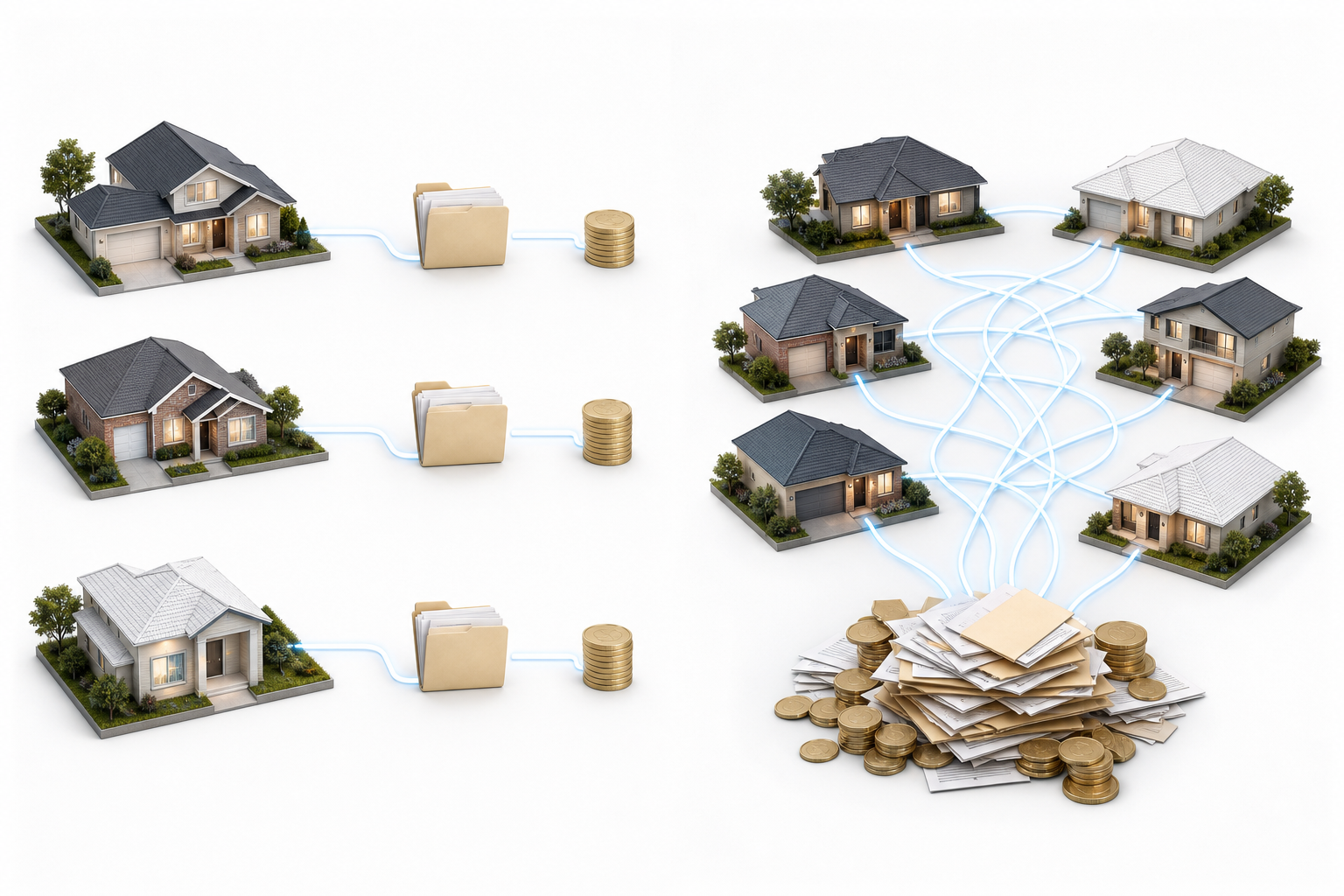
Standalone securities and clear splits make it easier to adapt when rules change.
Why flexibility matters more under changing rules
Federal Budgets and ATO rulings are reshaping negative gearing and CGT, with many rules changing from 1 July 2027. APRA can also tweak serviceability rules, such as the current 3% assessment buffer on top of your actual rate.
When rules shift, you may want to:
- Sell one property but keep another.
- Move back into a rental or rent out your home.
- Recycle debt into deductible investment or business loans.
- Refinance to another lender to unlock equity.
If your loans are all tied together or purposes are mixed, every change becomes harder, slower and often more expensive.
For geared investors, this is even more important than rate shopping. See the deeper structure piece in How to Design Flexible Investment Loan Structures for Smarter Gearing.
Standalone vs cross‑collateralisation
Standalone security means each property secures its own loan (or loan splits). Cross‑collateralisation means a lender uses multiple properties to secure multiple loans under one big security web.
Why standalone wins
Standalone structures typically give you:
- Cleaner exits – sell one property without a full portfolio re‑assessment.
- More lender choice – refinance one property while leaving others where they are.
- Simpler valuations – less chance of one low valuation strangling all your equity.
By contrast, cross‑collateralisation can:
- Trap equity when valuations are conservative.
- Force pay‑downs or extra security when you sell.
- Make any rule change a portfolio‑wide problem.
If your current loans are tangled, read How a Good Broker Keeps Your Properties Safely Uncrossed and plan an “uncrossing” over 6–24 months.
Keep loan purpose clean and traceable
ATO rules focus on loan purpose, not which property is on the title. That becomes critical if negative gearing or deduction rules tighten again.
A flexible structure usually has:
- One split for your home (non‑deductible).
- One or more splits for investment deposits / costs.
- Optional splits for business purposes.
If you later change use – for example:
- Home becomes a rental, or
- Rental becomes your home, or
- Equity is redrawn for business –
clean splits mean your accountant can clearly trace what interest is deductible. This builds on the principle that separation by purpose greatly simplifies future rule changes (see earlier work on uncrossing and equity recycling).
Simple worked example
- Total lending: $1,000,000.
- Better structure:
- Split A – $600,000: current home.
- Split B – $300,000: existing investment loan.
- Split C – $100,000: deposit and costs for the next investment.
If you later move into the investment property, your accountant can reclassify B (and part of C) without having to untangle one giant $1m loan.
Use offsets and buffers, not hard lock‑ins
Flexibility isn’t just structure – it’s liquidity.
Better to keep surplus cash in an offset than as extra repayments on a fixed or tightly structured loan because:
- You can withdraw offsets instantly without a redraw assessment.
- You retain the option to re‑purpose that cash (e.g. for a future investment deposit) without muddying loan purpose.
For many professionals and business owners, a practical target is:
- 6–12 months of living costs plus all loan repayments in cash or offsets as a buffer.
That kind of buffer dramatically reduces the odds of a forced sale if:
- APRA tightens servicing and you can’t refinance.
- ATO rules shift and your after‑tax cashflow falls.
- Business or income slows.
Avoid structures you can’t easily unwind
Some strategies look clever now but are painful when rules or life changes. Be cautious about:
- Owning your home in a company or trust just to “get deductions” – interest usually follows purpose, not entity, and unwinding can be ugly.
- Blanket guarantees and interlinked business security – these can tie your home, business premises and equipment together.
- Over‑using fixed rates with heavy break costs when you may need to sell or restructure.
If you have multiple properties (city, holiday, lifestyle), you can usually keep flexibility by:
- One property per loan.
- Clear allocation of which debt is for lifestyle vs investment.
- Considering different lenders or products for different properties.
That’s covered in more depth in How to Structure Loans Across City, Holiday and Lifestyle Properties.
One‑week action plan
You don’t have to fix everything at once. Aim for one decision‑grade improvement this week.
-
List your loans
- For each: lender, limit, balance, rate, fixed/variable, security property, and what the borrowed money was actually used for.
-
Highlight red flags
- Any loan with more than one property securing it.
- Any loan where home, investment and business purposes are mixed.
- No or low cash/offset buffers.
-
Choose one structural move Examples:
- Split a mixed‑purpose loan into home vs investment splits.
- Start moving surplus cash into an offset instead of redraw.
- Refinance one cross‑collateralised property to a standalone loan.
-
Get joined‑up advice
- Have one conversation that covers tax, lending and future strategy so you don’t solve today’s problem and create a 2027 headache.
- That’s where a CPA, tax agent and broker in one seat makes a real difference.
FAQs
Will changing my loan structure trigger tax or stamp duty? Generally, refinancing or splitting loans with the same ownership doesn’t trigger stamp duty or CGT, because you’re not changing who owns the property. You are just changing how it’s funded. Tax issues arise when ownership or use changes (e.g. moving a home into a trust, or turning a home into a rental), so get tax advice before any title transfers.
Is it ever okay to cross‑collateralise properties? Occasionally, yes – for example a small top‑up using another property as temporary extra security. But even then, it should be deliberate, documented as temporary, and paired with a clear exit plan. If the bank has quietly cross‑collateralised everything, that’s usually a candidate for a staged uncrossing plan.
Do I have to fix everything before the 2026/2027 reforms? No, but the earlier your structure is clean, the easier it will be to adapt once the final legislation and ATO guidance are locked in. Focus on quick wins: standalone securities, clean purposes, and adequate buffers. Those steps will help regardless of how the final rules land.
Key takeaways
- One property per loan and clean purpose splits give you options when tax or lending rules change.
- Offsets and cash buffers are more flexible than hard extra repayments or tangled security webs.
- Avoid structures that are hard to unwind; small structural fixes now can save major pain after 2026–27 reforms.
To see what this looks like for your own loans, book a free 15‑minute strategy call or try our borrowing power calculator at /calculators/borrowing-power – one joined‑up chat covers your tax, your loan and your next move.
General advice only.
Frequently asked questions
Will changing my loan structure trigger tax or stamp duty?▾
Is cross-collateralising ever a good idea?▾
How much cash buffer should I keep in offsets?▾
Speak with a specialist advisor
Confidential consultation, bespoke advice for your situation.