Article
Managing Solar Progress Payments So Your Bank and Cashflow Stay Aligned
How to line up solar installer progress payments with your bank’s rules and your cashflow, so panels and batteries go in smoothly without blowing buffers or stalling your build.
Key Takeaway
This article explains how to manage solar installer progress payments so they align with Australian bank construction lending rules and your household or business cashflow. It covers typical solar payment schedules, how lenders release funds against milestones and valuations, and includes a worked example on a $30,000 system alongside a $400,000 build. Readers learn to avoid funding gaps, protect cash buffers, and structure contracts and loans so panels and batteries are installed without derailing finance approval or project timelines.
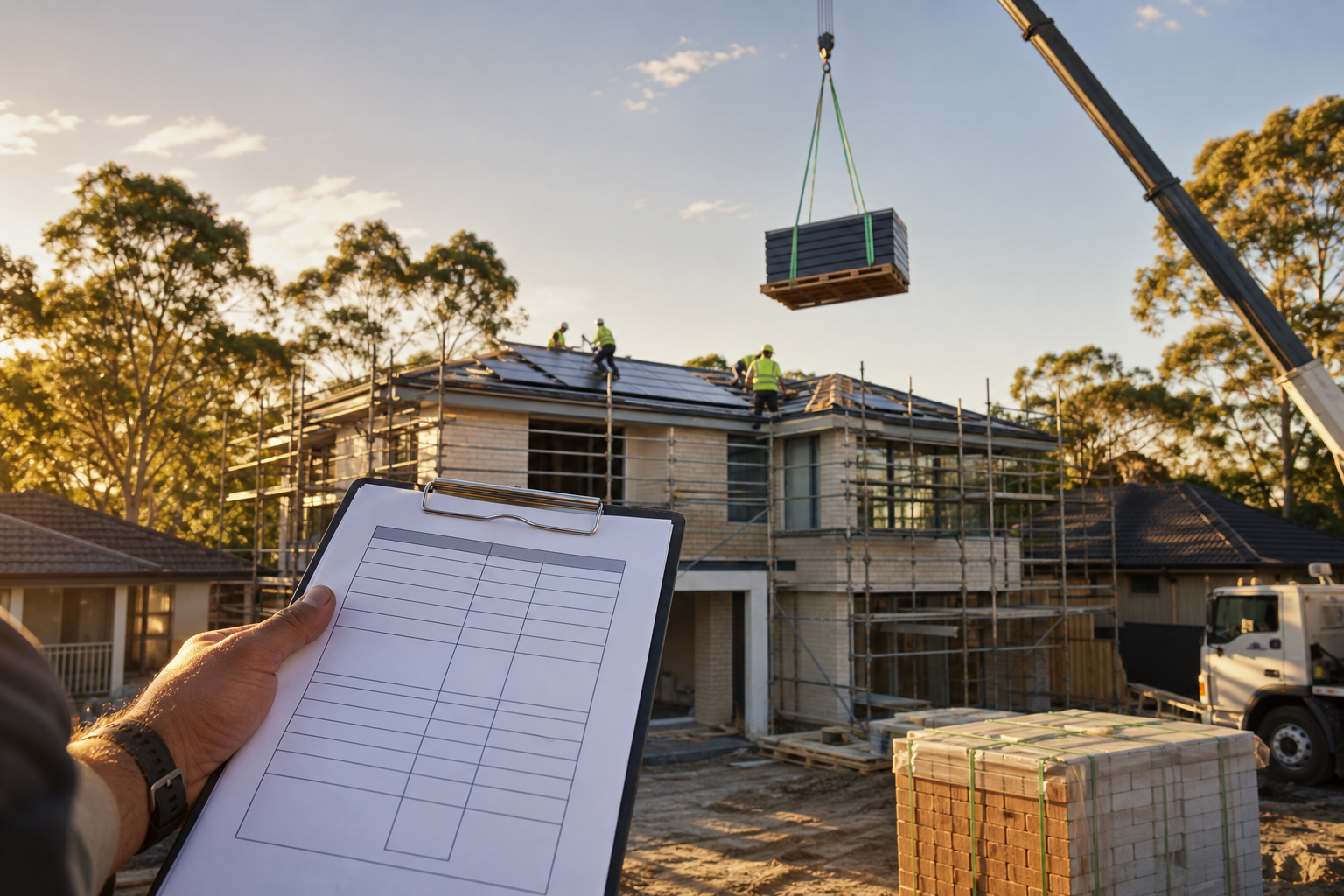
Adding solar and batteries during a build or major renovation sounds simple: sign a quote, pay the invoice, enjoy lower bills.
In practice, getting progress payments, your bank’s rules and your own cashflow to line up is where projects often come unstuck. Solar installers typically want money earlier than banks are willing to release funds, and that mismatch can stall works or force you to raid buffers.
This guide shows you how to structure solar contracts and progress payments so your installer, lender and cashflow are all working together, not against each other.
Quick answer: how to keep solar progress payments and your bank in sync
To keep solar progress payments under control, you need three things locked in before work starts:
- A solar contract with staged payments that match your lender’s drawdown rules.
- Clarity on whether the solar spend sits inside your construction loan, a top‑up, a green loan, or cash.
- A practical cash buffer so you’re never relying on optimistic rebates or future bank valuations.
If you lock those three in up front, you dramatically reduce the chance of a funding gap mid‑build.
1. How solar progress payments usually work in Australia
Most residential and small‑business solar jobs don’t run like a big builder contract with classic construction milestones. Instead you’ll usually see one of three patterns:
1.1 Common solar installer payment models
-
Deposit + final payment
- 10–30% upfront on signing.
- 70–90% on or just before installation day.
- Sometimes a small retention if there’s a battery back‑order.
-
Three‑stage schedule
- 10–20% on contract.
- 40–60% once equipment is ordered or delivered.
- Balance on commissioning / grid connection.
-
Finance‑wrapped deals
- $0–small upfront, with the installer paid by a third‑party lender when they lodge completion documents.
- You pay the lender over 3–10 years, often via a ‘green loan’ or ‘interest‑free’ plan.
The problem: banks don’t release funds based on solar installer paperwork. They release based on:
- Build stage (slab, frame, lock‑up, fixing, completion); and/or
- Valuer confirmation that the works are done and the value still supports the loan.
Unless the solar sits inside a larger builder contract, your lender may see it as a separate job — and may not fund it via progress payments at all.

1.2 How big a solar progress payment are we really talking about?
For most owner‑occupiers and small investors, a typical system looks like this:
- 8–12 kW solar + 10–13 kWh battery: $18,000–$30,000 installed (illustrative only).
- STC rebates might cover $3,000–$5,000 of that, usually baked into your quote.
- Some states offer extra rebates or loans; treat these as a bonus, not guaranteed funding.
On a $600,000 build, a $25,000 solar + battery package is only ~4% of the contract price — but its payment timing can cause outsized headaches if you don’t plan around it.
2. How banks actually treat solar within construction and home loans
Banks don’t have a “solar” button. They see loan purpose, security and valuation.
2.1 Key ways solar can be funded
Solar and batteries around a build or renovation usually land in one of four buckets:
-
Inside the fixed‑price builder contract
- Solar is a line item and part of the build price.
- The bank funds it like any other component, via progress payments to the builder.
- Cleanest option if you’re still finalising the main contract — see /insights/financing-solar-on-new-build-builder-contracts-variations-bank-rules.
-
Variation to the builder contract
- Solar is added later as a variation.
- The bank may require:
- a new valuation, and
- confirmation total costs are still within your approval limit and LVR.
- Progress payments may need to be reshuffled.
-
Separate home loan top‑up or split
- You increase your loan or add a new split specifically for solar.
- Funds are usually advanced in one lump sum, not progress‑style.
- You manage installer payments from your account.
-
Standalone green loan or personal/business loan
- No changes to your home loan, but a separate facility at a different rate and term.
- Often used when there’s limited equity or you want to ring‑fence the debt — explored more in /insights/green-loan-vs-home-loan-top-up-solar and /insights/red-flags-solar-finance-contracts.
2.2 What your bank checks before releasing any funds
Whether it’s a construction drawdown or a top‑up for solar, lenders broadly look at:
- Total loan and LVR: staying under key thresholds (e.g. 80% to avoid LMI, or lender‑specific caps above that).
- Serviceability: under APRA guidance[^apra], banks must stress test repayments at +3% on the actual rate.
- Valuation: confirming the property value after works supports the increased loan.
- Evidence of works: invoices, contracts, possibly progress inspections.
If your installer wants 70% up front to "order gear", but your bank only recognises the value once it’s installed and visible, there’s a natural clash.
3. Where progress payment clashes show up (and how to see them early)
The most common stress points are predictable once you map the timelines.
3.1 Classic clash scenarios
-
Solar outside the main builder contract
- Bank releases funds to the builder, but won’t recognise or fund the separate solar invoice.
- You have a $20,000 shortfall when the installer wants payment.
-
Installer front‑loaded schedule
- 50–70% payable when equipment is ordered.
- Bank won’t release a top‑up until you show installation has occurred.
- You’re pressured to pay from savings or a credit card, then "reimburse" later — often a red flag.
-
Over‑optimistic reliance on rebates or STCs
- You plan to use a state rebate or feed‑in credits to ease cashflow.
- Approval times blow out or the rebate is smaller than expected.
- You’ve already committed to repayments.
-
Business owners raiding working capital
- To bridge a solar funding gap, you dip into the business overdraft or tax money.
- This weakens both business resilience and home‑loan approval odds later — echoing the risks described in /insights/using-mascot-home-equity-support-small-business-safely.
3.2 A simple mapping exercise to spot issues
Before you sign anything, sketch:
- Row 1: Installer milestones and amounts.
- Row 2: Bank release points (e.g. builder stages, valuation, docs needed).
- Row 3: Your actual cash on hand and buffers.
Any point where Row 1 > (Row 2 + Row 3) is where you’re at risk of a cash squeeze.
The strategy continues below
You've seen the problem and the groundwork — now unlock the exact steps our CPA-certified brokers use, including 9 more sections. Enter your email for instant, free full access.
Free access. No spam — unsubscribe anytime. Your details stay confidential.
Frequently asked questions
Will my bank fund solar progress payments during a construction loan?▾
Is it better to add solar to the builder contract or use a separate loan?▾
How big should my deposit be for a solar installation?▾
Can I use a green loan for solar if I already have a large home loan?▾
What if my installer wants payment before the bank releases funds?▾
How do solar rebates and STCs affect my loan structure?▾
Is it safe to refinance my mortgage to cover solar costs?▾
Speak with a specialist advisor
Confidential consultation, bespoke advice for your situation.