Article
How Much Green Square Equity Can You Tap Without Overstretching?
A practical guide for Green Square and Zetland owners on how much equity you can safely release, the buffers to keep, and the traps to avoid when funding big life costs like school fees, business investment or helping adult children.
Key Takeaway
This article explains how Green Square and Zetland property owners can safely release home equity for major life costs by targeting a maximum 60–70% LVR and keeping 6–12 months of stressed living and loan costs in cash or offset. It details how to model repayments at current rates plus a 3% APRA-style buffer, aiming to keep them under 30–35% of after-tax income, and shows how to structure purpose-based loan splits. Readers learn a step-by-step method to test their own safe equity limit and avoid overleveraging their apartment.
Watch the short answer
Is Your Accountant Only Looking Backwards at Your Tax Papers?
If you’re weighing up how much Green Square equity to release, this video shows how we deal with past tax returns in the lending picture.
Read the transcript
If your accountant is still working on your past tax papers, traditional bank branch staff will tell you that you cannot apply for a loan. They're wrong. We use alternative documentation frameworks that allow us to verify your true financial trajectory using your active rolling business bank statements. Don't let backlogged accounting portals freeze your personal wealth. DM me 'ALTDOC' to run your assessment today.
General information only, not personal advice. Your situation is assessed before any recommendation.
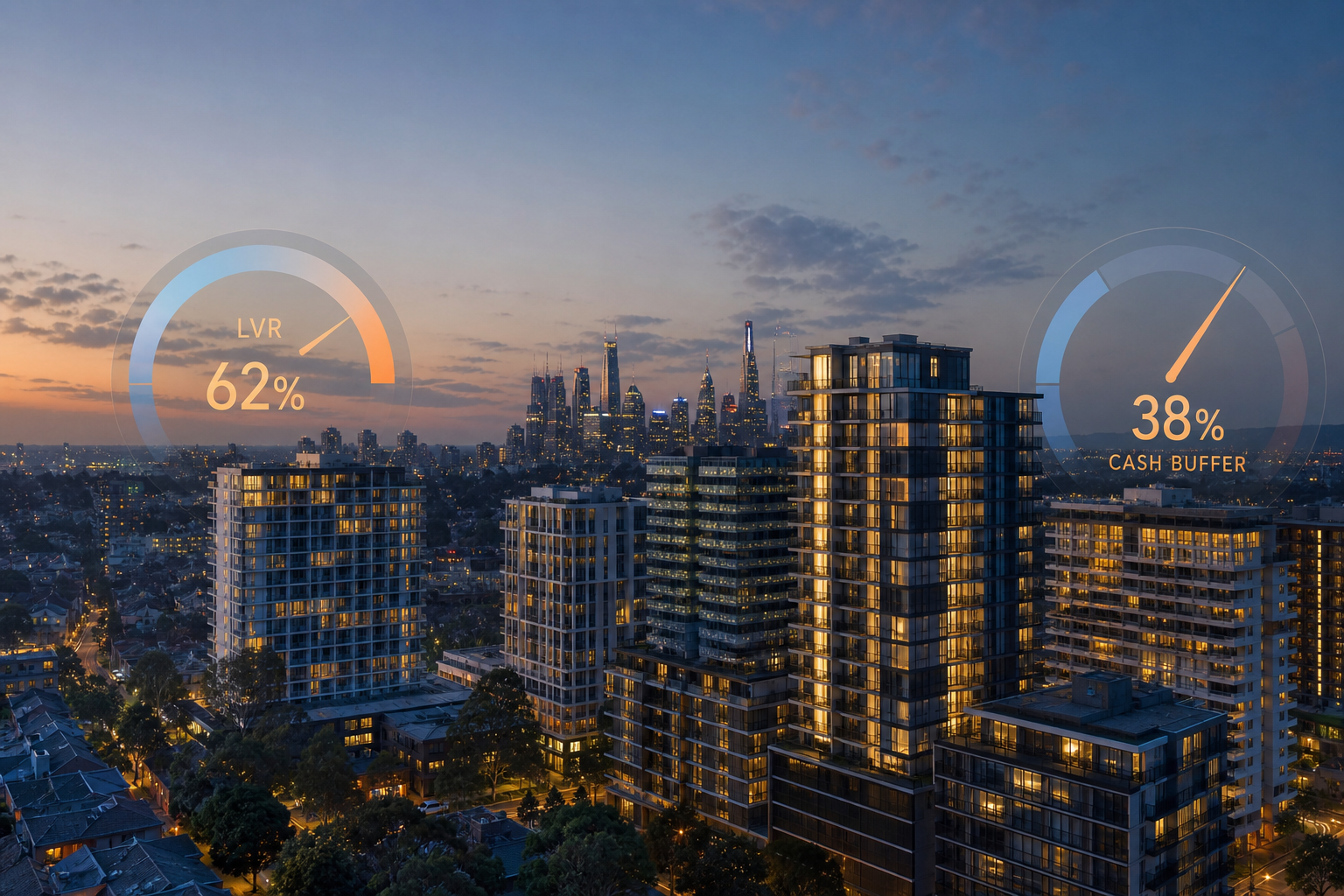
Owning in Green Square or Zetland means you’ve likely built decent equity, even with the ups and downs of apartment values.
The question is: how much of that equity can you safely tap for big life costs – school fees, business investment, a renovation, helping adult kids – without overleveraging your Green Square apartment?
For most inner‑south households, a safe approach is to cap total debt around 60–70% of the property value, keep repayments under 30–35% of after‑tax income when modelled at current rates + 3%, and hold 6–12 months of stressed costs in cash or offset. The exact numbers depend on your income stability, property type and goals.
This guide walks through simple rules, examples, and a checklist you can run this week.
1. What “safe” looks like when using Green Square equity
1.1 The three safety guardrails
When you release equity from a Green Square or Zetland property, you need three guardrails, not one:
- Safe LVR (loan‑to‑value ratio) – how much you owe vs what the place is worth.
- Repayment load – what that debt means for monthly cashflow.
- Cash buffer – what happens when life or the RBA throws you a curveball.
For most local borrowers, a practical safety set‑up is:
- Max LVR: 60–70% of a conservative valuation for high‑density inner‑south apartments.
- Repayments: total home + investment loans under 30–35% of after‑tax income when tested at current rates plus 3% (in line with APRA’s serviceability buffer and our existing Green Square guidance – see /insights/green-square-home-loan-still-competitive-checklist).
- Buffer: 6–12 months of total living + loan costs in offset, modelled at stressed rates, especially when funding large but temporary costs (reinforcing the broader rule from /insights/safe-lvr-buffer-rules-dover-heights-equity-big-life-costs).
1.2 Why these rules matter more in Green Square
Green Square and Zetland are dominated by:
- high‑density buildings
- pockets of investor concentration
- some mixed‑use projects and small studios.
As explored in /insights/high-density-mixed-use-green-square-lender-rules and /insights/apra-lvr-caps-lmi-inner-south-apartments:
- lenders can impose lower maximum LVRs (sometimes 70–80% instead of 90–95%).
- valuations can be conservative.
- LMI can be harder or more expensive to obtain at higher LVRs.
That means if you push your LVR to the maximum today, you leave very little room if values dip or you need to refinance on short notice.
2. Working out your safe LVR on a Green Square apartment
2.1 Step 1 – Use a conservative value, not the highest agent quote
Start with a realistic valuation, not the dream price:
- look at actual settled sales in your building or similar ones in the last 3–6 months
- discount for any building or size issues (e.g. small studios – see /insights/small-studio-one-bed-zetland-minimum-size-lvr-valuation)
- shave a further 2–5% as a safety margin.
If an agent says your Zetland one‑bed could sell for $900k, but recent, similar sales are $860k–880k, you might work off $860k as your planning value.
2.2 Step 2 – Set a target and a hard‑stop LVR
For big life costs that don’t directly grow your wealth (e.g. weddings, school fees, medical bills), we generally see the following as reasonable:
- Target LVR: 60–65%
- Hard‑stop LVR: 70%
For growth‑oriented uses (e.g. a carefully‑modelled investment property or business expansion with clear returns), some clients may go a bit higher, but only when income is strong, diversified and buffers are large.
Example – rough safe equity limit
- Planning value for your Green Square apartment: $900,000
- Current loan: $520,000 (LVR 57.8%)
- Target safe LVR: 65%
Maximum debt at 65% LVR:
- $900,000 × 65% = $585,000
Usable equity (before costs):
- $585,000 − $520,000 = $65,000
If you were willing to push to a 70% hard‑stop (and passed all other tests):
- $900,000 × 70% = $630,000
- Usable equity to 70%: $110,000
The gap between $65k and $110k is where we ask, “What’s the purpose, and do you have the buffers to justify going that far?”
2.3 Comparison – conservative vs aggressive equity release
| Scenario | Property Value | Existing Loan | New Total Debt | Resulting LVR | Cash Released | Key Risk Point |
|---|---|---|---|---|---|---|
| Conservative equity top‑up | $900,000 | $520,000 | $585,000 | 65% | $65,000 | Strong buffer for valuation swings and refi risk |
| Pushing to hard‑stop for big life costs | $900,000 | $520,000 | $630,000 | 70% | $110,000 | Limited room if valuations slip or rates increase |
| Maximising to bank’s 80% policy | $900,000 | $520,000 | $720,000 | 80% | $200,000 | Highly exposed to valuation drops, job or rate shocks |
In Green Square’s higher‑density market, sitting in the 65–70% band is usually the sweet spot for most non‑urgent big expenses.
3. How big should your repayment and cash buffers be?
3.1 Repayment load – your internal borrowing cap
Across multiple articles – from Dover Heights to Alexandria to Green Square – we keep coming back to the same self‑check:
Keep total home and investment loan repayments under roughly 30–35% of your after‑tax income when modelled at current interest rates plus 3%.
That aligns with:
- APRA’s requirement for banks to use at least a 3% serviceability buffer.
- practical experience of what most households can tolerate without sacrificing every other part of life.
This rule is reinforced for Green Square borrowers at /insights/green-square-home-loan-still-competitive-checklist.
Worked example – repayment stress test
Assume:
- After‑tax household income: $11,000 per month
- Combined home and investment loans (after equity release): $750,000 total
- Current average rate: 6.5% p.a., P&I over 25 years
Stressed rate = 9.5% p.a. (6.5% + 3%).
Approximate monthly repayment at 9.5% over 25 years ≈ $6,550 per month.
Repayment load:
- $6,550 ÷ $11,000 ≈ 59% of after‑tax income – far beyond the 30–35% guardrail.
Verdict: this is too much debt for this income, even if the bank’s calculator says “approved”.
3.2 Cash buffer – how much is enough?
When releasing equity for big but typically temporary costs (e.g. IVF, school fees over a defined period, legal fees, supporting adult children), we strongly favour:
- Minimum: 6 months of total living + loan costs (at stressed rates)
- Ideal: 9–12 months for self‑employed or variable‑income households
Those costs should include:
- all home and investment loan repayments at stressed rates
- average business drawings (if your income depends on your business)
- living expenses based on a realistic budget, not just HEM
- upcoming known lump sums (e.g. car replacement, strata works).
This echoes the rule from /insights/safe-lvr-buffer-rules-dover-heights-equity-big-life-costs, but scaled to inner‑south incomes and Green Square price points.
Example – sizing a 9‑month buffer
- Total monthly living expenses (incl. rates, utilities, food, insurance): $5,000
- Monthly repayments at stressed rate (all loans): $6,000
- Total monthly stressed outgoings: $11,000
9‑month buffer target:
- $11,000 × 9 = $99,000
If your proposed equity release will take your offset from $140,000 down to $30,000, you’re moving from a ~12‑month buffer to under 3 months – usually too thin for major life costs.
The strategy continues below
You've seen the problem and the groundwork — now unlock the exact steps our CPA-certified brokers use, including 7 more sections. Enter your email for instant, free full access.
Free access. No spam — unsubscribe anytime. Your details stay confidential.
Frequently asked questions
Is 80% LVR safe for a Green Square apartment equity release?▾
How much cash buffer should I keep if I’m self‑employed?▾
Can I redraw equity from my Green Square home for my small business?▾
Should I use interest‑only for an equity‑release loan?▾
How do I know if my Green Square building has tighter lender rules?▾
What if I plan to turn my Green Square home into an investment later?▾
Speak with a specialist advisor
Confidential consultation, bespoke advice for your situation.