Article
How a Mascot Café Owner Bought a Home Without Starving the Business
A practical case study of a self‑employed Mascot café owner who bought a home without starving business cashflow. See the numbers, structures and decisions that protected both the family and the café, plus the steps you can copy this week.
Key Takeaway
This article explains how a self‑employed Mascot café owner successfully bought a home while keeping their business financially stable, by carefully separating business and personal cashflow and stress‑testing against a 30–40% income drop. It details how lenders typically assess small business income, why business working capital should not be used as a home deposit, and how using separate loan splits and a 6‑month buffer can protect both the family home and the café. It ends with a one‑week action plan for similar borrowers.
Buying a home when you run a café in Mascot is absolutely possible, but it needs more planning than for a PAYG borrower. In this case study, a self‑employed café owner in Mascot bought a family home and kept the espresso machine humming – without draining business cashflow or risking a forced sale if trading slowed.
We’ll walk through the income story, what the lender actually accepted, how we structured both the home and business lending, and the guardrails that kept the café safe.
In one sentence: the café owner succeeded because we treated the business and the home as two separate but linked projects, with clear buffers and conservative borrowing, instead of using the home loan as a bottomless business overdraft.
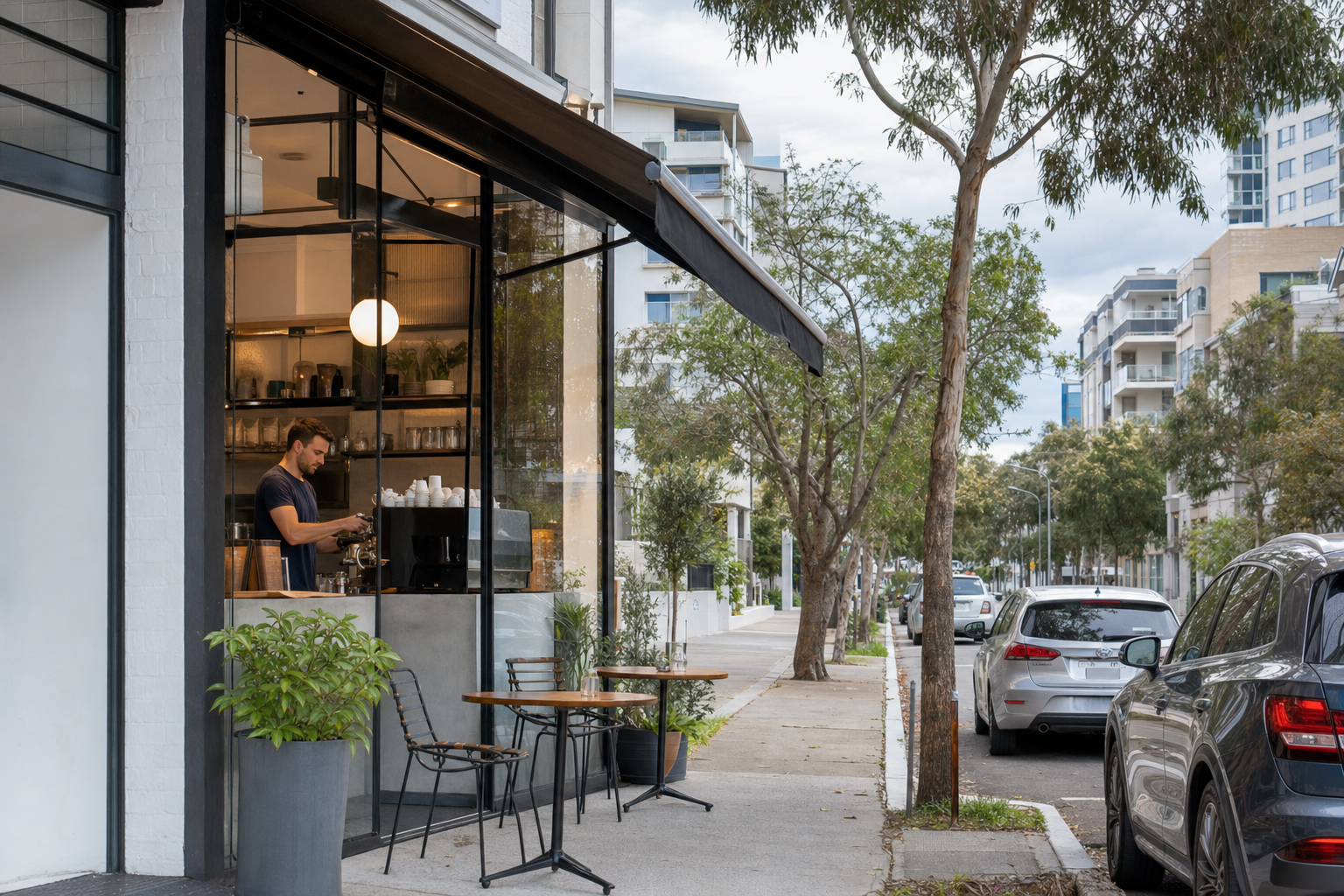
A Mascot café owner can buy a home without starving the business of cashflow.
1. Meet the client and the challenge
1.1 The Mascot café owner’s starting point
Client: “Lina”, late 30s, runs a small café near Mascot Station.
- Trading for: 3.5 years
- Structure: sole trader with a casual staff team
- Turnover: around $620,000 p.a.
- Net profit (after expenses, before Lina’s drawings):
- Year 1: $65,000
- Year 2: $92,000
- Year 3: $110,000 (preliminary)
- Existing debts: $40,000 equipment finance (espresso machine, fit‑out), $12,000 credit card limit (paid in full monthly)
Personal goals in the next 12 months:
- Buy a 2‑bed unit in Mascot (or close by) to stop renting.
- Keep at least three months of café expenses as a buffer.
- Avoid using the home as a “tap” for ongoing business working capital.
These goals clash if you don’t plan carefully. Many business owners either:
- Take too much out of the business for a deposit and weaken cashflow; or
- Over‑borrow on the home and feel forced to use redraw for wages, tax or stock – which concentrates business risk on the family home.
1.2 What Lina thought she could borrow vs lender reality
Lina had seen online calculators suggesting she could borrow around $900,000 based on her turnover. But lenders don’t lend on turnover.
They mainly look at:
- Taxable profit (after all expenses)
- Stability of income over 2+ years
- Existing business and personal debts
- Personal living expenses
- APRA’s 3% serviceability buffer – they test if you can afford the loan at about 3% above the actual rate
We needed to reset expectations using a realistic small‑business framework, similar to what we explain in Borrowing Power for Small Business Owners: A Practical Home Loan Guide.

Getting lender‑ready starts with a clean income story and separated buffers.
2. Step 1 – Getting Lina “lender‑ready” as a self‑employed borrower
2.1 Tidying the income story
Lenders want at least two full years of self‑employed income with lodged tax returns for most standard loans. Lina ticked that box, but her accountant had been very efficient at minimising tax.
We identified two issues:
- Aggressive deductions: claiming high car, phone and “miscellaneous” expenses reduced taxable profit and therefore borrowing power (see also /insights/buying-first-home-small-business-owner-timeline-traps).
- Irregular drawings: Lina was transferring different amounts to her personal account every month, depending on café takings.
Actions we took over 3–4 months:
- Agreed on a consistent “salary” transfer of $5,000 per month from café to personal account, matching what the business could comfortably support.
- For the latest tax return, her accountant aimed for clearer, justifiable deductions – still compliant, but less “over‑optimised” so taxable income reflected the real profit.
This aligned with a key principle: lenders work from taxable profit, not what “you really make in cash”.
2.2 Separating business buffers from the home deposit
Before we met, Lina planned to use $80,000 sitting across her café accounts as her home deposit.
We broke it down:
- $40,000: seasonal stock and wages buffer (about 2 months of trading costs)
- $20,000: upcoming BAS and tax provisions
- $20,000: genuine surplus
Using business working capital for a home deposit often weakens a self‑employed borrower’s position, even if the deposit ends up “big enough”. It reduces resilience and makes lenders nervous about future cashflow.
We agreed to:
- Ring‑fence $60,000 as business buffer + tax provision.
- Treat only $20,000 as available for the home journey.
We then used her personal savings plus a disciplined savings plan to build the rest of the deposit, much like in Smart Deposit Strategies For Self‑Employed First‑Home Buyers.
2.3 Deciding the right documentation pathway
We compared full‑doc vs alt‑doc options:
| Option | Docs Required | Indicative Rate* | Pros | Cons |
|---|---|---|---|---|
| Full‑doc | 2 years tax returns, NOAs, financials, bank statements | Lower (e.g. sharp owner‑occupied variable) | Strongest policy, more lenders, better pricing | Tougher if income volatile or very tax‑optimised |
| Alt‑doc | BAS, accountant’s letter, business bank statements | Higher (often +0.5–1.5% vs full‑doc) | More flexible on income volatility | Higher rates, fewer lenders, tighter LVRs |
*Rates are indicative only – we’re not quoting live rates.
Because Lina had three years of improving financials and we’d cleaned up the income story, we targeted a full‑doc loan with a mainstream lender. This maximised borrowing power and product choice.
3. Step 2 – Working out a safe borrowing limit
3.1 What the bank might lend vs what Lina should take
After reviewing her updated financials, a lender calculator suggested:
- Assessable taxable income (averaged last 2 years): $101,000
- Other income: nil
- Personal living expenses: $3,200/month (based on HEM cross‑check and her real budget)
- Existing debts: $40,000 equipment finance with 3 years remaining
The lender’s indicative maximum:
- Up to ~$850,000 at 30 years P&I, tested at a rate ~3% higher than the headline.
On paper this looked good, but we applied an owner‑operator reality check.
3.2 Stress‑testing the café and the home together
We modelled Lina’s position using a stress‑test framework similar to How Mascot Business Owners Can Stress‑Test a Home Loan Properly:
We assumed:
- 35% drop in Lina’s drawings for 9 months (e.g. extended roadworks, airport traffic shift or a new competitor).
- 2% rise in interest rates over the next two years.
We then compared three possible borrowing levels.
Scenario A – “Max bank” borrowing
- Loan: $850,000
- Rate modelled: 7% p.a. (stress‑tested)
- Term: 30 years, P&I
- Monthly repayment (stress rate): ≈ $5,655
Under a 35% income drop, Lina’s personal budget showed:
- After‑tax personal income (lower drawings): ≈ $4,900/month
- Basic living costs: $3,200/month
- Shortfall before mortgage: already tight
Outcome: uncomfortable. Any disruption to the café or personal life could force her to dip into business buffers or miss loan repayments.
Scenario B – Middle ground
- Loan: $750,000
- Rate modelled: 7% p.a.
- Term: 30 years, P&I
- Monthly repayment: ≈ $4,993
Still tight under stress, and would likely require cutting personal spending sharply and not contributing to long‑term savings.
Scenario C – Conservative borrowing
- Loan: $650,000
- Rate modelled: 7% p.a.
- Term: 30 years, P&I
- Monthly repayment: ≈ $4,325
With a 35% income drop, Lina’s budget looked like:
- After‑tax personal income: ≈ $4,900/month
- Mortgage (stress rate): $4,325/month
- Basic living costs: $3,200/month
On these stress numbers alone, it still looks impossible. But in reality we would not keep personal spending at $3,200/month under severe stress and we would review drawings temporarily. The real question was: what level of home debt allows some flexibility without raiding business buffers?
By modelling line‑by‑line and recognising discretionary spend, we could see that $650,000 was Lina’s practical ceiling if she wanted to preserve business resilience and keep at least 6 months of combined buffers.
Lina chose Scenario C. She didn’t want to be the café owner who loses the house because the street is dug up for six months.
Thoughtful structuring let the Mascot café owner secure a home and keep the business strong.
4. Step 3 – Structuring the loans to protect both home and café
4.1 Avoiding the “home loan as overdraft” trap
A big risk for self‑employed owners is using home loan redraw to cover:
- BAS and tax
- Wages in slow months
- Seasonal stock blowouts
Using long‑term home loan debt for short‑term business needs:
- Increases total interest over time; and
- Mixes loan purposes, complicating tax deductibility; and
- Concentrates business risk on the home.
We designed a different approach.
4.2 Home loan structure
Purchase target: older 2‑bed unit in Mascot, price around $800,000.
Available funds:
- $20,000: from business surplus (after buffers protected)
- $60,000: personal savings
- $20,000: parental gift (not a loan)
- $10,000: additional savings built over the planning period
Total deposit: $110,000 (not including costs).
We then allowed for:
- Purchase costs (stamp duty, legals, inspections): ≈ $35,000–$40,000 (varies by timing and concessions)
We landed on:
- Loan amount: ~$700,000 instead of $650,000, but with a larger cash buffer deliberately left in the offset.
Structure:
- Split A – $650,000 owner‑occupied, P&I, with 100% offset account.
- Split B – $50,000 owner‑occupied, P&I, no offset (slightly lower rate), set to pay down quicker.
Why this structure?
- Split A becomes the long‑term core home loan with flexibility.
- Split B can be targeted for extra repayments when cashflow is strong – a psychological win and faster principal reduction.
- Keeping the offset linked only to Split A clarifies its purpose: household buffer and long‑term savings, not business working capital.
4.3 Business lending structure
We also reviewed the café’s existing $40,000 equipment finance. The repayments were manageable, but Lina had no formal working capital facility – she had been using timing between supplier payments and takings.
To avoid future temptation to raid the home loan, we recommended:
- A small business overdraft (subject to separate approval) secured by business assets, not the home.
- Target limit: $20,000–$30,000.
This matched the principle that short‑term working capital should usually be funded from an overdraft or line of credit, not home loan redraw.
5. Step 4 – Buffers: the real reason this worked
5.1 Building a layered buffer system
We wanted Lina to be able to sleep at night if:
- Airport traffic dropped for a few months
- Construction disrupted foot traffic
- Interest rates rose another 1–2%
We aimed for three layers of buffers:
- Business buffer: At least 2–3 months of café operating expenses in the business account.
- Tax buffer: Separate account for GST, PAYG and income tax – treated as untouchable.
- Household buffer: At least 3–6 months of home loan repayments + basic living costs in the home loan offset.
Worked example (simplified):
- Monthly café operating expenses (excluding Lina’s drawings): $25,000
- Business + tax buffer goal: 3 months = $75,000
- Home loan repayment (initial rate ~6%, not stress rate): ≈ $4,200/month on $700,000
- Basic living costs: $3,200/month
- Household buffer goal (6 months):
- ($4,200 + $3,200) × 6 ≈ $44,400
Within 9–12 months of planning, Lina had:
- Business + tax buffer: ≈ $80,000
- Household buffer in offset: ≈ $45,000
This conservative buffer structure meant that even if café drawings dropped sharply, she had time and options rather than immediate panic.
5.2 Rules Lina agreed to
To keep both home and café strong, Lina committed to:
- Not using the home offset for regular café expenses.
- Reviewing her numbers quarterly with her accountant and broker.
- Triggering a “strategy check‑in” if:
- Monthly café revenue fell 20%+ for three consecutive months; or
- The RBA lifted rates by more than 1% in any 6‑month window.
This turns a one‑off loan decision into a living plan, similar to the approach in Turn Your Mascot Home Loan into a 10‑Year Property Strategy.
6. Step 5 – Lender choice and policy trade‑offs
6.1 What we prioritised in a lender
For a self‑employed Mascot café owner, we looked for:
- Strong self‑employed policy using averaged income, with scope to consider the improving latest year.
- Willingness to recognise consistent owner drawings as income.
- Reasonable treatment of existing business debt (not double‑counting expenses).
- Good offset structure and ability to split loans without extra fees.
We compared several options. Lina ultimately went with a mainstream lender offering:
- Full‑doc assessment.
- 30‑year P&I term.
- 100% offset on the main split.
- Sensible self‑employed policy.
6.2 What we consciously gave up
We decided not to chase:
- The absolute lowest headline rate in the market.
- Complex package features she wouldn’t use.
Instead, we prioritised:
- Policy fit.
- Serviceability.
- Clean structure that kept business and home purposes clearly separate.
7. Where Lina ended up – and what you can copy this week
Within about 10 months of first contact, Lina:
- Purchased a 2‑bed unit in Mascot for $795,000.
- Borrowed $700,000 across two splits, with an offset setup that supports long‑term flexibility.
- Maintained business buffers and tax accounts without raiding them for the deposit.
- Set up a modest overdraft for genuine short‑term café cashflow swings.
She didn’t stretch to the bank’s maximum. She bought a slightly cheaper property and kept the café healthy.
7.1 A one‑week action plan for Mascot hospitality owners
If you see yourself in this story, here’s what you can do this week:
-
Separate your money buckets.
- List your current business account balances.
- Mark what’s really tax, what’s working capital, and what’s genuinely surplus.
-
Start a reliable personal “salary”.
- Pick a realistic amount you can transfer from the business to your personal account every month.
- Run it consistently for 3–6 months.
-
Pull your last two years of tax returns and BAS.
- Check what your taxable profit actually is – that’s the starting point for borrowing capacity.
-
Rough‑check your borrowing power.
- Use the principles from Small business home loan eligibility: what lenders want to see and Borrowing Power for Small Business Owners to estimate a safe range, not a maximum.
-
Stress‑test your idea.
- Ask: “If my drawings dropped by 30–40% and rates rose 2–3%, could I keep both the café and the home afloat for at least 6–12 months?”
-
Talk to someone who understands tax + lending.
- A broker who can read both your financials and the lender policies can often find safer structures than a direct bank application.
8. Common questions from self‑employed café owners
FAQ 1: Can I use my café’s working capital as my home deposit?
You technically can move money out, but it’s usually risky. Those funds often represent tax, wages and stock buffers. Removing them can weaken your business resilience and make lenders question whether your income is sustainable. It’s far safer to treat working capital as an untouchable business buffer and build your deposit from genuine surplus and personal savings.
FAQ 2: My accountant minimises my taxable income – will that hurt my home loan chances?
Yes, it often does. Lenders assess borrowing capacity mainly from your taxable profit after deductions, not your cash turnover. Extremely low taxable income may save tax in the short term but can slash your borrowing power for several years. It’s worth having a three‑way conversation between you, your accountant and a broker to balance tax efficiency with lending goals.
FAQ 3: Should I just wait until my café is “perfect” before buying a home?
Not necessarily. You don’t need a flawless business to qualify for a sensible home loan. You do need a stable track record, realistic drawings and proper buffers. Often, 6–12 months of deliberate planning – tidying deductions, stabilising income and separating business and personal cash – is enough to move from “too messy” to “lender‑ready”.
FAQ 4: Is it safer to buy a cheaper place first and upgrade later?
For many self‑employed borrowers, yes. A slightly smaller or older property with a lower loan can leave more room for business volatility and future rate rises. You can then upgrade once your business is larger, more diversified or less hands‑on. The key is not to let maximum bank approval drive your purchase price.
FAQ 5: Can I refinance my home later to help the business grow?
You can, but it should be done carefully. Using long‑term home debt to fund short‑lived business needs can increase your total interest and concentrate risk on the home. If you do use equity, structuring it as a separate, clearly business‑purpose loan split helps preserve tax clarity and future flexibility.
FAQ 6: What if I’m only one year into running my café?
Most mainstream lenders want at least two full years of self‑employed history. If you’re earlier, focus this year on building a strong, clean income record, good tax compliance and buffers. Use that time to plan your deposit and structure, so that when you hit the two‑year mark, you’re ready to move quickly.
Key takeaways
- Lenders care about stable taxable profit and drawings, not just café turnover, so aggressive tax minimisation often backfires when you want a home loan.
- Separating business working capital, tax money and genuine surplus is essential; don’t gut the café to build a deposit.
- A safe borrowing limit is usually below the bank’s maximum once you stress‑test a 30–40% income drop and interest rate rises.
- Structuring separate home splits, a proper offset and dedicated business facilities helps avoid using the home loan as an overdraft.
- Strong buffers across business accounts and the home offset are what let you survive slow months without risking either the café or the house.
If you’re a Mascot café or small business owner thinking about a home purchase, you don’t have to choose between your business and your house. Walk through your numbers with someone who can see both your tax and your lending picture in one go. Book a free 15‑minute strategy call at localknowledge.finance or try our borrowing power tools at /tools/borrowing-calculator to see what’s realistically safe for you.
General advice only.
Frequently asked questions
Can I use my café’s working capital as my home deposit?▾
Will aggressive tax minimisation hurt my borrowing capacity?▾
How much buffer should a self‑employed café owner keep before buying a home?▾
Is it better to wait until my business is bigger before applying for a home loan?▾
Should I use my home loan redraw for café cashflow?▾
Can I get a home loan if I’ve only been self‑employed for one year?▾
Speak with a specialist advisor
Confidential consultation, bespoke advice for your situation.