Article
Winning Short Settlements and 66Ws in Alexandria Without Blowing Up
Short settlements, 66Ws and 5% deposits are common around Alexandria. This guide shows exactly how to structure your finance, buffers and contract terms so you can move fast without betting your deposit or your home on everything going perfectly.
Key Takeaway
Short settlements, 66Ws and 5% deposits in Alexandria can be used safely only when finance, valuations and cash buffers are locked in before signing. In a high‑stress market where over 30% of Australian borrowers are ‘At Risk’ of mortgage stress (Roy Morgan 2026), buyers should stress‑test repayments at rates 3% higher, keep at least 3–6 months of living costs and repayments in cash or offset, and avoid waiving finance clauses unless their loan is genuinely unconditional. The key action is to align contract terms with a conservative, stress‑tested finance plan before committing.

Alexandria buyers are being pushed towards short settlements, 66Ws and 5% deposits as if they’re “standard”. They can work — but they also strip away protections right when settlement risk is highest.
In plain terms: a short settlement gives you less time to get your loan and valuation sorted, a 66W (no cooling‑off) means you’re locked in the moment you sign, and a 5% deposit means you’re taking on more debt and more lender scrutiny. Used together, they magnify any weakness in your finance plan.
This guide shows how to structure your loan, buffers and contract terms so you can move quickly in Alexandria without betting your deposit or your current home on everything going perfectly.
1. What “short, sharp” deals in Alexandria really mean
1.1 Local norms: why Alexandria feels so rushed
Alexandria and the inner south run on fast campaigns:
- 3–4 week auction runs are common.
- Agents routinely push for 21–28 day settlements.
- Many contracts are offered with a 66W ready to sign.
- Buyers are nudged into 5–10% deposits even when their savings are thin.
Layer on rising interest rates and Roy Morgan’s finding that over 30% of borrowers are now ‘At Risk’ of mortgage stress, and the margin for error gets very small.
If you’re:
- Upgrading from an Alexandria apartment to a house,
- Keeping your unit as an investment while you buy a family home, or
- Self‑employed with lumpy income,
then short, unconditional deals are extra risky.
For a broader national context on these clauses, see /insights/short-settlements-66w-waivers-different-states-structuring-finance-safely.
1.2 Quick definitions (so we’re talking about the same things)
- Short settlement (Alexandria context): usually 21–28 days from exchange to settlement, vs a more traditional 42 days.
- 66W certificate (NSW): a signed waiver of your cooling‑off period. Once signed and exchanged, your contract is effectively unconditional.
- 5% deposit: you pay 5% at exchange instead of the more traditional 10%. You still owe the balance (plus costs) at settlement. Lenders may treat this as high‑LVR borrowing, which can mean LMI and tougher scrutiny.
1.3 Speed is a reward for preparation — not a substitute
You should only accept short settlements or 66Ws as a reward for being fully prepared, not as a shortcut to “beat other buyers”. If your plan can’t withstand a valuation hiccup, rate rise or paperwork delay, it’s not a fast plan — it’s a fragile one.
2. Stress‑testing your borrowing limit for Alexandria prices
Your true safe limit in Alexandria is not the maximum your lender will approve. It’s the point where you can ride out shocks without sliding into mortgage stress.
2.1 Translate the “bank max” into a safe Alexandria limit
Use these filters before you go near an auction:
- Stress‑test the rate: model repayments at 3% above today’s rate (aligned with APRA’s 3% buffer and our broader guidance for off‑the‑plan and higher‑risk deals).
- Cap stressed repayments at ~35% of after‑tax income. This aligns with Roy Morgan’s ‘At Risk’ thresholds and our Alexandria stress guidance.
- Maintain a buffer after settlement of:
- 3–6 months of total living costs + loan repayments for PAYG income; and
- 6–12 months for self‑employed buyers.
If a proposed purchase fails any of these, it’s too aggressive for a 66W or short settlement.
For Alexandria and similar inner‑south suburbs, we treat a stressed repayment ratio above ~35–40% of net income and a buffer under 3–6 months as an early warning that your debt load is becoming unsustainable (see /insights/alexandria-debt-load-red-flags-unsustainable).
2.2 Worked example: house upgrade in Alexandria
- Combined after‑tax income: $11,000/month.
- Existing unit loan: $650,000, P&I at 6.5% over 25 years → about $4,380/month.
- Considering keeping the unit as an investment and buying a $1.6m house with an $1.2m loan.
Stress‑test both loans at 9.5% (6.5% + 3% buffer):
- Current unit at 9.5%: about $5,500/month.
- New house at 9.5% over 30 years: about $10,100/month.
- Total stressed repayments: ~$15,600/month.
Stressed repayment ratio: $15,600 / $11,000 ≈ 142% of your after‑tax income.
Even if you assume some rental income from the unit, this is well beyond any safe line, especially for a 66W and short settlement. Either the purchase price, your plan to keep the unit, or both, need to change.
For a deeper dive into using Alexandria and Green Square as stepping stones, see /insights/using-alexandria-green-square-as-stepping-stones-into-eastern-suburbs.
3. 66Ws in Alexandria: when they’re survivable, when they’re not
3.1 When a 66W is still too risky
A 66W is usually unsafe if any of the following are true:
- Your pre‑approval is generic, not tied to this exact property, structure and price.
- You’re changing jobs, going on parental leave, or your business has lumpy or recently reduced income.
- You’re close to high LVR territory (90–95%) or you need LMI approval.
- The property has quirks: company title, high commercial component, cladding, legal works, or it’s very small or mixed‑use. (See /insights/company-title-strata-quirks-inner-south-finance-basics).
- You’re relying on gifts, guarantees, or a pending settlement for the deposit.
In these cases, you want a proper cooling‑off or, at minimum, a longer settlement and explicit finance clauses.
3.2 When a 66W can be managed — with discipline
A 66W becomes more manageable when:
- You have a written, property‑specific pre‑approval from a lender that has already assessed your income type and liabilities.
- Your broker has checked servicing at 3% higher rates and on the final structure (e.g. keeping vs selling your current place).
- Your solicitor has reviewed the contract, particularly any special conditions, title issues and vendor requirements.
- You have valuation options planned: either the lender is comfortable with the area and property type, or there are fallback lenders.
The rule: all the real thinking and checking must happen before you sign or bid, not in the 5 days you no longer have.
For a play‑by‑play on handling 66Ws and no‑cooling‑off deals, see /insights/short-settlements-66w-no-cooling-off-finance-rules.
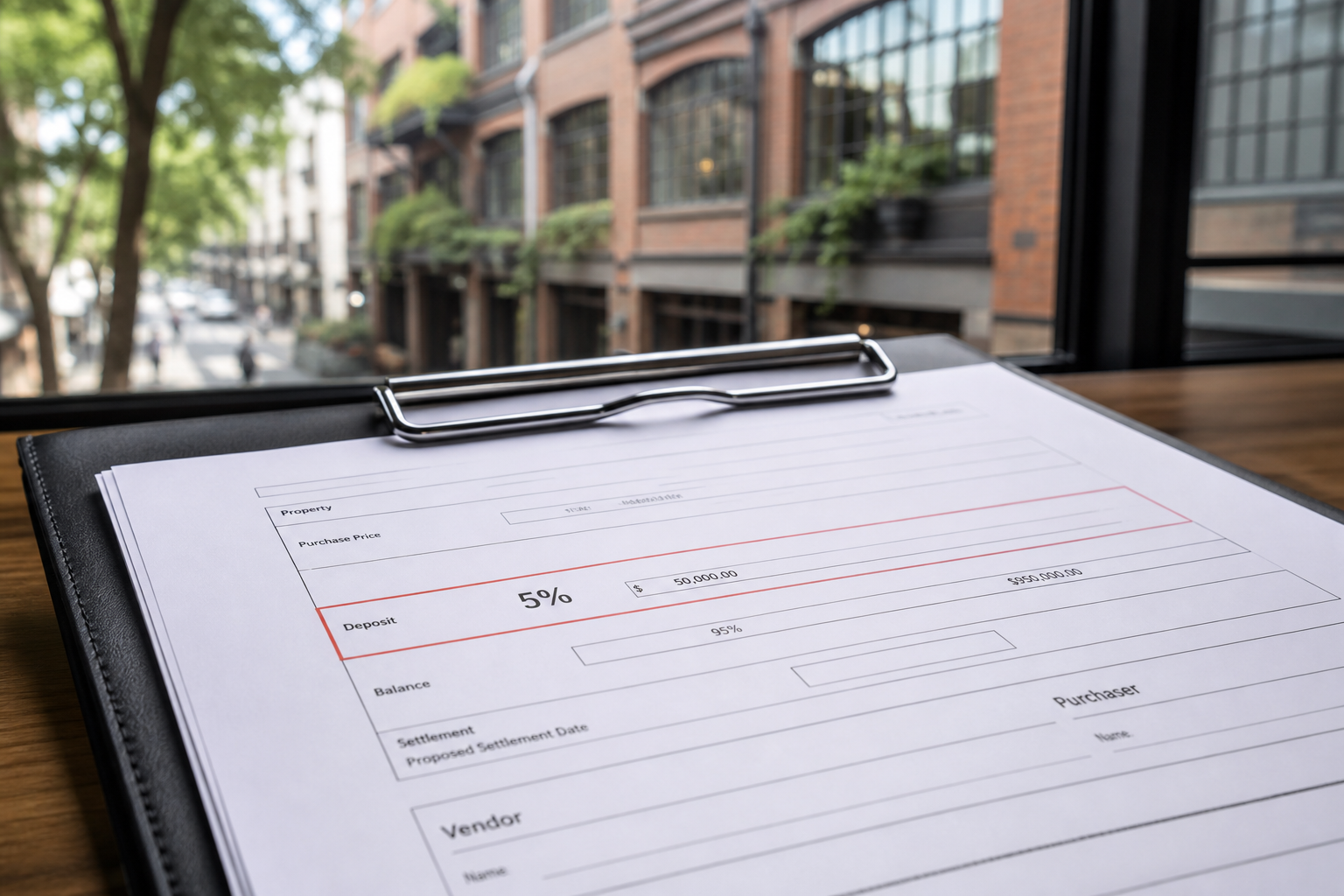 A 5% deposit in Alexandria raises both opportunity and settlement risk. ### 4.1 Cash 5% vs non‑cash deposits In Alexandria you’ll see 5% deposits offered using: - Actual cash (you physically transfer 5%). - Deposit bonds or bank guarantees. They’re not the same risk profile. | Aspect | 5% Cash Deposit | Deposit Bond / Bank Guarantee | |-------------------------------|-------------------------------------------|----------------------------------------------------------------| | What you pay…
The strategy continues below
You've seen the problem and the groundwork — now unlock the exact steps our CPA-certified brokers use, including 6 more sections. Enter your email for instant, free full access.
Free access. No spam — unsubscribe anytime. Your details stay confidential.
Frequently asked questions
Is a 21‑day settlement realistic for an Alexandria purchase?▾
When is it safe to sign a 66W for an Alexandria property?▾
How risky is buying with only a 5% deposit in Alexandria?▾
Should I use a deposit bond instead of cash for a 5% deposit?▾
How do self‑employed buyers reduce settlement risk in Alexandria?▾
Can a slightly longer settlement make my offer more attractive than a higher but risky bid?▾
Speak with a specialist advisor
Confidential consultation, bespoke advice for your situation.