Article
Buying Into a Boutique Rose Bay Block: Finance, Valuation, Exit
Thinking about a boutique luxury block in Rose Bay? This guide unpacks how lenders view small prestige buildings, what it means for valuation, liquidity and your loan structure, and the practical steps to protect yourself before you sign a contract.
Key Takeaway
Buying into a small luxury block in Rose Bay affects valuation, borrowing power and exit options because lenders often treat boutique prestige apartments as higher-risk or “specialised security” and may cap loan-to-value ratios below standard residential levels. In a market where around 28% of mortgage holders are already at risk of stress, illiquidity risk matters for buffers and loan structure. Buyers should stress-test valuations, maintain 6–12 months of buffers, and match lender appetite carefully before exchanging contracts.
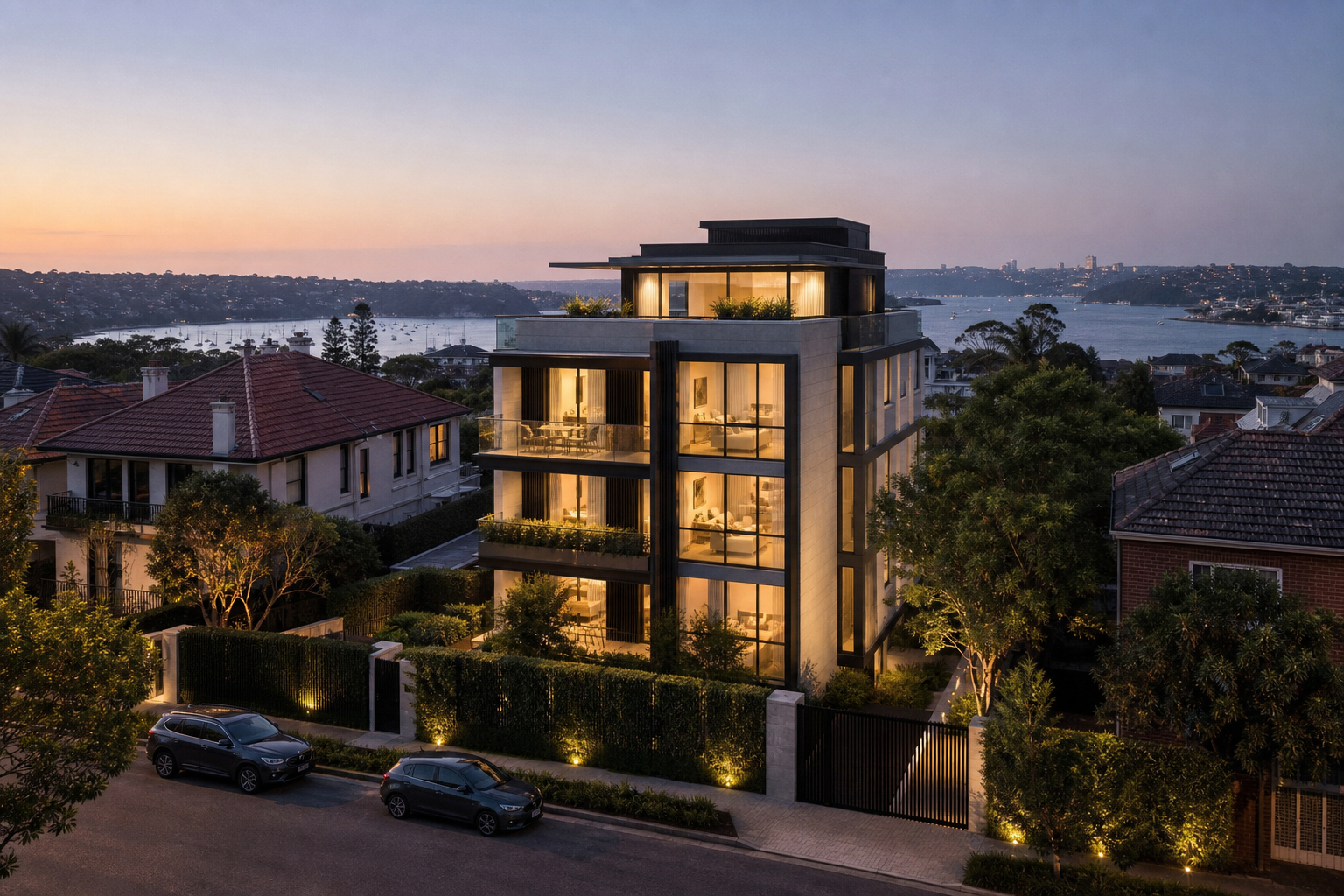
Buying into a small luxury block in Rose Bay is rarely a simple “buy the best you can afford” decision.
In a boutique harbourside building, valuation, liquidity and lender appetite all shift compared with a standard Eastern Suburbs apartment. Lenders may cap LVRs, apply tougher valuations and treat some prestige apartments as higher risk, which directly affects your maximum loan, cash contribution and exit strategy.
Here’s a decision‑grade guide you can work through this week, whether you’re upgrading, downsizing, investing or refinancing.
1. What makes a small luxury Rose Bay block different?
Not all Rose Bay apartments are equal in the eyes of lenders. A small luxury block typically means:
- 2–12 lots, often with lift access
- Premium finishes and larger floorplans
- High owner‑occupier share
- Harbour or district views, sometimes direct waterfront
- Higher strata levies (concierge, lift, landscaping, maybe pool)
From a finance perspective, three things stand out:
- Valuation risk – limited comparable sales make valuations more variable.
- Liquidity risk – fewer buyers at the price point, so slower and less predictable sales.
- Loan structure impact – some lenders quietly have lower LVR limits or extra conditions for small prestige blocks.
A high‑end apartment or penthouse in a small block can absolutely be financeable. But the playbook is closer to a bespoke commercial or prestige deal than a standard unit.
2. How lenders think about boutique prestige apartments
2.1 “Specialised security” and lender appetite
Internally, some banks classify certain properties as “specialised” or “non‑standard” security. They rarely publish this, but markers can include:
- Very small blocks (under ~10–12 lots)
- Very high price per square metre vs local median
- Penthouse or one‑of‑one layouts
- Waterfront or trophy properties with limited comparables
Outcomes can include:
- Lower maximum LVR (for example 70–80% instead of 80–90%)
- No LMI above a certain LVR, even if you’re willing to pay
- Stricter income verification – especially for self‑employed clients
- More conservative valuation – valuers lean to the low side when evidence is thin
This is similar in spirit to how lenders treat smaller, high‑density or mixed‑use apartments in Green Square and Mascot – different reason, same result: more conservative policy. See how that plays out in detail in /insights/high-density-mixed-use-green-square-lender-rules.
2.2 Rose Bay vs high‑density inner‑south stock
If you’ve previously looked at buying a tiny Alexandria or Mascot apartment, you’ll recognise some patterns:
- Inner‑south studios can be restricted on minimum size and postcode risk.
- Boutique Rose Bay blocks can be restricted on price, uniqueness and valuer evidence.
In both cases lenders ask: “How easily could we sell this, at close to valuation, if we had to?”
The answer to that question determines your practical LVR, not just the rate card.
For a worked comparison of size and LVR limits in small units, see /insights/small-studio-one-bed-alexandria-minimum-size-lvr-valuation.
3. Valuation mechanics in a small luxury block
3.1 Fewer comparables = wider valuation range
Valuers usually rely on recent comparable sales in the same building or very close by. In a small, tightly held Rose Bay block:
- There may have been no sales for 3–10 years in the building.
- The last sale might have been in different market conditions.
- Each apartment may differ (aspect, terrace size, renovation level).
So valuers tend to:
- Cross‑check against nearby prestige blocks
- Apply conservative adjustments to views, renovation quality and outdoor space
- Sit closer to the middle of the evidence range, not the top
That means a contract at $5.0m might be valued anywhere between say $4.7m and $5.0m depending on evidence. You need a plan for that range before you exchange.
3.2 Worked example: impact of a 5% down‑valuation
Assume:
- Contract price: $4,500,000
- Your planned LVR: 80%
- Expected loan at 80% of price: $3,600,000
- Deposit + costs available: $1,000,000
If the valuation comes in 5% lower at $4,275,000:
- Maximum 80% loan: $3,420,000
- Shortfall vs your expected loan: $180,000
- New effective deposit requirement: $1,080,000 (plus costs)
If you don’t have the extra $80k–$200k available, you may be forced to:
- Negotiate a price reduction (rare in tight markets)
- Scramble for family assistance
- Try another lender and risk timing
- Walk away and potentially lose your 10% deposit
Building a 3–5% valuation buffer into your numbers is non‑negotiable at this price point.
3.3 Desk‑top vs full valuations
A few lenders use automated or desk‑top valuations in prime postcodes for smaller loans.
For a $3m–$6m Rose Bay apartment in a boutique block, expect:
- Full kerbside or internal inspection
- Close scrutiny of strata, building history and finishes
- Queries about unusual features (boat pens, private lifts, rooftop terraces)
It’s worth asking your broker up front:
- What valuation type is likely?
- How does this lender normally treat prestige Eastern Suburbs apartments?
- Can we order a valuation before auction (or before cooling‑off ends) through a suitable lender?
4. Liquidity and exit risk in small luxury blocks
4.1 Why liquidity matters even if you’re a “long‑term holder”
Most Rose Bay buyers tell me they’re buying for 10–20 years. Life often disagrees.
Property exits can be triggered by:
- Relationship changes
- Business or income shocks
- Health issues
- Desire to upgrade to a house or downsize further
Roy Morgan estimates around 28.2% of Australian mortgage holders are ‘At Risk’ of mortgage stress. For high‑debt Eastern Suburbs households, a solid buffer is the difference between calmly riding out a shock and being forced to sell quickly into a thin market.
In a small luxury block, selling quickly at full value is not guaranteed.
4.2 What illiquidity looks like in practice
Signs of illiquidity risk in a boutique block:
- Very few sales in the last 5–10 years
- Big spread between top and bottom sale prices per m²
- Long days‑on‑market for higher‑end stock in the area
- Price discounts for apartments without A‑grade views or parking
Illiquidity is not all bad – tightly held buildings are often high quality. But you need to structure your loan on the assumption that selling fast may require a discount.
4.3 Simple exit‑risk stress test
Before you commit, run three quick checks:
- Price drop test – Could you sell for 10–15% less than purchase price and still clear the debt and costs?
- Time‑to‑sell test – Could your cash and income handle 6–12 months of overlap if you ended up owning two properties longer than planned?
- Buffer test – Do you have at least 6–12 months of stressed loan repayments plus essential living costs in cash or true offset after settlement? (Consistent with our Rose Bay buffer guide at /insights/rose-bay-home-cash-buffer-strategy).
If the answer to any of these is “no”, you may need to lower your price point, adjust timing or loan structure.
The strategy continues below
You've seen the problem and the groundwork — now unlock the exact steps our CPA-certified brokers use, including 9 more sections. Enter your email for instant, free full access.
Free access. No spam — unsubscribe anytime. Your details stay confidential.
Frequently asked questions
Do all banks cap LVRs lower for small luxury Rose Bay blocks?▾
How big a buffer should I hold after buying a $3m–$5m boutique apartment?▾
Can I rely on Airbnb income to help with my loan application?▾
Is buying in a tiny boutique block riskier than a big high-density building?▾
Should I buy my Rose Bay apartment in my personal name or via a trust?▾
How do I protect myself against a low bank valuation?▾
Speak with a specialist advisor
Confidential consultation, bespoke advice for your situation.