Article
Upsizing in Bronte With Kids: Work Out a Safe Borrowing Limit
Thinking about moving from a Bronte apartment to a semi or house? This guide shows how to work out a safe borrowing limit, stress‑test your repayments and structure your upgrade so your family’s lifestyle and buffers stay intact.
Key Takeaway
A Bronte family upsizing from an apartment to a semi can usually borrow safely around 5–6 times gross household income if they have a 20% deposit plus costs and keep 6–12 months of living expenses in buffer, but the real limit is cashflow under a 3% interest rate buffer. With 32.5% of Australian mortgage holders already ‘At Risk’ of stress (Roy Morgan, 2026), families should keep total home repayments near 30–35% of after‑tax income. The key actionable step is to set a personal borrowing cap before looking at properties.
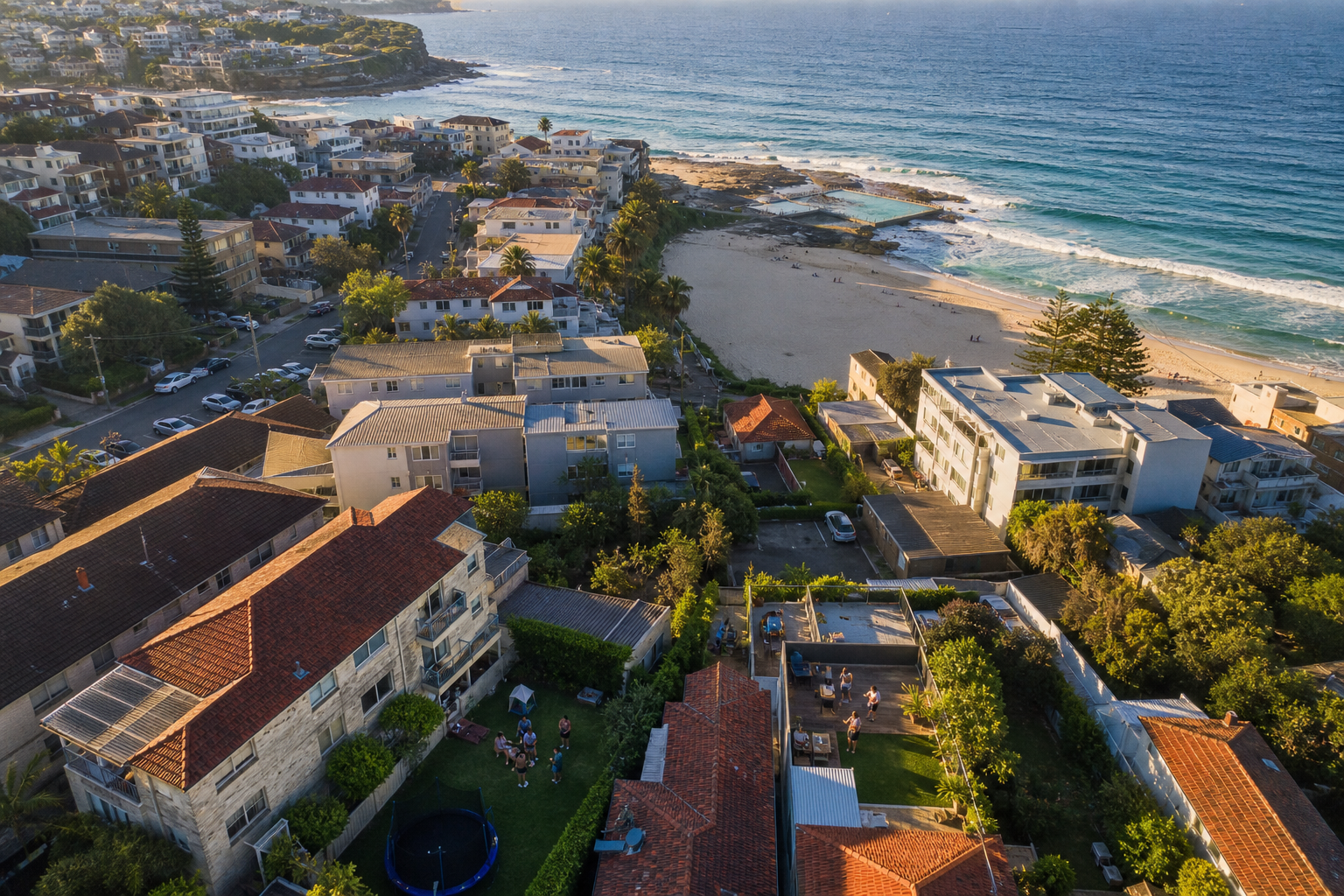
Thinking about moving from your Bronte apartment into a semi, terrace or freestanding home as the kids grow?
A safe borrowing limit for upsizing in Bronte is the point where your family can comfortably handle mortgage repayments even if interest rates rise by 3%, you keep at least 6–12 months of living costs in buffer, and your total home loan repayments stay around 30–35% of your after‑tax income. For many stable, higher‑income Bronte households this works out to roughly 5–6 times gross income, but your real number depends heavily on your equity, debts and how you structure the move.
This guide walks you through the specific numbers, trade‑offs and timing decisions Bronte families are actually facing right now.

1. Start With Bronte Reality, Not Just Bank Maximums
1.1 Why ‘how much can we borrow?’ is the wrong first question
Lenders will often approve more than is comfortable. Their calculators assume:
- benchmark living expenses (HEM), which may be lower than your real Bronte lifestyle costs
- a standard serviceability buffer (currently 3% above your actual rate as guided by APRA)
- income that keeps flowing at today’s level.
But Roy Morgan’s July 2026 research shows 32.5% of Australian owner‑occupier borrowers are now ‘At Risk’ and 22% ‘Extremely At Risk’ of mortgage stress, driven largely by rising rates and living costs. That’s the cautionary backdrop for any Bronte upgrade.
Your safer question is:
“What’s the most we can borrow and still live the life we want in Bronte, even if rates jump and work gets bumpy?”
1.2 A practical Bronte ‘speed limit’ for growing families
Across our Eastern Suburbs upgrade work (and echoing /insights/upsizing-rose-bay-growing-family-safe-borrowing-limit and /insights/borrowing-power-upgrade-unit-to-semi-terrace-eastern-suburbs), a sensible internal limit for many families is:
- Loan size: roughly 5–6× gross household income if you have a 20% deposit plus costs and minimal other debts.
- Repayments: total home (and investment, if any) repayments ≤30–35% of after‑tax income.
- Buffers: at least 6–12 months of essential living costs + all loan repayments in cash or offset.
These aren’t rules from the bank; they’re guardrails to avoid becoming part of the next mortgage stress statistic.
1.3 The Bronte apartment‑to‑semi price gap
Recent sales suggest a rough pattern (illustrative only):
- 2‑bed Bronte apartment: $1.6–$2.1m
- 3‑bed Bronte semi/terrace: $3.0–$4.0m+
That leaves a price gap of $1.2–$2.0m+ before costs.
Your safe borrowing limit is really about whether you can bridge that gap without:
- shredding your buffers
- crossing your 30–35% after‑tax repayment limit
- assuming unrealistic income growth or bonuses.
2. Step‑By‑Step: Calculate Your Safe Borrowing Limit
Here’s a clear sequence you can work through this week.
2.1 Step 1 – Nail your real after‑tax income
Add up all reliable income:
- PAYG: base salary, regular allowances
- Self‑employed: average of recent taxable income (2+ years), plus super contributions
- Extras: bonuses, RSUs, profit share – but treat these conservatively.
Banks will often shade variable income; see /insights/bonuses-rsus-profit-share-borrowing-power-bronte-home for a detailed treatment. For your own planning, it’s safer to:
- count only 50–70% of variable income, or
- assume a lower‑than‑average year.
Use an online tax calculator or your accountant to work out after‑tax income.
2.2 Step 2 – Set a personal repayment ceiling
Use this simple rule:
- Aim for total home loan (and investment property) repayments of no more than 30–35% of after‑tax household income.
- If you have very volatile or self‑employed income, stay closer to 30%.
Example – Bronte couple
- Combined gross income: $420,000
- After‑tax income (incl. SG super excluded): ≈ $270,000 p.a. ≈ $22,500 per month
- 30–35% band: $6,750–$7,875 per month for all property loans.
That’s your monthly repayment ceiling, not your target.
2.3 Step 3 – Stress‑test at rates 3% higher
APRA guides banks to test loans at 3% above actual rates. You should too.
Assume:
- today’s owner‑occupier P&I rate: say 5.7% p.a. (illustrative only)
- stress rate: 8.7% p.a.
Now work backwards from your repayment ceiling.
Worked example – translating ceiling to loan size
Using our example couple’s ceiling of $7,500 per month at 8.7% p.a. over 30 years:
- A loan of ≈$1.4m has stressed repayments of ≈$10,900/month → too high.
- A loan of ≈$1.0m has stressed repayments of ≈$7,800/month → just over the 35% upper band.
- A loan of ≈$900k has stressed repayments of ≈$7,000/month → safely within the 30–35% band.
So even if the bank would happily approve $1.4–$1.6m, this couple’s personal safe borrowing limit might be closer to $900k–$1.0m.
2.4 Step 4 – Preserve a real buffer
For a Bronte family, where private school fees, travel and activities can creep up, a robust buffer is:
- PAYG‑heavy households: at least 3–6 months of essential spending + all loan repayments (see knowledge fact 18).
- Self‑employed/variable income: 6–12 months is more realistic.
For our example couple:
- Essential living + all loans ≈ $12,000/month
- Target buffer (PAYG) = $36,000–$72,000
- Target buffer (self‑employed) = $72,000–$144,000.
That buffer should be in cash or true 100% offset, not tied up in shares you’d hate to sell in a downturn.
Any borrowing plan that empties you below that level is higher risk.
2.5 Step 5 – Check deposits, costs and sale proceeds
Add up:
- expected sale price of current Bronte apartment (after agent, marketing, staging)
- existing home loan to be paid out
- estimated purchase price for target semi or house
- stamp duty, legal, inspections, moving, and a contingency.
A rough cost stack for a $3.2m purchase:
- Purchase price: $3,200,000
- Stamp duty (NSW, non‑FHB): ≈ $155,000
- Legals, inspections, moving, incidentals: say $10,000–$15,000
- Total cost: ≈$3.37m.
Now compare:
- Cash + equity available vs 20%+ deposit target
- Required loan size vs your safe borrowing limit from Step 3.
If the deal only works by pushing past both your safe repayment ratio and your buffer target, something has to give: price, timing, structure, or location.

The strategy continues below
You've seen the problem and the groundwork — now unlock the exact steps our CPA-certified brokers use, including 7 more sections. Enter your email for instant, free full access.
Free access. No spam — unsubscribe anytime. Your details stay confidential.
Frequently asked questions
How much more can I safely borrow to upsize in Bronte?▾
Should I sell my Bronte apartment before buying a semi?▾
Can I keep my Bronte unit as an investment when I upgrade?▾
How do bonuses and RSUs affect my borrowing power for a Bronte upgrade?▾
Is it safe to use a family guarantee to buy in Bronte?▾
How often should I review my mortgage after upsizing in Bronte?▾
Speak with a specialist advisor
Confidential consultation, bespoke advice for your situation.