Article
How to Handle Auctions, Private Sales and Fast Deals in Mascot
Decision‑grade guide to handling auctions, private sales and fast deals in Mascot and Sydney’s inner south, with finance tactics you can set up this week.
Key Takeaway
For Mascot and inner south buyers, the right finance setup depends on whether a property is sold by auction, private treaty or fast off‑market deal. Auctions usually require fully assessed pre-approval and a 66W waiver, while short settlements can be as tight as 21–28 days in a market influenced by Sydney Airport and Port Botany. By aligning pre-approval, timelines and backup options to the deal type this week, borrowers can move quickly without taking unsafe risks.
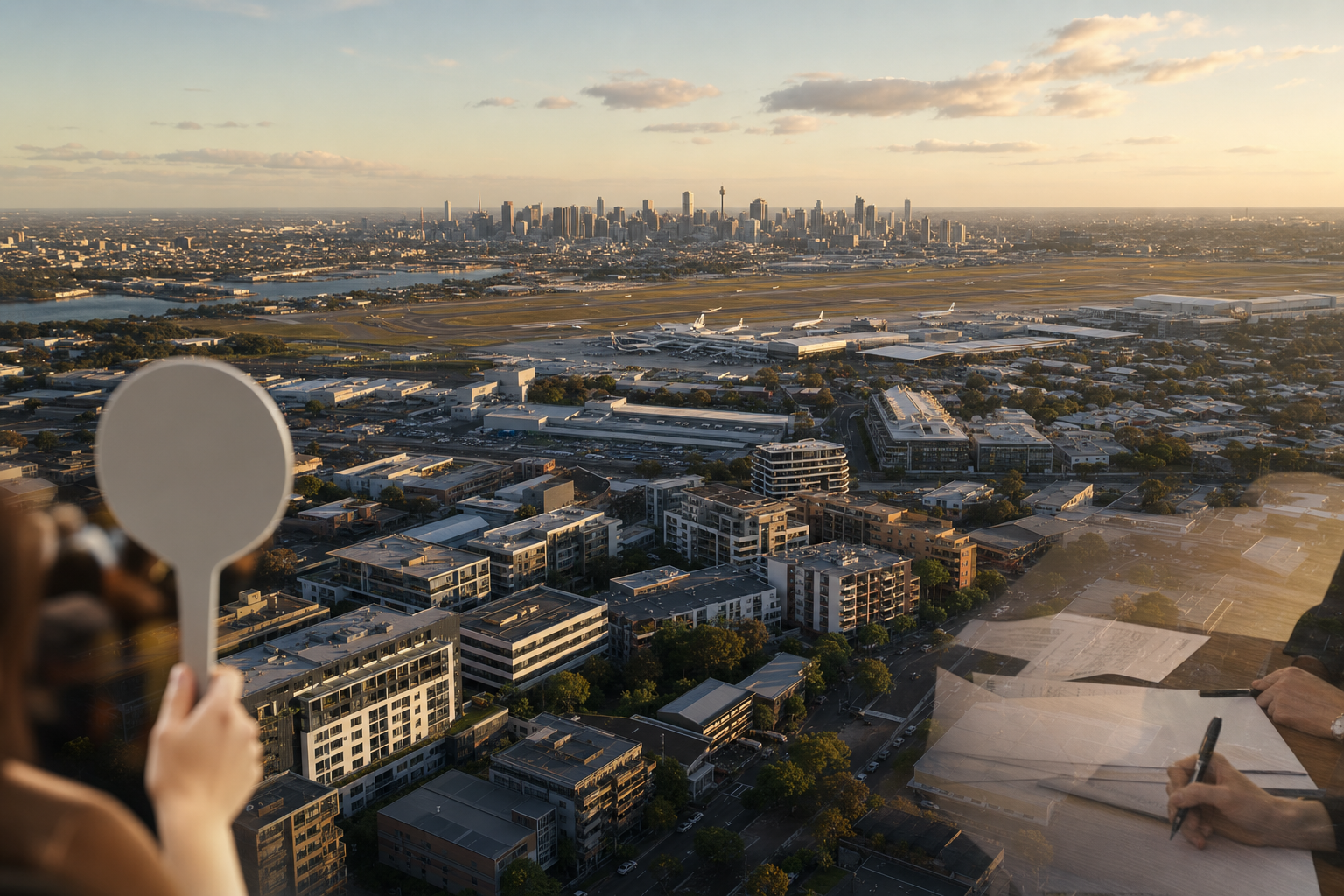
Buying in Mascot and the inner south is all about speed and certainty.
Sellers, agents and even other buyers assume you can move quickly – especially around Mascot, Alexandria, Rosebery, Pagewood, Botany and Wolli Creek. To compete, your finance has to match the way the property is sold: auction, private sale or fast off‑market deal.
In practice, that means three things this week:
- Tight, fully assessed pre‑approval matched to Mascot properties.
- Clear rules for auctions, cooling‑off, 66W certificates and short settlements.
- Backup options if a deal pops up faster than your bank can move.
This guide steps through what to do – in plain English – so you can act confidently on the next Mascot opportunity, without taking on dangerous risk.

Auctions in Mascot and the inner south demand fully tested finance.
1. How Mascot and the inner south actually sell property
Mascot sits inside Bayside Council – an LGA heavily shaped by Sydney Airport and Port Botany. That means a lot of:
- Investors trading units in large complexes
- Aviation and transport workers with shift‑based income
- Small business owners and contractors
- Off‑market or quick deals when vendors want certainty
1.1 The three main ways properties sell locally
You’ll mainly see:
- On‑site and in‑rooms auctions – common for houses, townhouses and well‑located units
- Private treaty (private sale) – standard for most units and entry‑level homes
- Fast or off‑market deals – agents ring their “hot list” of buyers before advertising
Each sale type sends a signal about what the vendor values:
- Auction – maximum price and competitive tension
- Private sale – price plus a clean, low‑risk contract
- Fast deal – certainty and speed, sometimes ahead of price
If you show up with the wrong finance strategy – for example, a loose, untested pre‑approval at an auction – you’re on the back foot from day one.
For a broader overview of how sale types link to finance more generally, see Match Your Finance to the Deal: Auctions, Private Treaties, Fast Settlements.
1.2 What’s different about Mascot and the inner south?
A few local quirks matter for lenders:
- Flight‑path and noise corridors – some banks take a harder line on certain streets or buildings.
- Density and building quality – big unit complexes and past building defects make valuations more conservative.
- Complex income – aviation, logistics, Uber, rideshare, casual and multiple jobs are common.
If your income is anything other than a simple PAYG salary, read Smart Mascot Home Loans for Aviation, Expats and Complex Income alongside this guide.
2. Mascot auction finance: how to be genuinely auction‑ready
At an auction in NSW, you’re buying unconditionally. There’s no finance clause, and cooling‑off doesn’t apply. If you win and can’t settle, you risk losing your 10% deposit and being sued for any shortfall.
So “auction‑ready” in Mascot means more than a quick online pre‑approval.
2.1 What a Mascot auction pre‑approval must cover
A decision‑grade auction pre‑approval should be:
- Fully credit assessed – a real credit officer has checked your documents.
- Valuation‑aware – your maximum bid should allow room if the bank values low.
- Property‑matched – suited to the type of property you’re bidding on (unit vs house, size, location, building age).
Key steps:
- Get documents bullet‑proof – payslips, tax returns, BAS (if self‑employed), bank statements, ID.
- Stress‑test borrowing power – lenders use a 3% APRA buffer on top of actual rates.
- Run property‑by‑property checks – strata, building size, location under flight paths, potential valuation issues.
In Rose Bay we call this an “auction‑proof” pre‑approval; the same idea applies here. For a deeper dive into how strict this needs to be, see Designing Auction‑Proof Home Loan Pre‑Approval for Rose Bay Buyers.
2.2 Setting a Mascot auction limit that survives valuation shocks
Mascot is unit‑heavy. Valuers compare your target to lots of similar stock, so they can be conservative.
Example:
- You plan to bid up to $950,000 on a 2‑bed unit.
- You’ve saved a $150,000 deposit plus $35,000 for costs.
- You expect to borrow $800,000 (LVR ≈ 84%).
If the bank’s valuation comes back at $910,000, they may only lend up to 90% of $910,000 = $819,000. You’re still fine at $800,000, but if you’d stretched to $880,000 deposit + $832,000 loan you could be forced to throw in extra cash to keep the LVR in bounds.
Build your limit assuming the valuer might sit $20k–$40k under the contract price – especially on investor‑heavy or newer complexes.
2.3 Auction contract checks you can do this week
Before bidding in Mascot or the inner south, line up:
- Solicitor / conveyancer review of the contract, strata records and special conditions.
- Building and pest / strata inspection report – or reliable shared reports.
- Insurance plan – who arranges building and contents from day one.
Your conveyancer can also help adjust:
- Deposit structures – e.g. 5% on the day, 5% later, or deposit bonds (if the vendor agrees).
- Settlement period – 35, 42 or even 60 days, depending on your lender’s timing.
2.4 Common Mascot auction traps
- Relying on ‘computer says yes’ pre‑approvals – they often fail once a real credit officer sees your file.
- Ignoring aviation or shift‑work income quirks – some banks shade this income more heavily.
- Bidding on an out‑of‑policy property – tiny studios, serviced apartments, or buildings with known issues.
A Mascot‑focused broker should be checking all three before you even register.
3. Private sales in Mascot: using conditions and timing as weapons
Private treaty is still the most common way to buy Mascot units and many townhouses. Here, your leverage often isn’t price – it’s terms.
3.1 The finance clause: your safety net
In NSW, a typical private sale involves:
- Making an offer (often by email or contract mark‑up)
- Negotiating price and terms
- Exchanging with either:
- A cooling‑off period (5 business days standard), or
- A contract subject to finance by a certain date (less common in metro NSW but still seen)
A well‑drafted finance clause should:
- Specify your lender or allow “a major lender at market rates”
- Give enough time – 14–21 days is common
- Let you walk away if the bank declines, with your deposit refunded
Remember: agents in Mascot see a lot of buyers. If your clause is vague or your broker can’t speak to your capacity, vendors will favour a cleaner, slightly lower offer from someone else.
3.2 Cooling‑off vs 66W: what you’re really signing
In Mascot and the inner south, agents often push for:
- Shorter cooling‑off (e.g. 3 days instead of 5), or
- No cooling‑off at all, via a section 66W certificate signed by your solicitor or conveyancer.
A 66W certificate means:
- You waive your cooling‑off rights.
- The contract becomes effectively unconditional when you sign.
- If finance falls over, you risk losing 0.25% (during standard cooling‑off) or more depending on how the deal is structured.
You only sign a 66W when:
- Your finance is fully assessed and close to formal approval,
- Your broker and conveyancer both confirm it’s safe, and
- You’ve checked for any contract nasties.
3.3 Negotiating terms that beat higher offers
Mascot vendors often respond well to offers that solve a problem:
- Flexible settlement – e.g. “We can do anywhere between 35 and 60 days.”
- Early release of deposit – from trust, if your solicitor agrees and you’re comfortable.
- Minor repairs waived – if the price already reflects the property’s condition.
You can trade these items against price. For example:
“We’ll offer $890,000, 42‑day settlement, with a 5‑day cooling‑off and no other conditions.”
That might beat a slightly higher but messy offer from another buyer.
4. Fast deals, 66W and short settlements: Mascot’s speed game
Because Bayside’s economy is tied to the airport and port, many owners work irregular hours, travel, or are juggling business timelines. That feeds a steady stream of fast, off‑market and short‑settlement deals.
4.1 What ‘fast’ looks like in the inner south
You may see:
- Off‑market SMS from an agent: “Unit at X Street, guide $820k, vendor wants clean 21‑ or 28‑day settlement.”
- Pre‑auction offers: “Make your best offer this week, 66W preferred.”
- Short‑notice auctions: 3‑week campaigns instead of the usual 4.
In these cases, your bank’s normal 25–30 day processing time is a real risk.
4.2 Finance tactics for short settlements
If you’re offered a 21–28 day settlement, look at:
- Lenders with faster credit teams – even if the rate is slightly higher at first.
- Bridging loans – if you’re selling and buying, and settlements don’t line up.
- Equity release ahead of time – top up your current loan months before you search.
Worked short‑settlement example
You’ve agreed to buy a Mascot unit for $900,000 with a 28‑day settlement.
- Deposit: $150,000 savings
- Costs (stamp duty, legals, inspections): ~$40,000
- Required loan: $790,000 (~88% LVR after costs)
If the lender needs 20–25 days for assessment and valuation, there’s almost no buffer. A better structure might be:
- Use a faster lender for the initial purchase with a slightly higher rate.
- Refinance to a lower‑rate lender 6–12 months later once things are settled.
That’s something an experienced Mascot broker can orchestrate – see Compete Confidently at Auction and Off‑Market with a Mascot Broker for how this works in practice.
4.3 66W in a fast deal: when does it make sense?
A 66W in a fast, off‑market deal only makes sense when:
- Your loan has been fully assessed and is one step from formal approval.
- Your broker has spoken directly with the credit assessor.
- The property has been informally reviewed for valuation risk (recent comparables, building history).
In many Mascot deals, a compromise is to:
- Sign with a very short cooling‑off (e.g. 2–3 business days), and
- Use that window to lock in final approval and valuation.
It’s less attractive to the vendor than a 66W, but safer for you than going fully unconditional.
5. Mascot finance tactics for different buyer types
The core sale mechanics are the same, but your tactics should vary depending on whether you’re a first‑home buyer, upgrader, investor or self‑employed.
Different Mascot buyer types need tailored finance tactics to handle fast deals.
5.1 First‑home buyers in Mascot and the inner south
First‑home buyers often:
- Have thinner savings buffers
- Rely on government schemes (FHBG, HGS, FHSS)
- Feel heavy pressure to waive cooling‑off or sign 66W
Your focus should be:
- Protection first – keep cooling‑off unless both your broker and conveyancer are comfortable.
- Buffer accounts – separate your settlement funds from everyday spending so they aren’t eroded by day‑to‑day expenses. (This supports the cash‑buffer principle noted in earlier insights.)
- Scheme‑friendly lenders – not every bank participates in all first‑home schemes.
For broader strategy ideas, see Mascot Home Strategies: First‑Home, Investor and Upgrader Game Plans.
5.2 Upgraders: selling and buying around Mascot
Upgraders face the classic problem: Do we buy first or sell first?
In Mascot’s fast‑moving unit market, common paths are:
- Sell first, then buy – lower risk, but you may need temporary renting.
- Buy first with bridging finance – higher complexity; timing is critical.
Questions to cover with your broker:
- If we buy first, what’s our peak debt during the overlap?
- Can we handle repayments if our existing place takes longer to sell?
- How will bridging affect our ability to negotiate at auction or in a private sale?
A long‑term perspective here is crucial – Turn Your Mascot Home Loan into a 10‑Year Property Strategy shows how a single upgrade decision can set you up (or hold you back) for the next decade.
5.3 Self‑employed and small business buyers
Mascot and the inner south have a big share of:
- Owner‑drivers and logistics contractors
- Café, hospitality and small retail owners
- Tradies and subcontractors
For self‑employed borrowers:
- Doc preparation is everything – tax returns, BAS, financials and ATO portals must be clean.
- Timing around tax – lodging a conservative tax return might reduce tax now but can hurt borrowing capacity.
- Business debt flows through – banks treat business loans and leases as personal commitments, which can cut your borrowing power.
If you’re chasing a fast deal, start this work months before you seriously search. Getting finance ready in parallel with tax planning is where a CPA‑level broker adds a lot of value.
5.4 Investors in a changing tax and policy landscape
Recent and upcoming changes to negative gearing and capital gains tax mean Mascot investors need to think beyond the next deal:
- New rules will restrict negative gearing on established properties purchased after 12 May 2026, while new builds may keep more favourable treatment.
- From 1 July 2027, the current 50% CGT discount will be replaced with an inflation‑linked model and a minimum 30% tax on net capital gains for most individuals.
That makes it more important to:
- Choose structures and loan splits that keep investment interest clearly separated.
- Stress‑test deals on after‑tax cash flow, not just today’s rates.
6. Comparing Mascot deal types: risk, speed and finance demands
Use this comparison table as a quick reference before you commit.
| Sale type | Typical in Mascot/inner south | Finance speed needed | Ability to use conditions | Main risks for buyers |
|---|---|---|---|---|
| Auction | Houses, townhouses, quality units | High – be fully assessed | No finance clause, no cooling‑off | Valuation shortfall, unconditional commitment |
| Private treaty | Most units, some houses | Medium – 14–21 days | Cooling‑off, subject to finance | Over‑negotiating and missing better properties |
| Fast/off‑market | Units, motivated vendors | Very high – 7–21 days | Often pressure for 66W or short cooling‑off | Rushed checks, lender delays, 66W risk |
In short:
- Auctions – do the heavy lifting upfront.
- Private sales – use clauses and timing to manage risk.
- Fast deals – only go hard if your finance is truly ready.
7. One‑week Mascot action plan: from browsing to deal‑ready
If you want to be ready to act on a Mascot or inner south opportunity within the next few weeks, here’s a practical seven‑day plan.
Short settlements and 66W certificates require careful timing with your lender.
Day 1–2: Clarify budget and strategy
- List your after‑tax income, regular expenses and existing debts.
- Decide what you’re targeting: unit, townhouse or house; owner‑occupier or investment.
- Chat with your accountant about any upcoming tax events that might affect borrowing.
Day 2–3: Engage a locally‑aware broker and conveyancer
- Share payslips, tax returns, BAS and bank statements with your broker.
- Ask specifically about Mascot flight‑path and building issues.
- Appoint a solicitor or conveyancer familiar with inner south contracts, 66W and strata.
Day 3–5: Lock in real pre‑approval
- Aim for a fully assessed pre‑approval, not just online numbers.
- Work through a Mascot‑specific property profile – price range, building size, strata type.
- Agree on your maximum safe bid/offer and a back‑up plan if valuations come in low.
Day 5–7: Prepare for real opportunities
- Inspect 3–5 realistic properties and send details to your broker and conveyancer.
- Practice your auction or negotiation script – including what you’ll say about finance.
- Decide in advance where you stand on cooling‑off, 66W and short settlements.
By the end of a focused week, most Mascot buyers can be genuinely deal‑ready – able to say “yes” to the right property without scrambling.
Key takeaways
- The way a Mascot property is sold – auction, private sale or fast deal – should directly shape your finance strategy.
- True auction‑readiness requires fully assessed pre‑approval, local property checks and a realistic bid limit that survives valuation shocks.
- Private sales give you room to negotiate cooling‑off periods, finance clauses, settlement timing and other terms that can beat higher offers.
- Fast, off‑market and 66W deals in Mascot demand backup lenders, short‑settlement tactics and only going unconditional when finance is genuinely secure.
- Different buyer types – first‑home, upgrader, investor, self‑employed – need tailored finance preparation to handle Mascot’s speed without taking on unsafe risk.
If you’re looking at auctions or off‑market opportunities around Mascot or the inner south, now is the time to line up serious finance. Book a free 15‑minute strategy call at https://localknowledge.finance and get your tax, your loan structure and your local property plan reviewed in one conversation – a CPA, tax agent and broker in the same seat. Or, if you’re just testing the waters, start with our borrowing power tools and then sanity‑check the numbers with a human.
General advice only.
Frequently asked questions
How much pre-approval do I need to bid at a Mascot auction?▾
Is it safe to sign a 66W certificate on a Mascot property?▾
How fast can I settle a home loan for a Mascot purchase?▾
Do I need different finance for auctions versus private sales in Mascot?▾
How do self-employed buyers compete in fast Mascot deals?▾
Are Mascot units harder to finance because of the airport?▾
Speak with a specialist advisor
Confidential consultation, bespoke advice for your situation.