Loading the latest on mortgages, RBA & inflation…

Article

Compete Confidently at Auction and Off‑Market with a Mascot Broker

How a Mascot-focused broker helps you bid safely at auction, move fast on off‑market deals, and avoid finance traps common with local apartments, flight‑path properties and complex income.

7 July 2026Updated 10 July 202612 min read

Key Takeaway

Using a Mascot broker to compete at auction or off‑market means having fully assessed pre‑approval, realistic valuation expectations and clear bidding limits based on the APRA‑required 3% serviceability buffer. A local broker understands Mascot‑specific risks like high‑density towers, small units and flight‑path noise, and can shape your finance, timing and conditions to match each deal type. The key actionable step is booking a one‑week “auction‑ready” finance check before you inspect or bid.

Compete Confidently at Auction and Off‑Market with a Mascot Broker

Why a Mascot broker changes how you compete this week

If you’re buying in or from Mascot, a local broker can be the difference between bidding confidently and crossing your fingers. A Mascot‑focused broker combines local property knowledge with lender policy, so you can set safe bidding limits, structure your finance correctly and move quickly on off‑market deals without blowing up your risk.

In practical terms, that means three things: (1) fully assessed pre‑approval that actually works under the APRA 3% buffer, (2) valuations and policies that reflect Mascot’s high‑density and flight‑path quirks, and (3) offer strategies that vendors and agents trust. You can usually get this in place within about a week if you’re organised.
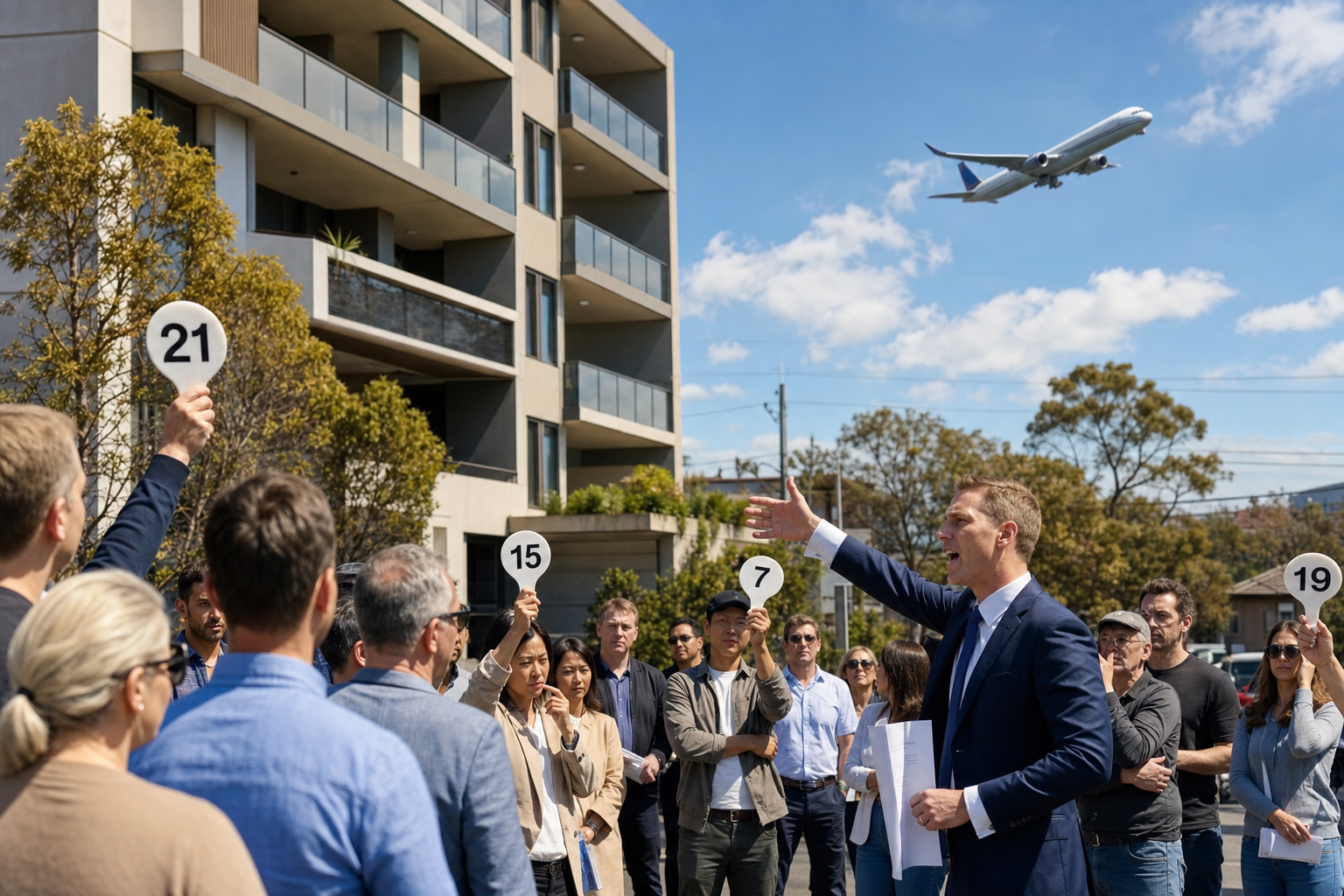
Property auction outside a Mascot apartment building Auctions in Mascot demand truly auction-ready finance, not just online pre-approvals.


Auction vs off‑market in Mascot: what’s really different

How Mascot deals usually run

Mascot is full of:

  • High‑density unit blocks, some with tight lender policies
  • Townhouses and older walk‑ups that can value very differently
  • Noise‑affected properties under the flight path
  • Investors and aviation workers with complex income

Those features shape how deals are run:

  • Auctions are common for units and houses where competition is strong.
  • Off‑market and short campaigns pop up when owners want privacy or a quick, low‑stress sale.

The way a property is sold should change how you set up your finance. That’s a key theme in /insights/auctions-private-treaties-fast-deals-finance-tactics, and it’s even sharper in Mascot because of local lending quirks.

Auction vs off‑market: finance differences at a glance

Here’s how a Mascot broker will usually shape your approach.

FactorMascot auctionMascot off‑market / fast deal
Finance conditionNone – you’re unconditional if you winOften possible (subject to finance), or 66W with prep
Pre‑approval typeMust be fully assessed, not just system‑generatedFully assessed still ideal, but more room to negotiate timing
Valuation timingAfter auction; risk sits with youOften ordered before going fully unconditional
Deposit needed5–10% on the dayNegotiable; sometimes smaller initial holding deposit
Time pressureSeconds while biddingHigh, but you usually have some hours or days to respond
Strategy focusHard bidding cap, emotional control, worst‑case checksPrice + terms that beat other buyers (timing, conditions, settlement)

A local broker’s job is to make sure your finance, structure and risk settings match the deal type – something a non‑local or pure online lender rarely does well in Mascot.

For a broader comparison of local brokers vs banks and online lenders, see /insights/mascot-mortgage-broker-vs-banks-non-local.


Step 1 – Get genuinely auction‑ready finance

What “fully assessed” pre‑approval really means

At auction you cannot rely on a quick online pre‑approval. If you win, you’re locked in – no finance clause. A Mascot broker will push for a fully assessed pre‑approval, which generally means:

  • Your payslips, tax returns and bank statements have been reviewed by a credit assessor.
  • Your income has been shaded the same way it will be at full approval.
  • Existing debts and credit cards are properly included.
  • Your borrowing capacity has been tested with the 3% APRA buffer (e.g. if the rate is 6%, assessed at ~9%).

Done properly, this gets you much closer to “if the valuation is okay, you’re okay”.

Self‑employed and aviation workers: extra prep

Mascot has plenty of:

  • Self‑employed trades, consultants and small business owners
  • Aviation and airport workers with allowances, overtime or variable rosters

Lenders treat these differently. A local broker will usually:

  • Use two years’ tax returns and financials where possible, or supported alt‑doc options
  • Normalise irregular income, bonuses or flying allowances
  • Check lender appetite for your industry early (some are cautious)

If you’re in that camp, read /insights/complex-income-expat-aviation-borrowers-mascot – it goes deeper into documents and lender behaviour.

Worked example: your real auction limit

Say you:

  • Earn $135,000 salary plus super
  • Have a $10,000 credit card limit and a $25,000 car loan
  • Want a Mascot unit around $900,000 with a 10% deposit

A typical major bank might, with the 3% buffer, cap you around $810,000–$850,000 borrowing for a 30‑year principal & interest loan, depending on your living expenses (HEM benchmark plus declared costs).

If you stretch to bid $900,000 with only $90,000 deposit, you’ll need a loan of ~$810,000 (after stamp duty and costs). A Mascot broker will model:

  • Best‑case (sharper lender, strong valuation)
  • Middle (average lender, conservative expenses)
  • Worst‑case (valuation shortfall, higher rate, higher HEM)

That range becomes your hard bidding cap.


Step 2 – Use pre‑auction valuation and property checks the right way

Why Mascot valuations can surprise you

Lenders don’t treat all Mascot properties equally. As covered in /insights/mascot-property-types-local-lending-rules:

  • Some high‑density towers have tighter maximum LVRs or are on internal watchlists.
  • Very small units (e.g. <40m² internal) can lose mainstream lender options.
  • Flight‑path noise and nearby infrastructure may push some valuers to be conservative.

Your broker will often order upfront valuations on likely targets or at least on similar units in those blocks, so you know if your bank is likely to:

  • Accept the full price
  • Shade the value (e.g. you pay $900k, valuer says $870k)
  • Decline the security altogether

Pre‑auction valuation: when it makes sense

You can’t always value the exact property before auction, but you can:

  • Value a comparable unit in the same building or a very similar one
  • Use desktop valuations for quick ballpark checks
  • Run policy and postcode checks for known high‑risk buildings

This helps you avoid the classic Mascot trap: winning an auction, then discovering your bank values the unit tens of thousands below the hammer price.

Managing valuation risk if you still want to stretch

If you know you’re pushing your budget, a Mascot broker might:

  • Choose a lender that tends to use panel valuers familiar with the area
  • Line up a backup lender with slightly different valuation panels
  • Build a plan for extra cash if the valuation comes in low (e.g. parental gift, second buyer, or accepting a slightly higher LMI tier)

That doesn’t mean you should bid recklessly – it just means you understand your downside before you raise your hand.

Mascot broker reviewing valuations and property details Local valuation insight helps you avoid surprises with high-density Mascot properties.


Step 3 – Build an auction game plan you can stick to

Set three numbers, not one

A Mascot broker who understands your bigger picture (future upgrades, investment plans, maybe business needs) will usually help you set three figures:

  1. Comfort number – What feels easily affordable even if rates rise again.
  2. Stretch number – What still works, but needs some lifestyle tightening.
  3. Walk‑away number – Your absolute maximum bid. Beyond this, future plans or sleep quality start to suffer.

Those numbers are based on real repayment modelling, not just online calculators. For example:

  • Loan: $800,000, 30‑year P&I
  • At 6.2%: ~$4,900 per month
  • At 7.2%: ~$5,450 per month

Your broker will test these numbers against your budget, future childcare, possible business changes and more.

On the day: how a broker supports you

While your broker won’t bid for you, they can:

  • Double‑check contract and special conditions with your solicitor before auction
  • Confirm your deposit arrangements (cheque, EFT, deposit bond where appropriate)
  • Be on standby to reality‑check last‑minute jitters or scope creep

You walk in knowing:

  • Your limit is grounded in what you can safely repay under the APRA buffer
  • The likely valuation outcome
  • Your plan B if this property goes past your walk‑away number

Step 4 – Playing off‑market and fast deals to your advantage

Why off‑market deals are common around Mascot

Off‑market sales or very short campaigns pop up when:

  • Owners are privacy‑sensitive (investors, aviation staff, business owners)
  • There’s a tenant in place and the landlord wants to minimise disruption
  • An agent has a buyer list and wants a quick, smooth transaction

Here you’re not just competing on price. You’re competing on certainty and terms.

Making your finance part of the offer story

A Mascot broker will help you structure offers that make agents and vendors feel safe. That can include:

  • A cover letter summarising your finance position (e.g. fully assessed pre‑approval with major lender X)
  • A tight but achievable finance clause (e.g. 10–14 days, not 21–28)
  • A longer settlement to suit the vendor, backed by your lender’s timing tolerance

Where your risk appetite allows – and only if checked with your solicitor – your broker and lawyer might support you to:

  • Exchange on a 66W certificate (no cooling‑off) with genuinely robust finance
  • Offer a larger deposit in exchange for a better price

This is all about finance clause negotiation – using your strength as a prepared buyer to secure better deals, not just paying more.

Fast settlements and bridge‑style problems

If you’re upgrading within or out of Mascot, timing can get messy:

  • You find an off‑market home before you’ve listed your current place.
  • The vendor wants a 30‑day settlement.
  • Your sale might take 60–90 days.

A Mascot broker who also understands business and cashflow lending (see /insights/coordinating-home-business-equipment-finance-one-broker-pros-cons) can:

  • Model bridging finance or short‑term loan structures
  • Check if your existing lender can support releasing equity upfront
  • Avoid unnecessary cross‑collateralisation that locks your properties together long term

Done well, that lets you secure the off‑market opportunity without being forced into a fire‑sale of your current home.

Buyers finalising an off-market property deal with a broker Strong, well-structured finance helps you negotiate better off-market terms.


Step 5 – Integrate today’s purchase into a 10‑year plan

Don’t treat this as a one‑off transaction

Mascot buyers are often:

  • First‑home buyers hoping to upgrade in 5–8 years
  • Investors using Mascot as a base while buying elsewhere
  • Self‑employed or small business owners whose income will evolve

If you treat this purchase as a one‑off, you can:

  • Trap yourself with a high LVR and heavy LMI that slows your next move
  • Lock in interest‑only or fixed structures that clash with future plans
  • Miss better tax and asset‑protection structures

A good Mascot broker will map this purchase into a 10‑year view – something we explore in /insights/mascot-broker-case-studies-long-term-planning.

Worked example: first home in Mascot, upgrade later

Scenario:

  • You buy a $900,000 unit in Mascot with 12% deposit.
  • Loan: $810,000, LVR ~90% plus LMI.
  • Plan: Live there for 4–5 years, then keep it as an investment and buy a house further out.

A Mascot broker thinking long term might:

  • Recommend principal & interest from day one to grind down the balance.
  • Set up a 100% offset account, so extra savings are ready for your future upgrade deposit.
  • Choose a lender with more flexible future investment lending policy.

By year 5, if the loan is ~$730,000 and the property is worth, say, $1,000,000, you’ve created equity that can part‑fund your next place – even if market conditions or RBA rates have been bumpy in the meantime.

Investors and small businesses: coordinating your worlds

Investors and business owners around Mascot often juggle:

  • Personal home loans
  • Investment loans
  • Business facilities or equipment finance

Using one broker who understands all three can reduce clashes between your tax strategy, asset protection and lender appetite. It’s not always right to centralise everything, but when it is, you gain a much cleaner story to banks and a clearer step‑by‑step roadmap.


How a Mascot broker actually saves you time and stress

You’re busy – here’s the one‑week action plan

You don’t need to turn property buying into a second job. A good local broker will:

  1. Day 1–2: Triage and direction
    30–45 minute strategy call. Outline your goals, income, debts, preferred suburbs and timelines. Broker narrows your likely lender pool and flags any red flags early.

  2. Day 2–3: Documents and numbers
    You upload payslips, tax returns, BAS, business financials, bank statements as needed. Broker runs borrowing capacity and repayment modelling under different rate scenarios.

  3. Day 3–5: Pre‑approval and valuations
    Broker submits full application for pre‑approval with a primary lender and, where appropriate, orders indicative valuations or postcode checks.

  4. Day 5–7: Strategy session and deal rules
    You set your comfort, stretch and walk‑away numbers. Agree auction and off‑market tactics, and what you’ll do if the perfect property appears tomorrow.

This is exactly the kind of time and stress saving described in /insights/benefits-using-mortgage-broker-australia, but tuned to Mascot’s market.

Why Mascot specifically favours a local broker

In Mascot, a local broker adds extra value because they:

  • Know which buildings and streets lenders already question
  • See real valuation outcomes weekly, not just theoretical policies
  • Understand aviation and airport‑linked income patterns
  • Are used to coordinating fast settlements and overlapping sale/purchase timelines

That combination means fewer last‑minute surprises and a better match between your risk appetite and your finance structure.


FAQs – Mascot auctions, off‑market deals and brokers

Do I really need a fully assessed pre‑approval to bid at a Mascot auction?

Strictly speaking, no one will stop you bidding without one – but you’re taking on significant risk. In Mascot, with high‑density units and flight‑path issues, valuation shortfalls are common. A fully assessed pre‑approval gives you a clear, realistic limit and means that if the valuation stacks up, your chances of formal approval are much higher.

Can my broker order a valuation before I make an offer?

Often, yes, but it depends on the lender and property. Many lenders allow upfront valuations on a proposed security or a very close comparable, especially if you’ve already started a pre‑approval. Your Mascot broker will decide whether the extra time and cost is justified based on the property type, building, and how quickly you need to move.

How much deposit do I need to buy at auction in Mascot?

Typical on‑the‑day deposits are 5–10% of the purchase price, but the real issue is your overall deposit position once stamp duty and costs are included. A Mascot broker will help you decide whether to aim for 80% LVR (no LMI), 85–90% (with LMI), or use family support or government schemes where available, and then set your auction limit accordingly.

Are off‑market deals always cheaper than going to auction?

Not always. Off‑market deals can be cheaper because there’s less public competition, but some vendors and agents use them to test higher prices with a hand‑picked buyer pool. The real advantage for you is the chance to negotiate better terms – finance clause, settlement length, inclusions – if your finance is rock‑solid and you can offer certainty.

I’m self‑employed – is it realistic to be auction‑ready in a week?

It’s tighter, but still possible if you have your paperwork in order. You’ll need recent tax returns, financials, BAS and bank statements ready to go. A Mascot broker used to complex income can often shortlist suitable lenders on day one, then push your application through to conditional approval within a week or so, subject to underwriting queues.

Should I use the same broker for my home, investment and business loans?

If that broker genuinely understands all three areas, it can make your life easier and improve strategy, especially around timing and tax. It does concentrate your relationship risk though, so you need to be confident in their capability. The pros and cons are covered in more detail at /insights/coordinating-home-business-equipment-finance-one-broker-pros-cons.


Key takeaways

  • Auctions in Mascot demand fully assessed pre‑approval, not quick online ticks, because there’s no finance clause once the hammer falls.
  • Local property quirks – high‑density towers, small units, flight‑path noise – make pre‑auction valuation checks and lender choice critical.
  • A Mascot broker helps you define clear comfort, stretch and walk‑away limits based on real repayment modelling and APRA buffers.
  • Off‑market deals are won with certainty and smart terms, not just price – your finance strategy is part of the offer.
  • Integrating today’s purchase into a 10‑year plan avoids structures that block future upgrades, investments or business moves.

Ready to compete confidently at auction or on an off‑market opportunity around Mascot? Book a free 15‑minute strategy call at https://localknowledge.finance and get a clear, CPA‑grade view of your borrowing power, auction limit and off‑market tactics – your tax, your loan, one expert in a single conversation. Or start with our borrowing power calculator at https://localknowledge.finance/calculators/borrowing-power and bring the results to your session.

General advice only.

Frequently asked questions

Do I really need a fully assessed pre-approval to bid at a Mascot auction?
No one will physically stop you bidding without a fully assessed pre-approval, but it’s risky. In Mascot, where valuations on units can be conservative, you could win the auction and then fail finance. A fully assessed pre-approval gives you a reliable limit and makes final approval more likely if the valuation comes in as expected.
Can my broker order a valuation before I make an offer?
Often they can, depending on the lender and property. Many lenders allow upfront or desktop valuations on a target property or a close comparable. A Mascot broker will weigh the benefit of more certainty against time pressures and decide whether an upfront valuation is worthwhile for your situation.
How much deposit do I need to buy at auction in Mascot?
Most Mascot auctions require a 5–10% deposit on the day, usually by cheque or EFT. However, your real deposit needs are higher once you add stamp duty and costs. A broker will model different LVR levels, including LMI options, and help you set your bidding cap around what you can genuinely fund.
Are off-market Mascot deals always cheaper than auctions?
No. Off-market sales can sometimes be cheaper due to less competition, but they can also be used to chase premium prices from targeted buyers. The main advantage is usually flexibility on terms and timing. With strong finance, you can negotiate conditions that work for both you and the vendor.
I’m self-employed. Can I be auction-ready in a week?
It’s possible if your paperwork is organised and your situation isn’t extremely complex. You’ll need up-to-date tax returns, financial statements, BAS and bank statements ready to upload quickly. A Mascot broker familiar with self-employed borrowers can often secure conditional approval within about a week, subject to lender turnaround times.
Should I use one broker for home, investment and business finance?
Using one skilled broker can simplify things and improve strategy across your home, investment and business loans. It helps avoid conflicting structures and duplicated paperwork. The trade-off is concentration risk if that broker isn’t strong in one area, so you should check their experience and protect yourself with clear structures and regular reviews.

Speak with a specialist advisor

Confidential consultation, bespoke advice for your situation.