Article
Financing a Prestige Apartment or Penthouse in Double Bay and Surrounds
A decision‑grade guide to financing a high‑end apartment or penthouse in Double Bay, Rose Bay or Bellevue Hill—how lenders really assess prestige strata, what it means for deposits, structure, buffers and timing this week.
Key Takeaway
This guide explains how to finance a high-end apartment or penthouse in Double Bay, Rose Bay or Bellevue Hill by focusing on building quality, minimum size rules and stricter lender policies for prestige strata. It outlines typical LVR ranges (often 70–80% for multimillion-dollar units), APRA’s 3% serviceability buffer, and how valuers assess boutique versus larger complexes. Readers get a practical one-week action plan: secure a local, property-specific pre-approval, stress-test repayments, and protect post-settlement buffers before making an offer.
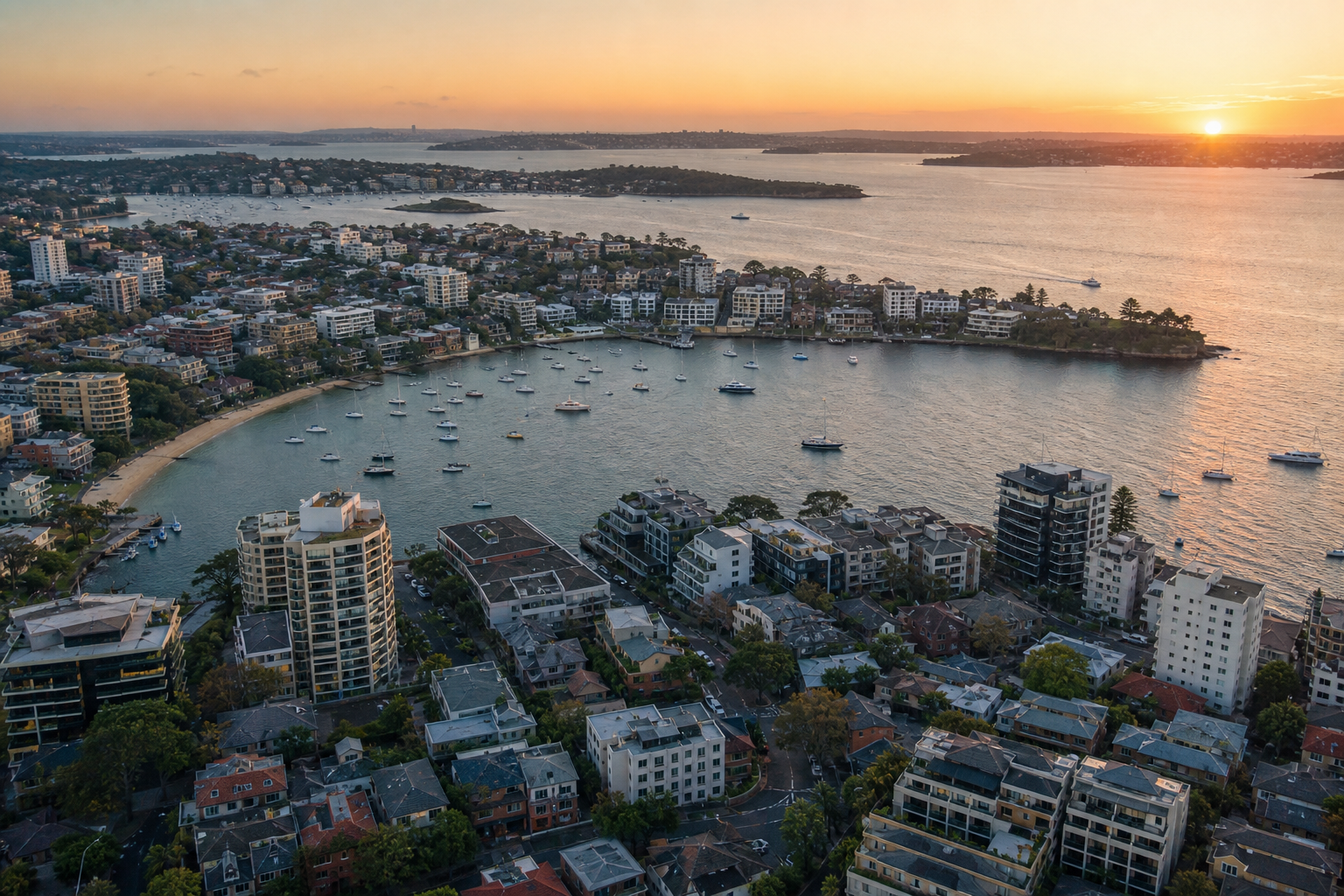
Buying a high‑end apartment or penthouse in Double Bay, Rose Bay or Bellevue Hill is not a standard home loan with extra zeros. Lenders treat prestige strata very differently: they worry about resale liquidity, valuation risk and your cash buffers in a market where prices and levies are both high. If you want to act this week, you need a property‑specific plan, not a generic pre‑approval.
In this guide, we’ll unpack how banks actually assess these properties, what it means for your deposit, structure and borrowing power, and the exact steps to take before you sign a contract on a Double Bay penthouse, a Rose Bay harbourside unit or a Bellevue Hill high‑end apartment.
1. What makes prestige Eastern Suburbs apartments different to finance?
Prestige apartments and penthouses in Double Bay, Rose Bay and Bellevue Hill sit at the intersection of high prices, complex strata and fussy lender policy. The property is usually attractive security; the challenge is how lenders view risk.
1.1 Price brackets and why they matter
In Woollahra LGA, incomes and education levels are among the highest in NSW (over half of residents hold a bachelor degree or higher), and property prices reflect that.
For apartments in this pocket, it’s common to see:
- Quality 2–3 bed apartments: $2.0m–$4.0m
- Penthouses / absolute prestige stock: $4.0m–$10m+ (and sometimes far higher)
Once you’re above about $3m–$4m for a unit, many lenders start applying “prestige” or “high value” rules:
- Lower maximum LVRs (e.g. 70–80% instead of 90–95%)
- Stricter valuation sign‑offs
- Extra scrutiny on your income stability and buffers
1.2 Why the building can matter more than the postcode
Lenders look past the street and focus on:
- Block profile – small boutique vs large complex, age and construction quality
- Unit size – internal area excluding balconies, car spaces and storage
- Strata health – sinking fund, special levies, defects history
- Market depth – how many comparable sales exist at your price point
If you haven’t yet read it, pair this guide with:
- Financing Boutique Blocks vs Larger Complexes in Sydney’s Eastern Suburbs
- Choosing Old Blocks or New Luxury Builds in Double Bay and Bellevue Hill
Together they give you the building‑selection context; this article focuses on the loan.
1.3 Minimum size rules – why some “perfect” units are near‑unlendable
Most mainstream lenders have minimum internal size policies for apartments, often around:
- 50 m² internal (excluding balconies and car spaces) for standard lending
- 40–45 m² with tighter LVRs or extra conditions
For high‑end stock, they’re even fussier. A 46 m² one‑bedder in a Double Bay boutique block might be incredibly desirable to buyers, but some banks will either:
- Decline outright, or
- Limit LVR (e.g. 60–70%) and require stronger income/buffers
Before you fall in love with a property, have the internal area confirmed on the strata plan and checked against lender rules.
2. How lenders actually assess a Double Bay, Rose Bay or Bellevue Hill penthouse
The core mechanics are the same as any home loan – income, expenses, debt, deposit – but the dials are turned up.
2.1 Serviceability with a 3% buffer
APRA expects banks to test your repayments at least 3% above the actual rate. If your likely rate is 6.3% p.a., the assessment rate could be 9.3% or higher.
Worked example – $4.0m Bellevue Hill penthouse (owner‑occupied)
- Purchase price: $4.0m
- Deposit: 25% ($1.0m) + costs
- Loan: $3.0m, 30 years, variable 6.3% p.a., P&I (indicative only)
Approximate repayments at 6.3%:
- Monthly: ~$18,600
- Annual: ~$223,000
Assessment at ~9.3%:
- Assessment repayment: ~$24,600 per month
To pass servicing, your after‑tax income needs to comfortably handle $24k+ per month plus living costs and any other debts.
For high‑income professionals and business owners, it’s critical to set your own internal ‘speed limit’ – often capping total home and investment loan repayments near 30–35% of net income rather than relying solely on the bank’s maximum capacity (see also our broader gearing guidance in other articles).
2.2 LVRs and deposit expectations
Indicative owner‑occupied ranges (prestige strata):
- Up to $2.0m: some lenders will still go to 80–90% LVR (with LMI above 80%)
- $2.0m–$4.0m: many cap around 80% LVR
- $4.0m+ and penthouses: common to see 70–80% LVR caps, sometimes lower for very unusual stock
Investors or complex scenarios (company title, unusual layouts, heavy short‑stay use) may see tighter limits again.
2.3 How the valuer can quietly cap your borrowing
For prestige property, the bank’s valuation is often the real limit, not the bank’s headline LVR.
Valuers weigh:
- Recent comparable sales in the same building and nearby
- Adjustments for views, renovation level, parking and outdoor space
- How many active buyers there would be at your contract price
If you agree to $5.5m on a Rose Bay penthouse but the valuer comes in at $5.1m:
- At 80% LVR, the bank lends 80% × $5.1m = $4.08m
- You must cover the $420k shortfall plus your original deposit and costs
This is why relying on online estimates or other agents’ opinions can be dangerous at the top end.
The strategy continues below
You've seen the problem and the groundwork — now unlock the exact steps our CPA-certified brokers use, including 6 more sections. Enter your email for instant, free full access.
Free access. No spam — unsubscribe anytime. Your details stay confidential.
Frequently asked questions
How much deposit do I need for a $3–4 million prestige apartment?▾
Will a bank lend on a small but high-end one-bedroom in Double Bay?▾
How do lenders value a penthouse with unique features like a pool or mooring?▾
Is it safer to choose interest-only repayments on a large prestige mortgage?▾
How big should my cash buffer be after buying a high-end apartment?▾
Can I rely on a standard pre-approval to buy an off-market Rose Bay apartment?▾
Speak with a specialist advisor
Confidential consultation, bespoke advice for your situation.