Article
How Mascot Property Types Shape Your Home Loan Options This Year
Mascot isn’t a one‑size‑fits‑all postcode for lenders. High‑density towers, flight‑path noise, small studios and mixed‑use buildings all trigger different bank rules. This guide shows how your specific Mascot property type changes borrowing power, LVR limits and approval risk – and what to check this week before you sign or refinance.
Key Takeaway
Mascot property types significantly affect home loan approval, with lenders often capping loan‑to‑value ratios on high‑density apartments, small studios and flight‑path‑affected homes. In dense postcodes, some buildings may be on lender restriction lists, limiting LVRs to around 70–80% or excluding them entirely. Buyers and refinancers should check building‑specific policies, noise and floor‑area rules, and mixed‑use zoning before committing, and structure finance to allow buffers and alternative lender options if a valuation comes in low.
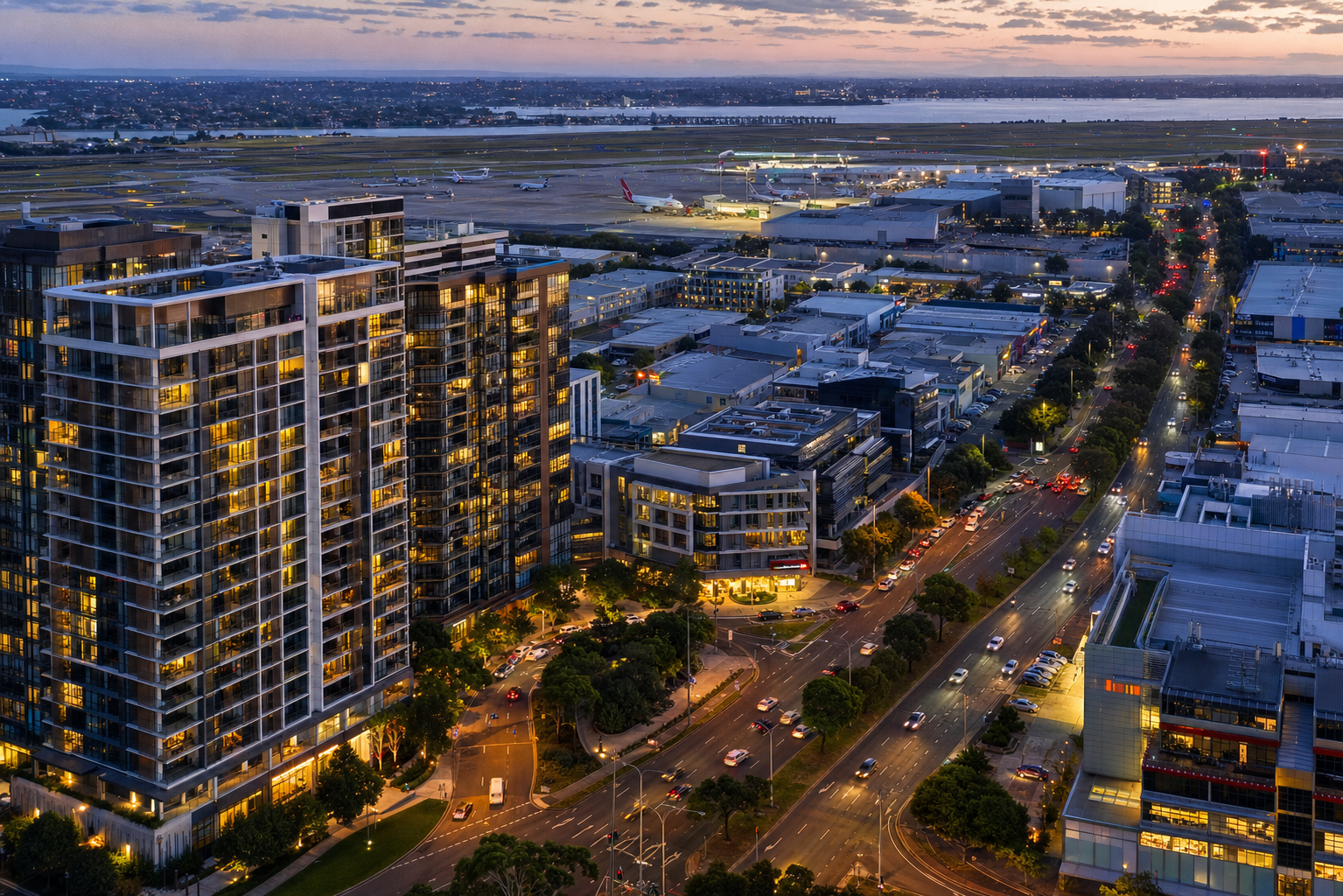
Mascot property types change how banks will lend — even within the same street. High‑density towers, flight‑path noise, small studios and mixed‑use buildings each trigger different policy rules, LVR caps and valuation behaviour. If you’re buying or refinancing in Mascot, you need to understand how the exact property you pick affects borrowing power, approval risk and future flexibility.
This guide explains how lenders view key Mascot property types, typical policy traps, and the checks you can run this week so your finance actually fits the home or investment you’re targeting.
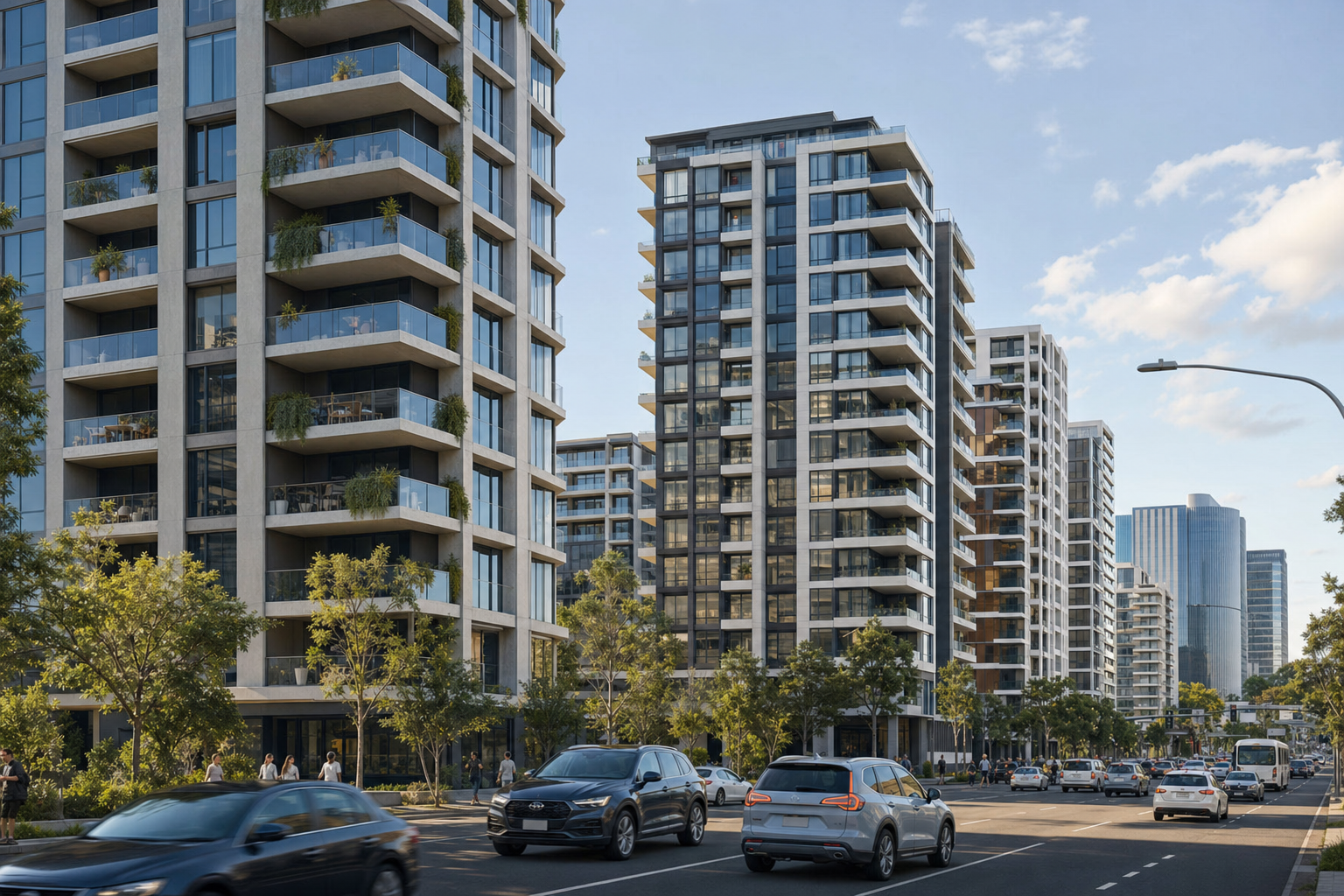
High‑density Mascot apartments often trigger special lender rules and LVR caps.
1. Why Mascot properties are treated differently by lenders
Mascot sits in a dense, airport‑adjacent corridor with a lot of newer apartments, busy roads and commercial activity. For lenders, that means higher concentration and resale risk than a typical low‑rise suburb.
Several things make Mascot “non‑standard” in bank credit models:
- High‑density classification – many complexes trigger high‑density policies (e.g. >50–100 units or specific postcodes). As seen in nearby Green Square, this often leads to building‑specific restriction lists and tighter LVRs (src: /insights/local-green-square-broker-building-knowledge).
- Airport and flight‑path noise – properties under heavy flight paths can raise valuation and resale concerns, especially for houses and low‑rise units that don’t have great sound insulation.
- Mixed‑use and commercial interfaces – retail podiums, serviced apartments, hotels and busy roads can all push a property into “non‑standard” territory.
- Building‑level risk – lender experiences with cladding, leaks or poor sinking funds in one building can lead to stricter rules for that exact address, even if neighbouring towers look identical (similar pattern noted in Rose Bay: /insights/rose-bay-property-types-lending-rules).
For Mascot, the message is clear: property risk management must include checks for building‑specific lender restrictions and local valuation behaviour, not just generic LVR rules (src: /insights/what-local-knowledge-looks-like-mortgage-broking).
2. High‑density Mascot apartments: what banks actually worry about
Most Mascot apartments sit in large complexes. Lenders worry less about you as a borrower and more about how easily they could resell that unit if they ever had to.
2.1 Common high‑density lending rules
Policies vary by lender and change regularly, but typical high‑density settings in Mascot‑style postcodes include:
- Lower maximum LVR – many lenders cap at 80% LVR, and some at 70–75% for specific buildings.
- Stricter valuation approach – valuers may be conservative, especially if there’s a lot of similar stock on the market.
- No LMI above certain LVRs – some lenders simply won’t use Lenders Mortgage Insurance (LMI) for high‑risk buildings, effectively blocking >80% loans.
- Income and deposit quality focus – tighter on overtime, bonuses or self‑employed income, because they want strong borrowers in higher‑risk buildings.
In dense apartment markets, this can extend to outright exclusions for some buildings (defects, cladding, sinking fund issues) or temporary limits until issues are resolved (src: /insights/common-first-home-off-the-plan-mistakes-green-square).
2.2 Example: LVR impact on a $750,000 Mascot apartment
Assume you’re buying a $750,000 two‑bed unit in a large Mascot complex.
- Buyer A: lender treats building as standard, allows 90% LVR with LMI.
- Minimum deposit (excl. costs): $75,000.
- Buyer B: lender flags building as high‑density; caps at 80% LVR.
- Minimum deposit: $150,000.
Same property, same price, but the building classification doubles the deposit needed.
2.3 Checks you can run this week
In the next seven days, you can materially reduce risk by:
- Getting a broker to run the exact building against multiple lender policy engines, not just postcode.
- Asking specifically: “Are there LVR caps, LMI bans or valuation issues on this complex?”
- Reviewing the strata report for: defect history, fire and cladding reports, insurance, and sinking fund strength.
If you’re deciding between buildings, these checks can be the difference between a smooth 90% LVR approval and a painful 70–80% cap.
3. Mascot flight‑path properties: how noise affects lending
Lenders don’t have a single “flight‑path policy”, but airport noise shows up indirectly through valuations and resale risk.
3.1 How valuers treat flight‑path risk
Valuers look at:
- Noise contour maps and insulation – double glazing, modern construction and proper sealing help.
- Comparable sales – if noisy streets consistently sell for less, that feeds into conservative vals.
- Market depth – if there are plenty of buyers despite noise (common near Mascot station), the risk is lower.
The result is usually lower valuations, not outright lender bans. That matters because the bank lends against the lower of price or valuation.
3.2 Worked example: valuation shortfall on a flight‑path home
You agree to buy a house near the airport for $1,500,000. Your lender will go up to 90% LVR, and you have $200,000 deposit plus costs.
- Target loan: 90% of $1,500,000 = $1,350,000.
- Suppose the valuer comes back at $1,420,000 due to noise.
- Max loan at 90% of valuation: $1,278,000.
- Shortfall: $1,350,000 – $1,278,000 = $72,000 extra cash required.
Without a buffer, that shortfall can kill the deal.
3.3 Practical moves if you’re under the flight path
This week you can:
- Ask your broker to order an upfront valuation where possible before you go unconditional.
- Build in a minimum 5–10% cash buffer above your ideal deposit to handle shortfalls.
- Consider negotiating slightly lower offer prices on noisier streets to give you a valuation safety margin.
If you work in aviation or with complex income, combine this with the strategies in /insights/complex-income-expat-aviation-borrowers-mascot so income and property risk don’t stack against you at once.
4. Small Mascot studios and one‑bedrooms: size and layout traps
Mascot has a mix of compact studios and one‑bed units aimed at investors and first‑home buyers. These are popular – but often come with tougher lending rules.
4.1 Typical small‑unit lending rules
Again, policies vary, but you’ll often see:
- Minimum internal area requirements – common cut‑offs are 40–50m² internal (excluding balconies and car spaces).
- Lower LVR caps for 1‑bed units and studios – e.g. 80% max, no high‑LVR LMI.
- Higher valuation risk – demand can be more volatile for very small units.
Some lenders will treat a 45m² one‑bed as full security; others might treat it like a studio with tighter rules.
4.2 Comparison: how property type changes loan settings
Indicative only; every lender is different, but this gives you a sense of the spread.
| Property type | Typical max LVR* | Common issues | Who it suits best |
|---|---|---|---|
| 2‑bed Mascot apartment (≥70m²) | 90–95% with LMI | High‑density caps, strict valuations | First‑home buyers, upgraders, investors |
| 1‑bed Mascot unit (~50–55m²) | 80–90% | Some lenders treat as higher‑risk, less LMI | FHBs with good deposit, investors |
| Small 1‑bed / studio (<40–45m²) | 70–80% | Many lenders exclude or cap LVR, valuation risk | Seasoned investors, strong equity |
| Mixed‑use resi over shops | 70–80% | Zoned commercial/retail, limited lender appetite | Investors, business owners |
*Illustrative only. Actual policies vary and change.
4.3 Worked example: small studio borrowing power
You’re eyeing a 38m² studio in Mascot for $550,000 as an investment.
- Lender A won’t lend at all below 40m² internal.
- Lender B will lend to 80% LVR, but no LMI.
- Max loan with Lender B: 80% × $550,000 = $440,000.
- You must contribute $110,000 plus stamp duty and costs from cash or equity.
If you assumed you could borrow 90–95% like a normal unit, this gap can derail your plan.
4.4 What to verify before you offer
Before making an offer on a small unit this week, you should:
- Get the strata plan and confirm internal living area (not including balcony or car space).
- Ask your broker which lenders will accept that size, and at what maximum LVR.
- Run the numbers on rent, costs and new negative gearing rules if you’re investing – established units bought after 12 May 2026 won’t be able to offset net rental losses against salary income (see 2026 reforms).
5. Mixed‑use Mascot buildings: living over shops and commercial interfaces
Mascot has plenty of buildings where residential units sit above retail, offices or even light industrial. Lenders often label these “mixed‑use”, which can push them closer to commercial‑style rules.
5.1 How banks classify mixed‑use
A property might be flagged as mixed‑use if:
- It’s zoned partly commercial or B4/MU rather than purely residential.
- It sits directly over shops, restaurants, gyms or medical centres.
- There is a substantial non‑residential portion of the building (e.g. hotel, serviced apartments).
Consequences often include:
- Lower max LVR (70–80% common).
- Fewer lender options – some banks exclude mixed‑use entirely.
- Higher rates in some cases, or commercial‑style assessment for larger loans.
5.2 When mixed‑use can still make sense
Mixed‑use apartments can offer:
- Sharply better yields due to convenience and lower purchase prices.
- Strong demand from tenants who value transport + retail + proximity to the CBD/airport.
But they work best for borrowers who:
- Have solid equity or cash deposits.
- Are comfortable with higher valuation volatility.
- See the asset as part of a broader 10‑year plan, not a short flip.
For a bigger‑picture approach to using your Mascot property in a longer strategy, see /insights/mascot-broker-case-studies-long-term-planning.
5.3 Checks before you buy mixed‑use in Mascot
This week, you can:
- Get the zoning certificate (s10.7) and confirm the exact zoning and permitted uses.
- Ask explicitly: “Will any lenders treat this as commercial or mixed‑use, and what LVR caps apply?”
- Budget on higher closing costs and potentially a slightly higher interest rate if your loan ends up on a commercial‑style product.
Mixed‑use Mascot properties can offer strong amenity but attract tighter lending policies.
6. Houses and townhouses: still policy‑simple, but not risk‑free
Houses and townhouses in Mascot look simpler to lenders than high‑rise apartments or mixed‑use units. But the airport corridor still introduces quirks.
6.1 How lenders see Mascot houses
Most banks treat Mascot houses as standard residential security, with:
- Potential LVRs up to 95% with LMI (subject to income, buffers and policy).
- Normal assessment rules: APRA 3% serviceability buffer above actual interest rate, realistic living costs using HEM plus your real expenses.
Risks arise more from:
- Flight‑path noise and traffic, which can weigh on valuations.
- Neighbouring commercial uses (warehouses, logistics, busy roads).
6.2 Example: serviceability vs property risk
Assume you’re buying a $1.8m townhouse in Mascot.
- You have income to service a $1.5m loan at current rates plus the 3% buffer.
- If the lender is comfortable with the security, you may get 90–95% LVR approved.
- If the valuation drops to $1.7m due to local issues, your maximum 90% loan becomes $1.53m — still fine.
Here, income and buffers, not property type, are the main hurdles. But in some locations, conservative valuations can push you back to an 80% LVR lender, forcing you to tip in more cash.
6.3 This week’s actions for house / townhouse buyers
- Order building and pest plus a valuation‑aware price check before going unconditional.
- Plan for rate rises and buffers – remember, around 28% of Australian mortgage holders were “At Risk” of stress in early 2026 (Roy Morgan). Don’t put yourself in that camp by stretching too far.
- If you’re self‑employed or run a small business, align this purchase with the income and documentation steps in /insights/small-business-home-loan-basics-eligibility.
7. Investors, negative gearing reforms and Mascot property types
From mid‑2026 and 2027, negative gearing and CGT reforms change how residential property is taxed in Australia. Mascot investors need to match property type, yield and tax treatment carefully.
Key points for investors:
- Established residential properties bought after 12 May 2026 – rental losses generally can’t be offset against salary or other non‑rental income. Losses are effectively quarantined.
- New builds and pre‑12 May 2026 holdings – can still access current negative gearing rules, subject to the new dual‑system and timing rules.
- From 1 July 2027, the CGT regime changes, shifting away from the 50% discount to indexation and minimum tax rules for many gains.
In Mascot, that means:
- High‑density or small‑unit investments with thin yields and high costs might be less attractive if you can’t use the tax loss against salary.
- New‑build apartments that qualify under the new rules may hold relative appeal if they stack up on quality and strata fundamentals.
Before committing to an investment unit in Mascot, run two sets of numbers:
- Cashflow standalone – ignoring tax, does it comfortably cover interest, strata, maintenance and a risk buffer?
- Post‑reform tax impact – assume you can’t use losses against salary unless it’s a new build under future definitions.
As a CPA and Tax Agent as well as a broker, this is where a joined‑up loan and tax strategy can save you from surprises.
8. Matching your Mascot property choice to your borrowing profile
Different buyers will fit different Mascot property types. The key is aligning your income, deposit and risk tolerance with the bank’s rules for that property.
8.1 First‑home buyers
Often best suited to:
- Standard 1–2 bed apartments in well‑regarded complexes (not too small, not too quirky).
- Houses or townhouses in slightly less dense pockets if budget allows.
This week:
- Shortlist 2–3 buildings that work for First Home Guarantee or similar schemes and are lender‑friendly.
- Get a borrowing capacity and property type brief from a local broker who knows Mascot buildings, not just products. See /insights/mascot-mortgage-broker-vs-banks-non-local.
8.2 Upgraders and families
Often better off targeting:
- Larger 2–3 bed apartments or townhouses in quieter pockets of Mascot.
- Properties with good noise insulation and parking, which help both liveability and valuation.
This week:
- Map out a 5–10 year plan – is this your forever home, or a step towards something else? The structure matters. /insights/mascot-broker-case-studies-long-term-planning walks through real strategies.
8.3 Self‑employed and small business owners
You may benefit from:
- Slightly more mainstream properties (standard units or townhouses) that don’t add property risk to already complex income.
- Keeping any higher‑risk assets (small studios, mixed‑use) for later, once your base is solid.
Align this with the documentation and structuring tips in /insights/home-loans-high-income-self-employed-professionals.
8.4 Investors
Consider:
- Quality over novelty – strong strata, good maintenance, realistic levies and genuine tenant demand.
- Being selective about high‑density towers: no obvious defect history, adequate sinking fund, realistic exit values.
- Whether new build vs established changes your negative gearing position under the 2026–27 reforms.
Small studios and one‑bed units in Mascot face stricter size and LVR rules with many lenders.
9. A one‑week action plan for Mascot buyers and refinancers
To turn this into decisions you can act on now, here’s a focused seven‑day checklist.
Day 1–2: Clarify your profile and risk appetite
- Confirm your true borrowing capacity under current rates plus APRA’s 3% buffer.
- Decide your maximum comfortable repayment, not just what the bank will allow.
- Identify whether you’re PAYG, self‑employed, investor, or business owner – your profile changes lender choice.
Day 3–4: Shortlist suitable Mascot property types
- Create two lists: “safe mainstream” (e.g. standard 2‑bed units, townhouses) and “higher‑risk” (small studios, mixed‑use, very noisy locations).
- For each property you like, pull the strata plan and a basic strata report.
- Ask a local broker to flag which buildings may be on restriction lists or subject to lower LVR caps.
Day 5: Run numbers under new tax settings (investors)
- Model each target property assuming no negative gearing if it’s established post‑12 May 2026.
- Check whether your plan still works purely on after‑tax cashflow.
Day 6: Pre‑valuation and lender fit
- Where possible, arrange upfront valuations on one or two top picks.
- Ask your broker: “Which lenders are most comfortable with this specific building and property type?”
- Confirm expected LVR, LMI, rate range and likely conditions.
Day 7: Decide your lane
- Lock in your property type lane for this purchase or refinance – e.g. mainstream 2‑bed, townhouse, or carefully selected mixed‑use.
- Get a pre‑approval aligned with both your profile and the property types you’ll actually chase.
From here, every offer you make or refinance you start is based on local, building‑level reality, not generic big‑bank assumptions.
FAQs: Mascot property types and lending rules
1. Are Mascot apartments harder to finance than in other suburbs?
Often yes, because many Mascot complexes fall under high‑density or building‑specific risk policies. That can mean lower maximum LVRs, more conservative valuations and fewer lenders who are comfortable with certain towers. The key is matching the exact building to a lender that already understands and accepts it, rather than applying blind.
2. Can I still get a 90–95% loan on a Mascot apartment?
In some buildings, yes – especially for standard‑size 1–2 bed units in well‑run complexes with no major defect history. But other towers may be capped at 70–80% LVR or excluded entirely, even if they look similar. You need property‑specific checks before assuming high‑LVR LMI is available.
3. Do banks avoid homes under the Mascot flight path?
Most lenders don’t ban flight‑path properties outright, but valuers may mark them down due to noise and resale risk. That can create valuation shortfalls, forcing you to contribute more cash or reduce your offer. Strong construction, insulation and comparable sales can offset some of this impact.
4. What size does a Mascot studio need to be for bank approval?
Many lenders want at least 40–50m² of internal area (excluding balconies and car spaces), but some will consider slightly smaller units with lower LVRs. Below about 40m², your lender options and maximum LVR start to shrink quickly. Always confirm the internal area from the strata plan and get lender feedback before you offer.
5. Are mixed‑use Mascot apartments (over shops) a bad idea?
Not necessarily, but they’re a niche product. You’ll often face lower LVR caps, fewer lender options and more valuation volatility. They can make sense for well‑capitalised investors or business owners who value location and yield, but they’re usually not ideal for stretched first‑home buyers or anyone needing maximum flexibility.
6. Should I use a local broker for Mascot, or just go to my bank?
If your situation is anything other than ultra‑simple, a Mascot‑savvy broker is usually safer. They can see lender restriction lists, know which buildings cause valuation problems, and navigate high‑density and mixed‑use rules. Your own bank only offers one policy, which may not fit the specific Mascot property you want.
Key takeaways
- Lenders treat many Mascot properties as higher‑risk due to high density, airport proximity and mixed‑use zoning.
- Building‑specific rules can cap LVRs at 70–80% or exclude certain towers entirely, regardless of postcode.
- Small studios, mixed‑use units and flight‑path homes require extra checks on size, zoning, valuation and resale.
- Upcoming negative gearing and CGT reforms make after‑tax cashflow more important for Mascot investors.
- The safest path is to match your income profile and risk appetite to a short‑listed set of lender‑friendly Mascot property types.
If you want decisions you can act on this week, book a free 15‑minute strategy call at localknowledge.finance. In one conversation you’ll get your borrowing power, a clear view on which Mascot property types fit your profile, and a draft loan structure that joins the dots between your tax, your loan and your next move — all with a CPA, Tax Agent and Broker in one.
General advice only.
Frequently asked questions
Are Mascot apartments harder to finance than in other suburbs?▾
Can I still get a 90–95% loan on a Mascot apartment?▾
Do banks avoid homes under the Mascot flight path?▾
What size does a Mascot studio need to be for bank approval?▾
Are mixed‑use Mascot apartments (over shops) a bad idea?▾
Should I use a local broker for Mascot, or just go to my bank?▾
Speak with a specialist advisor
Confidential consultation, bespoke advice for your situation.