Article
Financing High‑Density, Small and Studio Apartments Without Nasty Surprises
Buying a high‑density, small or studio apartment? Lenders use stricter rules on size, location, use and valuation. This guide explains the key policies, risks and action steps so you can check your numbers, pick the right lender and protect your finance before you sign or settle.
Key Takeaway
Lenders apply stricter rules to high‑density, small (typically under 50–60 m²) and studio apartments, often capping LVRs at 70–80% and requiring larger deposits due to valuation and resale risk. These policies interact with APRA’s 3% serviceability buffer and postcode restrictions, so buyers can lose borrowing capacity or face shortfalls at settlement. A clear pre‑checks process and contingency plan helps buyers choose suitable buildings, structure contracts, and avoid last‑minute finance failure.
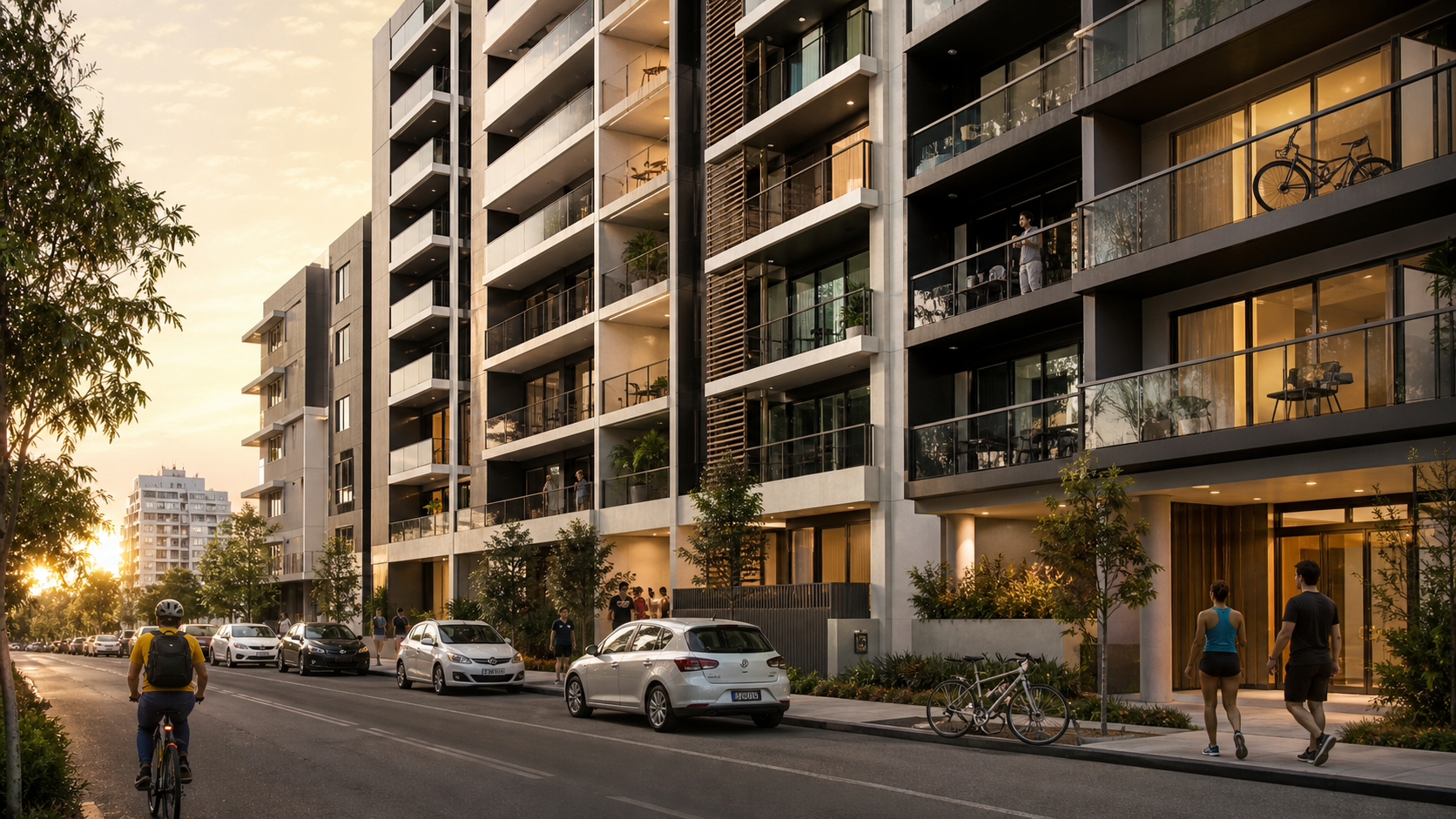
High‑density, small and studio apartments look affordable on realestate.com.au. In lending policy, they often sit in the “hard work” bucket.
Within the first 100 words: Australian lenders treat high‑density, small (typically under 50–60 m² internal) and studio apartments as higher‑risk security, so they commonly apply lower maximum LVRs, tighter postcode restrictions, stricter valuation rules and extra scrutiny of building quality and usage. That means you may need a bigger deposit, stronger income, or a different lender strategy than you would for a standard suburban unit.
This guide walks through those extra rules, how they show up in real numbers, and what you can do this week to protect your finance.
1. Why lenders see high‑density and small apartments as higher risk
1.1 The three core risks lenders care about
For high‑density and small apartments, banks and non‑banks are focused on three things:
- Resale risk – Is there depth in the market if they ever need to sell?
- Valuation volatility – Are prices more likely to fall or be choppy?
- Specialised use – Is this a “normal home”, or limited to a niche market?
High‑density towers, tiny studios and mixed‑use buildings score higher on these risk measures because:
- There are often hundreds of nearly identical units, so resale depends on supply, not uniqueness.
- Prices can move sharply when investors rush in or out.
- Some properties are effectively quasi‑hotel rooms (short‑stay, student, serviced apartments) with a narrower buyer pool.
APRA’s capital and serviceability rules push banks to hold more capital against these riskier exposures, so many respond with tighter LVRs and harsher shading. We unpack that in more detail in /insights/apra-lvr-lmi-high-density-off-the-plan-units.
1.2 What “high‑density” usually means in bank language
Each lender defines this slightly differently, but common red flags are:
- Buildings > 10–12 storeys or > 100 units
- Very dense clusters of similar towers in a small radius
- Certain “high‑risk” postcodes flagged internally
In places like Green Square, lenders slice property types more finely again – we break that down in /insights/green-square-property-types-lending-rules.
2. The key lending rules that change for high‑density and small apartments
2.1 Tighter LVR caps and bigger real deposits
Compared to a standard unit, lenders may:
- Cap LVR at 70–80% instead of 90–95%
- Refuse to lend above certain LVRs even with LMI
- Decline certain buildings altogether
Indicative example (actual policies vary by lender and change over time):
| Property type | Typical max LVR (owner‑occ, standard lender) | Typical max LVR (investment) | Notes |
|---|---|---|---|
| Standard suburban unit (≥50–60 m²) | 90–95% (with LMI) | 80–90% | Normal policy |
| High‑density metro unit | 80–90% | 70–80% | Some postcode caps |
| Small unit 40–50 m² internal | 80% | 70–80% | Lender‑specific |
| Studio < 40 m² or serviced apartment | 60–80% | 60–70% | Often specialist lenders only |
These caps feed directly into your real deposit need, especially for off‑the‑plan. We’ve mapped typical off‑the‑plan scenarios in /insights/how-much-deposit-off-the-plan-apartment-australia.
Worked example: how a lower LVR cap bites
- Contract price today: $650,000 high‑density, small unit
- You plan on 90% LVR (10% deposit) with LMI, owner‑occupied
- Two years later at settlement, your chosen lender updates policy: max 80% LVR for that building
If valuation comes back at $640,000 (lower of contract and valuation is $640k for lending purposes):
- Max loan at 80% LVR = $512,000
- Required equity = $640,000 − $512,000 = $128,000
If you’ve already paid a 10% deposit at exchange (say $65,000 plus costs), you now need an extra ~$63,000 cash or a guarantor/equity top‑up just to settle.
2.2 Minimum internal size rules
Most mainstream lenders set a minimum internal living area, often:
- 50 m² internal (excluding balconies/car spaces) as a common baseline
- Some will go down to 40–45 m² with restrictions (e.g. lower LVR, metro only)
- Studios under 40 m² often fall into “specialised” territory
Lenders generally look at:
- Internal living area as per plans (not strata title total)
- Usability (separate bedroom vs open plan bed in living space)
- Car space and storage (helpful, but rarely change core minimums)
If you’re considering a 35–45 m² unit, get the measured internal area in writing early and run it past a broker before signing.
2.3 Postcode and building concentration limits
High‑density zones often have:
- Postcode caps – e.g. “max 80% LVR for investment units in 2017 postcode”
- Building exposure caps – a lender will only fund up to a certain total number or value of loans in one project
This means:
- The first wave of buyers may get 90% LVR.
- Later buyers in the same tower can hit a hard wall at 80% LVR because the lender’s building limit is full.
For off‑the‑plan, this can be brutal if you’re one of the last to settle and your intended lender has since hit its limit or blacklisted the project.
2.4 Serviceability and rental income shading
APRA requires banks to use a 3% serviceability buffer over the actual rate. On high‑risk security, lenders may also:
- Shade rental income harder (e.g. use 70–75% of rent instead of 80%), especially for student or serviced apartments.
- Ignore “rental guarantee” income or heavy developer incentives – see our deep dive in /insights/developer-incentives-rental-guarantees-what-lenders-ignore (sibling article).
This means the same borrower might pass servicing for a standard townhouse, but fail for a high‑density studio, purely due to extra shading on income and stricter living expenses assumptions.
3. Off‑the‑plan high‑density, small and studio: double the policy risk
3.1 Two moving parts: valuation and policy
Off‑the‑plan is always a game of two variables at settlement:
- Valuation – the bank will lend against the lower of contract price or current valuation.
- Current policy – the rules in force at settlement, not at exchange.
For high‑density, small and studio apartments, both variables are more fragile:
- Valuations can fall if there is a glut of similar stock or investor demand drops.
- Policies can tighten if that postcode or building type starts to show stress.
We explain how and why standard pre‑approvals often fail in this environment in /insights/why-standard-pre-approvals-fail-off-the-plan-apartments.
3.2 Common off‑the‑plan traps for small apartments
Typical problems we see:
- Final size shrinks – a 50 m² plan ends up at 47 m², slipping under the lender’s minimum.
- Usage changes – building leans into Airbnb or short‑stay, making the whole project look more like a quasi‑hotel.
- Valuation shortfalls – especially in towers with heavy investor concentration.
All three can trigger either a lower LVR cap or complete ineligibility with your preferred bank, even though you’ve been waiting years.
3.3 Self‑employed buyers: double‑layered scrutiny
If you’re self‑employed buying an off‑the‑plan, high‑density or small apartment, lenders will:
- Scrutinise your income variability and add policy overlays.
- Assess against today’s higher rates plus the 3% buffer.
- Potentially be more conservative if your business is cyclical.
We outline specific strategies for self‑employed off‑the‑plan buyers in Green Square (relevant to other metros too) in /insights/off-the-plan-finance-green-square-self-employed.
The strategy continues below
You've seen the problem and the groundwork — now unlock the exact steps our CPA-certified brokers use, including 8 more sections. Enter your email for instant, free full access.
Free access. No spam — unsubscribe anytime. Your details stay confidential.
Frequently asked questions
Can I get a 95% loan for a high‑density or small apartment?▾
Do all banks refuse to lend on studios under 40 m²?▾
How do rental guarantees affect my borrowing power?▾
What happens if my small off‑the‑plan apartment values below the contract price?▾
Is a small apartment a bad investment with new tax rules?▾
How early should I speak to a broker about a studio or high‑density unit?▾
Speak with a specialist advisor
Confidential consultation, bespoke advice for your situation.