Article
Mascot Apartment Deposits: How Much You Really Need and Why
You don’t always need 20% for a Mascot apartment. This guide walks through realistic prices, 5–15% deposit paths, LMI, family guarantees, schemes and buffers so you can decide what deposit target actually suits you this year.
Key Takeaway
Most Mascot apartment buyers don’t actually need a full 20% deposit; many first‑home buyers can purchase with 5–10% using government guarantees or lender’s mortgage insurance, especially around the $750k–$900k price bracket. This article explains how deposit size, LVR, LMI, postcode risk rules and buffers interact, using worked examples and tables. The key actionable step is to pick a target building type and match a realistic deposit range and timeframe to that specific strategy before you start inspections.
You don’t always need a 20% deposit for a Mascot apartment.
For many Mascot buyers, a 5–10% deposit is workable if you’re prepared to use government guarantees, pay lender’s mortgage insurance (LMI), or involve family help. The right deposit isn’t a magic percentage – it’s the amount that lets you (1) pass the bank’s serviceability test, (2) avoid nasty surprises like a valuation shortfall, and (3) still have a real cash buffer once you move in.
This guide breaks down what that means for actual Mascot numbers, so you can pick a realistic deposit target this week.
1. Mascot apartment prices in 2026: what are you aiming at?
Before setting a deposit goal, you need a working price range.
Exact prices move, but Mascot is a unit‑heavy inner‑south market with a clear spread:
- Entry one‑bedder in an older/smaller block
- Newer two‑bedder in a large complex near the station
- Larger, better‑quality or top‑floor units with parking and storage
For planning, a realistic 2026 working range for Mascot apartments might be:
| Apartment type (Mascot) | Planning price (indicative) |
|---|---|
| Older 1‑bedder, smaller block | $650,000 |
| Newer 1‑bedder in larger complex | $700,000 |
| Standard 2‑bed, 1‑bath, 1‑car | $800,000 |
| Better 2‑bed, 2‑bath, 1‑car | $900,000 |
| Larger / premium 2‑bed or compact 3‑bed | $1,000,000 |
These aren’t valuations; they’re planning anchors. Your real target will depend on:
- Building age and construction quality
- Any cladding or defect history
- Distance to station and shops
- Parking, storage, and outlook
If you haven’t yet looked at actual listings and sold data, pair this guide with the step‑by‑step numbers in “Mascot first‑home buyers: practical steps to buy your first place”.
2. The simple answer: deposit ranges that actually work in Mascot
Let’s answer the core question up front.
2.1 Quick reference: Mascot deposit ranges by strategy
| Strategy / buyer type | Typical deposit range | When it works best |
|---|---|---|
| First‑home buyer using First Home Guarantee (FHBG) | 5% + costs | Stable income, price within caps, willing to live in property |
| First‑home buyer with LMI (no scheme) | 8–12% + costs | Good income, wants more choice of lenders and buildings |
| Using family guarantee (no cash beyond costs) | 2–5% + costs | Parents with strong equity and clear family agreements |
| Investor, standard apartment | 10–20% + costs | Solid income, aiming to balance leverage and risk |
| Investor, higher‑risk building (tiny / cladding) | 20%+ + costs | Valuation or policy concerns; lender wants more “skin in the game” |
| Upgrader using equity from existing place | 5–15% (equity‑funded) | Keeping decent buffer in current property |
You do not automatically need 20%. What you need is a matched set:
- Building type and price
- Deposit contribution (cash, scheme, family)
- Lender appetite for that postcode and building
We’ll unpack each.
3. Key definitions: deposit, LVR, LMI and buffers
3.1 Deposit vs purchase costs vs buffer
For Mascot buyers, think in three separate buckets:
- Deposit – the portion of the purchase price you contribute yourself (plus any family gift or guarantee equity).
- Purchase costs – stamp duty, legal fees, inspections, adjustments, moving costs.
- Buffer – extra cash in offset after settlement for emergencies and rate rises.
Trying to roll all three into a single “saving target” often leads people to underestimate what they really need in cash.
3.2 Loan‑to‑value ratio (LVR)
LVR = Loan ÷ Property value.
- 80% LVR = 20% deposit
- 90% LVR = 10% deposit
- 95% LVR = 5% deposit
LVR drives:
- Whether you pay LMI
- How strict the lender will be on building quality and postcode
- How much wriggle room you have if the bank valuation comes in low
3.3 Lender’s Mortgage Insurance (LMI)
LMI protects the lender, not you, when your LVR is typically above 80%.
- One‑off premium, usually added to the loan.
- In Mascot, buyers at 90–95% LVR commonly pay LMI unless using a government guarantee.
- Premiums climb sharply as LVR goes over 90%.
3.4 Why buffers matter more in Mascot
Mascot is dominated by strata apartments. That means:
- Unexpected levies (e.g. facade repairs, waterproofing)
- Lift and common area maintenance
- Potential defects in some larger complexes
A razor‑thin buffer may pass the bank’s test, but it’s risky for you.
As a rule of thumb, aim to sit with 3–6 months of total expenses (loan, strata, living costs) in offset after settlement, especially if you’re self‑employed or on variable income. For self‑employed strategy, cross‑check with “Smart Deposit Strategies For Self‑Employed First‑Home Buyers”.
4. How much cash you actually need at different deposit levels
Let’s run the numbers on a $800,000 Mascot two‑bed unit.
We’ll assume:
- NSW first‑home buyer, owner‑occupier
- No major stamp duty concessions (price above some thresholds)
- Rough stamp duty ~$31,000 (check a current calculator)
- Legal and other costs ~$4,000
So purchase costs ≈ $35,000.
4.1 Scenario A – 20% deposit (no LMI)
- Purchase price: $800,000
- 20% deposit: $160,000
- Loan (80% LVR): $640,000
- Costs: ~$35,000
Total cash needed ≈ $195,000, plus buffer.
Pros:
- No LMI
- More lenders and buildings to choose from
- Lower monthly repayments
Cons:
- Long saving time for most buyers
- May miss buying opportunities if Mascot rises while you save
4.2 Scenario B – 10% deposit (90% LVR, pay LMI)
- Purchase price: $800,000
- 10% deposit: $80,000
- Base loan: $720,000 (90% LVR before LMI)
- Indicative LMI: say $17,000–$20,000 (varies by lender and profile)
- Loan after capitalised LMI: ≈ $737,000–$740,000
- Costs: ~$35,000
Total cash needed ≈ $115,000 ($80k deposit + $35k costs), plus buffer.
Pros:
- Cuts cash target by ~ $80,000 vs 20%
- You get in sooner; more years paying off principal
Cons:
- Higher repayments (larger loan + LMI)
- Lenders will stress‑test your repayments at a rate ~3% above actual under APRA rules
4.3 Scenario C – 5% deposit using First Home Guarantee (95% LVR, no LMI)
Under the First Home Guarantee (FHBG), eligible first‑home buyers can purchase with 5% deposit without paying LMI, with Housing Australia effectively covering the gap.
- Purchase price: $800,000
- 5% deposit: $40,000
- Loan: $760,000 (95% LVR)
- LMI: $0 (because of FHBG)
- Costs: ~$35,000
Total cash needed ≈ $75,000 ($40k deposit + $35k costs), plus buffer.
Pros:
- Much smaller deposit hurdle
- You avoid tens of thousands in LMI
Cons:
- Need to meet FHBG eligibility and price caps
- Not all lenders, buildings or borrowers will qualify
- Very tight equity buffer if values dip or valuations are conservative
If you’re self‑employed, there are extra hurdles. See “First Home Guarantee for Self‑Employed Buyers: What Really Works”.
4.4 Scenario D – Family guarantee (minimal cash deposit)
If parents or close family offer a limited guarantee secured against their home, you may be able to:
- Borrow up to 100% of the purchase price, plus costs in some structures
- Use your parents’ equity to avoid LMI
For the same $800,000 purchase:
- Your cash contribution could be as low as just the costs (~$35,000) if the structure and lender allow
- Parents’ property secures the “top‑up” portion of the loan
This can get you in much earlier, but needs careful planning and legal documentation. For practical structuring, read “Using a Mascot Broker to Combine Schemes and Family Help Safely”.
5. Mascot‑specific wrinkle: postcode and building risk
Not all apartments are equal in a lender’s eyes, and Mascot has:
- Large multi‑stage developments
- Buildings near flight paths and major roads
- A history of some defect and cladding issues in parts of the wider inner‑south
5.1 How lenders view Mascot units
Many lenders have postcode policies that:
- Cap maximum LVRs on certain buildings
- Require a bigger deposit for small units (e.g. <40–50 sqm internal)
- Treat high‑density developments as higher risk
Practically, this can mean:
- A lender that will happily do 95% on a house in another suburb may only go to 80–90% on certain Mascot apartments.
- The unit you love might be in a building that requires a higher deposit even if you’re a strong borrower.
5.2 Off‑the‑plan and Mascot
Mascot and nearby Green Square have seen substantial off‑the‑plan activity. Common issues:
- Valuation at settlement coming in below the contract price
- Construction or defect concerns leading lenders to tighten policy
Example:
- You buy off‑the‑plan at $900,000 with a plan to borrow 90%.
- At settlement, the bank values it at $860,000.
- LVR at your planned 90% borrowing now looks like $900,000 ÷ $860,000 ≈ 105% to the lender.
You’ll be asked to:
- Tip in more cash (effectively a bigger deposit), or
- Find a second lender or change structure, often under time pressure
If you’re considering off‑the‑plan, cross‑check with “Using the First Home Guarantee to Buy Off‑the‑Plan in Green Square” – the same flags broadly apply in Mascot.
5.3 Practical takeaway
Before locking in a deposit goal, narrow your building type:
- Older, low‑rise with proven track record – often friendlier for higher LVRs
- Newer high‑density – may need more deposit, more scrutiny
- Micro‑apartments or studios – often need 20%+, sometimes 30% or more
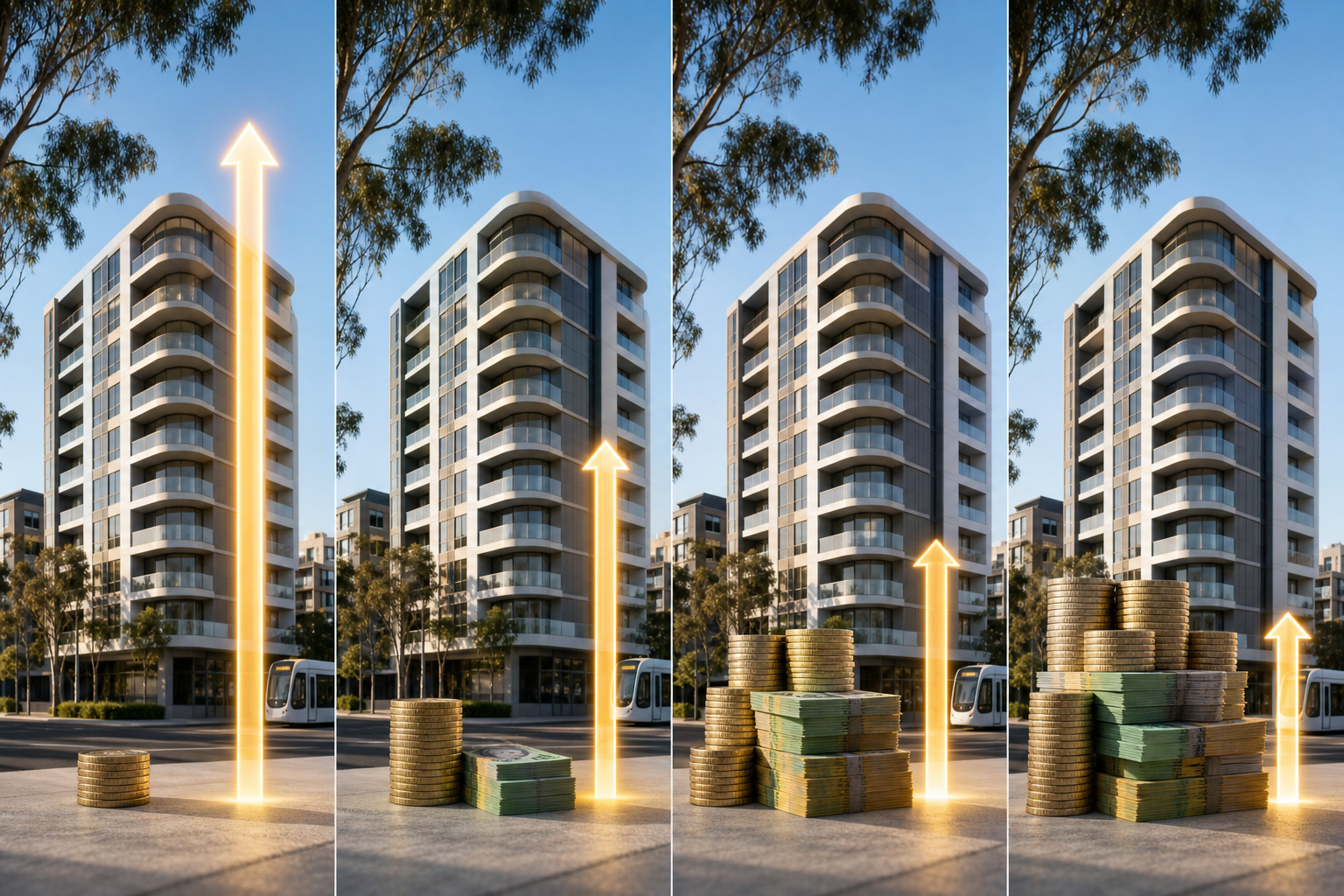
6. 5%, 10%, 15% or 20%? How to choose your Mascot deposit band
There’s no universal “right” number. Instead, match deposit size to your risk tolerance, income stability and timeframe.
Different Mascot deposit sizes change both risk and borrowing power.
6.1 Comparing deposit bands side by side
| LVR / Deposit | What it usually means in Mascot | Who it suits best |
|---|---|---|
| 95% (5% dep) | Needs FHBG or other guarantee, very tight equity, limited building choice | Strong income, want in ASAP, willing to accept constraints |
| 90% (10% dep) | Pay LMI, more lender options, still scrutinised on building quality | Solid income, moderate risk tolerance |
| 85% (15% dep) | Lower LMI, stronger position with lenders | Patient savers, self‑employed wanting more buffer |
| 80% (20% dep) | No LMI, best choice of lenders and buildings | Higher earners, investors, second‑time buyers |
6.2 When a 5% deposit can make sense in Mascot
A 5% deposit using FHBG can be sensible if:
- You’re a first‑home buyer, willing to live in the unit
- Your borrowing capacity comfortably covers the loan even with APRA’s 3% buffer
- You have stable employment and can build your buffer quickly after purchase
It’s powerful for:
- Tenants currently paying high Mascot rents who could redirect rent into their own loan
- Younger buyers with strong income but limited savings history
But you need to accept:
- Limited choice of lenders and buildings
- You’ll be more sensitive to price falls in the early years
6.3 Why many Mascot buyers end up targeting 10–15%
For many Mascot clients, a 10–15% deposit ends up being the sweet spot:
- LMI is still payable at 10%, but lower than at 5%
- You’re less exposed if valuations come in conservative
- More lenders will consider higher‑risk buildings at 85–90% than at 95%
For self‑employed buyers, a 15%+ deposit can offset perceived risk from variable income. See “Smart Deposit Strategies For Self‑Employed First‑Home Buyers” for cashflow‑friendly ways to get there.
6.4 20%+ deposits: when they’re worth the wait
A 20% or higher deposit is worth targeting if:
- You’re an investor and want lower holding costs
- You’re planning to upgrade within a few years and want flexibility to keep the unit as an investment
- The building or unit type is on a lender’s higher‑risk list
For upgraders, bigger equity in your current property may matter more than cash in the bank. See “From Mascot Unit to Bigger Home: Practical Upgrade Paths That Work” for those pathways.
7. Worked Mascot examples: how deposit choices change repayments
To make this practical, let’s compare different deposit sizes for a standard Mascot purchase.
Assumptions (illustrative only):
- Purchase price: $800,000
- Interest rate: 6.0% p.a. variable (P&I, 30‑year term)
- LMI rough estimates only, for comparison
7.1 Monthly repayment comparison
| Scenario | LVR | Approx loan (incl. LMI) | Est. monthly repayment* |
|---|---|---|---|
| A: 20% deposit | 80% | $640,000 | ≈ $3,839 |
| B: 15% deposit | 85% | $688,000 (with LMI) | ≈ $4,126 |
| C: 10% deposit | 90% | $737,000 (with LMI) | ≈ $4,425 |
| D: 5% + FHBG (no LMI) | 95% | $760,000 | ≈ $4,562 |
*Repayments rounded, for illustration only. Real rates and LMI will differ by lender and profile.
Key observations:
- Dropping from 20% to 10% deposit increases repayments by around $600 per month.
- Going from 10% (with LMI) to 5% (with FHBG) is a smaller step up in repayments, but reduces your initial equity buffer significantly.
You need to weigh:
- Time to save extra deposit vs
- Extra monthly repayments and
- Risk comfort with a thinner equity position in Mascot’s apartment market.
8. Family guarantees in Mascot: how they change the deposit equation
Family guarantees are common around Mascot where parents have strong equity but children face high entry prices.
Family guarantees can bridge deposit gaps but must be structured carefully.
8.1 What a family guarantee actually does
A typical structure:
- You borrow up to 80% of the Mascot unit’s value against the new property itself.
- You borrow an additional amount (say 15–20% of the price, sometimes plus costs) secured by a limited guarantee against your parents’ home.
Result:
- Combined, lenders get 100% (or more) secured, but no LMI is payable.
- Your cash requirement may drop to just costs and a small deposit.
8.2 Pros and cons
Pros:
- Much smaller cash hurdle
- Avoid or reduce LMI
- You get into the market while still building your own savings
Cons:
- Parents’ home is on the line if you default
- Family dynamics and estate planning issues if not documented properly
- Some lenders are more cautious where parents are near retirement
As highlighted in our broader work on family assistance, clearly documenting whether family support is a gift, loan or guarantee is critical to avoid future conflict.
8.3 Mascot‑specific cautions
In Mascot, family guarantees should be combined with:
- Careful building selection (to avoid long‑running defect dramas)
- A realistic exit plan – how and when the guarantee will be released (usually once your loan reduces or the property value grows enough to bring your LVR below 80%).
If you’re also planning to rely on FHBG or other schemes, see “Using a Mascot Broker to Combine Schemes and Family Help Safely” – mixing tools without a plan can easily backfire.
9. First‑home schemes, FHSS and state concessions: reducing the cash you need
While this guide focuses on deposit size, schemes change how long it takes to reach that target.
9.1 First Home Guarantee (FHBG)
Key points for Mascot buyers:
- Lets eligible first‑home buyers purchase with 5% deposit without LMI.
- You must live in the property for a minimum period.
- Price caps apply – check current NSW limits for Sydney.
This can make a 5–8% deposit plus costs a realistic Mascot target.
For a deeper dive into FHBG mechanics, see “First Home Guarantee for Self‑Employed Buyers: What Really Works” – the rules are the same whether or not you’re self‑employed.
9.2 First Home Super Saver (FHSS) scheme
FHSS allows you to:
- Make voluntary contributions to super (concessional or non‑concessional)
- Later withdraw eligible amounts to use as part of your home deposit
In practical Mascot terms, FHSS can:
- Boost your savings via concessional tax treatment
- Help disciplined savers reach a 10–15% deposit faster
9.3 State concessions and their effect on your target
NSW concessions may reduce or remove stamp duty for qualifying first‑home buyers within price thresholds. That effectively lowers your cash needed for costs, which can be significant at Mascot price points.
For example, if concessions reduce your stamp duty by $20,000:
- Your cash target drops by $20,000, or
- You can redirect that $20,000 to increase your buffer, making a 5–10% deposit strategy safer.
9.4 Combining schemes with different deposit sizes
Typical Mascot combinations:
- 5% deposit + FHBG + FHSS withdrawals – minimise LMI and buy earlier.
- 10% deposit + FHSS + partial family gift – balance saving effort, scheme complexity and family involvement.
The key is to: start with the building and price band, then see which combination bridges the gap fastest. The sibling guide “Using FHBG, FHSS and State Concessions to Get Into Mascot Sooner” (clustered with this article) explores scheme stacking in more detail.
10. Quick readiness check: is your Mascot deposit strategy realistic?
Use this 10‑minute diagnostic to see if you’re on track.
A simple readiness check helps set a realistic Mascot deposit target.
10.1 Income and serviceability
- Does your combined income comfortably cover estimated repayments + strata + living costs, even if rates rise another 1–2%?
- Do you have secure, verifiable income (PAYG or two+ years solid self‑employed financials)?
If “no” to either, target a larger deposit (10–20%) or a lower price band.
10.2 Savings behaviour
- Are you currently saving at least $1,500–$3,000 per month, and can you show this pattern over 3–6 months?
- Is your savings split clearly into deposit, costs and buffer buckets?
If not, refine your plan before locking in a timeframe.
10.3 Risk comfort
-
How would you feel if Mascot prices fell 5–10% in the year after you buy?
- With a 5% deposit, that could wipe out your equity on paper.
-
Are you comfortable with potential special levies (say $5,000–$20,000) within the first few years, if building issues are discovered?
If this makes you very uneasy, aim for more buffer, even if it means a slightly smaller unit or further out suburb.
10.4 Family and schemes
- Are your parents genuinely comfortable offering a guarantee, and has everyone had independent legal advice?
- Have you checked FHBG and FHSS eligibility and approximate timing for accessing funds?
If these pieces are vague, don’t base your plan on them yet – treat any family help or scheme approval as a bonus, not a certainty.
For a structured one‑week action list tailored to Mascot, revisit “Mascot first‑home buyers: practical steps to buy your first place”.
11. Saving for a Mascot deposit: practical targets and timelines
Once you’ve picked a deposit band and price range, turn it into a monthly savings target.
11.1 Example saving plans
Example 1 – aiming for 10% on $750,000 (plus costs):
- Deposit target: $75,000
- Costs: say $33,000
- Total savings target before buffer: $108,000
If you can save:
- $2,000 per month → ~54 months (~4.5 years)
- $3,000 per month → ~36 months (3 years)
- Combine FHSS + tax refunds + a $20,000 family gift → you might cut a year or more.
Example 2 – aiming for 5% on $700,000 with FHBG:
- Deposit: $35,000
- Costs: ~ $31,000
- Total: $66,000
Savings at:
- $2,000 per month → 33 months (~2.75 years)
- $3,000 per month → 22 months (~2 years)
If you already have $20,000 saved, timelines shorten materially.
11.2 Self‑employed deposit building
For self‑employed Mascot buyers, the challenge is often documented income, not just the deposit.
Focus on:
- Separating business and personal cash so your deposit doesn’t starve the business
- Building savings in an offset account, ready to convert into a formal deposit later
- Planning tax returns so that declared income supports the borrowing you need
The article “Smart Deposit Strategies For Self‑Employed First‑Home Buyers” sets out 6‑ to 24‑month action plans that still keep your business healthy.
12. Investors and upgraders: Mascot deposit strategy is different
This guide has focused on first‑home owner‑occupiers, but Mascot has many investors and upgraders.
12.1 Investors: balancing leverage and risk
For investors buying Mascot units:
- Lenders often expect 10–20% deposits, sometimes more for riskier buildings.
- Interest may be interest‑only for a period, changing cashflow dynamics.
You should weigh:
- Higher leverage (smaller deposit) → amplifies both gains and losses
- Larger deposit → lower risk of being forced to sell in a downturn
Deposit decisions also interact with negative gearing and future CGT changes. The sibling strategy piece “Mascot Home Strategies: First‑Home, Investor and Upgrader Game Plans” in this cluster covers those angles in more depth.
12.2 Upgraders: using equity from an existing Mascot unit
If you already own in Mascot or nearby, your “deposit” is often equity, not cash.
Example:
- Your current Mascot unit is worth $900,000.
- Your existing loan is $540,000 (60% LVR).
- Many lenders might let you go up to 80% LVR → $720,000.
- Usable equity ≈ $180,000 before costs.
That equity can fund:
- Deposit on a new home
- Costs on both sale and purchase
The article “From Mascot Unit to Bigger Home: Practical Upgrade Paths That Work” walks through realistic numbers and structures.
13. Mascot vs nearby: does deposit size change your suburb choice?
Deposit strategy sometimes pushes buyers to reconsider Mascot vs neighbouring suburbs (e.g. Alexandria, Rosebery, Green Square precinct).
Key considerations:
- Some nearby pockets may allow slightly cheaper units, reducing cash needed.
- Other areas might have tighter postcode policies, needing bigger deposits.
The cluster article “Renting in Mascot vs Buying Nearby: A 2026 Numbers Comparison” (a sibling to this piece) is designed to help you quantify whether a smaller unit in Mascot or a similar‑priced unit a suburb away is the better long‑term move at your chosen deposit size.
14. What to do this week: a decision‑grade Mascot deposit plan
To turn this into action in the next 7 days:
Step 1 – Lock in your Mascot price band (1–2 hours)
- Shortlist 5–10 real listings in Mascot you’d actually live in.
- Check recent sold prices for similar units.
- Pick a working target, e.g. $750k 1‑bed or $850k 2‑bed.
Step 2 – Choose your deposit band (30–60 minutes)
- Based on your income and risk comfort, pick 5%, 10%, 15% or 20%.
- Map your chosen band to a real cash number:
- Deposit
- Costs
- Minimum buffer (aim for at least 3 months expenses).
Step 3 – Test borrowing capacity with a buffer (1–2 hours)
- Use a borrowing power calculator with your chosen deposit and price.
- Then mentally add 3% to the interest rate to mirror APRA’s buffer.
- If repayments at the higher rate feel tight, lower the target price or increase your desired deposit.
Step 4 – Decide your tools: schemes, family, or solo (1–2 hours)
- Check whether FHBG and FHSS are realistically available to you.
- Have an honest conversation with parents about guarantees or gifts – and whether they want it documented as gift, loan or inheritance advancement.
- Decide which of these tools you’re comfortable basing your plan on.
Step 5 – Map a 6–24 month savings plan (2–3 hours)
- Turn your cash target into a monthly savings figure.
- Align this with your real budget – trim where needed.
- Make sure your plan also builds a post‑settlement buffer, not just the deposit.
If you want a Mascot‑specific sense check that also looks at tax and structure, a short session with a CPA + Tax Agent + Broker in one person can shortcut weeks of guesswork.
Key takeaways
- You don’t always need 20% deposit for a Mascot apartment; 5–10% is often workable using FHBG, LMI or family guarantees.
- For a typical $800,000 Mascot unit, total cash needed ranges from about $75k (with FHBG) to $195k (20% deposit) plus buffers, depending on your strategy.
- Mascot’s apartment‑heavy market means postcode and building policies matter – some high‑density or small units will need bigger deposits.
- Many Mascot first‑home buyers find a 10–15% deposit strikes the right balance between entry speed, monthly repayments and lender choice.
- Family guarantees can dramatically reduce cash needed but put parents’ home at risk and require careful legal and estate planning.
- Schemes like FHBG and FHSS, plus NSW concessions, can bring Mascot forward by months or years if you fit the rules.
- Self‑employed buyers should plan both deposit and taxable income 6–24 months ahead so lenders see stable, verifiable earnings.
- Your best next move this week is to pick a realistic price band, choose a deposit range, and map a monthly savings and buffer plan you can actually sustain.
Next step – get a deposit and borrowing power check‑up
If you’re serious about buying in Mascot or nearby in the next 6–24 months, book a free 15‑minute strategy call at /contact.
We’ll run through your income, savings, potential schemes and any family help, then sketch a Mascot‑specific plan that joins the dots between your tax position, loan structure and deposit target – all in one conversation.
General advice only.
Frequently asked questions
Is a 5% deposit enough to buy a Mascot apartment?▾
Do I really need a 20% deposit to avoid LMI in Mascot?▾
How much deposit do I need for a $800,000 Mascot apartment?▾
Are Mascot apartments riskier for high LVR loans?▾
Can my parents’ home guarantee reduce the deposit I need in Mascot?▾
How big a buffer should I keep after buying a Mascot unit?▾
How do first‑home schemes change my Mascot deposit target?▾
Speak with a specialist advisor
Confidential consultation, bespoke advice for your situation.